The short answer
Jamaica has no train and no subway, and distances are short but slow. A trip of 50 miles (80 km) can take two hours, because roads wind through towns and hills. For most visitors the sensible mix is a licensed airport taxi or pre-booked transfer, a private driver for day trips, and the Knutsford Express coach for longer hops between towns.
Renting a car is an option if you have driven abroad before and do not mind driving on the left. We cover that in full in the driving in Jamaica guide. If you are staying at an all-inclusive and leaving only for one or two excursions, you will probably never need anything beyond the transfers and tours your resort or tour company arranges.
This page is organized by choice: which option suits which trip, how long the common journeys take, then each kind of transport in turn. Fares change often and several operators publish no fare sheet, so where we could not confirm a price we say so and tell you where to check.
Which option for which trip
| Your trip | Best choice | Why |
|---|---|---|
| Airport to a resort | Pre-booked transfer or an authorized airport taxi | Door to door, fare agreed in advance, no navigation. See Montego Bay airport transportation. |
| Week at one all-inclusive, one or two tours | Tour operator pickups | Excursions include hotel pickup, so you need nothing else. |
| Moving between two bases (for example Negril to Ocho Rios) | Knutsford Express, or a private driver if you have luggage and a group | Coach is the cheapest comfortable option; a private car is faster and door to door. |
| Several days exploring on your own schedule | Rental car with a driver, or a rental car if you are confident | Sights are spread out and public transport does not reach waterfalls or beaches. |
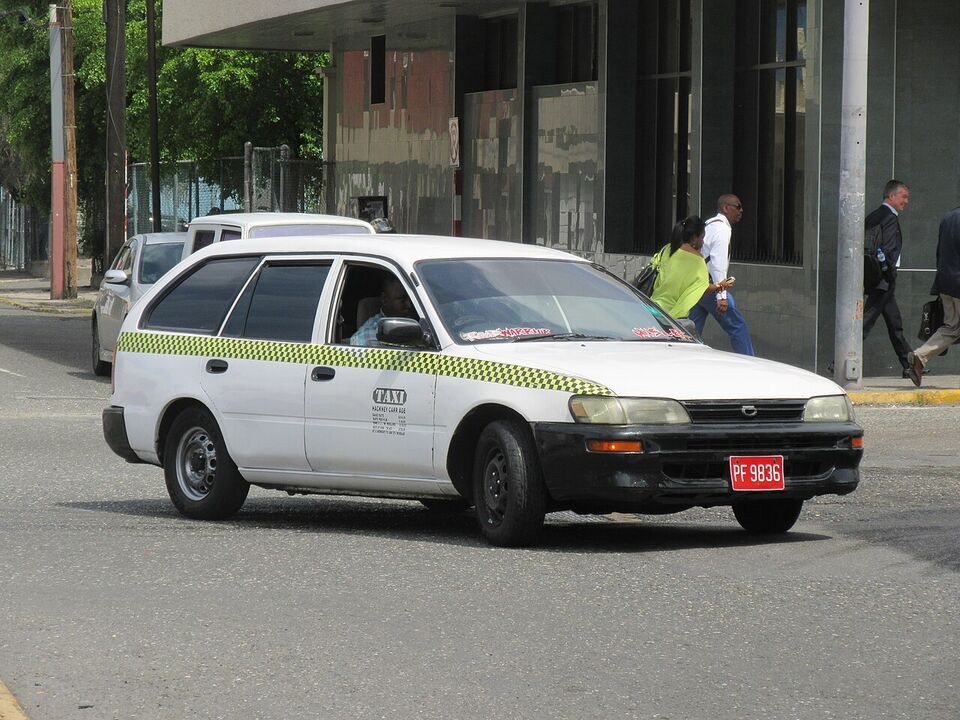
| Short hop within a town | Licensed charter taxi, fare agreed first | Quick and simple. Route taxis are cheaper but follow fixed routes. |
| Budget travel and you speak up easily | Route taxis and Knutsford | Cheapest, but you need patience and small J$ notes. |
| Kingston to the Blue Mountains or Port Antonio | Private driver or organized tour | Steep, narrow roads and little scheduled transport. |
| Skipping a long drive | Domestic flight | Small planes save hours but cost more and routes vary. |
Typical times between towns
These are typical drive times in normal traffic, not official figures. We could not find an official source, so treat them as planning estimates and add time for roadworks, school-run traffic in town centers and stops. After Hurricane Melissa some roads in the west are still being repaired, which can add delays. Coach times are close to car times, with extra stops.
| From | To | Distance (approx.) | Typical time |
|---|---|---|---|
| Montego Bay airport | Falmouth | about 20 miles (33 km) | 30-40 minutes |
| Montego Bay airport | Negril | about 50 miles (80 km) | about 1.5 hours |
| Montego Bay airport | Ocho Rios | about 61 miles (100 km) | 1 hour 45 minutes to 2 hours |
| Montego Bay airport | Treasure Beach | about 60 miles (95 km) | 2-2.5 hours |
| Montego Bay airport | Kingston (North-South Highway) | about 106 miles (170 km) | 2.5-3 hours |
| Montego Bay airport | Port Antonio | about 135 miles (217 km) | 4 hours or more |
| Ocho Rios | Kingston (toll highway) | about 55 miles (90 km) | about 1.5 hours |
| Ocho Rios | Port Antonio | about 65 miles (105 km) | about 2 hours |
| Kingston | Port Antonio | about 82 miles (132 km) | 2-3.5 hours |
| Kingston | Treasure Beach | about 87 miles (140 km) | about 3 hours |
| Negril | Treasure Beach | about 73 miles (117 km) | about 3 hours |
Insider tip
Plan to arrive anywhere before dark. Jamaican roads are poorly lit, pedestrians and animals share them, and drivers pass on blind bends. A flight that lands at 5 p.m. and a two-hour transfer means arriving in the dark: that is fine with a professional driver, and a good reason not to rent a car for your first night.
Knutsford Express coaches
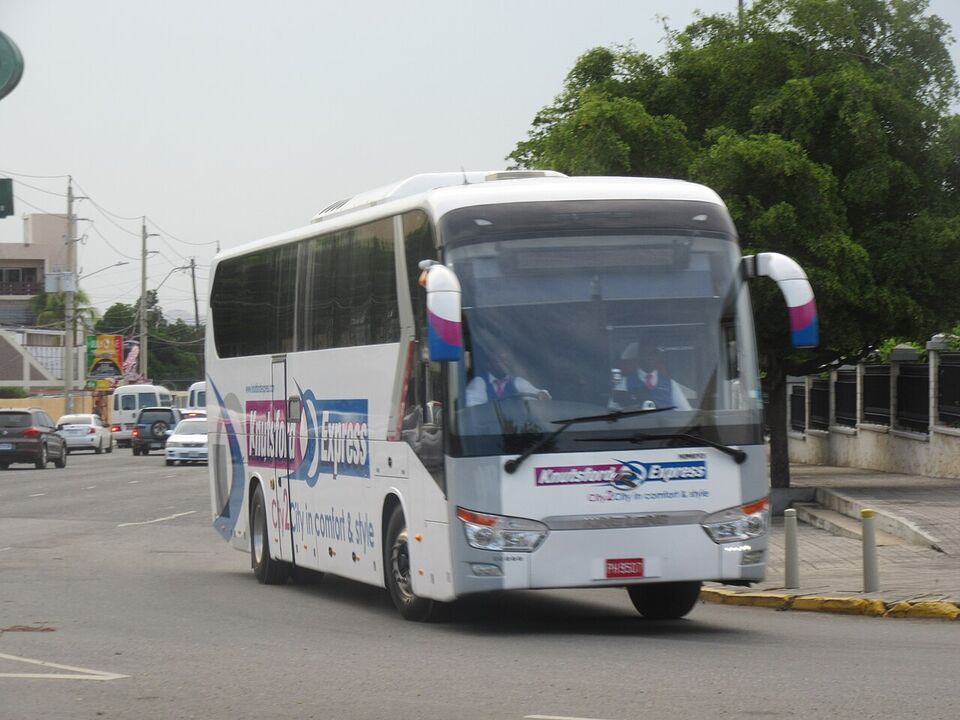
The Knutsford Express is the nearest thing Jamaica has to intercity rail. It runs scheduled, air-conditioned coaches linking Montego Bay (including a desk at Sangster airport), Negril, Ocho Rios, Kingston, Port Antonio, Mandeville and other towns, with more than 20 pick-up points. The company has been adding depots, and the Tourist Board lists it among the standard ways to travel between resort areas.
Booking and tickets
Book on knutsfordexpress.com or at a Knutsford office. Online payment takes Visa, Mastercard and Discover; offices take cash and cards. Personal and travelers cheques are not accepted. Fares are one way, and discounts exist for children 2 to 12, seniors, university students with a local ID and members of the Jamaica Stock Exchange.
We could not confirm the current fares, because the operator's fare table loads dynamically and showed no figures when we checked. Look up your route on the official site before you budget, and expect fares to be a small fraction of a private transfer. Tickets are non-refundable but stay valid for six months from purchase. A date change costs J$300 (about US$2), and you can use the ticket on the same route or a route of equal or lower value (pay the difference for a more expensive one).
Seats are not held until you book, and a trip with no direct bus is sold as separate tickets on a connecting bus. If your journey has a connection, book both legs and leave a buffer in case the first runs late.
Luggage and the airport desk
Each passenger may bring one bag up to 50 lb (23 kg) plus one carry-on; extra luggage costs more. The airport desk is in the ground transportation arrivals hall at Sangster, and Knutsford lists passenger service hours of 4:30 a.m. to 7:30 p.m. there. Other published hours are Negril 5:15 a.m. to 8 p.m., Port Antonio 5:45 a.m. to 8 p.m. and Kingston 4:30 a.m. to 8 p.m. Check timetables before you plan a late arrival, because coaches do not run around the clock.
What to expect
The coaches stop at depots, not at your hotel door. From the depot you will usually need a taxi to the hotel, so budget for that. Popular routes take two to four hours. Bring a light jacket, because the air conditioning is strong, and keep valuables with you rather than in the hold.
Save money
For a solo traveler or couple going between two towns, the coach plus a short taxi at the other end usually costs far less than a private transfer. For a family of four with luggage the gap narrows, and a private driver can come out close in price.
JUTC buses and the Rural Express
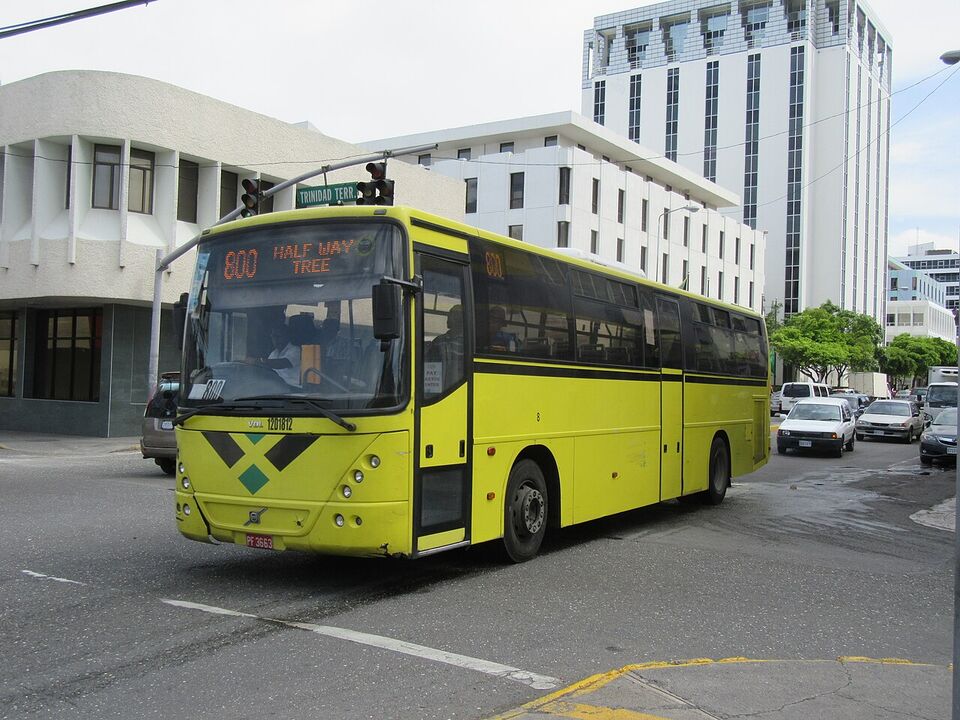
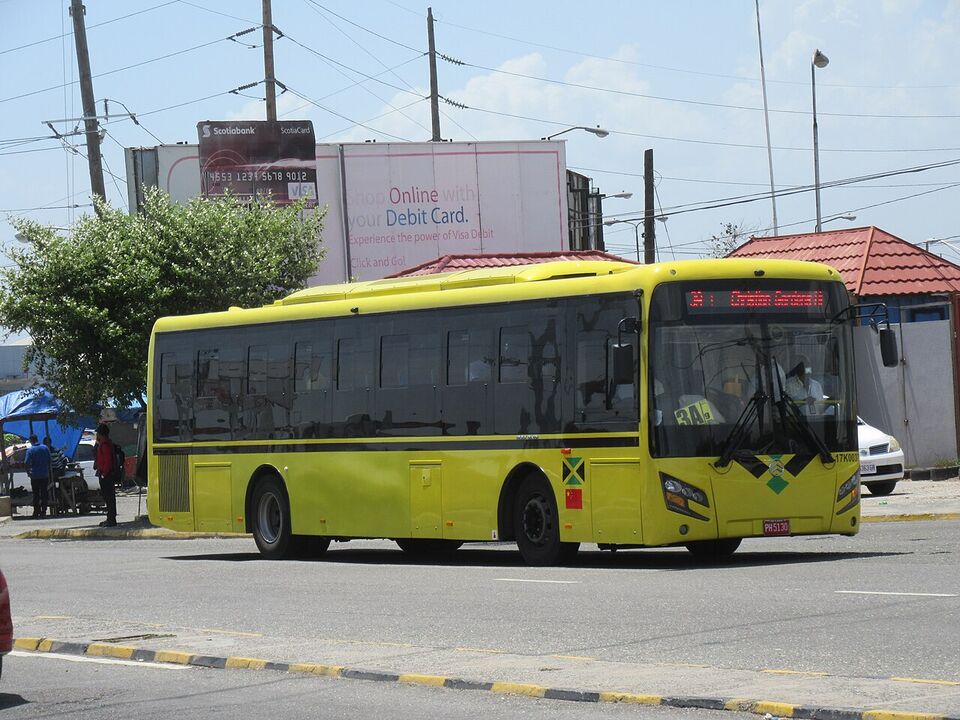
The Jamaica Urban Transit Company (JUTC) runs the bright yellow buses in the Kingston area. You can pay by cash or with a SmartFare card; the card system was launched in March 2025. We could not confirm the standard city fare, so check with the driver or the JUTC site, and carry small J$ notes.
The company has also started longer routes. The Rural Express 620Ex runs between Half-Way Tree in Kingston and Montego Bay, and the fare was J$2,000 (about US$13) per trip when it launched; check the current fare before you plan around it. The Tourist Board says JUTC also offers express routes between towns and cities. Timetables and fares for these newer services change, so treat any figure as a starting point and check jutc.gov.jm.
City buses are crowded at peak hours, route numbers are not always shown clearly, and tourists are rare riders. They work for a confident traveler who is based in Kingston and wants to go a few miles, not for a first visit.
Route taxis
A route taxi (a shared car or minibus on a fixed route) is how most Jamaicans get around locally. Licensed route taxis carry red plates beginning with PPV (public passenger vehicle), and the Transport Authority regulates their fares. Some sources describe the plate as "PP", but the Tourist Board wording is "PPV", which is what to look for.
How they work
Route taxis run a set route, such as between a town center and a suburb. You flag one down, tell the driver where you are going, and he or she will stop for others on the way. You pay in cash, in Jamaican dollars, when you get out or as the driver collects. There is no meter, and the fare depends on the route and distance.
Fares rose in two 8% steps in 2026, the first in early June and the second in July, and the Observer reported that St. James taxi fares rose 16% in total on July 1. There is no single published fare table, and some drivers set their own rates, so ask the fare before you get in, or watch what locals pay. Do not assume the figure you read online is still right.
When they make sense
Route taxis suit short hops in towns, where you know the route, and travelers who are comfortable asking questions. They are a poor choice with luggage, at night or on your first day, when you do not yet know which cars are licensed. A car with no red PPV plate on a route is an unlicensed vehicle.
Watch out
Do not accept a ride from someone who approaches you at the airport or on a street corner offering a "taxi". Use the authorized desk at the airport, a taxi your hotel calls, or a driver you booked ahead. Look for the red PPV plate and the driver's Transport Authority ID.
Charter taxis and private drivers
A charter taxi is a licensed car hired just for you, at a fare you agree beforehand. Hotels and resorts will call one, and the fare should be confirmed when you book. A private driver is the same idea for a longer period: a day trip, a transfer between bases, or the whole trip.
Airport taxis
At Sangster airport the JUTA and JCAL taxi associations each run an authorized desk just outside customs. The airport's own pages publish no fare sheet, so the price is confirmed at the desk before you get in. Ask whether the fare is per car or per person, whether it includes tolls and whether US$ or J$ is expected. JUTA can be reached on 876-952-0813.
Agreeing a fare
Taxis are unmetered, so the fare is a negotiation. Be polite and firm: ask the price, confirm the currency, and confirm the destination. Tourist rates are usually quoted in US dollars, and many drivers accept both. If you pay in US$ you will usually get any change in J$ at a rate that favors the driver, so carry small bills. See money in Jamaica for how to handle cash.
Hiring a driver for the day
A full-day driver is a popular choice for waterfalls, Black River or Kingston, because he or she knows the roads, and you can stop where you like. Ask your hotel, a licensed tour company or the airport desk for a recommendation, and agree the hours, the stops, the total price and what it covers (fuel, tolls, waiting time) before you set off. A tip is customary, and the usual guides suggest 10 to 15% for good service. Read tours and excursions for how to book safely.
Uber and inDrive
Ride-hailing exists but is unsettled. As of October 2026 Uber had no Transport Authority license in Jamaica, and the Ministry of Transport was still developing ride-hailing regulations. The Jamaica Union of Travellers Association (JUTA) has called for Uber to be banned, and inDrive operates under the same cloud. Drivers who work through these apps are supposed to hold a PPV license.
This means a ride may be available in Kingston or Montego Bay, but there is no guarantee, and the legal position is unsettled. Licensed taxis are the more predictable option, and we suggest them for visitors. Rules may change, so check the news before you rely on an app.
Domestic flights
Small carriers fly between Jamaica's aerodromes, which can turn a four-hour drive into a short flight. The Tourist Board lists AirLink Express (based at the domestic terminal at Sangster; flyairlink.net; 1-876-940-6660) and TimAir (timair.net), with aerodromes serving Kingston, Portland, the south coast and Negril. Routes, schedules and prices vary and are often by charter, and we could not confirm the current timetable or the status of every aerodrome after Hurricane Melissa.
Flights make most sense for Kingston to Montego Bay or Negril when you are short of time. Ask for the baggage allowance, which is usually tight on small aircraft, and book well ahead in the winter season. Your fallback in bad weather is always the road, so keep your onward plans flexible.
Renting a car, and what to know first
If you do want to drive, read the driving guide before you book. The key points: drive on the left, a valid US license works for up to three months, most rental companies want drivers 23 to 25 or older, and the highway tolls and potholes add cost and stress. Many visitors find that a rental plus a driver on the hardest days is a good compromise.
Different from home
Jamaica drives on the left, taxis are unmetered, horns are used as greetings and warnings, and public transport schedules are loose. Plan extra time, keep small J$ bills for fares and tips, and do not expect an address-based system: directions often use landmarks, so ask your driver or host for a pin on the map.
Safety, money and a checklist
The US State Department advises Americans to use caution on the roads, and its guidance for staff includes not using public buses or driving between cities at night. We suggest visitors follow similar common sense: licensed transport, daylight travel between towns, valuables out of sight. See safety in Jamaica for the advisory and the neighborhoods to check on travel.state.gov.
Carry a mix of money: US$ in small bills for tourist-priced taxis and tips, and J$ notes for route taxis, buses and small purchases. ATMs dispense J$ and are best used inside banks, malls and the airport.
- Book airport transfers or confirm the authorized desk fare before you leave the terminal
- Check Knutsford timetables and book tickets online if you plan to use the coach
- Download an offline map and save your hotel's address and phone number
- Carry small J$ notes and US$1 and US$5 bills
- Look for the red PPV plate, and keep your driver's name and number
- Arrive at your next base before dark
- Keep emergency numbers handy: 119 for police, 110 for fire and ambulance
Last, read the destinations overview to see how the places fit together, and the trip planning guide to choose your bases before you work out the transport between them.
Add it to a route in the trip builder, or ask us to plan the hotels, trains and guides for you.