Overview
Shopping in the Bahamas is easy to enjoy and easy to get wrong at the end. The good buys are hand-made things: straw hats and baskets, shell and bead jewelry, paintings, local rum, hot sauces and coffee. The mistakes come at the border, when a shell, a piece of coral or a box of cigars turns out to be something US Customs and Border Protection (CBP) will take away at the airport.
This guide covers where to shop in Nassau and on the Out Islands, what is worth buying, how much a duty-free price really saves you, how the tax works for visitors, how to bargain politely, and exactly what you can bring back to the United States. It also explains preclearance, the system that lets you clear US customs in Nassau before you board.
Two rules cover most of it. Declare everything you bought, including gifts. And if an item came from the sea (a shell, coral, a turtle product) or from Cuba, check the rule before you pay, not after. Related guides: money in the Bahamas, Nassau, things to do in Nassau, rum, Kalik and drinks, Nassau airport and cruises.
Bay Street and the Straw Market
Bay Street is Nassau's main shopping street. It starts near the British Colonial hotel and runs through several blocks of boutiques, jewelers and souvenir shops, with a few restaurants between them. Government and historic buildings, including Christ Church Cathedral and the Nassau Public Library, sit just off it. After about seven blocks the tourist stores thin out and smaller local shops take over. Bay Street is a short walk from the cruise port, so it is the first place many visitors shop.
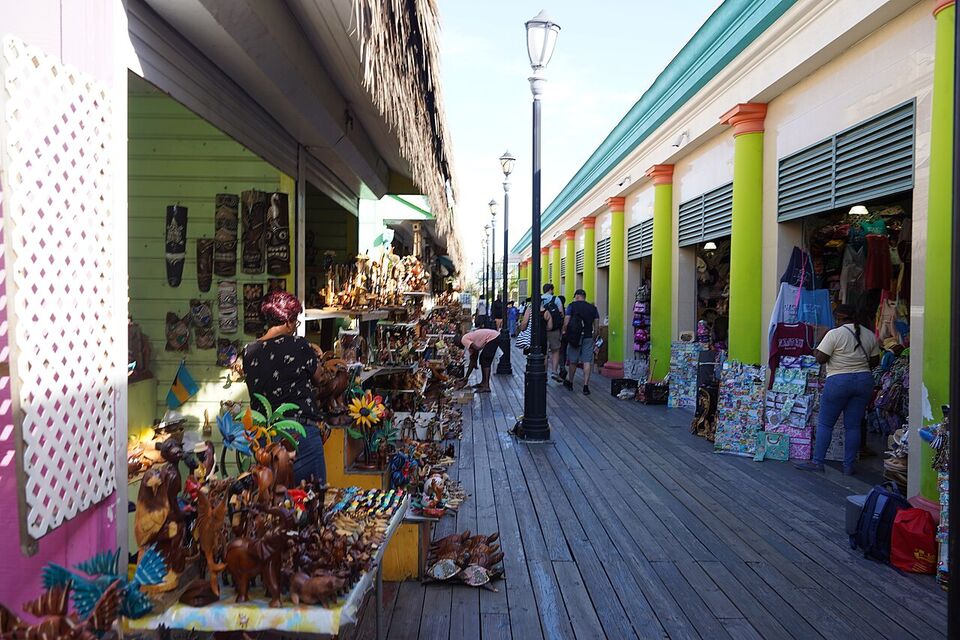
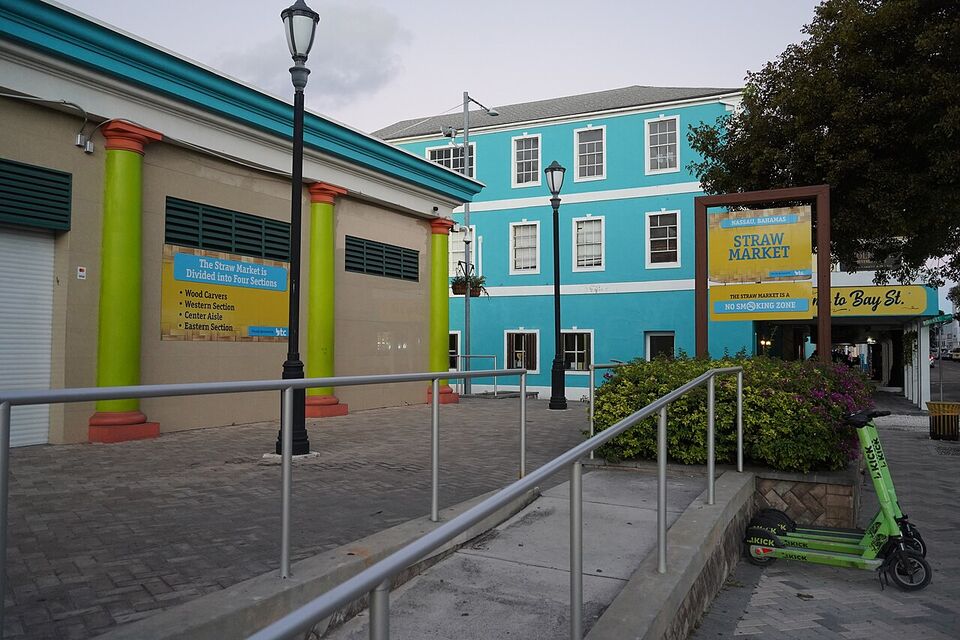
The Straw Market is the best-known craft market in the country. The current market opened in 2011, after a fire in 2001 destroyed the original Fish, Vegetable and Straw Market. It is open on all sides and holds many Bahamian craft stalls selling straw hats, baskets and bags, wood carvings, shell jewelry, T-shirts and small gifts. Traditional straw work in the Bahamas began as everyday craft: baskets for carrying fruit and for fishing traps. Today it is one of the main things sold to visitors.
We could not confirm the market's current opening hours, so check locally. Hours may follow cruise-ship days, and the market is likely to be busiest in the middle of the day when several ships are in port. Early morning is calmer, with more time to talk to the person who made an item. Our Nassau sights guide places the market in a walking route with the Queen's Staircase and the waterfront.
Insider tip
Ask who made an item and where. Many items in tourist markets are imported or machine-made, and a maker will usually say so about their own work. A genuinely hand-plaited piece has even, tight weaving and no glue marks, and it is worth more than a stamped souvenir.
Shopping outside Nassau
On the Out Islands (also called the Family Islands), shopping means a few small stores, craft stalls near settlements and work sold by individual artists and straw workers. Opening hours can be short, and some sellers may work only when a boat or flight arrives. Bring cash in small bills, because card machines are not guaranteed on small islands and change is often given in Bahamian money. Our Out Islands guide and Exumas guide describe the main settlements.
What to buy
These are the categories most travelers look for. We give no prices because they vary by seller, size and season, and we could not confirm a current price range for any of them.
Straw work
The signature Bahamian craft. Choose a hat you can try on, check that it holds its shape when you press it, and carry it on your head or in your hand on the plane rather than packing it flat. Baskets and bags pack easily.
Jewelry and small crafts
Look for beadwork, carved wood, painted calabash and jewelry made from beads, silver or seeds. The next sections explain why shell, coral and tortoiseshell pieces are the ones to avoid.
Art
Nassau has a National Art Gallery on West Street (nagb.org.bs) and private galleries. Prints and small canvases travel flat in a tube or a carry-on. Ask the seller to pack a painting for flying. Ask for a receipt that names the artist.
Rum and rum cake
Rum is a popular Bahamian drink to bring home, and rum cake is a common gift. See the alcohol rules below, and our drinks guide for what to try before you buy.
Hot sauces and spice blends
Pepper sauces, seasonings and condiments are everyday Bahamian food and good gifts. CBP says that, as a general rule, condiments, vinegars, oils, packaged spices, honey, coffee and tea are admissible. Liquids over the airline's carry-on limit must go in checked bags, so wrap glass well.
Coffee and packaged food
Sealed, commercially packaged coffee is easy to bring home under CBP's general rule. Look at the label to see where it was roasted: we could not confirm which brands are roasted in the Bahamas. Fresh fruit and anything with meat in it are different, as explained below.
The Bahamas has much more to buy at the source than in a souvenir shop: music, food and clothing tied to Junkanoo and the festival calendar, and local words that make a better souvenir story than a T-shirt (see Bahamian words and phrases).
Duty-free shops and how real the savings are
Downtown Nassau has many shops advertising duty-free prices on watches, jewelry, perfume, liquor and cigars. The term is easy to misread. "Duty-free" means the Bahamian import duty is not charged, or is lower, on goods sold to visitors. It does not mean the price is lower than at home, and it does not mean you can bring the item home without limit.
US Customs treats a duty-free shop abroad like any other purchase. Goods you buy count against your personal exemption, and CBP says that goods sold in a duty-free shop are free of duty only in the country where the shop is located. If the total goes over your exemption, you pay US duty on the extra, usually at a flat rate (CBP's example uses 3 percent).
How real are the savings? It depends on the product. A fair way to find out:
- Check the price of the exact model, size and brand at a US retailer or online before you travel.
- Compare it with the shop's price in dollars, which is the same as Bahamian dollars (B$1 = US$1; see our money page).
- Ask whether the displayed price includes VAT and whether any tax is added at the register.
- Count the item against your $800 exemption before deciding.
We could not confirm that duty-free prices in downtown Nassau beat US prices for watches, jewelry or perfume, and we do not suggest buying a high-value item on the assumption that they do. Savings may be larger on spirits and tobacco, but those are also the items with the tightest US limits.
Save money
Do the comparison on your phone before paying, and keep every receipt. The receipt is your proof of price if CBP asks. Do not buy a high-value item only to avoid a few dollars of duty: a flat rate on the amount over $800 is small next to a bad purchase.
Taxes: VAT and the visitor refund
The Bahamas charges value-added tax (VAT) at 10 percent on most goods and services. Since April 1, 2025, unprepared food items carry a reduced 5 percent rate. Shop prices usually show the amount before or after tax depending on the seller, so ask whether the ticket price is the final price.
The Bahamas Inland Revenue Department lists a "VAT FREE SCHEME - Global Blue" on its VAT pages, which suggests visitors can claim VAT back on qualifying purchases. We could not read the rules, so we cannot say the minimum spend, the refund rate, where to claim or which shops take part. Look for Global Blue VAT-free signs in shop windows, ask the shop for the paperwork before you pay and check the details on the Inland Revenue site (inlandrevenue.finance.gov.bs). Allow extra time at the airport if you plan to claim.
Other prices you meet while shopping, such as taxi rides and restaurant bills, often add VAT or a gratuity. Many restaurants and hotels add a gratuity, often 15 percent, to the bill, so check before you tip again. Our money guide explains cash, cards and change.
How to bargain politely
In the Straw Market and at craft stalls, prices are often open to discussion, but not in the shops on Bay Street, in galleries or in grocery stores. We could not confirm a posted-price policy for the market, so treat these as good manners rather than rules.
- Say hello first. Greeting people before you talk about business is standard in the Bahamas (see Bahamian etiquette).
- Ask the price, look at the item properly and say what you would like to pay. Do not start with a very low offer.
- Offer a bundle: two hats, or a hat and a bag, give you a reason to ask for a better price together.
- Pay the price you agreed in cash and smaller bills. Do not agree to a price you do not intend to pay.
- Walk away politely if the price is not right. A friendly "thank you, I will think about it" is enough.
- Ask permission before you photograph a seller or a stall.
Haggle for crafts, not for services. Taxi fares in Nassau are set by zone (confirm the fare before you get in), and our getting around guide covers when to ask the price.
What you can bring home: US Customs allowances
CBP's rules apply to US residents returning from the Bahamas. These are the main figures, as CBP states them.
| Item | Duty-free allowance | Notes |
|---|---|---|
| General goods | $800 per returning resident | Once every 31 days, after at least 48 hours outside the US. Includes gifts and duty-free shop goods. |
| Alcohol | 1 liter (33.8 fl. oz.) per adult 21 and over | Personal use only. Extra liters are dutiable, and state limits may apply. |
| Cigarettes | Up to 200 per adult 21 and over | Counts within the $800 exemption. |
| Cigars | Up to 100 per adult 21 and over | Not Cuban-origin cigars, which are a separate issue. |
| Amounts over the exemption | Flat duty rate | CBP's example uses 3 percent. Family members in one household can declare jointly. |
The 48-hour condition matters on a short trip. If you were away less than 48 hours, ask CBP how the exemption applies to your trip, because the full $800 may not apply. The exemption is also available once every 31 days, so it may already be used if you took another trip recently.
Declare everything you acquired abroad, including gifts, items bought on a cruise and anything you were given. CBP's own page asks for this. Keep receipts with your bags. For rules on a specific item, use the CBP "Know Before You Go" pages at cbp.gov.
Bahamian customs on the way in and out
The Bahamas has its own allowances for arriving adults: one quart of spirits and one quart of wine, tobacco not over one pound (or 200 cigarettes, or 50 cigars), and a $100 exemption on any dutiable article. If you carry more than used personal items, Bahamas Customs asks you to complete a baggage declaration (C17) through its "Exempt" app. The customs phone number is (242) 604-3124.
On departure, cash, negotiable instruments, precious metals or stones worth B$10,000 (US$10,000) or more must be declared, and the penalty can include forfeiture and a fine of up to $2,000. Most visitors will never need this, but do not carry a large amount of cash without checking. The rules on arrival and money are on our entry page.
What to leave behind: shells, coral, wildlife and Cuban goods
Watch out
Conch shells, coral and anything made from turtle shell are the items most likely to be taken at the airport. A purchase you made in good faith can still be seized, and in serious cases it can bring penalties. When in doubt, leave it in the shop.
Conch shells and shell jewelry
Queen conch is the animal behind the famous pink-lipped shell and the national dish of the Bahamas. Cleaned conch shells and polished fragments are sold to tourists in the Bahamas and elsewhere in the Caribbean as souvenirs and jewelry. The species is under pressure: the international wildlife-trade body CITES asked countries in 2003 to take action on trade in queen conch, some Caribbean countries have banned exporting the shells, and CITES asked all countries to ban imports from countries that do not follow its recommendations. Reports also say that the US listed queen conch as threatened under the Endangered Species Act in 2024. Shells and fragments that tourists carry from non-compliant countries can be confiscated on return.
We could not confirm the Bahamas' current rules for exporting shells, or which shells in tourist shops are legal to take. CBP says that anyone planning to import shellfish, mollusks, other invertebrates or products made from them should check with the US Fish and Wildlife Service first. The practical advice is simple: buy a shell, or shell jewelry, only if you have checked, and eat the conch instead (see our Bahamian food guide).
The same applies to sand dollars, starfish and other shells you find on the beach. A single common shell from a beach is a different matter from a protected species, but do not take shells from protected areas or from living animals. For the rules on beaches and parks, see our beaches guide.
Coral, tortoiseshell and other wildlife products
Coral, including pieces sold as jewelry or decoration, comes from a protected reef ecosystem. CBP says endangered wildlife species and products made from them generally may not be imported, and travelers need a permit from the US Fish and Wildlife Service for restricted items. CBP also tells anyone who plans to buy tortoiseshell jewelry, or items made from whalebone, ivory, skins or fur, to contact the US Fish and Wildlife Service Division of Law Enforcement (1-800-344-WILD). Do not buy sea turtle products in the Bahamas.
Cuban cigars and other Cuban products
Cigar shops in Nassau may sell cigars labeled Cuban, and Cuban cigars are famous. US rules are different from Bahamian ones. CBP says that, generally, you may not bring in merchandise from Cuba, which falls under US sanctions enforced by the Treasury's Office of Foreign Assets Control, and that licenses to bring such goods in are rarely granted. Some limited imports are authorized under Treasury rules, but a Cuban cigar from a Bahamian shop is not a safe way to test them.
Do not assume a cigar is allowed because the shop sells it. Buy cigars made in other countries, such as the Dominican Republic or Nicaragua, if you want a gift that you can bring home within the 100-cigar allowance. Check cbp.gov before you buy anything labeled Cuban. The Bahamas foreign ministry also advises avoiding non-essential travel to Cuba, and we do not recommend any trip there from Nassau.
Different from home
A shop in the Bahamas can legally sell things that you cannot legally bring into the United States. The shop's right to sell is not CBP's permission. The rule that counts is the US one at the airport.
Food, fruit and plants
CBP restricts fresh fruit, vegetables, plants, meat and animal products because they can carry pests and diseases. The right answer depends on where the item came from and where you are going in the US, so the safest approach is not to carry fresh produce home. CBP's general rule says that condiments, vinegars, oils, packaged spices, honey, coffee and tea are admissible, and that almost anything containing meat products, such as bouillon or soup mixes, is not.
In practice:
- Eat the pineapple, mango or guava in the Bahamas; do not pack it.
- Bring home sealed jars, bottles and bags with their labels intact.
- Skip anything with meat or animal products, and be careful with conch products and fish.
- Declare every food item on your CBP form. Declaring costs nothing, and an undeclared item can be fined.
- Do not bring soil, plants, seeds or cuttings home.
For what is worth eating and drinking while you are there, see our guides to Bahamian food and rum, Kalik and drinks.
Preclearance: clearing US customs in the Bahamas
The Bahamas is not part of the United States, but Nassau has US preclearance. At Lynden Pindling International Airport, CBP officers inspect US-bound passengers before the flight, so you clear US customs and immigration in the Bahamas and arrive in the United States as a domestic passenger. On arrival you do not go through another CBP or TSA line. CBP lists the Nassau facility at 1 Windsor Field Road, with hours of 6:00 a.m. to 7:00 p.m. and a phone number of (242) 377-7125.
What this means for shopping:
- Your bags are inspected in Nassau. The CBP officer asks what you bought and may look at your bags. The rules you have just read apply there, and an item that fails is taken in Nassau.
- Duty questions are handled in Nassau. If your purchases are over the exemption, CBP tells you what is owed at preclearance.
- Plan your last purchases. Duty-free shops at the airport, and gifts at the last minute, still count against your $800. Buy before you reach the preclearance area, and keep receipts accessible.
- Pack for an inspection. Keep food, bottles and fragile items easy to reach.
We could not confirm how early to arrive for a preclearance flight, so follow your airline's check-in advice and add time if you plan to claim a VAT refund. We also could not confirm preclearance at Freeport (Grand Bahama): CBP's list of preclearance locations names only Nassau for the Bahamas, so check with your airline before you fly from Freeport. Our Nassau airport guide and flights guide cover the airport day.
Cruise passengers return to the US at a US port, not through preclearance, and the same CBP rules apply on arrival there. See our cruise guide.
Packing and shipping your purchases
- Glass and liquids. Wrap bottles in clothing and put them in a checked bag. Carry-on liquid limits apply to liquor and sauces.
- Straw hats. Wear or carry them. A crushed hat rarely recovers.
- Fragile art. Ask the seller for a tube or a hard sleeve, and carry it with you.
- Receipts. Keep every one in one envelope, with items listed.
- Connecting flights. If you buy liquor at the airport and connect through another airport, ask the shop to seal it and check TSA guidance on duty-free liquids before you fly.
- Shipping. We could not confirm shipping services for visitors. Items shipped home are subject to customs duty and rules on arrival, so ask the seller what documents they provide.
Our packing list has a section for the trip home, including a spare bag.
Common mistakes and a last check
- Buying a conch shell, coral or tortoiseshell piece and finding it taken at the airport. Skip these.
- Assuming Cuban cigars are allowed because a shop sells them.
- Forgetting that gifts, cruise-ship purchases and duty-free goods all count against the $800.
- Bringing more than one liter of alcohol per adult without planning for duty.
- Carrying fresh fruit or meat products in a bag.
- Paying a high price for a duty-free item without checking the US price first.
- Leaving purchases for the last half hour at the airport.
- Skipping a receipt for a high-value item.
- Assuming you can use US dollars and get dollar change; change is often given in Bahamian money, which is hard to exchange back home.
Rules can change. Before you shop, check the CBP pages on customs duty and on prohibited and restricted items at cbp.gov, and the Bahamas Customs site (bahamascustoms.gov.bs). If you are unsure about an item, ask CBP or the US Fish and Wildlife Service before you buy it.
Add it to a route in the trip builder, or ask us to plan the hotels, trains and guides for you.