Overview: the swimming pigs in a few lines
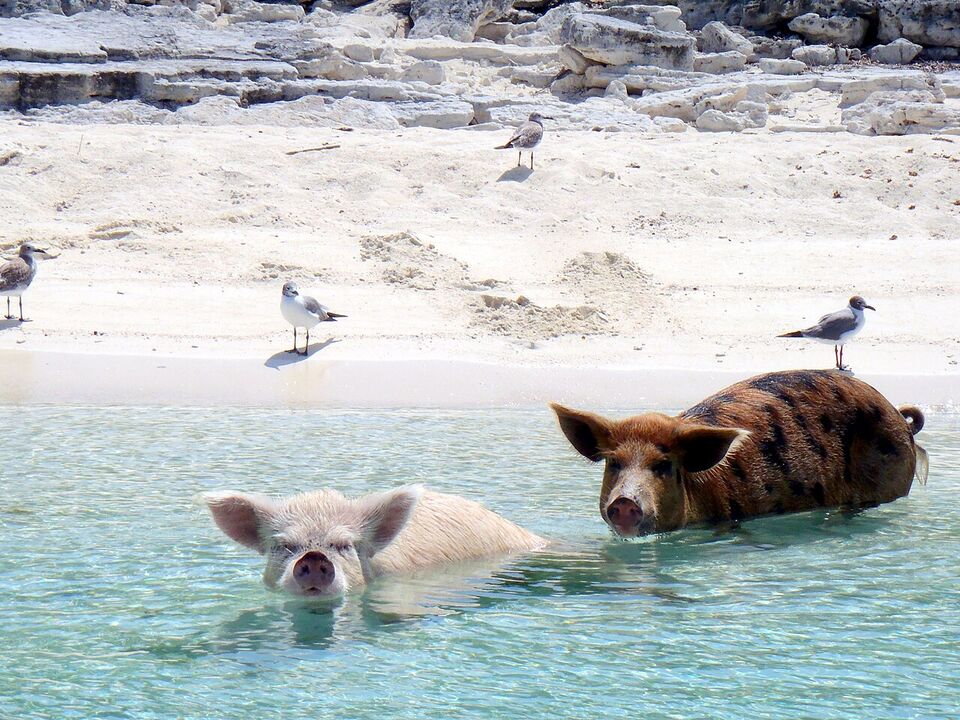
The swimming pigs live on Big Major Cay, a small, uninhabited island in the Exumas, close to Staniel Cay. The beach is known unofficially as Pig Beach. Boats pull up, pigs walk down the sand and wade or swim out to meet them, and visitors take photos from the boat or the shallows. That is the whole attraction, and it is why a pig stop is usually one of several in a boat day through the northern Exuma cays.
This page covers what you need to decide: where the pigs are, how the tours work, what to expect, what the rules are (and where there are none we can confirm), how to deal with animal welfare questions, and how to pick a responsible operator. For the islands around them, see our Exumas guide.
Different from home
There is no admission desk or ticket office. Pig Beach is on an uninhabited cay and you reach it by boat, so your experience depends on your tour operator. Most operators are small, independent boat companies, and the quality varies.
Where the pigs are
Big Major Cay is in the Exuma chain, near Staniel Cay, which one source puts about 75 miles (120 km) south of Nassau. Another source gives the distance from Nassau to Pig Beach as 89 miles (143 km) and about 2 hours by speedboat. The cay has no people living on it, three freshwater springs, a handful of stray cats and goats, and a colony of pigs. One estimate in 2019 put the pig population at 50 to 60.
No one knows for certain how the pigs got there. Local stories include sailors who left them to cook later, a shipwreck, and an escape from a nearby cay. One account says residents of nearby Staniel Cay put them there in the 1990s to raise for food. The pigs are now fed by residents of neighboring islands and by visitors, which is why they come down to the beach.
Other places that advertise pigs
Big Major Cay is the original, but other islands in the Bahamas have swimming or beach pigs too, and operators advertise stops at places such as Rose Island near Nassau and on Grand Bahama. We could not confirm the details of these, such as whether they are open to visitors, how many animals are there or which operators have permission to land, so check with the operator and the Ministry of Tourism (bahamas.com) before you book. If your trip includes Nassau only, a pig stop nearby may be easier than the trip to the Exumas. If you are heading to the Exumas anyway, Pig Beach is the more famous stop.
How tours work
There are four main ways to see the pigs.
| Option | How it works | Best for | Trade-offs |
|---|---|---|---|
| Tour from Great Exuma or Staniel Cay | Boat trip, usually half or full day, with pigs plus sandbars, snorkeling or iguanas | Visitors staying in the Exumas | Fixed stops; the pig stop can be crowded |
| Speedboat day trip from Nassau | Fast boat to the Exumas and back the same day | Visitors with one spare day in Nassau | About 2 hours each way per one source; rough seas can cancel it |
| Plane plus boat from Nassau | Small plane to Staniel Cay or Great Exuma, then a boat to the pigs | Visitors who want less time on the water | Higher price; baggage limits; weather |
| Private charter | A boat and captain for your group | Families and groups who want to choose their own timing | Higher total cost; check licensing and insurance |
We found no confirmed 2026 prices for pig tours, so we give none. In comparison terms, a group tour from the Exumas costs the least per person, a private charter costs more in total but can be split, and a day trip from Nassau by air costs the most because of the flights. Ask for the all-in price, including VAT (10%), any park or landing fees and a gratuity. A gratuity is often added to the bill, so check before you tip again.
No ferry goes to Big Major Cay. Bahamas Ferries says so on its own FAQ, and its Nassau to George Town sailing is freight only. Anyone selling a "ferry to the pigs" is selling a boat tour, so ask what the boat is and who runs it.
Day trip tradeoffs
A day trip from Nassau is possible, but it can leave you with only an hour or two at the pigs after several hours in transit. Nassau-based operators often combine the pigs with a sandbar and a snorkel stop. Weigh the options this way:
- Nassau by speedboat. Cheapest way to see the pigs from Nassau if you do not mind a long day. Open water can be rough, and you may be tired and wet on the way back.
- Nassau by plane. Faster but pricier. Ask about the return flight and what happens if weather grounds it.
- Stay in the Exumas. Costs the least in time, and you can book the pigs for a calm morning. Our Exumas guide covers where to stay.
- Cruise passengers. Your ship leaves on schedule. Ask how much buffer there is for the return, and what the operator does if weather delays the trip. See our cruise guide.
What to expect at Pig Beach
You will arrive by boat, usually in a group, and the boat will either anchor in the shallows or pull up to the beach. The pigs will come to you, because they associate boats with food. Expect to share the beach with several other boats at midday. Time at the beach varies by operator, so ask how long you will have. The pigs are large, with big teeth, and they can be pushy.
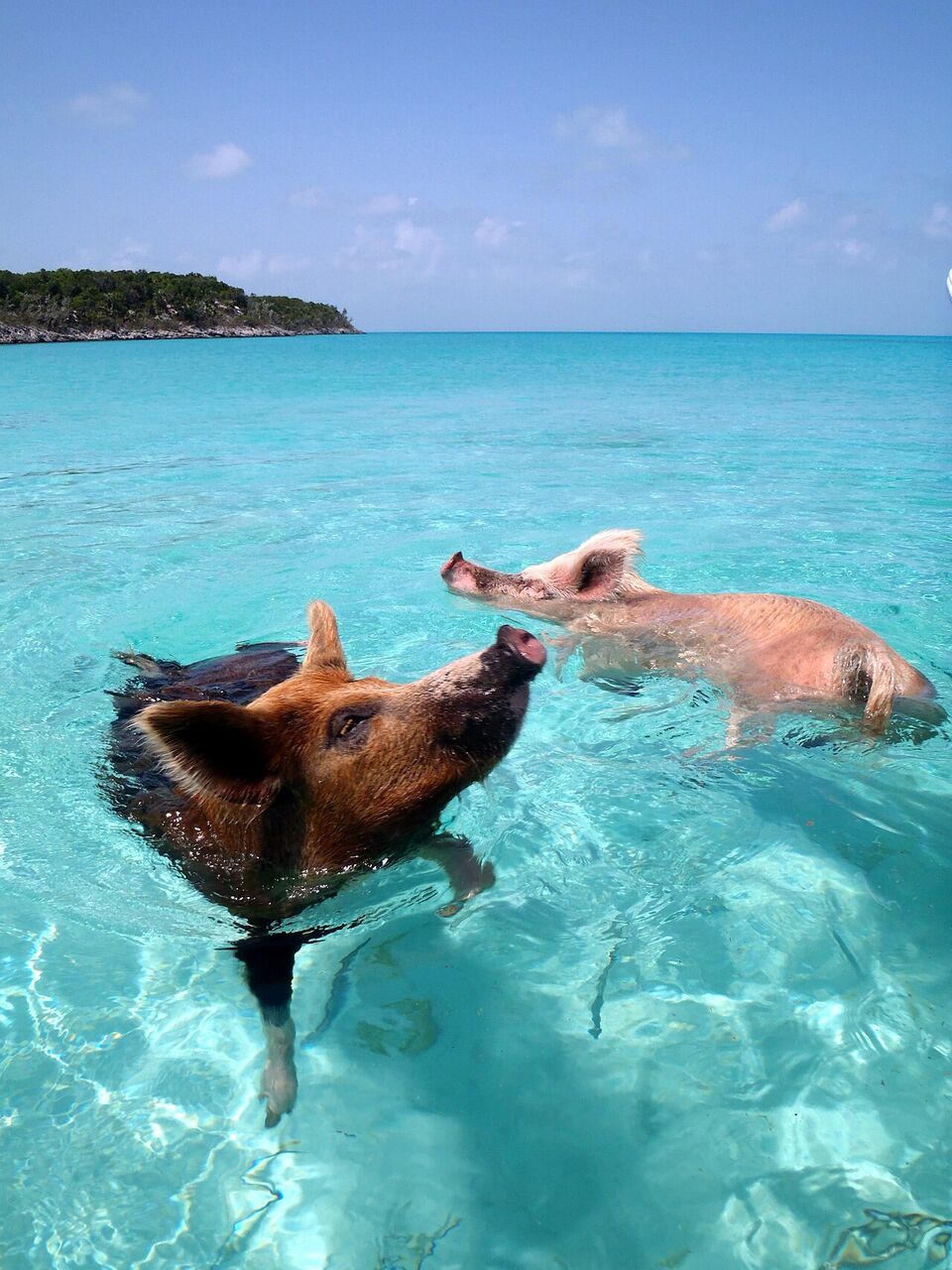
The water is shallow and clear, and the pigs swim. Visitors who go in with them should be comfortable standing in water around waist or chest deep, because pigs paddle in close. Wear water shoes, a swimsuit that stays on, sun protection and a cover-up. Keep your phone and camera on a strap or in a waterproof pouch. Bring a dry bag, because boats can be wet.
Beyond the pigs, many tours stop at other places in the northern Exumas: the sandbars, Thunderball Grotto off Staniel Cay, and the Allen Cays, where the endangered Allen Cays rock iguana lives. Cats and goats live on Big Major Cay as well. None of these animals are pets, so treat all of them as wild.
Feeding, touching and the rules
We did not find an official Bahamian rule on feeding or touching the pigs, a visitor limit or a fee for landing at Big Major Cay, and we could not confirm that tours remain allowed under any new restrictions. Check the Bahamas Ministry of Tourism (bahamas.com) and the Bahamas National Trust (bnt.bs) before you go, and follow your operator's rules. Because the pigs are fed by residents and visitors, the practice is long established, but it is not the same as being officially approved.
Whatever the rule, use common sense.
- Never give pigs alcohol. A number of pigs died in 2017, and claims at the time pointed to alcohol from visitors.
- Feed them only what your guide hands you, if the guide allows feeding at all.
- Do not feed them human snacks, drinks, sweets or leftovers.
- Keep food out of your pockets and out of children's hands. Pigs will go for it.
- Do not chase, grab, ride or pick up a pig or a piglet.
- Do not leave trash on the beach or in the water.
- Do not touch the pigs unless your guide says it is fine and shows you how.
Watch out
Pigs bite, usually when food is involved or when they are crowded. Keep fingers away from the mouth, do not hold food in your hand in front of a pig, and keep children close. If you are bitten or scratched, clean the wound with soap and water and see a doctor soon after. Ask about tetanus before you go.
Animal welfare concerns, discussed neutrally
People differ about pig tours. Supporters point out that the pigs are fed by people who live nearby and that the tours are a source of income for small island communities. Critics point to cases where animals were harmed, and say that feeding wild animals changes their behavior and health.
The best known case is from 2017, when a number of the pigs were found dead. At the time, claims were made that visitors had given them alcohol, and that the pigs had swallowed sand while eating food dropped on the beach. We cannot say what the cause was, and sources differ. What is clear is that the pigs eat what people give them, so visitor behavior affects their health. The cay has three freshwater springs, but the pigs are also fed by residents and visitors.
Operators' conduct varies. Some give a briefing and set rules before guests step ashore. Others may let guests feed from the beach with little guidance. Ask which kind you are booking. Your choice of operator is the main way you affect the animals. If you do not want to feed or touch animals, you can still enjoy the pigs from the boat or the shallows, and you can tell your guide so.
Choosing a responsible, safe operator
The US State Department's summary of its July 28, 2026 advisory says boating in the Bahamas is poorly regulated, with injuries and deaths, and that some watercraft are unsafe or uninsured. It also warns about unregulated water tours and for-hire fishing without a license. That covers the type of operator that sells pig tours. Many companies are careful, but you should ask. Use this list.
Questions to ask your operator
- Is the boat and captain licensed, and is the boat insured? Can you see the paperwork?
- How many passengers does the boat carry, and how many life jackets are on board? Are there child sizes?
- Is there a working marine radio or phone and a first-aid kit?
- What is the total price, with VAT, park or landing fees and any gratuity?
- How long is each leg of the trip, how long do we stay at the pigs, and what time do we return?
- What is the policy on feeding, touching and swimming with the pigs? What food do you bring?
- How do you keep the animals safe, and how many boats visit at once?
- What happens if weather cancels the trip? Is there a refund or a new date?
- If we transfer from a larger boat to a small one, who helps with the steps and how are children handled?
Good signs are a clear name and a website, a briefing before you reach the beach, life jackets that fit and are offered without asking, and a captain who cancels when the weather is bad. Warning signs are cash-only deals made on the street, overloaded boats, no life jackets, alcohol served heavily on the way to the animals and a promise to take you anywhere you want.
Insider tip
If you are staying on Great Exuma or Staniel Cay, ask your hotel which local operators it uses. A property that sends guests out every day has a reason to pick a reliable boat.
Safety: bites, transfers and the sea
Most problems on pig tours are not with the pigs. They come from the boat, the weather and the people.
- Bites and scratches. Keep food in a bag. Keep children close and out of the water if a pig is aggressive.
- Boat transfers. Stepping from one boat to another, or from a boat onto a beach, is where people slip. Take your time, use a hand from the crew, and wear shoes you can get wet.
- Sun and heat. There is little shade on the cay. Bring water, a hat and sunscreen.
- Currents and depth. Water near sandbars and cays can flow strongly with the tide. Wear a life vest if you are not a confident swimmer, and never swim alone.
- Other boats. Watch for boats near the shore and while you are in the water.
- Weather. Winter fronts and storms can turn the sea rough. Hurricane season runs June 1 to November 30; check the National Hurricane Center (nhc.noaa.gov) and the Bahamas Department of Meteorology.
The Level 2: Exercise Increased Caution advisory (as of November 2026) is mostly about crime in Nassau and Freeport, but it also lists boating risk. Read it at travel.state.gov and our safety guide. Buy travel medical insurance: an injury on a remote cay may need a flight to Nassau. For emergencies, dial 911 or 919.
Costs and when to go
Since we could not confirm tour prices, think in comparison terms. A pig stop within a half-day tour from the Exumas is the cheapest per person, a full day with sandbars and snorkeling costs more, and a private charter or a flight from Nassau costs the most. Prices rise in the busy months from mid-December to April, and book early at holiday weeks. Ask what is included, and whether VAT, park fees and gratuities are in the price. See our budget guide for a total trip view.
Weather decides more than the calendar. Calm mornings are best, because the sea can pick up later in the day. In winter, days with strong north winds can cancel trips; in summer, thunderstorms and heat can do the same. The crowd is smaller early in the morning or later in the afternoon, but check the tide and the operator's schedule first.
Save money
If you are staying in the Exumas, book a shared group tour rather than a private boat, and do it on a weekday if you can. Compare two or three operators on what is included, not just on the headline price.
Alternatives and what else to see nearby
If you do not want to visit the pigs, or want more to do on the same day, the Exumas have plenty of other stops.
Thunderball Grotto
A limestone cave off Staniel Cay, used in a 1965 James Bond film. Ask your operator about tide timing and fees.
Allen Cays iguanas
Home to the endangered Allen Cays rock iguana. Ask your operator about the rules for visiting, and do not feed the iguanas.
Exuma Cays Land and Sea Park
A no-fishing marine park with reefs, mangroves, hiking trails and the park headquarters. Operators pay landing fees.
Sandbars and snorkeling
Shallow sandbars appear at low tide. See our diving and snorkeling guide.
George Town beaches
Beach days on Great Exuma, including the Tropic of Cancer Beach on Little Exuma. See our beaches guide.
For a wider choice of animal and nature trips across the Bahamas, browse our interests guides. For traveling with children, our families guide has more on boats and beaches.
Mistakes to avoid
- Booking a Nassau day trip without checking travel time. You may spend more time on the boat than at the pigs.
- Choosing the cheapest unlicensed operator. Check the license, insurance and life jackets.
- Giving the pigs alcohol, sweets or snacks. Only feed what your guide hands you.
- Carrying food in the water. Pigs will chase it.
- Skipping travel insurance. Medical care on remote cays is limited.
- Assuming rules have not changed. Ask the operator and check bahamas.com and bnt.bs for the latest.
Add it to a route in the trip builder, or ask us to plan the hotels, trains and guides for you.