Overview
Between Seville, Málaga and the Atlantic coast lies the most rewarding road trip in Spain. In a week you can drive through cork-oak hills and limestone mountains to the pueblos blancos (white towns) that cling to clifftops, taste sherry in the bodegas of Jerez where it is made, walk the 3,000-year-old port of Cádiz and swim on wide, empty Atlantic beaches facing Morocco.
This is the Spain of whitewash and geraniums, of Moorish castles above Christian churches, of horse fairs and flamenco in the bars. Most of it sits in Cádiz province, with Ronda just over the line in Málaga province and Doñana in Huelva. Distances are short: no leg of the route below is more than about 1 hour 30 minutes of driving, and many are under an hour.
You need a car to do it well. Trains and buses link the bigger places, but the white towns are spread across the hills with a few buses a day, and the best moments (a village at dusk, a beach without a bus timetable) come from having your own wheels. Combine the road trip with Seville, Córdoba and Granada by train, before or after.
Planning the route
The simplest plan is a one-way loop: take the train to Seville (or fly, while Madrid–Andalusia high-speed trains are suspended after the October 28, 2026 Urda collision; Renfe stopped selling tickets on the route until December 13, 2026, so check Renfe, Iryo and Ouigo first), see the city without a car, pick up a rental on your last morning, drive the route below, and drop the car at Málaga airport or the train station. One-way rentals within Spain usually carry a modest drop fee; check it when you compare prices. Málaga has the most flights out, including, in recent summers, a seasonal United nonstop to Newark (see flights).
Plan two nights in at least two places so you are not packing every morning. Good bases are Jerez or El Puerto de Santa María for the sherry towns and Cádiz, Vejer for the coast, and Ronda or Grazalema for the mountains. Hotels in the white towns are mostly small and family-run, often in old houses, $ to $$ outside holidays. There are paradores, the state-run historic hotels, in Ronda, Arcos, Cádiz and Carmona; see where to stay.
| Leg | Distance | Driving time |
|---|---|---|
| Seville to Jerez | About 55 miles (90 km) | About 1 hr |
| Jerez to Cádiz | About 22 miles (35 km) | About 40 min |
| Jerez to Sanlúcar de Barrameda | About 15 miles (25 km) | About 30 min |
| Cádiz to Vejer de la Frontera | About 30 miles (50 km) | About 45 min |
| Vejer to Tarifa | About 30 miles (50 km) | About 45 min |
| Vejer to Arcos de la Frontera | About 50 miles (80 km) | About 1 hr |
| Arcos to Grazalema | About 30 miles (50 km) | About 1 hr (mountain road) |
| Grazalema to Zahara de la Sierra | About 10 miles (17 km) | About 30 min (steep pass) |
| Zahara to Ronda | About 22 miles (35 km) | About 45 min |
| Ronda to Málaga | About 60 miles (100 km) | About 1 hr 30 min |
Insider tip
Rent the smallest car that fits your luggage. The old centers of Arcos, Vejer, Grazalema and Ronda have steep lanes built for donkeys, and a compact car with an automatic transmission (book it early; most Spanish rentals are manual) makes the whole trip less stressful.
Ronda
Ronda is the most dramatic town in Andalusia, split in two by El Tajo, a gorge about 330 feet (100 m) deep. The Puente Nuevo (New Bridge), finished in 1793 after more than 30 years of work, spans it in a single stone arch. Walk across, then take the paths down into the valley below for the classic view of the bridge and the houses perched on the cliff edge.
On the south side is the old Moorish town, La Ciudad, with the Casa del Rey Moro, whose "water mine" stairway was cut down through the rock to the river; the well-preserved 13th-century Arab baths; and the Palacio de Mondragón, now the city museum. On the north side, the Real Maestranza bullring of 1785 is one of the oldest in Spain, and its museum is open to visitors. Ronda's bullfighting tradition drew Ernest Hemingway and Orson Welles, and every September it holds the Corrida Goyesca, with costumes from Goya's time.
Give Ronda one night, two if you want to hike. Day-trippers from the Costa del Sol fill the bridge area from late morning to late afternoon; in the evening the town is yours. Ronda is also the one white town you can reach without a car: it has a train station with direct trains from Córdoba and Granada (and from Madrid when the high-speed line is running), and buses from Seville and Málaga of about 2 hours.
The white towns
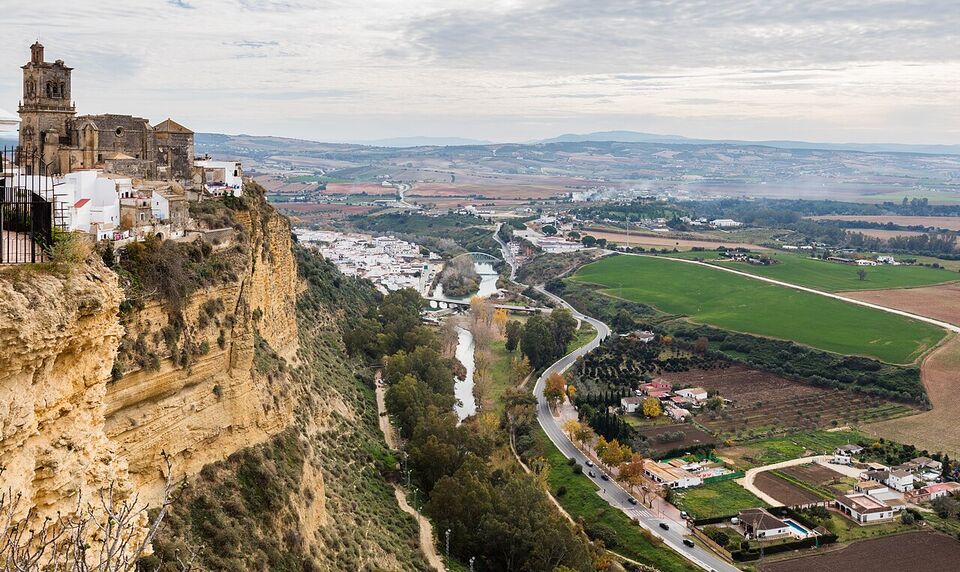
The pueblos blancos are whitewashed hill towns, most of them frontier strongholds during the centuries of war between Christian Castile and Muslim Granada; that is why so many names end in de la Frontera. Each has a castle or church at the top, a main square with a bar or two, and narrow lanes that tumble downhill. Two or three in a day is plenty.
Arcos de la Frontera
A town on a sheer cliff above the Guadalete river. The viewpoint on the Plaza del Cabildo, next to the parador, looks straight down on birds of prey circling below. Park at the bottom and walk up; the lanes at the top are a squeeze even for small cars.
Vejer de la Frontera
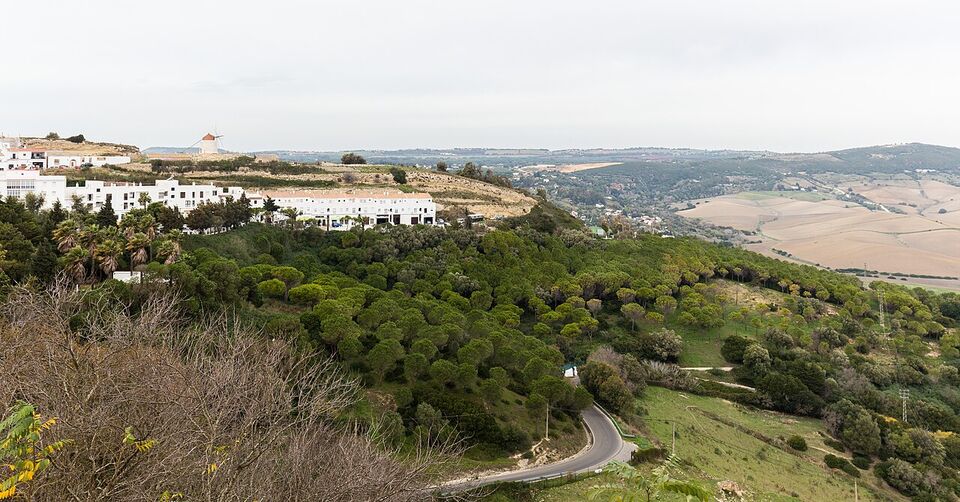
The most beautiful white town for many visitors, on a hilltop 6 miles (10 km) from the Atlantic, with Moorish-looking lanes, a castle and a lively square of palms and tiled fountains. The best base for the Costa de la Luz beaches.
Grazalema
A mountain village in a natural park of limestone peaks and Spanish fir forests. It is one of the rainiest places in Spain, which keeps it green. Several hiking trails, including the walk through the fir forest (pinsapar), need a free permit from the park office; apply ahead.
Zahara de la Sierra
A tiny village under a ruined Moorish castle above a turquoise reservoir. The drive from Grazalema over the Puerto de las Palomas pass is one of the most spectacular in Spain, with hairpin bends; take it slowly.
Setenil de las Bodegas
A village where houses are built into overhanging rock along a river gorge, so whole streets run under a stone roof. Very busy on weekends; go on a weekday morning.
Olvera
A castle and a big church crown a cone-shaped hill. Olvera is the start of the Vía Verde de la Sierra, an old railway line turned into a walking and cycling path of about 22 miles (36 km).
Watch out
Don't follow your GPS into the top of a white town. It will happily send you down lanes that narrow to the width of a car, with no way to turn around. Park in the signed public lots (aparcamiento) at the edge of town and walk up. Leave nothing visible inside the car, especially at trailheads and beach parking lots.
Jerez de la Frontera
Jerez is the capital of sherry, the city of the Andalusian horse and one of the great centers of flamenco. It is a working city of about 210,000 people, less pretty than Seville but less touristy, with a cathedral, a Moorish alcázar and whole streets of whitewashed wine warehouses (bodegas) with high ceilings to keep the wine cool.
Sherry bodegas
Sherry can only come from the triangle formed by Jerez, El Puerto de Santa María and Sanlúcar de Barrameda. Most of the big houses in Jerez run tours with tastings in English several times a day, including González Byass, maker of Tío Pepe, and Lustau; smaller houses such as Bodegas Tradición add an art collection to the tasting. Book on the bodegas' own sites a few days ahead in spring and fall. Learn the styles: bone-dry fino and manzanilla, nutty amontillado, rich oloroso and sticky-sweet Pedro Ximénez. See Spanish wine.
The dancing horses
The Real Escuela Andaluza del Arte Ecuestre (Royal Andalusian School of Equestrian Art) stages its show, Cómo bailan los caballos andaluces ("How the Andalusian horses dance"), on set days each week, usually at midday, with extra performances in busy months. On some other days you can watch the horses train and visit the stables and museums. Check the calendar and buy at realescuela.org.
Flamenco
The old Santiago and San Miguel neighborhoods are home to famous flamenco families, and small bars and peñas host performances, especially on weekends. The Festival de Jerez, one of the most important flamenco festivals in the world, takes over the city for about two weeks from late February. See flamenco.
Different from home
Spain's drink-driving limit is 0.5 g/l of blood alcohol (0.05 percent), lower than the 0.08 percent used in most US states, and only 0.3 g/l for drivers with less than two years' experience; the government has proposed lowering it further. One glass of fino at a tasting is fine; a full bodega tour with several glasses is not. Base yourself in Jerez and walk to the bodegas, or let one person skip the tasting.
Cádiz and the Costa de la Luz
Cádiz
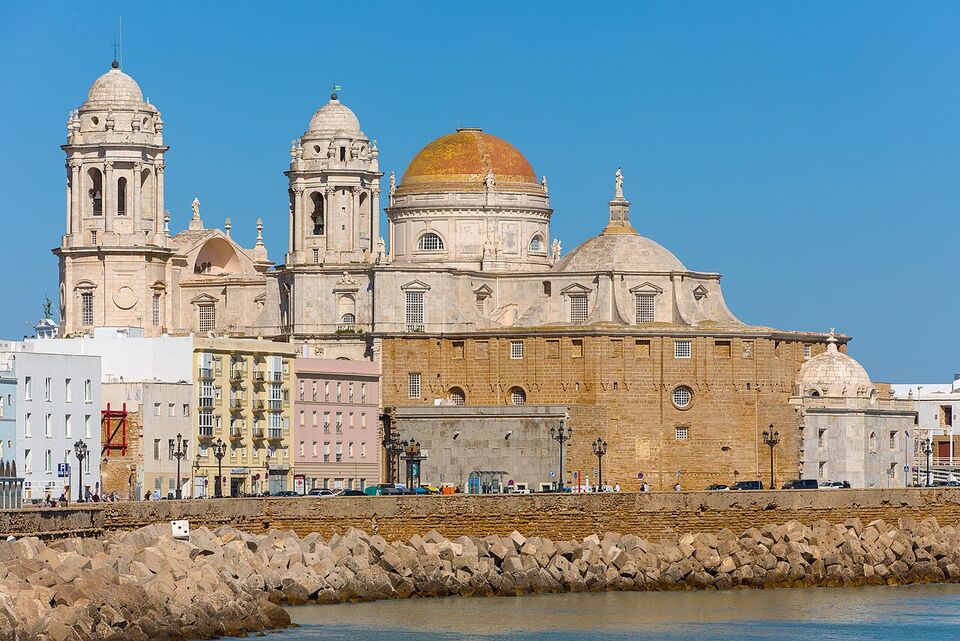
Founded by the Phoenicians about 3,000 years ago as Gadir, Cádiz claims to be the oldest continuously inhabited city in Western Europe. Its old town fills the tip of a narrow peninsula, almost surrounded by the Atlantic, with a grid of tall 18th-century houses from its golden age of trade with the Americas. Climb the Torre Tavira, an old merchants' watchtower with a camera obscura that projects live views of the city, visit the gold-domed cathedral, and eat fried fish in the Mercado Central or the La Viña neighborhood. La Caleta beach sits right in the old town.
Cádiz is about 1 hour 45 minutes from Seville by regional train, and the station is at the edge of the old town, so you can visit without a car. Its Carnival in February, famous for satirical songs, is one of Spain's biggest; the 2027 Carnival falls in early to mid February, ahead of Ash Wednesday on February 10. Cádiz is also a cruise port; see cruises.
Sanlúcar and El Puerto
Sanlúcar de Barrameda, at the mouth of the Guadalquivir, makes manzanilla, the saltiest and lightest sherry, and its riverside Bajo de Guía is lined with seafood restaurants famous for langostinos (prawns). In August it holds horse races on the beach, a tradition since the 1840s. El Puerto de Santa María, across the bay from Cádiz, has more bodegas and fried-fish shops (freidurías), and a ferry to Cádiz.
Beaches and Tarifa
The Costa de la Luz between Cádiz and Tarifa has some of the best beaches in Spain: long, wide, golden and much less built up than the Costa del Sol. Bolonia combines a dune and a beach with the ruins of Baelo Claudia, a Roman town that made fish sauce. Zahara de los Atunes and El Palmar are relaxed beach villages. Tarifa, the southern tip of mainland Europe, is a kitesurfing capital with a walled old town, whale- and dolphin-watching trips into the Strait, and fast ferries to Tangier in Morocco in about an hour (see Spain with Morocco).
Watch out
The Atlantic here is colder than the Mediterranean, and the east wind (levante) can blow hard for days, sandblasting beaches and kicking up dangerous currents. Swim where there are lifeguards, respect red flags, and on a windy day head for the more sheltered beaches or inland. See safety.
Doñana National Park
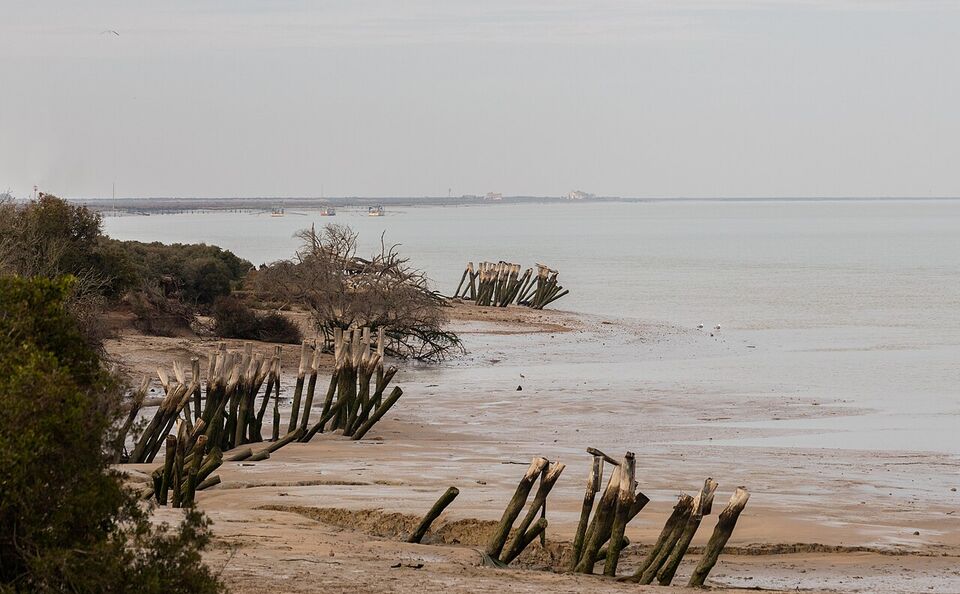
Doñana, where the Guadalquivir meets the sea, is one of Europe's most important wetlands and a UNESCO World Heritage Site: marshes, dunes and pine forest that host flamingos, spoonbills, hundreds of thousands of wintering ducks and geese, the rare Spanish imperial eagle and the Iberian lynx, which you are unlikely to see. Recent droughts and the over-pumping of groundwater for farming have shrunk its lagoons, a major environmental controversy in Spain.
Most of the park is closed to private visitors, so go with a licensed operator. Doñana Visitas, run by a local cooperative, takes small groups in all-terrain vehicles from the El Acebuche visitor center from about €35 (about $39). Its site lists winter times of 8:30 a.m. and 3 p.m. Tuesday to Sunday, and summer times of 8:30 a.m. and 5 p.m. Monday to Saturday; confirm the departure when you book. It also runs a visit starting from Sanlúcar de Barrameda from about €50 (about $56). Book ahead by phone or email at donanavisitas.es. The best months for birds are October to March.
Next to the park, El Rocío is a village of sand streets, hitching rails and whitewashed brotherhood houses that looks like a set from a Western. It fills with hundreds of thousands of pilgrims for the Romería del Rocío at Pentecost (May 16, 2027), when it is best avoided unless you are going for the pilgrimage itself.
Further afield
- Antequera. Prehistoric dolmens (burial mounds) on the UNESCO list and the strange limestone formations of El Torcal, about 40 minutes north of Málaga. The cliff walkway of the Caminito del Rey is nearby and needs timed tickets; see Málaga and the Costa del Sol.
- Úbeda and Baeza. Two Renaissance towns in a sea of olive groves in Jaén province, on the UNESCO list since 2003, about 1 hour 45 minutes from Granada.
- The Alpujarras. Berber-style villages on the southern slopes of the Sierra Nevada, about 1 hour 15 minutes from Granada, with fine walking; see Granada and the outdoors.
Driving in Andalusia
Driving here is easier than most Americans expect. Highways (autovías) are modern and quiet outside cities, and the AP-4 between Seville and Cádiz has been toll-free since 2020. Mountain roads in the sierra are narrow and winding but well paved. For full details, see driving in Spain.
- Paperwork. Carry your US license and an International Driving Permit (from AAA in the US), plus your passport. Rental companies may not ask for the permit, but the police can.
- Speed limits. 120 km/h (75 mph) on highways, 90 km/h (56 mph) on other roads, 50 km/h (31 mph) in towns and 30 km/h (19 mph) on most single-lane town streets. Fixed and mobile cameras are common.
- Roundabouts. Cars already in the roundabout have priority. Use the outside lane to exit.
- Fuel. Sold by the liter. Gasolina sin plomo 95 is regular unleaded; gasóleo or diesel is diesel. Many village stations close on Sunday afternoons and at night; fill up before the mountains.
- Parking. Blue lines (zona azul) mean paid parking with a time limit. Historic centers in Seville, Córdoba, Cádiz and Ronda restrict access with cameras, and low-emission zones are spreading in the bigger cities; ask your hotel how to park before you arrive.
- Emergencies. Call 112. Keep the reflective vest and warning device the rental car carries.
Sample routes
Seven days: Seville to Málaga
- Day 1
Seville to Jerez
Pick up the car in Seville. Drive to Jerez for a bodega tour in the afternoon and flamenco in the Santiago neighborhood at night.
- Day 2
Sanlúcar and Cádiz
Morning at Sanlúcar for manzanilla and prawns at Bajo de Guía, then on to Cádiz for the Torre Tavira, the cathedral and sunset at La Caleta. Sleep in Jerez or Cádiz.
- Day 3
To Vejer
Drive to Vejer, stopping at the hilltop town of Medina Sidonia for its almond pastries (alfajores). Afternoon on the beach at El Palmar, evening in Vejer's square.
- Day 4
Bolonia and Tarifa
Baelo Claudia and the Bolonia dune in the morning, then Tarifa's old town and a whale-watching trip. Back to Vejer.
- Day 5
Arcos and Grazalema
North to Arcos for the clifftop view, then into the mountains to Grazalema. Short hike if you have a permit.
- Day 6
Zahara, Setenil and Ronda
Over the pass to Zahara de la Sierra, a detour to Setenil, and on to Ronda for the evening.
- Day 7
Ronda to Málaga
Morning walk down into the gorge below the Puente Nuevo, then drive to Málaga to drop the car.
Ten days
Add Doñana at the start (one night in El Rocío or Matalascañas, with an early 4x4 tour), a second night in Ronda for the hiking, and a night in Antequera with El Torcal and the Caminito del Rey on the way to Málaga. For complete trips combining the road trip with the cities, see planning your trip and the trip builder.
When to go
Spring, from March to May, is the best season: green hills, wildflowers, orange blossom and highs of 68–80°F (20–27°C). Holy Week processions in every town (March 21 to 28, 2027) are a highlight, though hotels fill. Late September to November is the other sweet spot, with warm sea water into October and the Jerez harvest festivals in September.
In July and August, the inland towns regularly reach 100°F (38°C) or more and wildfire risk is high, so roads and trails in the sierra can close at short notice; the coast is cooler but packed with Spanish families. Winter is mild on the coast and cool and damp in the mountains, where Grazalema can get snow. It is a quiet, cheap time to go, but some coastal hotels and beach restaurants close from November to March. See when to go.
Save money
Andalusia charges no tourist tax as of November 2026, and the white towns are among the cheapest places to sleep and eat in Spain. A menú del día (set lunch of two courses, bread and a drink) in a village bar usually costs noticeably less than the same meal on the Costa del Sol or in central Seville. See money and the budget planner.
Add it to a route in the trip builder, or ask us to plan the hotels, trains and guides for you.