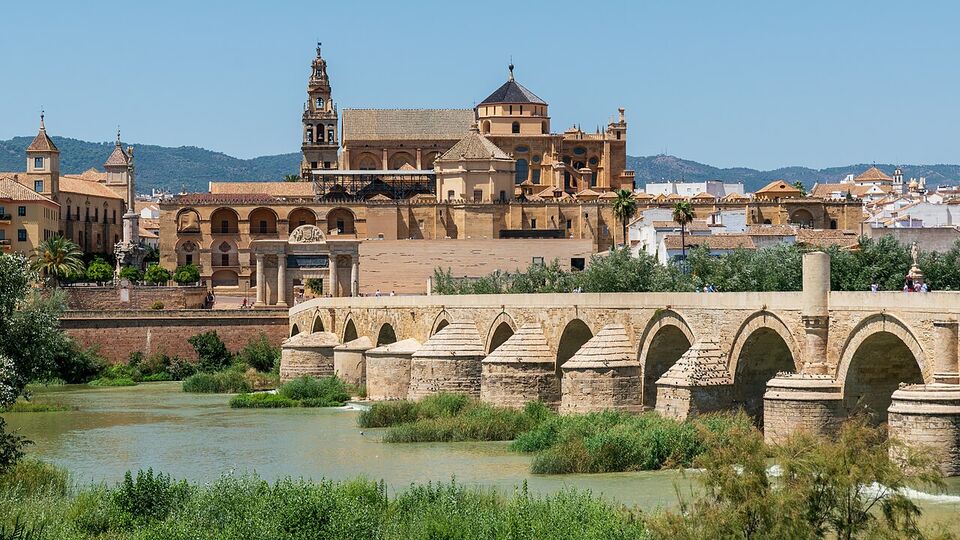
Overview
Around the year 1000, Córdoba was one of the largest and most sophisticated cities in Europe, capital of the Caliphate of Córdoba, with paved streets, public baths, libraries and a mosque that rivaled any in the Islamic world. The philosophers Averroes and Maimonides were born here, as was the Roman writer Seneca a thousand years earlier. Today it is a small, walkable provincial capital of about 320,000 people, and its old center is a UNESCO World Heritage Site.
Most visitors come for one building, the Mezquita-Catedral, and it justifies the trip on its own. But the city rewards more time: the whitewashed lanes of the Judería (the old Jewish quarter), the Alcázar's gardens, the Roman bridge at sunset, the patios full of flowerpots and the caliphs' ruined palace city of Medina Azahara just outside town.
Córdoba sits between Seville, Granada and Málaga on the high-speed line from Madrid, which makes it the easiest stop on any Andalusia trip. Many people see it as a day trip from Seville, which works. A single night is better: the day-trippers leave by 6 p.m., the lanes go quiet, and you can walk into the Mezquita for free the next morning.
The Mezquita-Catedral
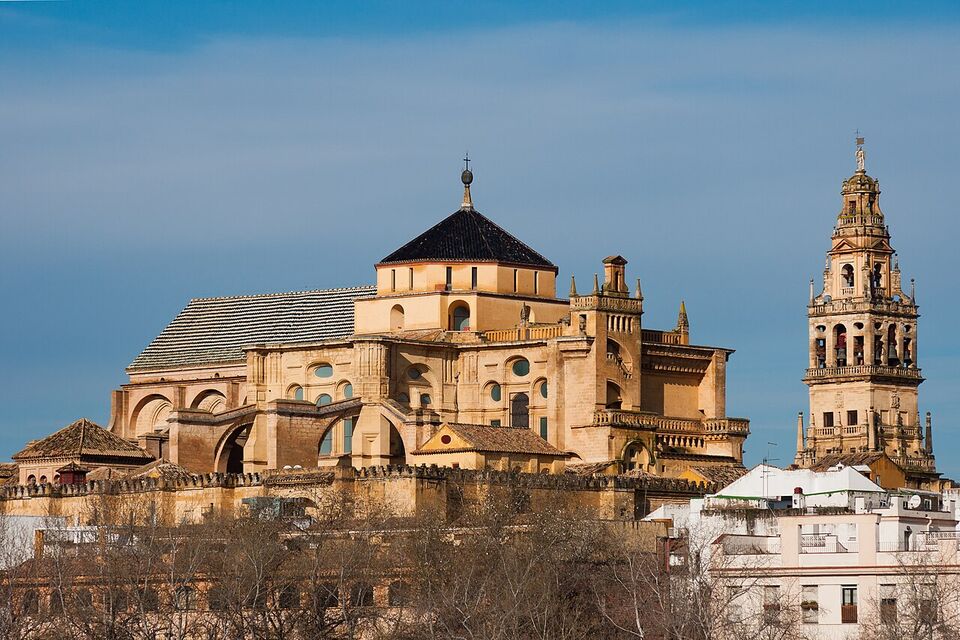
The Great Mosque was begun in 785 by Abd al-Rahman I, the Umayyad prince who escaped Damascus and founded an emirate in Spain, and was enlarged three times over the next two centuries. The result is a forest of some 850 columns of marble, jasper and granite, many reused from Roman and Visigothic buildings, holding up double arches striped in red brick and white stone. At the far end, the mihrab (prayer niche) of the 960s glitters with gold Byzantine mosaics sent by the emperor in Constantinople.
After Ferdinand III of Castile took the city in 1236, the mosque became a cathedral. In the 1500s a soaring Renaissance and Baroque cathedral nave was built right through the middle of it, which is why the building is now called the Mezquita-Catedral. Walking from the dim arches into the bright choir is one of the strangest and most memorable experiences in Spain. Plan 1 hour 30 minutes to 2 hours.
Tickets and hours
| Ticket | Price | Notes |
|---|---|---|
| Mezquita-Catedral, general | €15 (about $17) | Online or at the Patio de San Eulogio ticket office |
| Reduced | €12 (about $13) | Over 65 and students 15–26, with ID |
| Children 10–14 | €8 (about $9) | Under 10 free |
| Free early hour | Free | Monday–Saturday 8:30–9:30 a.m., individual visitors only |
| Bell tower (Torre Campanario) | €4 (about $4.50) | Timed climbs about every 30 minutes; small groups |
| Night visit, El Alma de Córdoba | €25 (about $28) | Reduced €18 (about $20) for over 65, students and children 7 and up; not every night |
Opening hours vary by day and by the church calendar. On Sundays and holy days the building closes from late morning to mid-afternoon for Mass (on Sunday, November 1, 2026, for example, visits ran 8:30 to 11:30 a.m. and 3 to 6 p.m.). Ticket sales and entry stop 30 minutes before closing. Check the day's hours and buy tickets on the official site, mezquita-catedraldecordoba.es.
Save money
From Monday to Saturday, entry is free from 8:30 to 9:30 a.m., except on days with special celebrations. Groups are not allowed in that hour, so it is also the quietest time of the day. Arrive by 8:20 at the Patio de los Naranjos; staff close entry 10 minutes before 9:30 and begin clearing the building at 9:30. If you want a longer visit, buy a regular ticket for later in the day.
The bell tower was built around the old minaret and gives the best view of the Mezquita's roofs, the Judería and the Guadalquivir. The climb is steep and narrow and not suitable for people with mobility problems. The night visit is a sound-and-light tour through the dark prayer hall, and it sells out on spring and fall weekends.
In August 2025 a fire broke out in one corner of the building, damaging part of a chapel and a column. It was put out quickly, restoration of the damaged area followed, and the building is open to visitors as usual.
Different from home
The Mezquita is a working Catholic cathedral, with daily Mass, and the Diocese runs it. Muslim prayer inside is not permitted. Dress as for any church (shoulders and knees covered is safest), keep your voice down, and don't expect a museum-style visit with a full story of its Islamic past; read up before you go or book a guide.
The Judería and the old town
The lanes north and west of the Mezquita are the Judería, the medieval Jewish quarter. Córdoba's Jewish community was among the most important in Spain until the riots of 1391 and the expulsion of 1492. Walk Calle Judíos to the Synagogue, built in 1315 and one of only three medieval synagogues surviving in Spain (the other two are in Toledo). Its single prayer room has Hebrew inscriptions carved in plaster. Entry is free or costs very little; it is closed on Mondays.
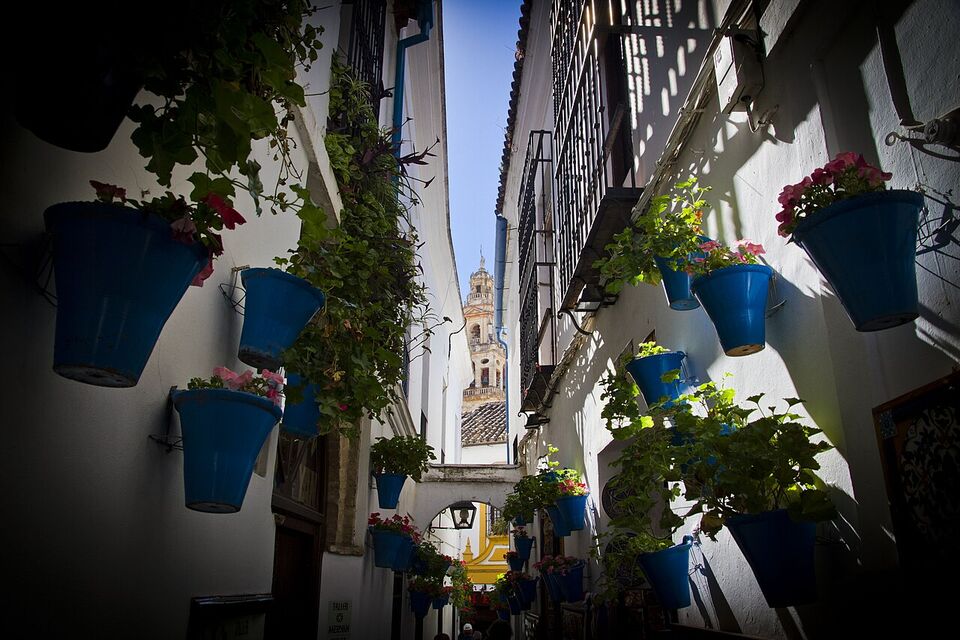
Nearby, the Casa de Sefarad is a small private museum on Sephardic Jewish life, music and food, and a statue of Maimonides sits in the little Plaza de Tiberíades. Just east of the Mezquita, the tiny Calleja de las Flores frames the bell tower between walls of geraniums. It takes a minute to see and is very crowded at midday.
Insider tip
The Judería empties remarkably early. After 7 p.m. in spring and fall you can wander the lanes almost alone, and the Mezquita's walls are lit after dark. That is the best argument for staying one night.
The Roman bridge and the river
The Roman bridge, rebuilt many times since the first century, crosses the Guadalquivir from the Puerta del Puente gate to the Torre de la Calahorra, a fortified tower that now holds a museum on life in al-Andalus. Walk across at sunset for the classic view of the Mezquita over the river. Game of Thrones fans will know it as the Long Bridge of Volantis.
More sights
Alcázar de los Reyes Cristianos
The fortress-palace of the Christian kings, where Ferdinand and Isabella met Columbus before his first voyage. Roman mosaics inside, but the terraced gardens with pools and cypresses are the star. Closed Mondays; go first thing or late in the day in summer.
Palacio de Viana
An aristocratic palace with 12 courtyards, each planted differently, open year round. The easiest way to see Córdoba's patio tradition outside May.
Roman temple and Plaza de la Corredera
The standing columns of a first-century Roman temple, then the 17th-century arcaded square of the Corredera, once used for bullfights and now lined with café terraces.
The Fernandine churches
About a dozen churches built after the Christian conquest of 1236, often on the sites of mosques, mixing Gothic and Moorish styles. A combined route is sold through the Mezquita's ticket site.
Caliphal baths
The excavated bathhouse of the caliphs' palace, with its star-shaped skylights, next to the Alcázar. A quick, cool stop on a hot day.
Córdoba's markets and Tendillas
The Plaza de las Tendillas, with its flamenco-guitar clock chimes, and the shopping streets around it are where Cordobeses actually live and shop. A good break from the monuments.
Medina Azahara
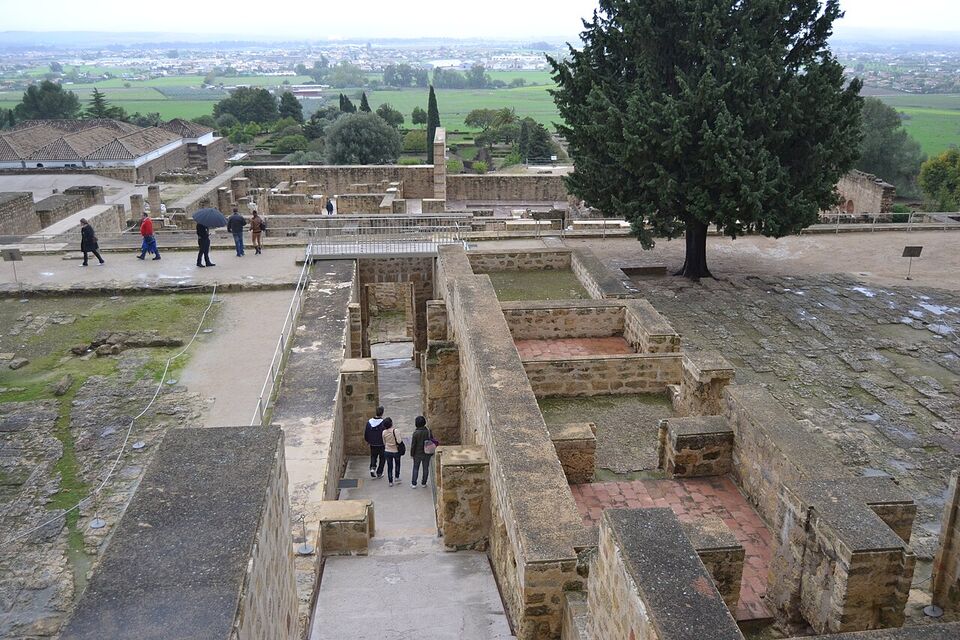
About 5 miles (8 km) west of the city, Medina Azahara (Madinat al-Zahra) was the palace city built from 936 by Abd al-Rahman III, who had declared himself caliph. It was the seat of government for a few decades before being sacked in civil wars around 1010 and lost for centuries. Excavations have uncovered only a part of it, including the reconstructed Hall of Abd al-Rahman III with its carved stone. It was added to the UNESCO World Heritage list in 2018.
Start at the modern museum and visitor center, which explains the site, then take the shuttle bus up to the ruins. Plan 2 to 3 hours. Entry is free for EU citizens and costs a token fee for others; the site is closed on Mondays. Without a car, take a guided tour or the tourist bus that runs from the city center on most days; check the Junta de Andalucía's site for current times. In summer, go at opening time, since there is almost no shade.
The patios and May festivals
May is Córdoba's month. The city's houses are built around inner courtyards, and families fill them with hundreds of potted geraniums, carnations and jasmine. During the Fiesta de los Patios, usually the first two weeks of May, several dozen private patios open to the public for free, and the city holds a competition for the best. The festival is on UNESCO's list of intangible cultural heritage. The city publishes a map of open patios and their hours each year; the San Basilio and Santa Marina neighborhoods have the densest clusters.
May also brings the Cruces de Mayo (early May), when neighborhood associations build flower-covered crosses in the squares with bars beside them, and the Feria de Mayo at the end of the month, Córdoba's version of the Seville fair but with open public tents. Check the 2027 dates on the city's tourism site when they are announced, usually early in the year, and book hotels well in advance.
Watch out
Lines for the most famous patios can reach an hour on May weekends, and many patios close at midday. Go on a weekday, start at 11 a.m. or after 6 p.m., and don't try to see more than a dozen. Respect the owners: these are private homes, and they ask you not to touch the plants.
Eating in Córdoba
Córdoba's food is simple, hearty and cheap by Spanish standards. Meal times follow the Andalusian pattern: lunch from about 2 to 4 p.m., dinner from 9 p.m. The traditional tabernas, old bars often with a patio at the back, serve tapas and half or full portions (media ración, ración) for sharing.
What to order
- Salmorejo: Córdoba's cold tomato and bread soup, thicker than gazpacho, topped with chopped egg and ham.
- Flamenquín: pork loin rolled around ham, breaded and fried, usually served with fries.
- Rabo de toro: oxtail slow-cooked in red wine, the city's signature stew.
- Berenjenas con miel: fried eggplant drizzled with cane molasses.
- Caracoles: snails in a spicy broth, sold from street stands in spring.
- Pastel cordobés: a puff-pastry cake filled with candied squash, for dessert.
Drink the local wine: Montilla-Moriles, made about 30 miles (50 km) south of the city, produces dry fino and nutty amontillado similar to sherry, and the sticky-sweet Pedro Ximénez. Locals order it chilled with tapas. See Spanish wine and Spanish food.
Insider tip
The restaurants on the streets right around the Mezquita are the most expensive and the least local. Walk 10 minutes north to the Santa Marina and San Lorenzo neighborhoods, or around the Corredera, for tabernas full of Cordobeses, with tapas at a few euros each and mains in the $ to $$ range.
Where to stay
- The Judería, next to the Mezquita. The most atmospheric choice, with small hotels in old houses around patios. Can be touristy by day but quiet at night. Taxis cannot reach every lane, so check how close they can drop you.
- San Basilio and the Alcázar Viejo. The patio neighborhood next to the Alcázar, quieter and very pretty.
- Around the Plaza de las Tendillas. The modern center, with chain hotels, shops and a 10-minute walk to the Mezquita. Easier with a car.
- Santa Marina and San Lorenzo. Residential, local and full of tabernas, 15 to 20 minutes' walk from the Mezquita.
Most of the center is $ to $$ for a double outside May and holidays, cheaper than Seville or Granada. Prices rise sharply during the patios, the Feria and Holy Week. See where to stay in Spain.
Getting there and around
Córdoba's train station, Córdoba Central, is on the high-speed line from Madrid to Seville and Málaga, and Renfe's AVE, Iryo and Ouigo all stop here. Fastest times are normally about 1 hour 45 minutes from Madrid, 45 minutes from Seville, about 1 hour from Málaga and about 1 hour 30 minutes from Granada. After a fatal collision near Urda (Toledo) on October 28, 2026, high-speed trains between Madrid and Andalusia were suspended; Renfe stopped selling tickets on the route until December 13, 2026, though service may return sooner. Check Renfe, Iryo and Ouigo before you plan, and consider flying to Seville or Málaga or taking a long-distance bus in the meantime. Trains within Andalusia, such as Málaga–Seville, were reported running normally. Even before the collision, temporary speed limits near the city, in place since the January 2026 derailment near Adamuz, were making trains from Madrid slower than the fastest timetables.
The station is about a 25-minute walk from the Mezquita, through the modern center and the Jardines de la Victoria. City buses and taxis wait outside, and a taxi to the Judería costs only a few euros. Once in the old town, you will walk everything. There are no direct US flights; fly into Madrid, Málaga or Seville and take the train. See getting around Spain.
Watch out
Don't drive into the historic center. Access is restricted to residents and hotel guests and enforced by cameras, and the lanes of the Judería are barely wider than a car. If you arrive by car on an Andalusia road trip, ask your hotel where to park, or use a public garage on the edge of the old town.
Heat and when to visit
Córdoba is regularly the hottest city in Spain. In July and August, afternoon highs often pass 104°F (40°C), and the stone streets hold the heat well into the night. If you come in summer, see the Mezquita at 8:30 a.m., retreat indoors from 2 to 7 p.m., and go out again in the evening. The Alcázar and some museums keep shorter morning hours in high summer.
The best months are March to May, with orange blossom in March and the patios in May, and October to November. Winter is mild and quiet, with highs in the upper 50s to low 60s°F (14–17°C), the cheapest hotels and the emptiest Mezquita. See when to go and the November page.
How long to stay
- Day trip
The essentials
Arrive by 10 a.m. Mezquita-Catedral and bell tower in the morning, lunch in a taberna, then the Judería, the Synagogue and the Alcázar's gardens. Walk the Roman bridge before the train back.
- One night
Day 1
Arrive by lunchtime. Alcázar and the caliphal baths in the afternoon, the Judería and the Roman bridge at sunset, dinner in Santa Marina. Night visit to the Mezquita if it is running.
- One night
Day 2
Free hour in the Mezquita at 8:30 a.m., then the Palacio de Viana or a morning at Medina Azahara, and an afternoon train to Seville, Granada or Málaga.
With a car and an extra day, add the castle of Almodóvar del Río, about 30 minutes west, or the Montilla wine country and the hill villages of the Subbética to the south. For routes that include Córdoba, see planning your trip and all destinations.
Add it to a route in the trip builder, or ask us to plan the hotels, trains and guides for you.