Overview
Madrid is the capital that Americans tend to underrate until they arrive. It has no beach, no Gaudí and no single postcard monument, and it wins people over anyway with three of the world's great art museums, a huge park, a food culture built around standing at a bar with friends, and streets that stay full until well after midnight.
It is also the easiest base in Spain. Barajas airport has more nonstop flights from the US than any other Spanish airport, and the high-speed rail network radiates out from Madrid, so Valencia and Barcelona are normally about 1 hour 40 minutes to 3 hours away by train, Seville and Córdoba are under 3 hours when the line is running (see the warning below on Madrid–Andalusia trains), and Toledo and Segovia are under 35 minutes.
This page covers how the city works: neighborhoods, where to stay, airport transfers, transit, train stations and the daily rhythm. For the Prado, Reina Sofía, Thyssen and Royal Palace, see Madrid sights. For tapas, markets, cocido and flamenco, see Madrid food. For Toledo, Segovia, Ávila and El Escorial, see day trips from Madrid. Deciding between the two big cities? Read Madrid vs Barcelona.
Different from home
Madrid runs about three hours later than an American city. Lunch is the main meal, served from about 2 to 4 pm. Dinner starts at 9 pm and restaurants are still filling at 10:30. The upside is that museums and shops are quiet first thing in the morning, when locals are at work.
How the city fits together
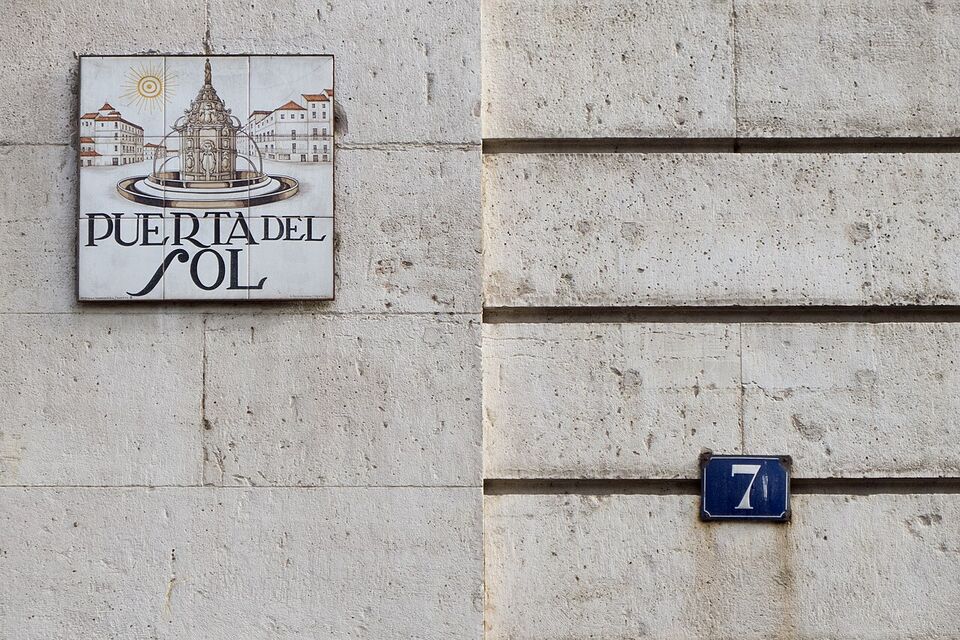
Almost everything a visitor needs sits inside a rectangle about 2.5 miles (4 km) across. At its center is the Puerta del Sol, the half-moon plaza with the clock that Spaniards watch on New Year's Eve and the "Kilómetro Cero" plaque from which national road distances are measured.
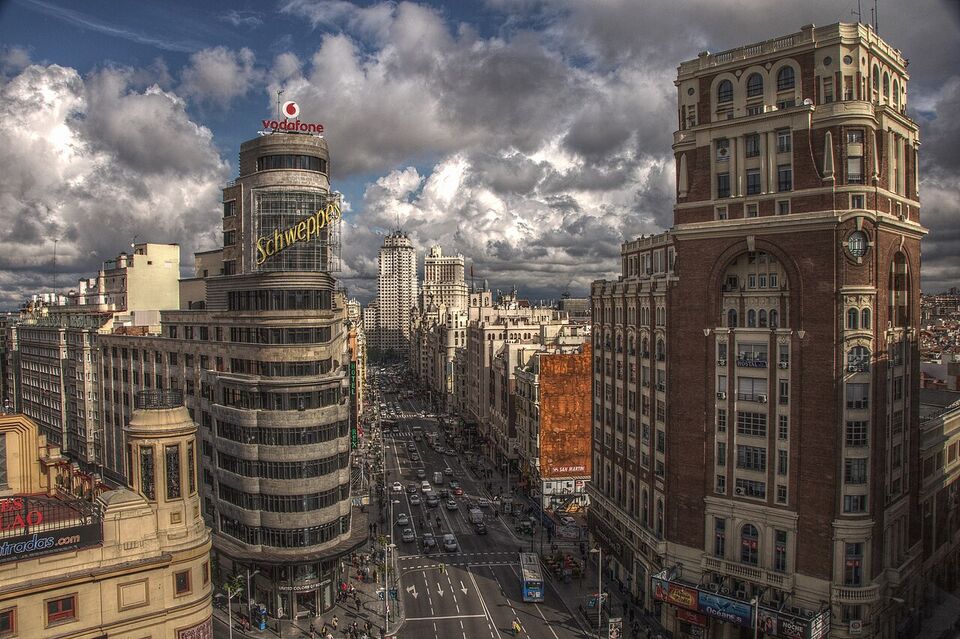
West of Sol, the oldest part of town, the Madrid de los Austrias (Habsburg Madrid), runs down past the Plaza Mayor to the Royal Palace and the cathedral. South of it, La Latina and Lavapiés tumble downhill. East of Sol, the Barrio de las Letras slopes down to the Paseo del Prado, the tree-lined boulevard with the Prado, Thyssen and Reina Sofía, with the Retiro park beyond. North of Sol, the Gran Vía cuts across town, a 1910s–1930s avenue of theaters, chain stores and rooftop bars, with Malasaña and Chueca just above it.
The Paseo del Prado and the Retiro were listed together as a UNESCO World Heritage Site in 2021, under the name "Landscape of Light". The Castellana, the long north–south avenue that continues the Paseo del Prado, leads to the business district, the Santiago Bernabéu stadium and Chamartín station.
Neighborhoods
Madrileños identify with their barrio (neighborhood). These are the ones you will spend time in or might sleep in.
Sol and Centro
The Puerta del Sol, the pedestrian shopping streets of Preciados and Carmen, and the Plaza Mayor. You can walk to the Prado, the palace and most tapas areas. It is crowded, touristy and loud at night, and it is the main hunting ground for pickpockets, so keep your bag zipped and in front.
Madrid de los Austrias and Palacio
The 16th- and 17th-century streets between the Plaza Mayor and the Royal Palace, with the Plaza de la Villa, convents and the Plaza de Oriente facing the palace. Quieter than Sol and lovely in the evening. Metro at Ópera.
Barrio de las Letras (Huertas)
Named for the writers who lived here (Cervantes, Lope de Vega, Quevedo), with lines of their work set in brass in the paving. Plaza Santa Ana is full of bars. Five minutes' walk to the Prado and ten to Sol, which makes it the best all-round base for a first visit. Noisy on weekend nights near the plaza.
La Latina
Medieval street plan, domed churches and the Cava Baja and Cava Alta, two streets lined with tapas bars. On Sunday mornings the Rastro flea market fills the streets below, and the whole neighborhood goes out for vermouth afterward. Metro at La Latina.
Lavapiés
Steep streets, the city's most diverse population, Indian and Senegalese restaurants, alternative theaters and the Reina Sofía at its lower edge. Lively and good value. Some streets feel scruffy late at night, and the hills are steep with luggage.
Malasaña
The heart of the 1980s Movida counterculture, now vintage shops, brunch cafés, cheap bars and late nights around the Plaza del Dos de Mayo. Fun if you want to be out late; ask for an interior room if you want to sleep. Metro at Tribunal or Noviciado.
Chueca
Madrid's gay neighborhood since the 1980s, with design shops, cocktail bars, the Mercado de San Antón and the epicenter of the Pride celebrations in late June and early July. Central, walkable and welcoming to everyone.
Salamanca
A 19th-century grid of wide streets east of the Castellana, with the designer shops of Calle Serrano and Calle Ortega y Gasset, good restaurants and well-dressed locals. Calm, safe and a 15- to 25-minute walk to the Prado and the Retiro. Less atmosphere at night.
Chamberí
A residential neighborhood north of Malasaña with handsome buildings, neighborhood markets, and Calle Ponzano, one of the city's best tapas streets. Fewer visitors, good metro links, and a more local feel.
Where to stay in Madrid
First-timers do best in the Barrio de las Letras, Sol, the Austrias area or La Latina, where you can walk to the museums, the palace and the tapas bars and back to the room midafternoon. Salamanca and Chamberí are calmer bases with excellent metro links. Malasaña and Chueca suit people who want to be out late.
| Style | Typical rate for two | Best areas |
|---|---|---|
| Hostel or simple hostal (family-run guesthouse) | $ under €100 | Sol, Huertas, Lavapiés, Malasaña |
| Three-star or boutique hotel | $$ €100–200 | Huertas, La Latina, Chamberí, Chueca |
| Four-star or design hotel | $$$ €200–400 | Gran Vía, Austrias, Salamanca, Paseo del Prado |
| Five-star grand hotel | $$$$ over €400 | Paseo del Prado, Castellana, Salamanca |
The two classic grand hotels face each other across the Plaza de Neptuno by the Prado: the Mandarin Oriental Ritz, which reopened in 2021 after a long restoration, and the Palace (long known as the Westin Palace), with its glass-domed lounge. Both are $$$$. Madrid has added several new luxury hotels in the last few years, which keeps the top end competitive.
Prices peak in spring and fall, around big trade fairs at IFEMA, and on weekends when Real Madrid or Atlético play a big match. Book two to four months ahead for May, June, September and October. In July and August rates often drop, because the city empties out in the heat.
Apartments and the rental rules
- Registration numbers. Spain introduced a national registration number for short-term rentals in July 2025, but the Supreme Court struck it down in May 2026. What still counts is the regional tourist license, so look for a license or registration number from the Community of Madrid on the listing. A listing without one is a red flag.
- Madrid's crackdown. The city has tightened its rules on tourist flats in the historic center, where most new ones in residential buildings are no longer allowed, and it fines illegal operators. Rentals still exist, but a licensed hotel or hostal carries less risk of a last-minute cancellation.
- ID at check-in. Hotels and hosts must record guests' passport details for the police, so expect to show your passport and give your address.
Save money
Madrid does not charge a city tourist tax at the time of writing, unlike Barcelona and the Balearic Islands. A family-run hostal on an upper floor in Huertas or Sol often costs half the price of a hotel a block away, with simple, clean rooms. Check recent reviews for noise and air-conditioning, which matters from June to September.
For more on hotels, paradores and rentals across the country, see where to stay in Spain.
Barajas airport to town
Adolfo Suárez Madrid-Barajas (MAD) sits about 8 miles (13 km) northeast of the center. It has two separate terminal complexes: T1, T2 and T3 in one group, and T4 (with its satellite T4S) about 2 miles (3 km) away, linked by a free shuttle bus. Iberia and its oneworld partners, including American Airlines, use T4; most other airlines use T1 or T2. Check your booking. See flights for nonstops from US cities.
| Option | Time to center | Cost | Best for |
|---|---|---|---|
| Official taxi | 20–40 min | Fixed fare to anywhere inside the M-30 ring road, €33 (about $37) at last check; it is posted in the cab | Couples, families, late arrivals, luggage |
| Airport Express bus | 30–45 min | €5 (about $5.60), pay on board by card | Hotels near Cibeles, Atocha, the Prado and Huertas |
| Metro Line 8 to Nuevos Ministerios | 15–20 min to Nuevos Ministerios, then change | €4.50–€5 (about $5–5.60) including the €3 airport supplement | Salamanca, Chamberí, travelers going north |
| Cercanías commuter train (from T4 only) | About 25 min to Atocha | About €2.60 (about $3); free with a same-day long-distance Renfe ticket | Connecting straight to a train at Atocha or Chamartín |
| Uber, Cabify, Bolt | 20–40 min | Varies with demand, often €25–40 (about $28–45) | Groups, if the app beats the taxi fare |
The details that matter
- The taxi fare is fixed in both directions, at any hour, with luggage, for any address inside the M-30 (which covers every neighborhood on this page). Use the official white taxis with a red diagonal stripe on the door at the rank outside arrivals. Drivers must accept cards.
- The Airport Express bus runs 24 hours a day. By day it goes from the terminals to O'Donnell, Cibeles and Atocha station; late at night it stops short at Cibeles. It leaves every 15 to 20 minutes by day and about every 35 minutes at night.
- Metro Line 8 stops at both terminal groups. You pay a €3 airport supplement on top of the regular fare, unless you hold a Tourist Travel Pass, which includes it. A 10-trip card does not cover the supplement, so you add it at the machine.
- The Cercanías C1 leaves from the station under T4 only, with trains about every 30 minutes. If you have a long-distance or AVE ticket for that day, you can print a free connecting ticket (the Combinado Cercanías) using the code on your ticket at the station machines.
Watch out
Ignore anyone in arrivals offering a ride. Unlicensed drivers charge far more than the fixed fare. If you take a regular taxi to an address outside the M-30, or from a train station, the meter runs, so ask the driver before you set off.
Metro, buses and transit passes
Madrid's metro is one of Europe's best: 12 numbered lines plus a short branch, clean, air-conditioned on most trains, and running from 6 am to 1:30 am. At the time of writing, part of the Line 6 circle (Laguna to Avenida de América) closes at 11 pm from Sunday to Thursday for overnight works expected to run to the end of 2026, with free replacement buses. Most visitors use it for the airport, the train stations and longer hops, and walk the rest. City buses run by EMT fill the gaps, and night buses called búhos ("owls") leave from Cibeles after midnight.
Tickets
| Ticket | Price | Notes |
|---|---|---|
| Single metro ticket, Zone A | €1.50–€2 (about $1.70–2.25) | €1.50 for up to five stations, rising 10 cents per stop to €2 for ten or more |
| 10-trip ticket (Metro, EMT buses, ML1) | €7.30 (about $8.20) | Shareable between people traveling together; tap once per person |
| Airport ticket | €4.50–€5 (about $5–5.60) | Single fare plus the €3 airport supplement |
| Tarjeta Multi (reloadable card) | €2.50 (about $2.80) | You load tickets onto it; free with a Tourist Travel Pass |
| Tourist Travel Pass | Sold for 1, 2, 3, 5 or 7 days | Unlimited travel in Zone A (the city) or Zone T (the whole Community of Madrid, including Alcalá de Henares, Aranjuez and El Escorial); includes the airport supplement |
These fares were set for 2026 and run until December 31, 2026, so check the January 2027 prices if you travel next year. Children under 4 ride free.
Save money
Do the math before buying a Tourist Travel Pass. At €7.30, the 10-trip ticket works out to 73 cents a ride, and two people can share one card. Most visitors who walk the center take two to four rides a day, so the 10-trip ticket is usually cheaper. The pass makes sense mainly if you ride a lot, or if it saves you the airport supplement and covers a day out to El Escorial or Alcalá de Henares.
How it works
- Buy a Tarjeta Multi at a metro station machine (they have English menus) or at a tobacco shop (estanco), and load a 10-trip ticket onto it. Tap it on the reader at the turnstile, and keep it handy, since the airport stations check it on the way out too.
- On EMT buses you can also tap a contactless bank card or phone for a single fare. For repeat rides on the metro, the Multi card with a 10-trip ticket is the cheaper option.
- Line 6 is a circle line; Line 1 (light blue) runs through Sol and Atocha, Line 2 (red) links Sol with the Retiro and Ópera, and Line 3 (yellow) runs from Sol to Lavapiés and Moncloa, where buses leave for El Escorial and Segovia.
- Expect maintenance closures on some lines in summer, when sections close for weeks and replacement buses run. Check Metro de Madrid's site before you rely on a line in July or August.
Taxis and ride apps
Madrid's white taxis are plentiful, metered and reasonably priced, and you can hail them on the street: a green light on the roof means free. A ride across the center usually costs €8–15 (about $9–17), with higher rates at night, on weekends and on holidays, and supplements from train stations. All taxis must accept cards.
Uber, Cabify (a Spanish company) and Bolt all operate, as do taxi-hailing apps such as FreeNow. Prices swing with demand; at busy times a street taxi often costs less. Traffic in the center is slow, so for trips under 1.5 miles (2.5 km) walking or the metro is often faster.
Madrid's train stations
Madrid is the hub of Spain's high-speed network, and three companies compete on the main routes: state-owned Renfe (AVE and its low-cost brand Avlo), Iryo and Ouigo. That competition has pushed fares down on the busiest lines, especially Madrid–Barcelona, Madrid–Valencia and Madrid–Andalusia. See getting around Spain for how to book and how the three compare.
- Puerta de Atocha – Almudena Grandes (usually just "Atocha") is at the bottom of the Paseo del Prado, a 10-minute walk from the Prado. It handles trains to Seville, Córdoba, Málaga, Granada, Toledo, Cuenca and many to Barcelona and Valencia.
- Chamartín – Clara Campoamor is in the north, about 15 minutes by Cercanías or metro from the center. It handles trains to Segovia, Valladolid, León, Asturias, Galicia and the Basque Country, and some services to Valencia and Alicante.
- The two stations are linked by Cercanías trains through a tunnel in about 10 to 15 minutes, and by Metro Line 1. Allow at least an hour if you change stations between trains.
Watch out
After a fatal collision near Urda (Toledo province) on October 28, 2026, high-speed trains between Madrid and Andalusia were suspended, and Renfe stopped selling tickets on the route until December 13, 2026, though service may return sooner. Madrid–Toledo trains kept running. Check Renfe, Iryo and Ouigo before you plan a trip to Córdoba, Seville, Málaga or Granada, and consider flying or a long-distance bus in the meantime.
Insider tip
Spanish long-distance trains have airport-style security: your bags go through an X-ray scanner before the platform. Arrive 20 to 30 minutes before departure at Atocha, where lines can build on Friday afternoons and before holidays. Boarding closes a couple of minutes before the train leaves.
The daily rhythm and seasons
Plan your days around the Madrid clock and the city gets much easier.
- Morning. A coffee and tostada (toasted bread with tomato and olive oil) at a bar counter around 8 to 10 am. Museums open at 10 am and are quietest in the first hour.
- Midday. Locals take a mid-morning snack, then lunch from 2 pm. The menú del día (set lunch, usually two courses, bread, a drink and dessert or coffee) is the best-value meal in the city on weekdays.
- Afternoon. Small shops may close from about 2 to 5 pm; big stores, chains and anything on Gran Vía stay open. The "siesta" is mostly a myth for working madrileños, though a rest at the hotel is smart in summer.
- Evening. The paseo (evening stroll), then tapas and drinks from 8 pm, dinner from 9:30 pm. Bars stay busy past midnight, and clubs do not fill until after 1 am.
- Sunday. Many shops close, though the center has broad Sunday opening rules. The Rastro flea market runs on Sunday and holiday mornings, followed by vermouth in La Latina.
Weather by season
Madrid sits on a high, dry plateau. Summer afternoons regularly reach 95°F (35°C) and heat waves can push past 104°F (40°C); nights cool off a little. Winters are sunny and cold, with highs around 50°F (10°C) and nights near freezing. Spring and fall are the sweet spots, though May and October can bring rain. August is quiet: many madrileños leave, and some family-run restaurants close for two to four weeks. See when to go and the month guides for November, December and January.
Different from home
Air-conditioning is standard in hotels but set more conservatively than in the US, and older apartments may have none. If you book a June to September stay, confirm air-conditioning in the room.
Safety and scams
Madrid is a safe city for its size, and violent crime against visitors is rare. The US State Department rates Spain at Level 2, "exercise increased caution", because of terrorism and civil unrest; see safety in Spain for the full picture. What actually affects visitors is petty theft.
- Hotspots. The Puerta del Sol, Plaza Mayor, Gran Vía, the Rastro, the Prado area, and crowded metro lines, especially Line 1, Line 2 and Line 8 to the airport. Thieves often work in teams and target phones on café tables and bags hung on chairs.
- Common tricks. Someone "helps" clean a stain off your coat, asks you to sign a petition, or presses close at metro doors. A sprig of rosemary pushed into your hand around the Plaza Mayor comes with a demand for money; keep walking.
- At night. Watch your drink in busy bars and clubs, and use licensed taxis or ride apps rather than accepting lifts.
- Protests. Marches are frequent and usually peaceful, often on weekends along the Gran Vía, Cibeles and Sol. Avoid them and expect traffic diversions.
Watch out
Keep your passport in the hotel safe and carry a photocopy or a photo of it, unless you need the original for a train ticket check or hotel check-in. Keep your phone in a front pocket on the metro. If something is stolen, report it at a police station (comisaría) for your insurance; the US Embassy on Calle Serrano helps with lost passports by appointment.
Practical details
- Money. Cards and contactless work almost everywhere, including taxis and many market stalls. Carry a little cash for tiny bars and the Rastro. When a card machine offers to charge you in dollars, choose euros. See money.
- Tipping. Round up at bars, leave a euro or two after a casual meal and 5 to 10 percent for excellent service at a sit-down restaurant. Service is not added to the bill.
- Water. Madrid's tap water, piped from the mountains to the north, is excellent. Ask for agua del grifo (tap water); restaurants must serve it free.
- Power. Type C and F sockets, 230 V. Phone and laptop chargers handle it; American hair tools usually do not. See staying connected.
- Health. Pharmacies have a green cross sign, and one in each area stays open overnight on a rota. For emergencies call 112. Medicare does not cover you abroad, so carry travel insurance. See health.
- Driving. Do not drive in central Madrid. The center is a low-emission zone with camera enforcement for non-resident cars, parking is scarce and expensive, and the metro is faster. Rent a car on your way out of the city. See driving in Spain.
How many days
Three full days covers the essentials: one for the Prado and the Retiro, one for the palace and old Madrid, one for the Reina Sofía or Thyssen and the neighborhoods. A fourth day lets you add Toledo or Segovia. If Madrid is part of a first Spain trip with Barcelona and Andalusia, see planning for routes and how long to give each city.
A simple shape for four days: old Madrid and the Royal Palace on day one, the Prado and the Retiro on day two, the Reina Sofía or Thyssen and an evening in Chueca and Malasaña on day three, and Toledo or Segovia on day four. Madrid sights has a day-by-day museum plan, and Real Madrid and Atlético fans should see football for stadium tours and tickets.
Add it to a route in the trip builder, or ask us to plan the hotels, trains and guides for you.