Is Delft worth a visit?
Yes, especially if you want a small Dutch town with canals, historic churches and craft traditions, without the crowds of Amsterdam. Delft is a place to walk, not to race through. A half day is enough for the center, and a full day adds the Royal Delft museum and a slow lunch.
It also sits in a convenient spot between The Hague and Rotterdam, so it works well as part of a day on the western side of the country. Many travelers fit it in between the two, and some use it as a base for both. For context on the whole area, see our regional guide.
The town is known for three things: its blue-and-white pottery, its connection to the painter Johannes Vermeer, and its link to the House of Orange, the Dutch royal family. All three are visible in a short walk around the market square.
Getting to Delft
From The Hague and Rotterdam
Delft is one of the easiest stops in the country. Trams run frequently between Delft and The Hague, and trains between Delft and both The Hague and Rotterdam run as often as every five minutes. The tram is slower but goes into the center of both towns, while the train is faster and stops at Delft station on the edge of the old center, a short walk from the Markt. Check the HTM and NS apps or 9292.nl for the current options.
- Tram. Best if you are staying in central The Hague. Tap in and out with a contactless Visa or Mastercard (OVpay).
- Train. Best from Rotterdam Centraal, from Den Haag Centraal or from Den Haag Hollands Spoor.
The nationwide OVpay system accepts contactless Visa and Mastercard, Apple Pay and Google Wallet, but not American Express. Tap out at the end of every train trip, because a missing check-out can lead to a charge of €33.30 (about $37) that you must reclaim. The minimum one-way train fare is €3.00 (about $3.40).
From Amsterdam and Schiphol
There is no single fixed route. Depending on the time of day, you may have a direct train or a change at a larger station. We did not retrieve official journey times, so check the NS app or 9292.nl on the day. A realistic guide is roughly an hour or a little more from Amsterdam, and a shorter ride from Schiphol. See our guide to getting around the Netherlands for how fares and tickets work, and our day trips guide for other options.
Insider tip
Delft is often described as an easy half-day add-on to The Hague. If you are short on time, do the Mauritshuis in the morning and take the tram to Delft for the afternoon, then return to Amsterdam from Delft or The Hague in the evening.
The Markt, Nieuwe Kerk and Oude Kerk
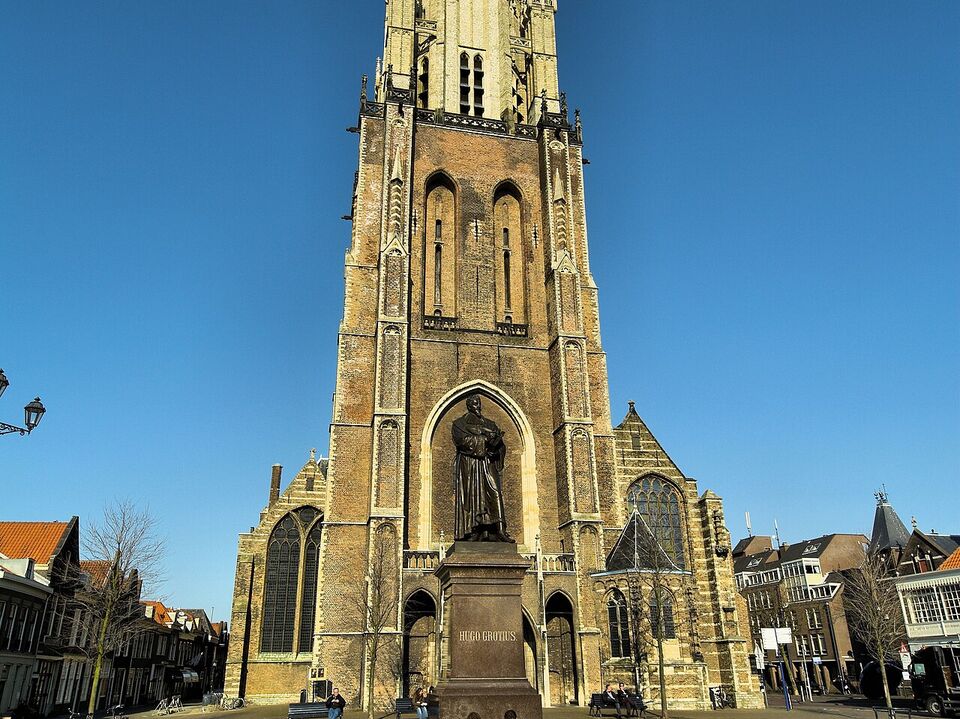
Everything starts at the Markt, a long market square with the City Hall at one end and the Nieuwe Kerk (New Church) at the other. A statue of the jurist Hugo Grotius stands near the church, and the old Waag (weigh house) is nearby. The square is the town's meeting place, with cafés and terraces around it.
The Nieuwe Kerk is "new" only by Delft standards. The two churches are long-standing landmarks of the skyline, and the Nieuwe Kerk was built between 1381 and 1496. It is the burial place of the House of Orange: William of Orange, known as William the Silent, was shot dead on July 10, 1584, at the Prinsenhof, and buried here, and the royal family has continued the tradition. You can climb its tower for views over the roofs.
The Oude Kerk (Old Church) is on a canal a few minutes' walk away and is known for its leaning tower. It dates from between 1246 and 1350, and Vermeer is buried there, according to Wikipedia. We have not confirmed what the church shows about him, so check the churches' page. You can buy a combined ticket for both churches online, at either church or at the churches' shop on the Markt (Markt 73).
Tickets and hours
| Ticket | Adult | Student (to 25) | Child 6 to 11 |
|---|---|---|---|
| Both churches | €10 (about $11) | €8 (about $9) | €4.75 (about $5) |
| Tower (Nieuwe Kerk) | €7.50 (about $8) | €5.75 (about $6) | €4.25 (about $5) |
| Churches plus tower | €15 (about $17) | €12 (about $13) | €6.50 (about $7) |
| Churches plus Vermeer Centre | €18.50 (about $21) | €11.50 (about $13) | €5 (about $6) |
Children under 6 are free for the churches and the Vermeer Centre combination, but they cannot go up the tower. Children aged 6 to 16 may climb the tower only with an adult. Backpacks and umbrellas are not allowed in the tower, and the churches do not allow food or drinks.
The churches are open Monday to Friday from 11 a.m. to 4 p.m. and on Saturday from 10 a.m. to 5 p.m. from November to January. From February to October, they are open from 10 a.m. to 5 p.m. on weekdays and Saturdays. During the Christmas holidays, hours are 10 a.m. to 5 p.m. on weekdays and Saturdays. The churches' hours list no Sunday opening. The tower closes an hour earlier than the churches, no visitors are admitted to the churches in the last 15 minutes before closing, and the tower may close in bad weather.
We found no renovation closure notice on the churches' pages as of mid-November 2026, but the pages say the churches may close for events, so check the official calendar before you go. Visitors with a Rotterdampas or Delftpas get free entry, and the churches are not part of the Museumkaart, though they offer a discount if you show one.
Watch out
Winter hours are short, and Sunday is not listed. If you plan Delft for a Sunday between November and January, check the churches' calendar first and have a backup plan for the afternoon.
The Vermeer connection
Johannes Vermeer lived and worked in Delft in the 17th century, as did other painters of the Dutch Golden Age, including Carel Fabritius and Pieter de Hooch. The Vermeer Centre is housed in a rebuilt version of the Guild House of St. Luke, the painters' guild. It is a good place to learn about his life and technique, but check what it displays before you go.
We make no claims here about where particular paintings hang beyond one: the Mauritshuis in The Hague names Girl with a Pearl Earring as one of its masterpieces, and it is a short trip from Delft. Our art guide and museum guide cover the other Dutch painters and museums.
Delft Blue pottery
Delft Blue (Delfts Blauw) is the blue-and-white pottery that began as the Dutch answer to imported Chinese porcelain in the 17th century. Royal Delft, also known as De Porceleyne Fles, says it has been making Delft Blue since 1653 and calls itself the oldest Delftware factory in the Netherlands. It still paints pieces by hand in Delft.
Visiting Royal Delft
Royal Delft is at Rotterdamseweg 196, a bit outside the old center. The museum is open Monday to Sunday from 9:30 a.m. to 5 p.m., and the brand store on the Markt ("The Market") is open daily from 10 a.m. to 6 p.m. The flagship store and Brasserie 1653 are open Monday to Friday from 9 a.m. to 5 p.m. We could not confirm the museum's ticket price, so check royaldelft.com before you go. Allow about 90 minutes.
How to buy genuine pieces
Delft Blue is a popular souvenir, and many shops in the center sell blue-and-white items. They are not all alike. A few simple habits help:
- Ask how it was made. A hand-painted piece should be described as such, and the maker should be able to say where it was made.
- Look underneath. Royal Delft marks its pieces, and the company publishes a guide to its date letters and hallmarks. Ask for a certificate: Royal Delft says every ceramic product ships with a certificate of authenticity.
- Compare prices. On Royal Delft's own webshop in November 2026, everyday pieces such as mugs started around €22.95 (about $26), dinner plates ran up to about €49.95 (about $56), and hand-painted collector pieces started around €419 (about $469) for a herring dish. Very low prices for large pieces are a warning sign.
- Be wary of unmarked stock. Some souvenir shops mix handmade, printed and imported pieces. If a seller cannot explain the difference, buy something else.
Save money
If you want a modest Delft Blue souvenir, a single hand-painted tile or small dish from a known maker can be a better choice than a cheap set of unknown origin. Everyday-line pieces at Royal Delft are designed for use and cost far less than hand-painted ones. Pack fragile items in your carry-on, and check with your airline about size limits.
Canals and the small-scale walk
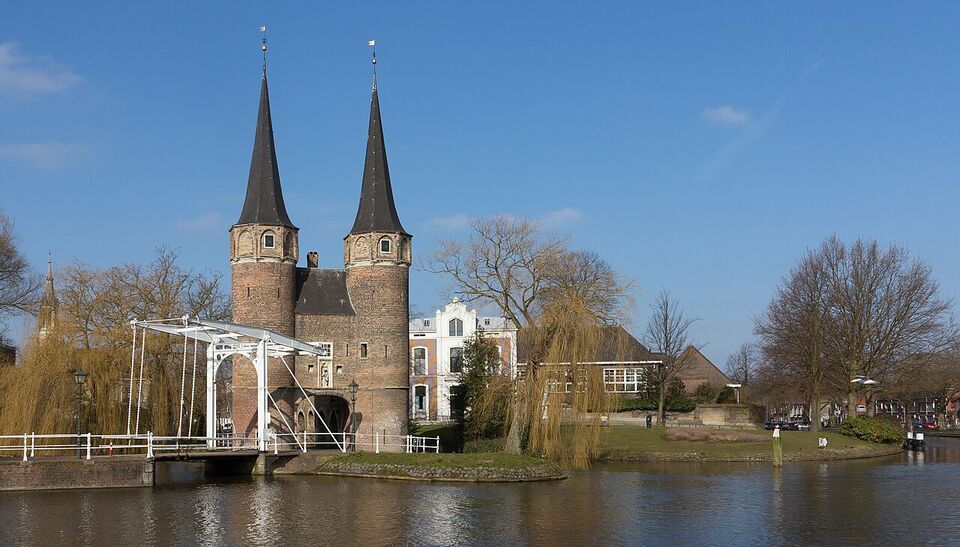
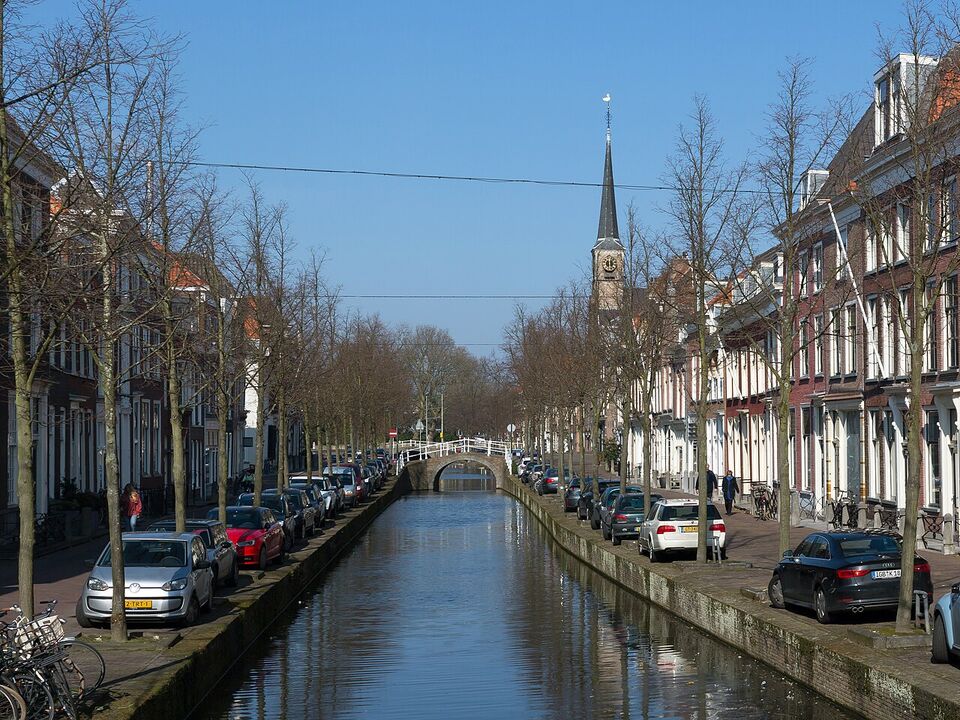
The old center is small, and a walking loop of about an hour takes in the main canals, the churches and the market square. The Oude Delft canal is the town's main waterway, and the Gemeenlandshuis Delfland, a building from 1505 that has housed the regional water authority since 1645, stands on it. The Oostpoort (Eastern Gate), built around 1400, is the only remaining gate of the old city walls.
Delft has a history of disaster that shaped the center. A great fire destroyed much of the city in 1536. On October 12, 1654, a gunpowder store exploded in the "Delft Thunderclap," destroying a large part of the city; the blast was heard on the island of Texel, some 70 miles (110 km) away. The Kruithuis, a gunpowder store built in 1660 on the water of the Delftse Schie, was built afterwards for public safety.
Windmill De Roos, a tower mill built around 1760 and restored to working order in 2013, is one of the few mills in the city. If you like windmills, our windmill guide lists larger sites, and our day trips guide shows how to reach them.
A short walking route
- Start at the Markt and look at the City Hall and the Nieuwe Kerk.
- Walk to the Oude Kerk along the canals.
- Follow the Oude Delft canal to the Gemeenlandshuis.
- Continue to the Oostpoort and back along the outer canal.
Student life in Delft
Delft University of Technology (TU Delft) was founded in 1842 as an academy for civil engineering. As of December 2025 it had 26,502 students, which is a lot for a town of this size. In term time you will see bikes parked along the canals, students in the cafés around the squares and a youthful feel in the evenings.
That has practical effects. Students tend to keep the cafés busy in term time, and rooms can be harder to find around busy university periods, so book early if you visit then. The Delft Science Center also draws children and adults to hands-on exhibits.
William of Orange and the Prinsenhof
Delft's link to the royal family begins with William of Orange, nicknamed William the Silent. In 1572, at the height of the Eighty Years' War against Spanish rule, he took up residence in a former convent that became known as the Prinsenhof. Delft had city walls and was one of the leading towns in the region, so it served as his headquarters, and for a time it was the de facto capital of the new Dutch Republic.
He was shot dead in the hall of the Prinsenhof on July 10, 1584. The Prinsenhof is now a museum, and Dutch history lessons start here. Because the family's traditional burial place in Breda was then in Spanish hands, William was buried in the Nieuwe Kerk, which began a tradition that continues in the House of Orange. We have not verified current Prinsenhof hours or prices, so check the museum's own site if you want to add it.
Science, technology and the university
Delft's story is not only about art and royalty. The town was home to Antonie van Leeuwenhoek, a pioneer of microscopy, and to the microbiologist Martinus Beijerinck, and the university continues the tradition in engineering and water management. If you travel with teenagers or anyone who likes how things work, the Delft Science Center and a walk through the university campus area add variety to a day of churches and pottery.
When to visit and what to wear
Delft works in all seasons because its sights are indoors or short walks. In mid-November, daylight in this part of the country lasts about 8 hours 49 minutes, from around 8 a.m. to 4:50 p.m., and in mid-December about 7 hours 44 minutes, so plan outdoor walking in the morning and keep the churches for the afternoon. In summer, evenings stay light until after 9 p.m., which makes terrace dinners easy. Rain is possible in every month, so carry a light waterproof jacket. For help choosing a month, see our when to go guide.
Where to eat
Delft is a good place to eat simply. Around the Markt and the Beestenmarkt (another square) you will find cafés, brown cafés, pancake houses and international restaurants. Expect koffie and appeltaart (apple pie) in the afternoon, and a plate of bitterballen with a drink in the evening. Menus and prices vary, so check ahead if you have dietary needs. For more ideas, see our guide to Dutch food.
Weekly markets on the Markt and nearby streets are common in Dutch towns. Check Delft's tourist information for market days and times, which we have not verified.
One day in Delft, with options
- Morning
Markt and Nieuwe Kerk
Arrive by about 10 a.m., have coffee on the Markt, then visit the Nieuwe Kerk and, if the weather is clear, climb the tower.
- Midday
Oude Kerk and the canals
Walk to the Oude Kerk, then take the canal loop above. Have lunch in a café near the canals.
- Afternoon
Royal Delft
Walk or take a short ride to Royal Delft for the museum and the shops.
- Evening
Dinner and the canals at dusk
Stay for dinner. The center is calm after the day visitors leave.
Combos with The Hague and Rotterdam
- Delft and The Hague. Spend the morning at the Mauritshuis in The Hague, then take the tram to Delft for the afternoon.
- Delft and Rotterdam. Visit Delft in the morning and go on to Rotterdam for the Markthal and the harbor. Trains between them run as often as every five minutes.
- A night in Delft. Use Delft as a base and day-trip to both cities. It is calmer than Amsterdam, but compare live prices, because it is not always cheaper.
Leiden is the next stop north on the same rail corridor and pairs well with Delft on a second day.
Where to stay in Delft
Delft offers a few kinds of stays. Rooms in or near the old center suit most visitors because you can walk everywhere. Options near the station are convenient for trains. Hotel tiers: $ is under $120 for a double, $$ is $120 to $300 and $$$ is over $300. Check live prices, because rates vary by season and by university events.
Hotel room VAT rose from 9% to 21% on January 1, 2026, and municipalities add their own tourist tax. The average municipal tourist tax in the Netherlands was €4.54 (about $5) per night in 2026, but we do not have Delft's own rate, so check the total price before booking. Our where to stay guide has more on choosing a base.
Parking in the center is paid and expensive, so use the train or tram if you can. Cycling is common, and our cycling guide explains the basic rules.
Practical tips
- Check the church calendar for closures, and note that no Sunday hours are listed.
- Carry a contactless card for trams and trains.
- Ask how any Delft Blue piece was made, and ask for a certificate.
- Bring a rain jacket: showers can pass quickly.
- Book hotels early around busy university periods.
For emergencies in the Netherlands, call 112. See our safety guide for more.
Add it to a route in the trip builder, or ask us to plan the hotels, trains and guides for you.