Overview
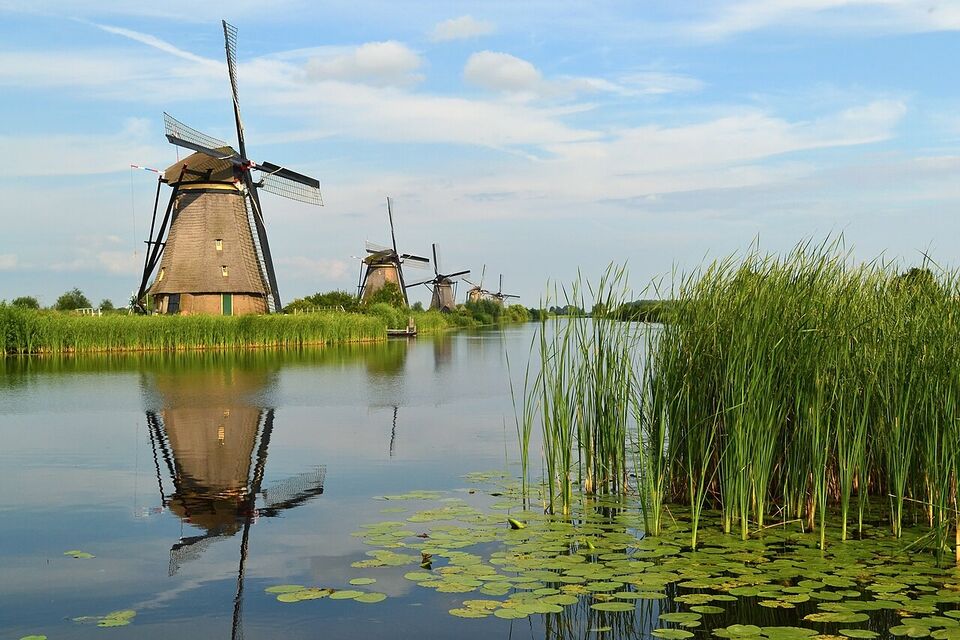
If you want one windmill day trip from Amsterdam, go to Zaanse Schans: it is about 20 minutes by train, free to walk around, and packed with working mills. If you want the postcard Dutch landscape (a row of mills along a canal in the fields), go to Kinderdijk, a UNESCO World Heritage site near Rotterdam. They are different experiences, and you can see both in two days.
The Netherlands once had thousands of windmills, and most of them did work: pumping water off low land, grinding grain, pressing oil, sawing timber, making paint and mustard. Only a fraction survive, and a smaller number work for visitors. This guide explains what the mills did, how to tell them apart, how to reach the main sites, what each costs, and how touristy each really is. It also covers lesser-known mills in Schiedam, Leiden, Haarlem and Delft, and ways to combine mills with cycling.
Most of these places are easy to reach without a car. For the bigger picture of trains and tickets, see Getting Around the Netherlands. If you are planning a full day trip loop, see Day Trips from Amsterdam. For spring combinations with tulips, see Tulips and Keukenhof.
What windmills did, and how water management works
Much of the Netherlands sits at or below sea level. The Dutch kept land dry with dikes, ditches and pumps, and from around the 13th century windmills began to pump water out of low areas. Mills later drained whole lakes, creating the flat farmland called polders (polder, land reclaimed from water). Local public bodies called water boards (waterschappen) still manage this water today and have existed for centuries.
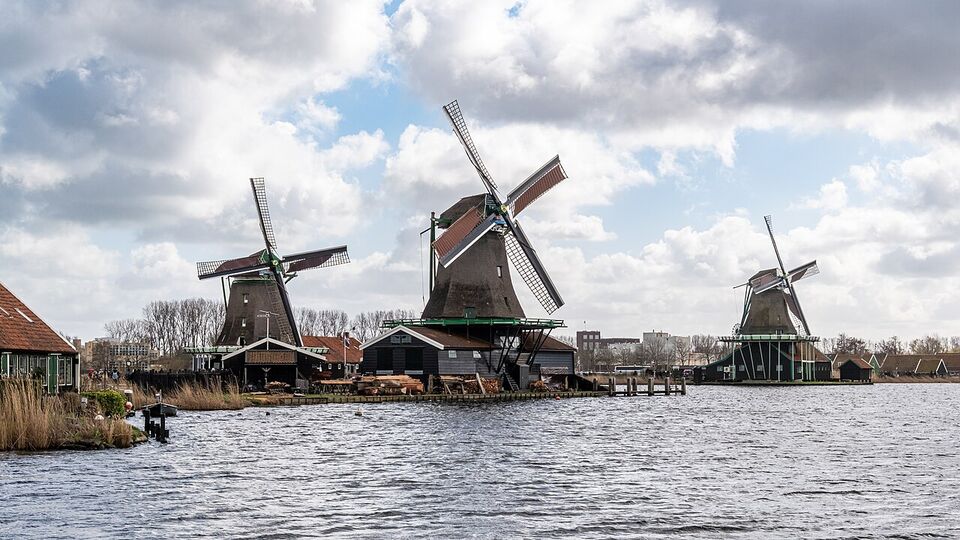
Not every mill pumped water. In the Zaan region north of Amsterdam, industrial mills turned wind into power for factories. A mill might press oil from seeds, saw logs into boards, grind pigments for paint, or crush spices for mustard. At Zaanse Schans the official site describes a spice mill, paint mill, oil mills and sawmills, which gives you a quick view of the variety.
How to tell the types apart
- Drainage (polder) mills: usually standing beside a canal or ditch in open fields. Kinderdijk is the classic example, with mills lined up along the water.
- Industrial mills: clustered near towns and waterways, often taller and with several floors inside. Zaanse Schans is the best-known group.
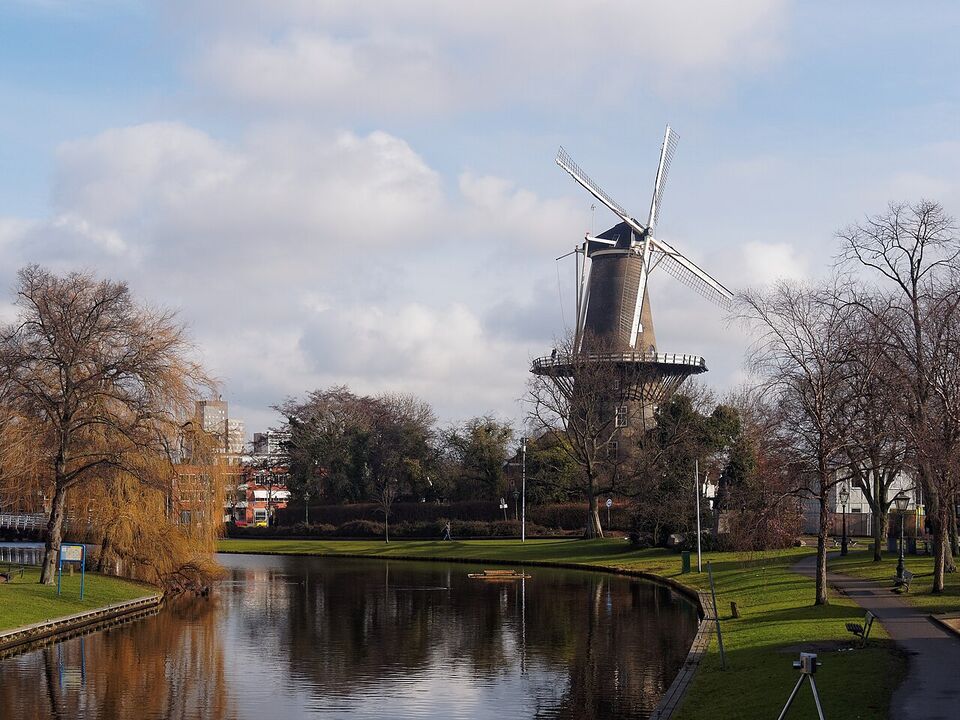
- Corn (grain) mills: often in towns, such as Leiden's De Valk, now a museum.
- Body shape: a round stone or brick base is a tower mill, an eight-sided wooden body is a smock mill, and a wooden box balanced on a central post is a post mill. In most smock and tower mills only the cap with the sails turns toward the wind.
Zaanse Schans
Zaanse Schans is a preserved neighborhood on the Zaan river, with wooden houses, craft workshops, shops, restaurants, three museums you can visit free every day and a cluster of working windmills. It is a residential and working area, not a theme park, a point its own site makes. People live here.
What is free and what costs money
The official site says the village is free to enter 365 days a year, with no entrance fee and no need for a "Zaanse Schans ticket." The windmills and some museums charge, so you buy at each. Museums are free with a Museumkaart or an I amsterdam City Card, though the mills are not free for Museumkaart holders. The village includes many free things: shops, restaurants, several craft centers, and walking paths.
The municipality of Zaanstad discussed a €17.50 (about $20) tourist charge in 2025, planned for 2026, and opponents asked for a referendum. The official site, read on November 13, 2026, still says entry is free, so we treat the charge as a proposal, not a rule. Check the site before you go, because policy here has been contested.
| What | Cost | Notes |
|---|---|---|
| Walking around the village | Free | Open every day of the year |
| Zaanse Schans Card, adult | €29.50 (about $33) | Museums, two open mills of your choice, audio tour, 10% off at one restaurant |
| Zaanse Schans Card, child 4-17 | €20 (about $22) | Groups of 10 or more: adult €26.55 (about $30), child €18 (about $20) |
| Parking (car) | €15 (about $17) a day | Card only; no hourly rate |
| Toilets | €1 (about $1.10) | Card only |
The Card covers the Zaans Museum, the Verkade Experience, the Windmill Museum, the Weaver's House, Museum Zaanse Tijd and two mills that are open on your day. Two locations (the Cooperage and the Heritage Chambres on Kalverringdijk) were temporarily closed. You swap your e-ticket for a printed flyer at an information desk and have it scanned at each stop. If you hold an I amsterdam City Card, you may not need the Zaanse Schans Card at all. Do the math before you buy.
The mills you can enter
The official site lists the mills by what they make. De Huisman cuts spices (mustard is made here), De Kat makes pigments, De Zoeker (the oldest) presses oil, Het Jonge Schaap saws logs and De Bonte Hen presses oil. Not every mill is open every day, and the site recommends checking its interactive map for hours. Most attractions are open from about 9 a.m. to 5 p.m., but not all are open daily, so go on a weekday if you want the most choices.
Getting there
There is a train station called Zaanse Schans, about 20 minutes from Amsterdam by train, with a walk to the village. Check 9292.nl or the NS app for the exact stop and the walking route. A one-day Amsterdam & Region Travel Ticket costs €23 (about $26) in 2026 and covers trains, trams and buses in the Amsterdam area, including the trip to Zaanse Schans. Compare it with a contactless card with OVpay, which charges per trip. For fares and the card rules, see the transport guide.
Driving costs €15 (about $17) a day for parking, card only, and the site says parking is limited. There is no ATM, so bring a card. Coaches pay €35, €45 or €55 depending on the season.
Different from home
Dutch attractions are often small businesses inside a residential area, so "open all day" is rare. At Zaanse Schans, most places keep roughly 9 a.m. to 5 p.m. hours, but each mill, shop and museum sets its own days. Check the day you plan to visit rather than assuming everything is open, like you might at a large US theme park.
Kinderdijk
Kinderdijk is a UNESCO World Heritage site where a group of windmills (commonly cited as 19; confirm on kinderdijk.nl) stands along the waterways of a polder. It is quieter and more open than Zaanse Schans, and it tells the story of water management more directly, because the mills still sit in the landscape they were built to drain. The site is close to Rotterdam and Dordrecht, not Amsterdam.
Tickets and what is included
An adult ticket is €21 (about $24) and a child aged 4-12 is €9 (about $10); children 0-3 are free. Buying online gives an automatic 10% discount, which brings the adult price to about €18.90 (about $21) and the child price to about €8.10 (about $9). The ticket covers the museum mills, a boat tour, the Wisboom pumping station, a bird theater, a short film and an exhibition: all the visitor locations. Opening hours were not on the page we read, which says the site is open nearly all year and points to its opening hours page. Check it before you go, especially in winter.
Getting there
- WaterShuttle from Rotterdam: about 30 minutes, and you can bring your bike on board. This is the most pleasant way to arrive.
- Bus: the site says public transport runs year-round from cities such as Dordrecht and Rotterdam, with a stop at the entrance. Bus line 489 is two stops from the camper parking.
- Car: parking is €9.75 (about $11) per car, and only with an admission ticket. From March 16 to November 1 you park at the Transferium in Alblasserdam (Kabelbaan 1) and take a free shuttle. From November 2 to mid-March the Transferium is closed and you park at the entrance (Nederwaard 1). As of mid-November 2026, the low-season arrangement applies. Campers pay €12.50 (about $14) a day.
- Bike: there are cycle paths to the entrance area and secure bike parking at the visitor center.
From Amsterdam, this is a full day: take a train to Rotterdam (check 9292.nl or the NS app for current times), then the WaterShuttle or a bus. For Rotterdam itself, see Rotterdam.
Insider tip
Go early or late. Tour groups tend to cluster in the middle of the day, and the low sun at either end gives the mills their best look. In winter, check whether the boat tour is running, because the weather affects how many things are open.
Schiedam, Leiden, Haarlem and Delft
Smaller mills sit inside historic towns, and they pair well with other sights. We could confirm only some details from sources we could read, so check each site for hours and prices.
Schiedam
Schiedam is known for a group of unusually tall mills that once ground grain for the city's gin distilleries. It is a short hop from Rotterdam by train or metro. We did not confirm opening hours or ticket prices, so check the local visitor information.
Leiden: Molen de Valk
De Valk is a corn-grinding windmill from 1743, now a museum. It is a good indoor-outdoor stop on a Leiden day. Hours and prices were not confirmed.
Haarlem: De Adriaan
This mill stands in the town center beside the water. Haarlem is 15 to 20 minutes from Amsterdam by train, with several trains an hour, which makes it an easy add-on.
Delft: De Roos
A tower mill from about 1760, restored to working order in 2013. A short stop when you are already in Delft.
For town guides, see Leiden, Haarlem and Delft.
Comparing the main sites
| Site | Style | From Amsterdam | Cost | How touristy |
|---|---|---|---|---|
| Zaanse Schans | Industrial mills, crafts, shops | About 20 minutes by train | Village free; mills and museums extra | Very. Almost 2.6 million visitors a year, according to news reports |
| Kinderdijk | Drainage mills in polder landscape | Full day via Rotterdam | €21 (about $24) adult | Moderate; busiest midday |
| Schiedam | Tall town mills | Via Rotterdam | Varies | Low |
| Leiden | Corn mill museum | Short train ride | Varies | Low to moderate |
| Haarlem | Town mill by the river | 15-20 minutes by train | Varies | Low |
The visitor figure for Zaanse Schans comes from a news report on the municipality's planning in 2025. The municipality said the site was too busy and that residents suffered parking problems. That is a good reason to arrive early on a weekday and to avoid the middle of the day in summer.
Families, accessibility and what a visit costs
Both main sites work for children, but they suit different ages. Zaanse Schans is easy for short attention spans: you can step in and out of shops, watch craftspeople, climb into a mill for ten minutes and leave. Kinderdijk is a slower outing built around a walk or bike ride and a boat tour. For a family of two adults and two children aged 4 to 12, online tickets at Kinderdijk come to about €54 (about $60) before parking, using the discounted online prices of €18.90 and €8.10. At Zaanse Schans, two adults and two children on the Card would cost €99 (about $111) at the standard prices, so the Card only pays off if you plan to see several museums.
Accessibility is mixed. The Zaanse Schans site says not all locations are reachable with a wheelchair or walker because of its 17th and 18th century buildings, though some bridges are low-threshold, there are accessible toilets at the main entrance and in the Zaans Museum, there is reserved parking, and the Zaans Museum has a few wheelchairs that you can reserve in advance by email or phone. Dogs on a leash are welcome in the village but not in every museum or shop. A free, unattended locker room at the Zaans Museum is available with a valid ticket. We did not find Kinderdijk's accessibility details, so ask the visitor center before you go if mobility is a concern. Inside the mills, expect steep ladders and narrow stairs.
What it is like inside a working mill
At a working industrial mill, expect a low, dusty, noisy interior where a guide or miller explains how the sails turn a central shaft and how gears move the machinery on each floor. You may climb steep wooden stairs, duck under beams and see the stones, saws or presses at work if the wind is up. Some mills let you step outside onto the gallery. Wear flat shoes, keep hands off moving parts and follow staff instructions. Photography is usually fine, but ask. If wind is weak, a mill may be explained rather than running, so the experience depends on the day.
Best light, crowds and seasons
The mills look best in low sun, which means the first and last hours of the day. In summer the sun rises around 5:17 a.m. in June and sets near 10 p.m., so you can start very early. In April it sets about 8:36 p.m. In December the day runs only from about 8:43 a.m. to 4:27 p.m. Plan accordingly if you visit in winter.
Weather matters for the mills themselves. Sails turn when there is enough wind, so a breezy day is best and a calm day shows motionless mills. The Amsterdam area is often windy, with about 133 days a year that bring 1 mm or more of rain (KNMI averages). Bring a waterproof layer and a hat.
- Spring (April-May): tulip season. Pair a mill stop with the bulb region, and expect more visitors.
- Summer (June-August): longest days and the busiest crowds. Go early.
- Autumn (September-October): mild light, calmer sites.
- Winter (November-March): quiet, short days, and some attractions run on reduced hours. Kinderdijk's low-season parking rules apply from November 2.
Mills and cycling
Windmill country is flat and made for bikes. From Amsterdam you can ride toward Zaanse Schans by crossing the IJ on one of the free GVB ferries from behind Centraal Station, then following signed cycle routes north. It is an easy ride for confident cyclists but takes time, so many visitors bike one way and take the train back. At Kinderdijk the WaterShuttle takes bikes from Rotterdam in about 30 minutes, and good cycle paths lead to the entrance. For rules, rentals and safety, see Cycling in the Netherlands.
Watch out
Bike lanes are for bikes, and they are fast. Americans often stop in the lane to take a photo or step into it without looking. Pull over onto the grass or a pavement area before you stop, and check both directions before crossing any red-painted path.
A one-day plan from Amsterdam
- Easy day
Zaanse Schans in the morning
Take an early train and walk the village before the tour buses arrive. Pick two mills, perhaps the paint mill and the oil mill, and add one museum. Have lunch in the village, then be back on a train by early afternoon, with time for the evening in Amsterdam.
- Longer day
Zaanse Schans plus Haarlem
Combine the mills with a late-afternoon stop in Haarlem and its riverside windmill, then return to Amsterdam by train.
- Full day
Rotterdam and Kinderdijk
Take a morning train to Rotterdam, ride the WaterShuttle to Kinderdijk, spend two to three hours at the mills and boat tour, and return by water or bus in the afternoon.
Before you go
- Check Zaanse Schans fees and individual mill opening days on zaanseschans.com.
- Buy Kinderdijk tickets online for the 10% discount and check the hours page.
- Carry a contactless card. Zaanse Schans parking and toilets are card only, and there is no ATM.
- Check the wind and weather. Calm days mean still sails.
- If you have an I amsterdam City Card, check what it covers before buying a Zaanse Schans Card.
If your trip is built around a cruise, see River Cruises for how ships handle the Kinderdijk area.
Add it to a route in the trip builder, or ask us to plan the hotels, trains and guides for you.