Is Rotterdam worth a visit?
Yes, and it rewards a different kind of traveler than Amsterdam does. Rotterdam is the Netherlands' second-largest city, with a population of about 674,000 in 2026, and Europe's largest seaport. It is a working harbor city, with cranes, container ships and a skyline of towers, not a postcard of gabled canal houses. If you want to see that side of the country, plan at least one day here.
The city is easy to reach by train from Amsterdam and Schiphol, so it works as a day trip or as a base for a night or two. It also pairs well with Delft and The Hague, which sit between Rotterdam and Amsterdam on the western edge of the country. For a wider view of the region, see our regional guide.
Why Rotterdam looks nothing like Amsterdam
On May 14, 1940, German bombers destroyed the heart of Rotterdam. About 900 people were killed and some 80,000 were left homeless, and the Dutch army surrendered the next day. The City Hall survived, and so did the shell of the Sint-Laurenskerk (St. Lawrence Church), which was later restored. Almost everything around them had to be built again.
After the war, the city chose to rebuild for the future instead of copying what was lost. The Lijnbaan, an early car-free shopping street, opened in the early 1950s. In the 1980s the city began an active architecture policy that pulled in international designers, and the result is the mix you see now: tilted cubes, a covered market hall, a swan-shaped bridge and high-rise towers along the river.
Near the Leuvehaven harbor, close to the Erasmus Bridge, stands a bronze statue called De Verwoeste Stad (The Destroyed City) by Ossip Zadkine. It shows a figure with raised arms and a hole where the heart would be, and it is the quickest way to understand what the city lost. Give it a few quiet minutes.
Different from home
Dutch cities are usually described as old and picturesque. Rotterdam is the exception, and it is proud of that. Rotterdam was rebuilt on a grand scale after disaster, and architecture is its main attraction.
Getting to Rotterdam
From Amsterdam and Schiphol
Rotterdam Centraal is connected to Amsterdam and Schiphol by direct NS trains. The exact ride time depends on which train you take, so check the NS app or 9292.nl on the day. The journey is roughly an hour or less, which is why many visitors do Rotterdam as a day trip.
One thing catches travelers out. The Intercity Direct line (Amersfoort, Amsterdam Zuid, Schiphol, Rotterdam, Breda) is faster but needs a supplement of €3.20 (about $3.60) in 2026, rising to €3.40 (about $3.80) in January 2027. It also does not stop at Amsterdam Centraal. If you are staying near Centraal, take a regular intercity train or change at Amsterdam Zuid.
Pay with a contactless Visa or Mastercard (or Apple Pay or Google Wallet) at the gates. American Express is not accepted on OVpay. A single-use paper ticket carries a €1.60 (about $1.80) surcharge in 2026, so tapping a card or buying an e-ticket in the NS app is cheaper. Always tap out at the end of the trip: if you forget, the full €33.30 (about $37) fare is charged, although it can be refunded afterwards. For more on how tickets work, see getting around the Netherlands.
From London and other European cities
Eurostar runs from London St Pancras to Rotterdam Centraal in 3 hours 13 minutes, and in the other direction in 3 hours 30 minutes, according to the Eurostar page we checked in November 2026. That makes Rotterdam a convenient first stop if you are arriving from the UK, with no need to go through Amsterdam.
By air
Rotterdam The Hague Airport is a small regional airport. Most Americans fly into Schiphol and take the train. For flight planning, see our guides to flights and Schiphol.
Getting around Rotterdam
The center is compact and flat, and walking covers most of it. Between districts, the metro, trams and buses are operated by RET, and the same OVpay contactless card works for all of them (check ret.nl for current fares, which we have not verified). Remember to tap in and out on the metro.
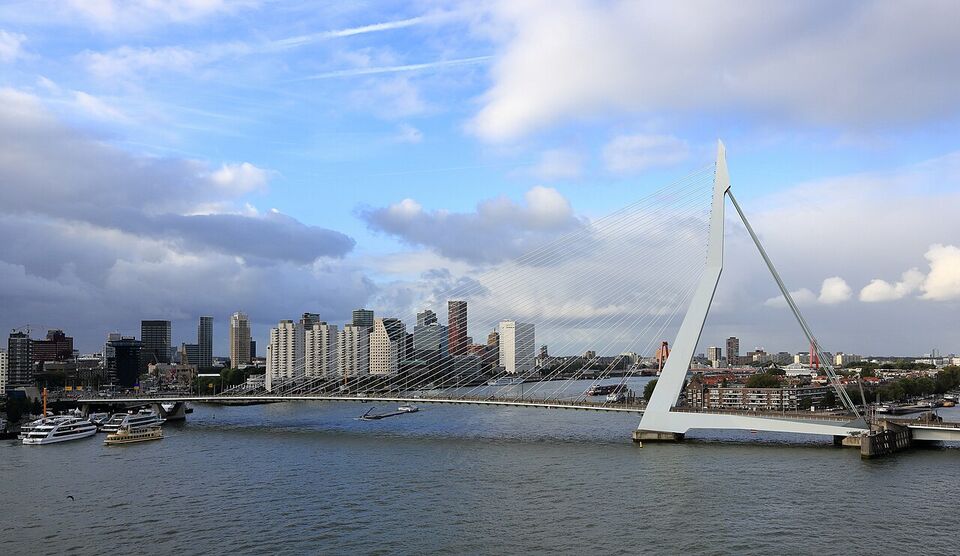
The Nieuwe Maas river splits the city into a north bank and a south bank, linked by the Erasmus Bridge, the Maastunnel and others. The Kop van Zuid district on the south bank is where much of the newest architecture stands. You can cross on foot by the Erasmus Bridge, which is the best way to see the skyline.
Cycling is common here, as everywhere in the country, and bike lanes are well marked. If you rent a bike, remember that front and back lights are required after dark, and that riding on footpaths and shopping streets is not allowed. We cover the basics in our cycling guide.
The four landmarks to see
Erasmus Bridge
The Erasmusbrug is a cable-stayed bridge held up by a single bent pylon 138 m (453 ft) tall, which earned it the nickname De Zwaan (The Swan). Walk across at dusk, when the lights come on, and look back at the skyline.
Markthal
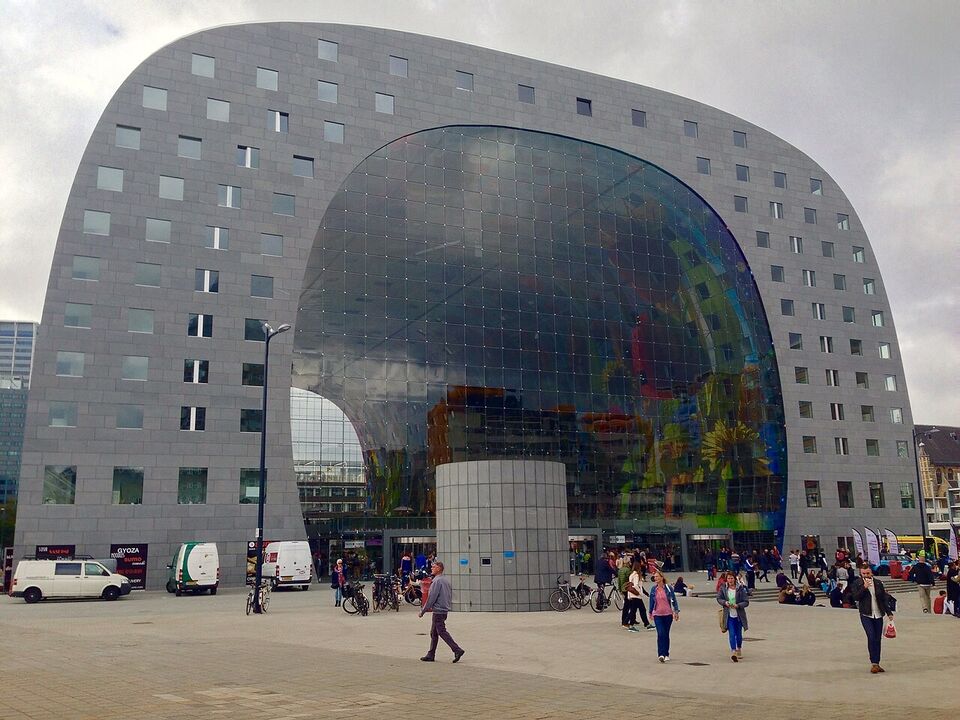
A horseshoe-shaped market hall with homes built around the outside and a huge painted ceiling inside. Its site lists more than 100 food spots, from Asian and Caribbean to Mediterranean and Dutch counters. It is a good place for lunch and a look around.
Cube Houses
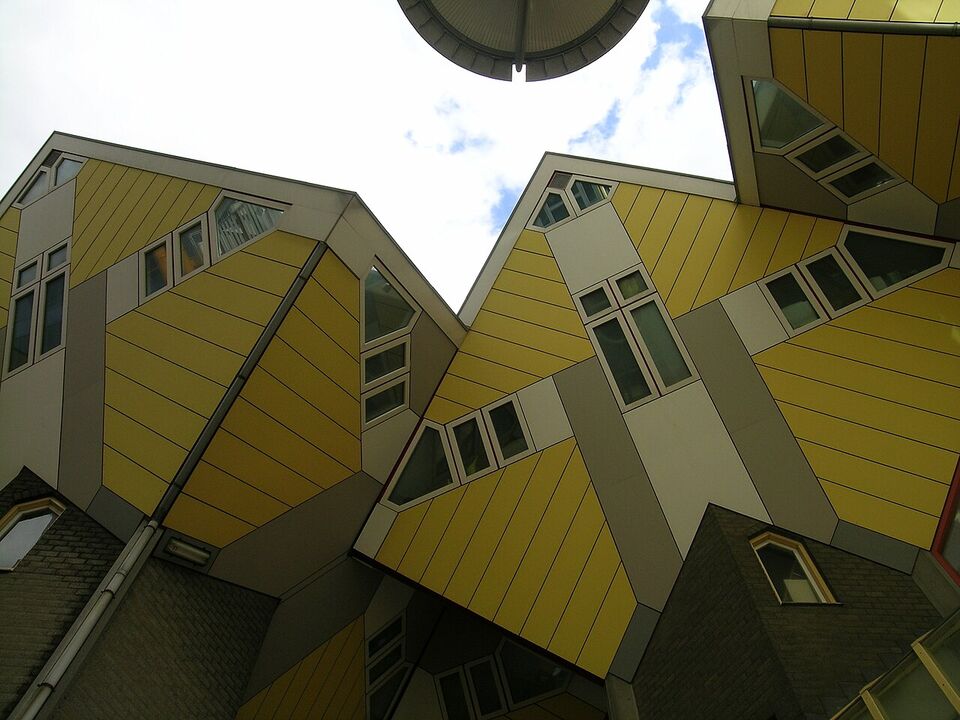
The Kubuswoningen were designed by Piet Blom and have been an icon since 1984. One cube is a show house you can walk through. Seniors 65+ and students pay €2.50 (about $2.80), children to 12 pay €1.50 (about $1.70), and under-4s are free.
Euromast
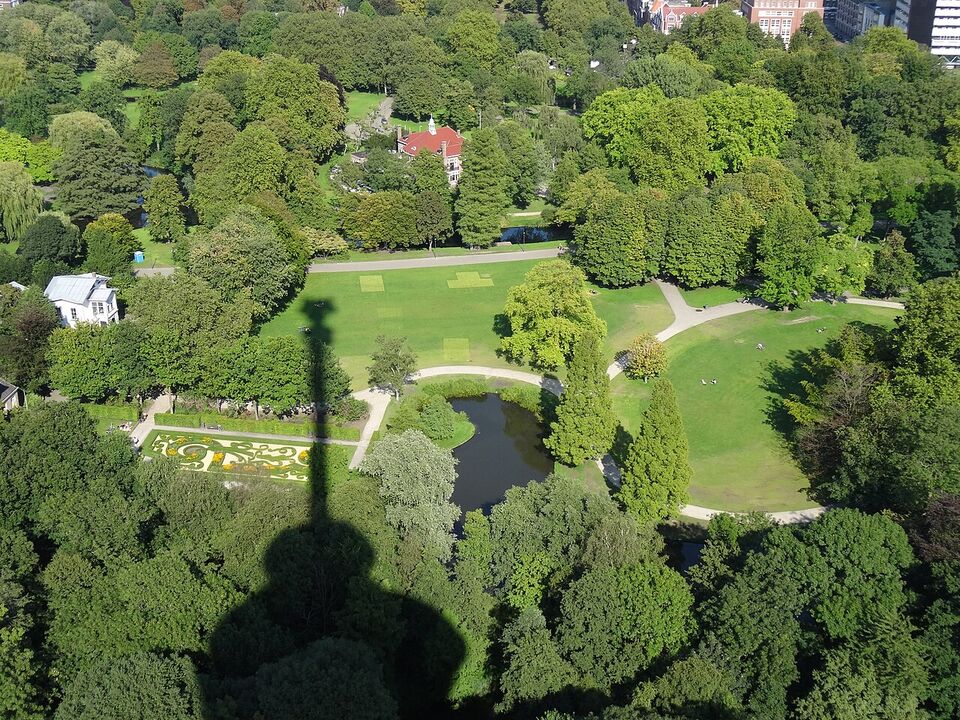
Built in 1960 for the Floriade horticultural show, the tower has observation decks at 112 m (367 ft) and a rotating glass-floored lift, the Euroscoop, rising to 185 m (607 ft). The basic ticket does not include the Euroscoop.
Markthal and Cube Houses in detail
The Markthal is open Monday to Thursday 10 a.m. to 8 p.m., Friday 10 a.m. to 9 p.m., Saturday 10 a.m. to 8 p.m. and Sunday noon to 6 p.m., although individual shops and food counters set their own hours. In December the hall turns into the Kersthal (Christmas hall) from December 5 to 27, 2026, with winter acts and festive events. Check markthal.nl before you go if you are planning around a specific stall.
The Cube Houses sit directly beside the Markthal, so see both in one stop. The show cube is open daily from 10 a.m. to 6 p.m., and may stay open until 7 p.m. in July and August. The stairs are steep and the rooms are slanted, so it is not an easy visit for anyone with mobility problems. People live in the other cubes, so keep noise down outside.
Euromast tickets
| Ticket | Standard price | Online price | What you get |
|---|---|---|---|
| General | €17.50 (about $20) | €13.50 (about $15) | The Rise of Rotterdam exhibit and decks at 112 m |
| Complete experience | €23.50 (about $26) | €19.00 (about $21) | The above plus the Euroscoop to 185 m |
| Euromast + Spido cruise | from €32.00 (about $36) | Check site | Entry plus a 75-minute harbor tour |
| Euromast + ss Rotterdam | from €31.50 (about $35) | Check site | Entry plus an audio tour of the ship |
The Euromast is open daily from 9:30 a.m. to 10 p.m., according to its site as of November 2026. The site also carries a blog post (no year shown) about a renovation, saying the tower will close its doors after Christmas, so check the official page for closed dates before you plan a visit around it. Combination prices above are "from" prices based on the adult rate.
Save money
Buy Euromast tickets online. The listed online price is €4 to €4.50 (about $4.50 to $5) lower than the standard price. If you want one view only, the free option is to walk across the Erasmus Bridge and see the skyline from the water.
The harbor and boat tours
Rotterdam's port is the point of the city, and the best way to feel its scale is from the water. Several operators run cruises past container terminals, shipyards and old harbors. The Euromast page lists a 75-minute Spido port tour as a combination option, and an amphibious Splashtours city tour that lasts 60 minutes and drives into the water, from €44 (about $49) with a Euromast ticket.
The ss Rotterdam, the largest Dutch cruise ship ever built, is kept in Rotterdam as a visitor attraction, with an audio tour (the Euromast sells a combination ticket). We have not verified current opening hours or ticket prices for it or for harbor tours alone, so check the operators' own sites for November 2026 and spring 2027 schedules.
Plan your cruise for a day when the weather is calm, and bring a windproof layer. The river is exposed, and even in summer it can be cool on the open deck. In winter, some cruises run on reduced timetables.
Delfshaven
For a look at an older Rotterdam, take the metro or tram to Delfshaven, a harbor district that sits outside the bombed core. It has a quiet old harbor, canals and gabled houses, and a long tradition of ties to the Pilgrim Fathers, who are associated with leaving from this harbor in 1620. We have not verified details on current exhibits, so check locally before you go.
Kinderdijk by WaterShuttle
Kinderdijk is a UNESCO World Heritage site with a row of historic windmills, and Rotterdam is the best starting point for a car-free visit. The WaterShuttle takes about 30 minutes each way, and you can take a bike on board. Bus line 489 is another public-transport option; from the camper parking it is two stops to the site.
| Ticket | Price | Notes |
|---|---|---|
| Adult | €21 (about $24) | 10% off when bought online, about €18.90 (about $21) |
| Child 4 to 12 | €9 (about $10) | About €8.10 (about $9) online |
| Child 0 to 3 | Free | |
| Parking, per car | €9.75 (about $11) | Only with an entry ticket |
The ticket covers the museum mills, a boat tour, the Wisboom pumping station, the bird theater, a film and an exhibition. The site is open nearly all year, but we could not retrieve the winter hours, so check the opening-hours page on kinderdijk.nl before you go. If you drive instead of taking the boat, low-season parking from November 2 to mid-March is at the entrance (Nederwaard 1). For other windmill options, see our windmill guide.
Insider tip
Buy your Kinderdijk ticket online before you board, and note your WaterShuttle return time. Timetables can be thinner outside the main season, so check the last departure, and remember that a bus is the fallback.
Museums and the museum quarter
Rotterdam's main museum cluster sits around the Museumpark, west of the center. The Museum Boijmans Van Beuningen, the Kunsthal, Het Nieuwe Instituut (architecture and design), the Natural History Museum and others are within a short walk of each other. Boijmans also runs the Depot, which opened on November 5, 2021, as the world's first fully accessible art depot, a building where the museum's stored collection can be seen. Check boijmans.nl for which buildings are open and what the tickets cost, because the main museum building has been undergoing renovation and we could not verify current details.
Other museums worth considering, depending on your taste, are the Wereldmuseum Rotterdam (world cultures), the Maritime Museum (the port and shipping), Museum Rotterdam (the city's own history) and the FENIX Museum of Migration, which opened in May 2025. We have not verified prices or hours for any of them in November 2026.
If you hold a Museumkaart, the Dutch museum pass, check each museum's list of accepted passes. Most visitors do better with single tickets, as we explain in our museum guide. A few Rotterdam museums sell timed tickets, so book ahead on busy weekends.
Food and markets
Rotterdam's food scene reflects its mix of cultures: many backgrounds, with Caribbean, Asian, Mediterranean and Middle Eastern food all easy to find. The city has a Chinatown on West-Kruiskade near the station. Expect an informal food culture, with market halls and street food more than white-tablecloth dining.
- Markthal. Its site groups food counters by region: 26 Asian, 20 Dutch, 16 Mediterranean, 6 Middle Eastern and 5 Caribbean as of November 2026. Walk the full loop before you buy.
- Weekly market. An open-air market runs near Blaak station, beside the Cube Houses. Check the days and hours locally, as we have not verified them.
Try Dutch snacks while you are here: bitterballen (deep-fried meat croquettes served with mustard), stroopwafel (a syrup waffle) and fresh haring (raw herring) from a stand if you feel adventurous. For more on what to eat across the country, see Dutch food.
Watch out
Not every restaurant takes cash, and some counters in food halls take cards only. Carry a Visa or Mastercard with contactless, and tell your bank you will be abroad. Keep valuables close in crowds and on trams.
Nightlife and evenings
Rotterdam is known for a younger, more informal nightlife than Amsterdam, with clubs in converted harbor buildings, bars around the Oude Haven and Witte de Withstraat, and live music. Closing times and door policies vary by venue, so check the venue's own site.
The city also hosts large events. North Sea Jazz ran July 10 to 12, 2026, at Rotterdam Ahoy for its 50th edition, and organizers have agreed to keep it at Ahoy through at least 2031. We do not have 2027 dates, so check the festival site. The Rotterdam Philharmonic plays at De Doelen. For other events across the year, see festivals.
Check ret.nl or the 9292 app for late-night service before an evening out. Use a licensed taxi or a ride-hailing app rather than an unmarked car.
One day and two days in Rotterdam
A one-day route
- Morning
Station, Markthal and Cube Houses
Arrive at Rotterdam Centraal by about 9 a.m. Walk to the Markthal (about 15 minutes) for coffee and a look around, then cross the street to the Cube Houses and the show cube.
- Midday
Lunch and the Old Harbor
Eat at the Markthal, then stroll to the Oude Haven and the Leuvehaven to see the Zadkine statue.
- Afternoon
Harbor cruise and the Erasmus Bridge
Take a 75-minute harbor tour, or walk across the Erasmus Bridge to Kop van Zuid for river views.
- Evening
Euromast at sunset
Take the metro or tram to the Euromast and go up for the view, then eat dinner nearby and return to Amsterdam by train.
A two-day route
- Day 1
Architecture and the harbor
Follow the one-day route, but stay for dinner and an evening around Witte de Withstraat or the Oude Haven.
- Day 2
Kinderdijk and a museum
Take the morning WaterShuttle to Kinderdijk and spend 2 to 3 hours there. Return by mid-afternoon for a museum in the Museumpark, then catch your train.
If you have a third day, add Delft by tram or train or The Hague, which is a short train ride north. Delft trains to Rotterdam run as often as every 5 minutes.
Where to stay in Rotterdam
Pick your neighborhood by what you want from the trip:
- Near Rotterdam Centraal. Best for train connections, with Markthal and Cube Houses within a 15-minute walk. Good for a short stay or an early train.
- Kop van Zuid. On the south bank near the Erasmus Bridge, with river views and a quieter evening feel. Good for architecture fans.
- Witte de Withstraat and the center. Close to bars, restaurants and galleries. Good for nightlife, though it can be noisy at weekends.
- Delfshaven. A calmer area with an old harbor, farther from the main sights. Good if you want a local feel.
Hotels fall into tiers: $ is under $120 a night for a double, $$ is $120 to $300, and $$$ is over $300. Hostels and simple rooms fall into the $ tier, and most standard hotel rooms into $$, but check live prices. Rates can rise during large events at Ahoy.
Budget for taxes. Hotel room VAT rose from 9% to 21% on January 1, 2026, and municipalities add their own tourist tax on top. The average Dutch municipal tourist tax was €4.54 (about $5) per night in 2026, but we do not have Rotterdam's own rate, so check the hotel's total before booking. For more on choosing where to sleep, see our where to stay guide.
Many Americans base themselves in Amsterdam and visit Rotterdam on a day trip. Staying overnight gives you the evening harbor lights and a calmer morning, and is often cheaper than Amsterdam. See also day trips for other options.
Practical tips for visiting Rotterdam
- Carry a contactless Visa or Mastercard and check that it works for transit before you leave home.
- Check the opening days of the Euromast (a renovation closure is mentioned on its site) and any museum you plan to visit; some venues close on certain dates.
- Pack a rain jacket: the city is by the sea, and weather changes quickly.
- Book Kinderdijk and the Euromast tickets online for the discount.
- Look at the harbor from the water at least once.
For general travel safety in the Netherlands, including emergency numbers, see our safety guide. The emergency number is 112.
Plan more of your trip with our trip-planning guide, and see our money guide for cards, cash and tipping etiquette.
Add it to a route in the trip builder, or ask us to plan the hotels, trains and guides for you.