
Do Americans need a visa for Ireland?
No. A US citizen visiting Ireland for a holiday, a family visit or a short break does not need to apply for a visa. The Irish immigration service says visitors who do not need a visa can stay "for less than 90 days," and that is the figure to plan around. You bring a valid US passport, you answer a few questions at the immigration desk, and you are in.
The simple version covers the Republic of Ireland only. The island has two jurisdictions, and the rules change at the border. The Republic is outside the EU's Schengen area and has its own entry rules. Northern Ireland (Belfast, Derry, the Giant's Causeway) is part of the United Kingdom, which has its own electronic travel authorisation for visitors. We cover both below, because many first trips to Ireland cross the line at least once.
This page is written for US passport holders. If anyone in your group holds a different passport (a green card holder, a friend from another country), they should check the rules for their own nationality on irishimmigration.ie rather than assume they match yours.
Different from home
You do not fill in an online form before flying to Ireland. There is no Irish equivalent of ESTA for US visitors. The forms that do exist concern the UK (for Northern Ireland, see below) and the US (for non-citizens flying home).
Passport rules and what to carry
Take a passport book, not a photo of one. The State Department advises that your passport be valid for your whole stay, and we suggest at least six months of validity left on the day you fly as a margin, because airlines and neighboring countries can be stricter than the minimum. We could not open the State Department's Ireland page in the current check, so confirm the passport-validity and blank-page wording on travel.state.gov before you book.
Passport renewals in the US take weeks, and expedited service costs extra. If your passport expires within a few months of your trip, renew first and book flights after. A passport card is not enough: it cannot be used for international air travel.
- US passport book, signed, in good condition and valid for your whole stay (check travel.state.gov for the current wording)
- Return or onward ticket details on your phone or on paper, in case the officer asks
- The name and address of your first night's lodging
- Travel insurance details, including the medical coverage number (our health guide explains why this matters)
- A UK electronic travel authorisation for each traveler, if you plan to cross into Northern Ireland
- A printed or saved copy of your passport photo page, kept separately from the passport
Make copies of your passport and keep them apart from the original. If the passport is lost or stolen, the US Embassy in Dublin handles emergencies for US citizens on +353 1 668-8777, the same number out of hours and from outside Ireland. The embassy's page lists this number, and we cover what to do in more detail on safety guide.
What happens when you land
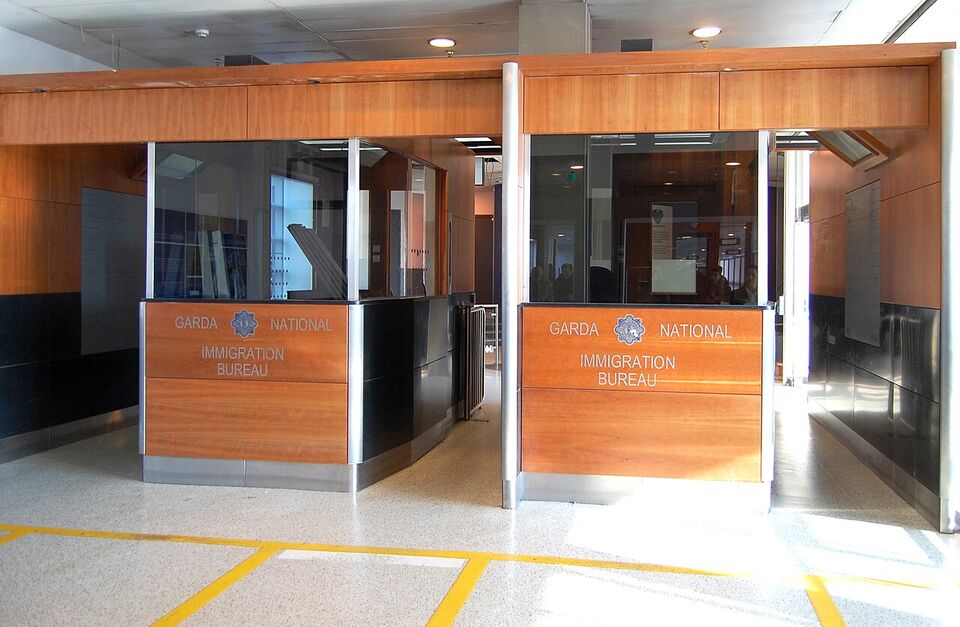
Most Americans arrive at Dublin or Shannon on an overnight flight, early in the morning. You walk off the plane into the immigration hall. Follow the signs for passport control and join the line for non-EU passports. A uniformed immigration officer looks at your passport and may ask a few routine questions, such as why you are visiting, how long you are staying and where you will sleep.
After immigration you collect checked bags, and then you go through customs. Most travelers walk through the green channel (nothing to declare). Use the red channel if you carry more than the allowances below, or goods that must be declared.
What we can confirm and what we cannot: the 90-day rule for visitors is stated on the Irish immigration site. The page we could open does not describe the officer's stamp, the exact length of stay the officer grants, or how to extend a visit, and the extension page we tried was not available. So we do not name a stamp type or promise a specific number of days. If you need to stay longer than three months, ask irishimmigration.ie before you fly. Our long-stay guide explains the common routes.
Insider tip
Keep your hotel or rental address, and a return flight confirmation, where you can pull them up in seconds. Answers that are short and match your documents are what officers expect. Also keep your phone charged and your passport out of the bag in the final minutes before the desk, so the line keeps moving.

Ireland is not in Schengen: EES and ETIAS
Many Americans now hear about two European systems: the Entry/Exit System (EES), which started operating on October 12, 2025, and ETIAS, a pre-travel authorisation that is not running yet. Neither applies to a trip that stays within Ireland.
Ireland is not part of the Schengen area and is not taking part in the EES. Irish news coverage from October 2025 said travelers arriving directly in Ireland are not bound by it. The EES affects people entering Schengen countries, such as France, Italy and Spain.
ETIAS is a separate story. It is an online travel authorisation, with a fee reported as €20 (about $22), for visitors to Schengen countries. A July 2026 report citing the Financial Times said launch had slipped to 2027, though the official ETIAS site still pointed to the last quarter of 2026. In short, it is not running as of November 2026. We have not seen an official statement on how it treats Ireland, but because Ireland is outside Schengen the system is aimed at the Schengen countries on your itinerary, not at Ireland.
If you plan to add Paris, Amsterdam or Rome after Ireland, check the EU's official pages (europa.eu) close to your travel date for the EES and ETIAS position, and see our guide to adding mainland Europe for how people usually combine Ireland with the rest of Europe.
Crossing into Northern Ireland: the UK ETA
Northern Ireland is in the United Kingdom, so for entry purposes it is a different country from the Republic. US citizens usually need a UK electronic travel authorisation (ETA) to visit the UK, and an ETA lets you stay for up to six months. According to the UK government page, the fee is £20 (about $27), British and Irish passport holders do not need one, and every traveler including babies and children needs their own.
The land border between the Republic and Northern Ireland is open. There is no passport control on the road, no barrier and often no sign beyond a change in speed signs (the Republic uses km/h, Northern Ireland uses mph). That open border is where confusion starts, so here is the plain picture:
- The law: a US visitor entering the UK, which includes Northern Ireland, needs an ETA. Arriving in the Republic first does not exempt you.
- The road: in practice, nobody checks documents on the Dublin-Belfast road. The Irish Times reported in February 2026 that the ETA has been unenforced at the Northern Ireland land border for about a year, and that a cross-border traveler is no more likely to be asked for it than for a passport, which is almost never.
- The boarding gate: strict checks at boarding began on February 25, 2026 for transport to the UK. Aer Lingus has asked for passports on flights to Britain since then. If you fly or ferry into any UK port or airport, expect to be checked.
Our advice is to follow the law: apply for the ETA before the trip. It takes minutes online, and most applications are approved within minutes, but applicants are advised to leave three working days. An ETA does not guarantee entry, and the Home Office page says so. Apply through the government's own page, not through a search result.
Watch out
Lookalike sites charge a lot more than the official fee for the same ETA, and some copy the government's design. The UK government warns that other websites may charge more and imitate government services. Go to gov.uk, search "apply for an electronic travel authorisation," and check the address before you pay. The fee on the official page is £20 (about $27) per person.
Two practical points. First, if you rent a car in the Republic and plan to drive north, the rental company must allow it, usually in writing and often for a fee; see car rental guide. Second, remember that the money changes at the line: pounds sterling in the north, euros in the south. See money guide for the rule. Our Belfast guide and Causeway Coast guide cover what to do once you are there.
US preclearance at Dublin and Shannon
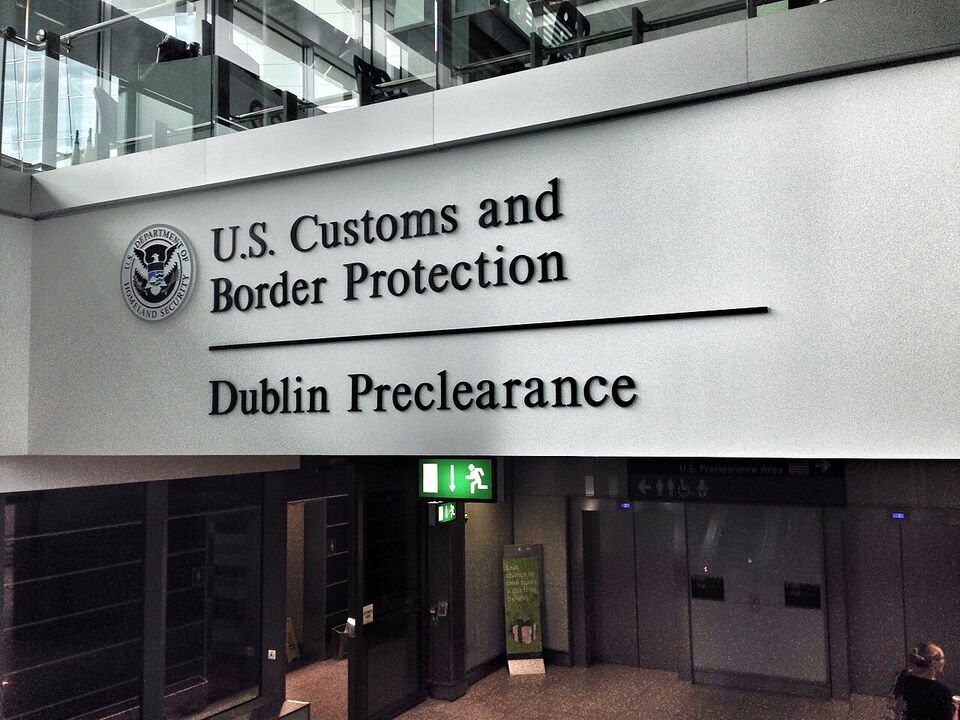
Preclearance is the single biggest difference between leaving Ireland and leaving most other countries. Instead of clearing US immigration, customs and agriculture when you land in the US, you do all three in Ireland, before you board. Dublin Airport describes it as a facility that lets you clear all US inspections before you fly, so when you land you skip the immigration lines. You arrive in the US as a domestic passenger, pick up your bag (if it was not checked through) and walk out.
Where it is and when it is open
At Dublin, preclearance is on the ground floor of Terminal 2, beyond security, and the facility is run by US personnel. US Customs and Border Protection (CBP) lists Dublin (Terminal 2, Pier 4) as open 7:00 a.m. to 4:30 p.m. GMT. Shannon Airport also has a full US Preclearance facility and Mobile Passport Control, and CBP lists Shannon as open 9:00 a.m. to 5:00 p.m. (CBP prints the time zone as IST). These are the published hours of the facilities, not your flight time. Your airline's departure time is what governs your day. CBP lists 16 preclearance locations in 6 countries, including these two.
Dublin Airport says most direct flights to the US from Terminal 2 include preclearance, but "not all flights offer this option, so check with your airline." Aer Lingus's media factsheet says the late-departing flights EI109 (New York) and EI139 (Boston) do not use preclearance. That factsheet is dated 2018, so treat the flight numbers as a prompt to ask, not as current fact.
How it changes your departure day
The practical effect is that the airport takes longer, and you spend the time in Ireland rather than at the other end. Dublin Airport advises arriving 3 hours before a long-haul flight, and more if you are checking bags or traveling in a group. Terminal 2 is busiest for security from 5 a.m. to noon, which is when most morning and early-afternoon US flights depart. A typical sequence looks like this:
- Check in with your airline and drop your bags as normal. An older Aer Lingus factsheet says transatlantic check-in closes 75 minutes before departure in economy and 60 in business; confirm the cutoff with your airline for your flight.
- Go through Irish airport security.
- Wait for your preclearance time to appear on the flight information screens. Do not enter the preclearance area until your flight is called.
- Go to the US officer, as you would at a US airport arrival hall. You answer the usual customs and immigration questions and present your passport (and anything you must declare).
- Collect your things, shop or eat in the area beyond the booth, and wait for boarding. Dublin has a lounge after preclearance for US-bound passengers.
If your flight connects onward in the US, your bags are checked through to your final destination, and the preclearance step means you do not have to re-clear customs at your US arrival airport. Connecting passengers can use preclearance as well.
Mobile Passport Control
Mobile Passport Control (MPC) is a free app that lets eligible travelers submit their information before reaching the officer. Dublin Airport's FAQ says MPC is open to US citizens with a valid US passport, Canadians, US green-card holders and Visa Waiver travelers, with up to 12 family members per submission. You can only submit once you are at the airport. Global Entry members use the kiosks and are advised not to use MPC.
Different from home
Because you clear US customs in Ireland, the food, drink and duty-free rules apply before you board, not after you land. Food bought before preclearance may be restricted: carry any food in your hand luggage, declare it and present it for inspection. Per the Aer Lingus factsheet, duty-free goods including alcohol and cigarettes cannot be sold on board flights that preclear.
Watch out
Arriving late is the common mistake. The preclearance queue is separate from the Irish security line, and it can be long in the morning peak. If you reach Terminal 2 with less than the advised three hours on a morning flight, ask airline staff to help you through. Missing your preclearance slot can mean missing the flight. See Dublin Airport guide for terminals and transfers, and flights guide for airline planning.
If someone in your group is not a US citizen
Travelers who fly to the US under the Visa Waiver Program need an approved ESTA to board, and Dublin Airport says to apply at least 72 hours before departure because real-time approvals no longer exist. Without an approved ESTA you will not be allowed to board. This does not apply to US citizens, but it matters to a friend or relative who has a different passport. Use the official ESTA site.
Customs: what you can bring into Ireland
You pass customs after baggage claim. For a visitor arriving from outside the EU, which includes a flight from the US, Revenue (the Irish tax and customs authority) sets allowances for goods carried in your luggage. These figures are from Revenue's page published in December 2025.
| Item | Allowance (age 15 and over) | Notes |
|---|---|---|
| Goods in general | €430 (about $482) combined | €215 (about $241) if under 15. If one item is worth more than the allowance, tax applies to its full value |
| Cigarettes and tobacco | 200 cigarettes, or 100 cigarillos, or 50 cigars, or 250 g of smoking tobacco | Can be split between types |
| Spirits and strong drinks | 1 liter | Or 2 liters of drinks of 22% or less, such as port, sherry or sparkling wine, or a split |
| Still wine | 4 liters | On top of the spirits or lighter-drinks allowance |
| Beer | 16 liters | On top of the above |
Do not bring meat, dairy or plant products from home without checking the rules first. Our packing guide has a short list of what to leave behind.
Cash and large sums
Large sums of cash must be declared when you enter or leave the EU. We could not open Revenue's cash-control page, so we do not give a figure here. Check revenue.ie for the current threshold before you travel with a lot of cash. The US has its own reporting rule on the way home; check cbp.gov. In practice, almost no traveler needs to carry that much cash, because cards work nearly everywhere (see money guide).
Bringing things back to the US
US Customs and Border Protection is the official source for what you can bring home. Dublin Airport quotes these personal exemptions for US travelers: 1 liter of alcohol, 200 cigarettes, and up to $800 worth of goods per person ($1,600 per couple). It adds that duty-free exemptions apply only in the country of purchase, and that if you exceed the limits you may need to pay duty. Because of preclearance, you declare to the US officer in Ireland rather than in the US.
The CBP page we reached does not list these figures itself, so confirm them on cbp.gov before a large purchase. A few practical points follow:
- Keep receipts for anything valuable, such as a sweater, jewelry or crystal. They help if an officer asks the price.
- Declare food honestly. Agriculture screening happens at Dublin and Shannon, so fruit, meat and dairy gifts are the usual problem.
- If you plan to shop, read our shopping guide for what is worth buying and how refunds on sales tax work.
Medicines, drones and children
Medicines
Carry prescription medicines in their original labeled containers, in your hand luggage, with a copy of the prescription or a letter from your doctor. Pack enough for the whole trip plus a few extra days. Some medicines that are ordinary in the US are controlled elsewhere. If you take a strong painkiller, a stimulant for attention disorders or a sleep medication, ask your doctor and check with the Irish health authorities before you go. We did not find a single official Irish page that lists what visitors may carry, so do not rely on a blog. The health guide covers pharmacies and seeing a doctor.
Drones
If you plan to fly a drone, treat it as a regulated activity, not a casual extra. Ireland follows EU drone rules administered by the Irish Aviation Authority, and operators of many drones must register. We have not confirmed the current registration steps for visitors from outside the EU, so check iaa.ie before you pack one. Flying near airports, over crowds or near some historic sites can be restricted, and heritage sites may have their own rules.
Children and one-parent travel
Each child needs their own passport. If a child travels with one parent, with grandparents or with another adult, we suggest carrying a signed and dated letter of consent from the absent parent or parents, with their contact details, and a copy of the birth certificate. We did not find a universal Irish rule that requires it, but airlines and officers can ask, and a letter takes five minutes to prepare. For a UK ETA, babies and children need their own too.
Mistakes to avoid
- Paying a lookalike site for a UK ETA. Use gov.uk only, and expect £20 (about $27) per person.
- Skipping the ETA because "nobody checks." It is a legal requirement, and the check happens at boarding if you fly or take a ferry to the UK.
- Arriving late for preclearance. Plan on 3 hours at Dublin, and more for a group or checked bags.
- Buying liquids or food after you think you are through. The rules differ before and after preclearance. Ask staff if unsure.
- Assuming ETIAS or EES apply to Ireland. They do not, but they may affect other parts of your trip.
- Driving north without telling your rental company. Cover and permission can be limited to the Republic.
- Carrying a passport that expires soon. Renew first.
- Treating a stale source as current. Rules change. Cross-check the official sites linked below.
Before you go: a short checklist
- Passport valid for your whole stay, preferably with six months to spare
- UK ETA for every traveler, if any part of your trip is in Northern Ireland
- Rental company permission and insurance for Northern Ireland, if driving across
- Prescription letters and original containers for medicines
- Consent letters and birth certificates for children traveling with one adult
- Receipts for valuable items, and a note of what you plan to declare on the way home
- A plan to reach Terminal 2 at Dublin, or Shannon, about 3 hours before a US flight
Rules change, so verify the entry details on the official sites below a few weeks before you fly, and again the week you leave. Our trip-planning guide ties these steps to a timeline, and FAQ answers other common questions.
Add it to a route in the trip builder, or ask us to plan the hotels, trains and guides for you.