How Irish pubs work
An Irish pub is a social center as much as a bar. It is where people meet neighbors, watch matches, hear music and eat a simple meal. Many pubs are named for the owner or the street, and most sell a wide range of drinks.
The basic rules are simple. Order and pay at the bar. Carry your drinks to your seat. Say thank you and move on. This page covers ordering, rounds, children and food, how to find and behave at a traditional music session, the difference between Temple Bar and a local, smoking and vaping, drinking age, safety, mistakes to avoid and a short regional list. For what to drink, see our drinks guide, and for what to eat see our food guide.
Different from home
There is no host who seats you, no server who brings the check, and no tip built into the evening. You order at the bar, pay when you order (or open a tab if the bartender allows one), and the pint is yours to carry. In busy pubs the bar is the center of the room, not a place to wait while drinks arrive.
Ordering at the bar
Walk up to the bar and wait your turn. Bartenders keep track of who was there first, and they will ask "What'll you have?" when they get to you. Do not wave money, shout or snap your fingers. A nod and eye contact are enough.
Say what you want and how many. An Irish pint is 568 ml, about 19 US ounces, so it is larger than a 16-ounce US pint. A half pint is called a "half" or a "glass" in some places. Wine comes by the glass, spirits by the measure, and a "short" is a spirit without a mixer. If you are not sure what to order, ask what is good. For help with Guinness, see our drinks guide.
Pay when the drinks arrive. Many pubs accept cards and contactless payment, but small rural ones may be cash only or prefer it, so carry some euros. In Northern Ireland, pay in pounds sterling. If you want to keep a tab, ask; many bars will do it for a card behind the bar but not all.
Table service
A few pubs, especially those that serve full dinners and hotel bars, have waiters. Look for tables set with menus and cutlery. If there is table service, a server will tell you. If in doubt, ask "Do I order at the bar?" That is a normal question, and no one will mind.
Rounds, and how not to get caught out
If you drink with local people or with a group, you will meet the round. One person buys drinks for everyone in the group, and then someone else buys the next. It is considered bad manners to leave before you have bought your round. The system works because everyone ends up paying about the same.
If someone offers you a drink and you do not want one, say so politely. If you do accept, expect to return the favor. If you are with a group of three or four, make sure you take your turn. If you do not want to get into a round, order your own drink with your own money and say so first. The traditional toast is "Sláinte" (SLAWN-cha), which is the Irish word for "health" and means "cheers." See our guide to Irish words for more.
Insider tip
If you are traveling in a group of Americans, agree before you go in whether you will buy rounds or pay separately. Rounds are friendly with locals, but they can be unfair when one person drinks fast and another drinks slowly. Paying separately is not rude if you explain it before the first order.
Opening hours, children and pub food
Hours and closing time
Closing times differ by pub, by day and by season, and we have not confirmed a single national rule for this guide. Many pubs call last orders late in the evening, with city and music pubs often open later on Friday and Saturday. Pubs often close early or stay shut on Christmas Day and, in some places, Good Friday. Check the pub's own page, its door, or ask the bartender. See our December guide for the holiday period.
Children in pubs
Many pubs serve food and welcome families during the day and early evening, and the pub is a normal place for a family lunch. House rules differ, and many pubs ask families to leave by an evening cut-off, so ask when you arrive. A pub that is mainly a bar may not welcome children at all. If you are traveling with kids, a pub that serves meals is a good choice, and a table near the food service is usually the easiest.
Pub food
Pub food was rare until the 1970s, but food is now a big part of the pub trade. Expect soup, sandwiches, stew, fish and chips, seafood chowder, burgers and a daily special. Standard pub dishes are usually the most reliable choice. Some pubs serve food only at lunch and early evening, so ask when the kitchen closes. VAT on food served in pubs fell to 9% from 13.5% on July 1, 2026, but the pub trade said most pubs do not serve food and would not benefit, so drinks did not get cheaper. See our food guide for dishes and menu words.
What a traditional music session is
A traditional music session is a gathering of musicians who play together, usually in a pub, without a stage or a set list. They sit around a table in a corner, and one player starts a tune, and the others join. The instruments are typically fiddles, flutes, tin whistles, uilleann pipes (the Irish bagpipes), accordions, concertinas, a guitar or bouzouki, and a bodhrán (a frame drum). There may also be a singer, and the singing is often unaccompanied.
The music is made up of jigs, reels, hornpipes, polkas and slow airs. Tunes come in sets, and the players move from one tune to the next without a break. A session is a community event, not a performance for an audience, and the musicians play for themselves and for each other. Visitors are welcome to listen. They are not there to be entertained on demand.
Many pubs have live music on weekends, but not every pub does, and it is not guaranteed that you will find a session on a given night. Sessions are often informal and can start late and end early. The same pub may have a session on one night and not the next. If you care about the music, check ahead.
How to behave at a session
- Listen. Do not talk through the music, and keep your voice low during the tunes.
- Applaud between sets, not in the middle of a tune.
- Do not request songs, and do not ask the band to play a tune you know from a movie.
- Do not sit at the musicians' table unless invited. Leave the corner free.
- Silence your phone, and do not hold it up to film in the musicians' faces. If you want to record, ask first.
- Do not join in with a bodhrán, spoons or a harmonica unless you are asked. If you play an instrument, wait to be invited.
- Thank the musicians at the end of a set.
The usual way to show thanks is to buy a drink for a musician. Musicians are often paid little or nothing, and they commonly receive free drinks for the music. Ask the bartender to send a drink to the table, or, if there is a collection, put a little in. A tip jar is not the norm. Where a pub pays the musicians and calls it a concert or show, it is a different arrangement, and there may be an entry fee.
Watch out
Treating a session as background music is the biggest mistake visitors make. If you want to talk, sit at the other end of the pub or step outside. Loud conversation over the tunes is the thing that annoys players and listeners most.
Real sessions versus tourist shows
There are two kinds of live music in Irish pubs. A session is informal, often unannounced, and there is usually no charge. A tourist show is a booked performance in a pub or hall, with a stage, a time and sometimes a ticket. Both can be good, but they are not the same thing. If you want the session, here is how to tell the difference.
- Setting: a session usually has players sitting together at a table or in a corner at floor level, not on a stage with a microphone.
- Timing: sessions often begin around 9 p.m. or later, and some start earlier on weekends or afternoons. A set time on a sign can mean a show.
- Music: a session tends to include tunes in sets and unaccompanied singing, not a playlist of pop songs and well-known ballads.
- Ask: staff at a local pub will tell you which nights have a session. Ask the bartender, your B&B host or the local tourism office.
- Official sources: Discover Ireland (discoverireland.ie) and local festivals list music. We have not been able to confirm current listings for each pub, so check before you go.
Festivals are another way in. Traditional music weeks and festivals are held across the island, including TradFest in Dublin, which is scheduled for January 20 to 24, 2027, and the Fleadh Cheoil na hÉireann, which Belfast hosts again in early August 2027 (check the dates). See our festivals guide.
Temple Bar versus a local pub
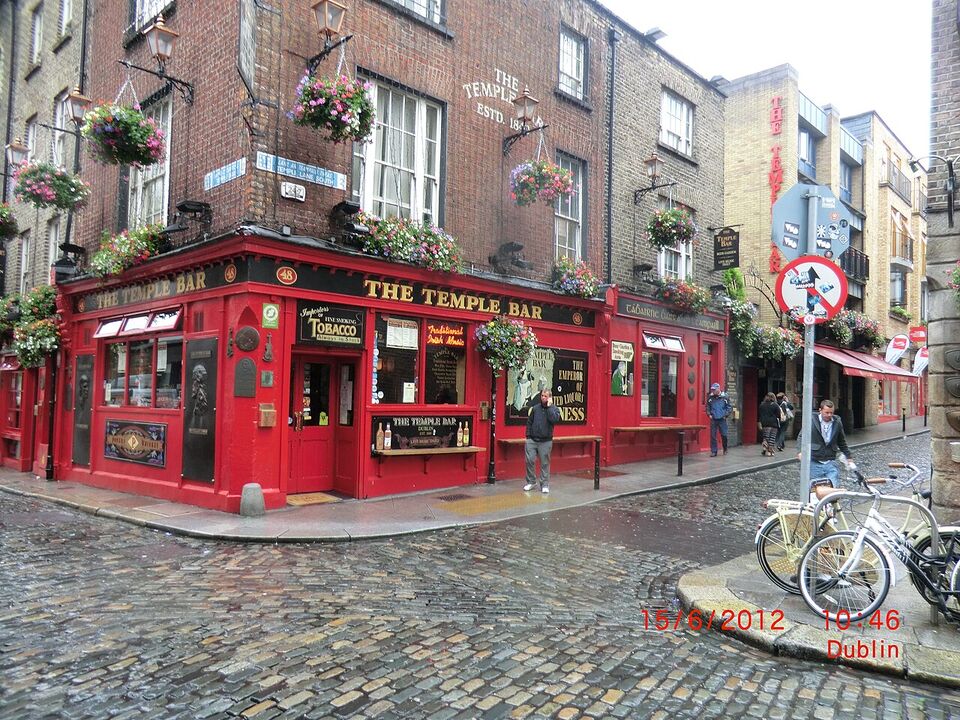
Temple Bar is a district in central Dublin full of pubs, restaurants and live music, and it draws large crowds of visitors. It is easy to find and fun for a first night. It is also expensive. A pint in Temple Bar cost up to €10.45 (about $12) on St Patrick's Day 2025, compared with a national average of €6.08 (about $7) in November 2025. A study cited by RTÉ found Guinness averaging about €2 (about $2) more in Dublin than in Westmeath.
A local pub away from the main tourist street is usually cheaper, quieter and more likely to have a session. Walk ten minutes in any direction in Dublin and you will find them. In smaller towns, the pub on the main street may be the only pub, and it is the local. If you want a mix, have one drink in Temple Bar for the atmosphere, then move on. See our Dublin guide for neighborhoods.
Smoking, vaping and drinking age
Ireland banned smoking in pubs and other workplaces in 2004, and Northern Ireland followed in 2007. Many pubs now have outdoor smoking areas, often enclosed and heated. Smoking is not allowed inside. Vaping rules are less clear to us, and we have not confirmed them, so assume you should not vape indoors and ask staff.
The legal age to buy and drink alcohol is 18, and you should carry photo ID, such as a passport or a copy. Distillery and brewery tours also ask for ID at check-in and set a minimum age of 18. A passport is the safest ID, and a clear photo of it on your phone may be accepted in some places but not all. Do not drink and drive. The Irish limit is lower than in most US states. See our drinks guide and our driving guide.
Safety, prices and tabs
Irish pubs are generally friendly, and tourists are often drawn into conversation. Use normal city precautions: keep your bag on your lap or between your feet, never leave a drink unattended, and watch your belongings in crowded bars. In the countryside, plan your way home before you drink, because taxis can be few and far between and public transport may stop early. See our safety guide.
Prices vary widely. The national average for a pint of stout was €6.08 (about $7) in November 2025, up 18% since November 2022. Guinness costs on average about €2 (about $2) more in Dublin than in Westmeath. We do not give set prices for wine, spirits or soft drinks, because they vary too much, but menus and price lists are posted in most pubs.
Save money
If you are on a budget, drink outside peak hours and away from the main tourist streets. A pub in a residential neighborhood or a side street is often cheaper than one on the main drag. Food at lunch is often cheaper than at dinner. See our budget guide.
Mistakes to avoid
- Ordering a joke drink name. Do not order a shot or cocktail with a name that refers to violence in Ireland's history, such as the "Irish car bomb." It is offensive here, and bartenders will refuse or be unhappy. Order Guinness and whiskey separately.
- Treating a session as background music. Keep quiet while the players play.
- Asking for a table and a server. Order at the bar unless the pub has waiters.
- Leaving before your round. Take your turn.
- Asking for a "black and tan." The name is offensive in Ireland because of its history. Ask for the two beers by their own names if you want to mix them.
- Tipping at the bar. It is not expected, though a drink for the band is fine.
- Assuming everyone is Irish. Pubs in Northern Ireland and the Republic have different histories, and the politics are sensitive. Be polite and avoid arguing.
- Assuming a pub serves food late. Ask when the kitchen closes.
A regional shortlist
We do not name individual pubs as "the best," and we cannot confirm which are open and which have sessions in winter 2026-27. Instead, here are places known for pubs and music. Check the town's tourism page for current listings.
Dublin
Old pubs, snugs and music venues in the center. The Brazen Head is said to date from 1198 and is held to be the oldest pub in Dublin, but check its opening hours. Away from Temple Bar, neighborhood pubs are cheaper and quieter. See our Dublin guide.
Galway
A compact city with many pubs and live music most nights. Walk the streets away from the main square for local sessions. See our Galway guide.
Doolin and County Clare
Doolin is widely known for traditional music, and it is close to the Cliffs of Moher. Sessions vary by season, so check before you go. See our Cliffs of Moher guide.
Dingle
A small town with many pubs, music and some pubs that double as shops. See our Dingle guide.
Killarney and Cork
Live music and food pubs for visitors in Killarney, and a lively local scene in Cork city. See our Killarney guide and our Cork guide.
Belfast and Derry
Belfast has Victorian pubs, including the Crown Liquor Saloon, which is owned by the National Trust, and the city is the host of the Fleadh Cheoil in 2026 and 2027. Derry has Peadar O'Donnell's, a traditional music pub. Prices there are in pounds sterling, for example £5 (about $7) for a drink. See our Belfast guide.
Add it to a route in the trip builder, or ask us to plan the hotels, trains and guides for you.