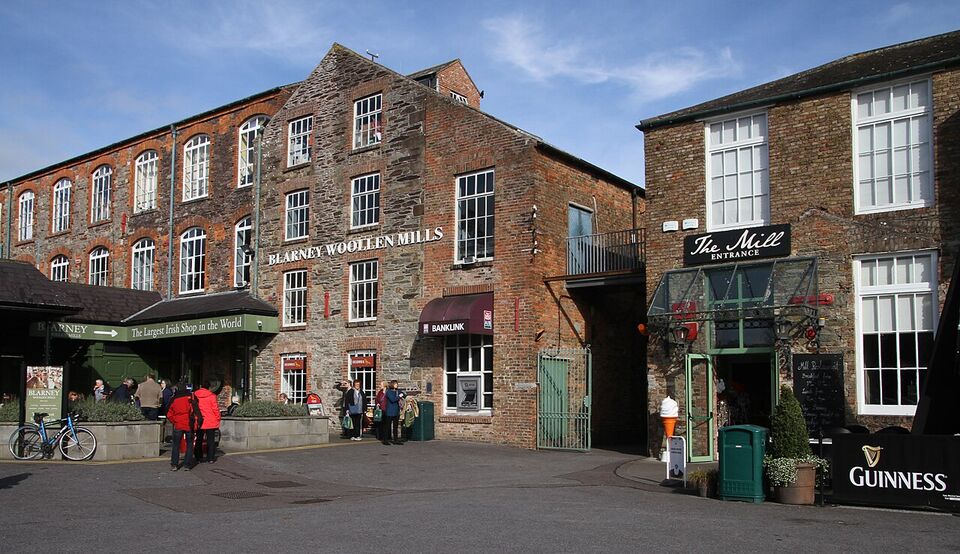
What this guide covers
Good shopping in Ireland is about quality, not quantity. The best things to take home are woolens, tweed, linen, handmade pottery, crystal, jewelry and food and drink, and the best places to buy them are often small shops and makers rather than airport stalls. This guide covers what to buy and where, how to avoid fake or imported "Irish" goods, how the VAT refund works for visitors from outside the EU, what Northern Ireland changes, how to ship things home, and what US customs lets you bring back.
A word on prices first. The Republic of Ireland uses the euro, and we convert at €1 = US$1.12. Northern Ireland uses pounds sterling, converted at £1 = US$1.33. Shelf prices include value-added tax (VAT), which is 23 percent at the standard rate, so the price on the tag is the price you pay. See our money guide for cards, cash and why you should always pay in euros (or pounds) when a terminal offers you dollars.
We have not listed prices for most souvenirs, because they vary by shop and by quality. Where we do give a number, we say where it comes from.
What to buy in Ireland
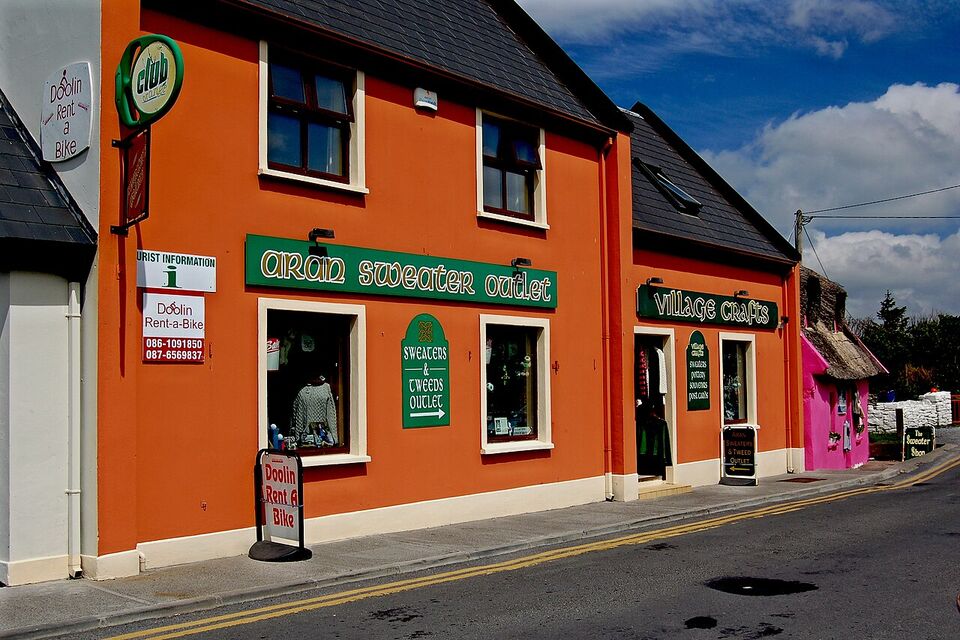
Aran knitwear and wool
The cream-colored Aran sweater takes its name from the Aran Islands off Galway, and its cable and diamond patterns are a hallmark. The story that each family had its own stitch is widely told but not well documented, so treat it as a tale. Choose wool or a wool blend, check the label for fiber content, and feel the weight. Hand-knits cost much more than machine-made ones. Merino and lambswool are softer for scarves. See our Aran Islands guide for the islands themselves.
Donegal tweed
Tweed is a woven wool cloth, and Donegal tweed is known for flecks of color in the weave. Caps, jackets, scarves and throws are all good buys, and a good tweed cap lasts for years. Harris Tweed is a different, Scottish cloth, so check the label if you want Irish. Mills in the west and northwest sell directly, and the staff can tell you how a piece was made.
Crystal
Waterford crystal is the best-known name, with a long tradition of hand-cut glass in Waterford city. Look at the label for where an item was made, and ask the shop about it. Cut glass is heavy and fragile, so plan how you will carry it, or have the shop pack and ship it. A good piece can be a lifetime keepsake, and a cheap lookalike will disappoint.
Claddagh rings
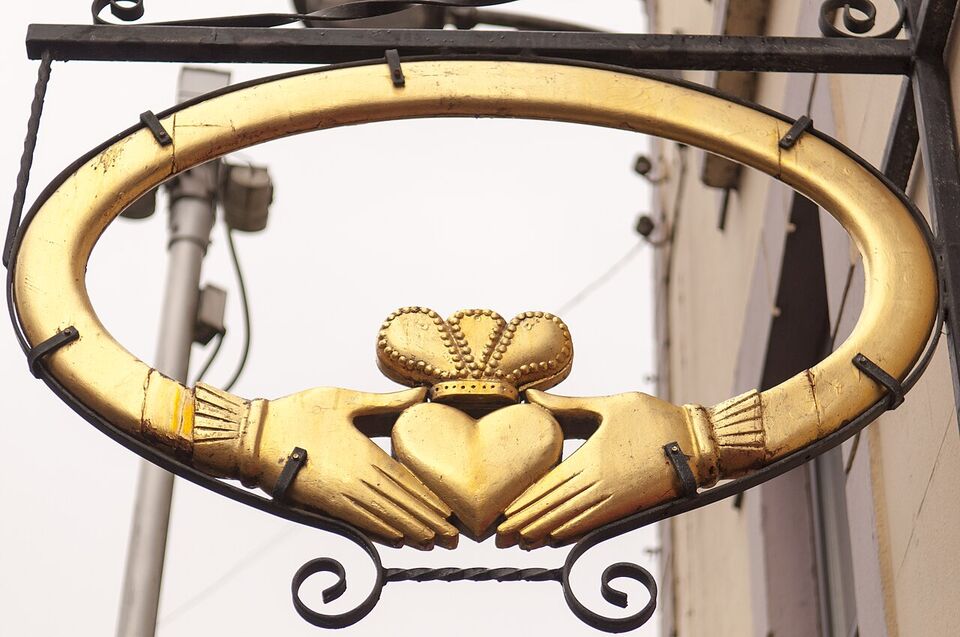
The Claddagh design shows two hands holding a crowned heart, for friendship, love and loyalty. It takes its name from the old fishing village of Claddagh in Galway. By tradition, wearing the ring on the right hand with the heart pointing outward means you are single, with the heart pointing inward means you are in a relationship; on the left hand, outward means engaged and inward means married. Buy gold or silver with a hallmark.
Pottery and ceramics
Irish studio potteries make hand-thrown and hand-painted tableware, often in the local colors of the landscape. Mugs and small bowls pack well. Buy directly from a studio or a craft shop where staff can tell you the maker, and ask for packing for long flights. Craft shops in Kilkenny, Dingle and Galway are good places to look.
Linen
Irish linen has a long history, especially in Ulster, and tea towels, table linen and napkins are good gifts that pack flat. Check whether the linen was woven or just finished in Ireland, since some pieces are imported. Pure linen feels crisp and softens with washing; check the care label.
Food gifts
Packaged food travels well and is cheap. Irish tea, jam, chutney, honey, biscuits, chocolate and sea salt are easy to carry. Shops at farmers' markets often sell artisan products. Be careful with meat, dairy and fresh items for US customs (see below).
Irish whiskey
Irish whiskey is spelled with an "e". Distillery shops often sell bottles that are not widely sold in the US, and a distillery tour is a good way to taste first. The Jameson Midleton Distillery Experience in Co. Cork starts at €28 (about $31) for a 75-minute tour, and the Dingle Distillery Tour is €25 (about $28), according to their booking pages. Know the US limit before you buy (see below).
Other classic gifts include Irish crafts such as baskets and bog-oak carvings, books by Irish authors, traditional music CDs from the musicians you hear, and prints from local artists. For what to eat and drink while you are there, see the food guide and the drinks guide.
Where to shop
Dublin
Grafton Street is the main pedestrian shopping street south of the River Liffey, with department stores and international chains, and side streets such as those around South William Street have smaller design and gift shops. Henry Street and Mary Street on the north side are busy with high-street shops and a large shopping center. Moore Street has an outdoor street market with fruit, vegetables and flowers. For craft and design, look around Temple Bar and the Powerscourt area. Markets and shop hours vary, and many shops close earlier on Sunday, so check before you go. See Dublin and Dublin sights.
Galway
Shop Street and the streets around Eyre Square are the center of Galway shopping, and the Claddagh area has jewelers. Galway has a lively street market near St. Nicholas' Church on weekends. Check days and hours. The Christmas market in Eyre Square runs November 6-December 22 in 2026, with free entry. See Galway.
Cork, Kilkenny, Dingle and Kinsale
Cork has a covered food market in the city center. Kilkenny's Castle Yard area has craft and design shops, and the city is a good place for ceramics and gifts. Dingle and Kinsale have small craft shops, galleries and food shops. See Cork, Kilkenny and Dingle.
Belfast and the north
Belfast has a covered market at weekends (check days and hours) and a lively mix of high-street and independent shops. In Northern Ireland you pay in pounds sterling. See Belfast.
Outlets, mills and workshops
Outside the cities, the best value often comes from woolen mills, craft workshops and farm shops. Some have visitor centers and sell directly. Check opening times before you drive out, because many small makers close in winter or open by appointment. A visit also lets you see how the goods are made.
Insider tip
Buy at the place where the thing is made, if you can. A tweed cap in a Donegal mill, or a pottery mug at the studio, is more likely to be genuine than the same item on a souvenir shelf in Temple Bar, and you can ask the maker how it was made.
Authenticity and quality tips
"Made in Ireland" is a claim you can check. Many souvenirs sold in Irish tourist shops, including some shamrock goods, Celtic-pattern jewelry and cheap "Aran" sweaters, are made in other countries. That is not illegal, but it is not what most visitors expect.
- Read the label. Most products should show their country of origin. A sweater labeled "designed in Ireland" may have been made elsewhere. Look for "made in Ireland" and the fiber content.
- Ask who made it. A seller who knows the maker, the mill or the studio is a good sign. Vague answers about "traditional" goods are not.
- Judge the price. A hand-knit Aran sweater that costs less than a machine-made one in the next shop is not hand-knit. Authentic hand-made goods cost more.
- Check the fiber. Wool feels dense and warm. If the label says acrylic or "wool-rich" with a small percentage, the price should reflect it.
- Look for hallmarks. Gold and silver sold as such in Ireland should carry a hallmark showing the metal's purity and the assay office. Ask the jeweler to explain the marks.
- Look at crystal marks. Fine crystal usually has an etched maker's mark on the base. Run a finger along the cut edges; real cut crystal feels sharp and clear, and pressed glass feels smooth and light.
- Beware of "clan" and "crest" goods. Surname plaques, "family crest" scrolls and clan books are decoration, not records. See tracing your Irish roots.
- Use the returns policy. Ask what happens if an item arrives broken or does not fit. Keep receipts.
Watch out
The most common mistake is buying a "Made in Ireland" souvenir without checking the label. Turn the item over. If it does not say where it was made, ask. If the answer is vague, buy something else.
VAT refunds for visitors from outside the EU
Irish shelf prices include VAT, which is 23 percent at the standard rate. Visitors who live outside the European Union can sometimes claim the VAT back on goods that they take out of the EU in their luggage. The scheme is usually called tax-free shopping. We could not fetch an official page on the scheme for this guide, so what follows is the general outline, and you should confirm the current rules on the Revenue Commissioners' site (revenue.ie) and with the shop before you buy.
How it generally works
- Ask before you pay. Not every shop takes part. Look for a "tax free" sticker in the window, or ask at the till. There may be a minimum purchase amount, and some goods are not eligible.
- Show your passport. The shop will ask for it to prove you live outside the EU, and it will fill in a refund form or give you a receipt with a barcode. Check that the details are correct.
- Keep the goods unused and in your hand luggage. Customs may ask to see them. If your bags will be checked in, you may need to have the form validated before you check in, so ask the shop where.
- Get the form validated when you leave the EU. At the airport, a customs desk or kiosk validates the form. The location, the opening hours and whether you need the goods in hand depend on the airport and the refund company. Check the signs and the shop's instructions.
- Claim the refund. The refund is made by the shop or a refund company. The company often takes a fee, so the refund is less than the full VAT. You may receive it in cash, on a card, or by bank transfer. Follow the instructions on the form, and keep your copy.
If you fly to the US from Dublin or Shannon, you also pass through US Preclearance (see below). Ask the shop and the airport staff exactly which desk validates the form and whether it must be done before you check your bags, and leave plenty of time. If you travel on from Ireland to another EU country first, the validation normally happens at your last point of exit from the EU. Rules for this vary and are the main reason people lose their refund.
VAT on hotels, meals and services is not refundable under this scheme, which covers goods you take home. A minimum spend and handling fees mean that refunds are most worthwhile on larger purchases such as a good coat, a piece of crystal or jewelry.
Save money
Before you buy a large item, ask two questions: "Do you offer tax-free shopping?" and "How much will I actually receive after fees?" On a small purchase the refund may not be worth the time at the airport.
Shopping in Northern Ireland
Northern Ireland is part of the United Kingdom. Prices are in pounds sterling, at £1 = US$1.33 on this site, and many shops accept contactless cards. Some places that take euros near the border give a poor exchange rate, so pay in pounds.
Do not assume that you can claim VAT back in Northern Ireland, because the UK's rules for visitors differ from the Republic's. Ask the shop and check the current rules on gov.uk. We could not confirm them for this guide.
Goods you buy in Northern Ireland and carry to the Republic do not cross a customs checkpoint, since there is no border control on the road. But when you leave the island for the US, the same US customs allowance applies to everything you bought on both sides of the border. See our Belfast guide for shopping in the city, and the entry guide for the UK electronic travel authorization that US visitors need for Northern Ireland.
Keep your currency straight when you cross the border. If you plan to spend your last euros at the airport or in a shop, make sure you are in the Republic, and in Northern Ireland, spend or exchange pounds before you leave.
Shipping things home
If you buy something large, heavy or fragile, shipping it home can be easier than carrying it. Many shops ship for you, and larger crystal and furniture sellers do so routinely.
- Ask the shop first. Find out the total cost, the delivery time, whether the shipping is insured, and who is responsible if it breaks.
- Ask about duty and fees. Goods that arrive in the US by mail or courier can be charged duty and handling fees, and the carrier may collect them on delivery. Ask whether the price quoted includes them.
- Keep paperwork. Keep the receipt, the tracking number and the packing slip. If you claim VAT, ask how that works with shipped goods, since the refund process depends on goods leaving the EU.
- Do not ship alcohol or food without checking. Alcohol is regulated, and many shops will not ship it to the US. Food can be held at the border. Ask first, or carry it with you within the allowance.
- Weigh the alternative. A suitcase has a weight limit, and airlines charge for extra bags. Compare the cost of shipping with an extra checked bag. For packing tips, see our packing guide.
US customs: what you can bring home
US Customs and Border Protection (CBP) sets the rules on what you can bring back. Check cbp.gov before you buy, because limits and rules change. Dublin Airport's page for US-bound passengers quotes the usual personal exemptions as follows.
| Item | Duty-free exemption quoted by Dublin Airport |
|---|---|
| Goods in total | Up to $800 per person (about $1,600 for a couple), at US retail value |
| Alcohol | 1 liter per adult |
| Cigarettes | 200 |
The airport adds that if you exceed these limits you may need to pay duty. The $800 is the combined value of everything you bring back, including what you buy in Northern Ireland, and gifts you carry count too. Keep receipts, and be honest on your declaration form. The exemptions are per person, so travelers in a group should not pool receipts casually.
Whiskey and other alcohol
The exemption is 1 liter of alcohol per adult (age 21 or over). That is one standard bottle of whiskey or a little more. You can usually bring more, but you will pay duty and may owe other taxes, and individual US states have their own limits on how much you can bring in. Check cbp.gov and your state's alcohol regulator before you buy more than one bottle. Pack bottles in checked luggage wrapped in clothes, or in a sturdy shipper.
Food, plants and animal products
You must declare all food, plants and animal products on your customs form. Shelf-stable, commercially packaged items such as tea, biscuits, chocolate, jam and sealed sauces are usually fine. Fresh fruit and vegetables, plants, seeds and soil, and many meat products are restricted or prohibited, and dairy and other items depend on the product and its packaging. An undeclared item can mean a fine that costs far more than the item. If you are not sure, declare it and let the officer decide. Check cbp.gov for the current rules.
Other items to know about
- Cash. Large sums of cash must be declared when entering the US. Check cbp.gov for the amount.
- Wool, leather and ivory. Wool and leather goods are fine. Items made from protected species are not.
- Antiques and art. Older items may be exempt from duty, but you must declare them. Keep the seller's paperwork.
- Counterfeits. Fake branded goods can be seized.
Preclearance and timing your shopping
Dublin and Shannon airports both have US Preclearance. That means US immigration, customs and agriculture checks happen before you board, so you land in the US as a domestic passenger. At Dublin, preclearance is in Terminal 2, and CBP lists its hours as 7 a.m. to 4:30 p.m., and at Shannon as 9 a.m. to 5 p.m.; check the current hours with your airline. Not all flights use preclearance, so check with your airline. See the Dublin Airport guide and entry guide.
What this means for your shopping:
- You declare in Ireland. The customs officer you meet is a US officer in Dublin or Shannon. Have your receipts ready, and declare what you bought.
- Food needs care. Dublin Airport advises that food bought before preclearance may be restricted. Carry it in hand luggage, declare it and present it for inspection.
- Duty-free alcohol. Aer Lingus has said (in a 2018 factsheet, so confirm with your airline) that duty-free alcohol and tobacco cannot be sold on board preclearance flights. Buy in the airport before you board, and ask the shop how to carry liquids if you have a connecting flight in the US.
- Arrive early. Dublin Airport advises arriving three hours before a long-haul flight. If you want a VAT refund validated, build in extra time.
- Do your big shopping earlier. Leave the last day free for packing and the airport. Buy fragile gifts a day or two before you leave, so you can pack them well.
- Pay attention to your return connection. If you connect to another US flight, liquids in your carry-on can be a problem at the connecting security check. A sealed, tamper-evident bag from the airport shop can help; ask there.
Mistakes to avoid
- Do not buy a "Made in Ireland" souvenir without reading the label.
- Do not accept a card terminal's offer to charge in dollars. Choose euros (or pounds in Northern Ireland).
- Do not assume every shop offers tax-free shopping. Ask before you pay.
- Do not forget to get your VAT form validated before you check your bags.
- Do not buy more than 1 liter of alcohol per adult without checking cbp.gov and your state's rules.
- Do not pack food in your suitcase without declaring it.
- Do not buy a family crest or clan scroll. See tracing your Irish roots.
- Do not leave all your shopping to the airport; selection is narrow and prices are not always better.
- Do not forget the weight. Wool, crystal and bottles add up. Check your airline's baggage allowance.
- Do not ignore opening hours. Shops outside cities close early, and many are closed on Sundays and public holidays. See the festivals and holidays guide.
Add it to a route in the trip builder, or ask us to plan the hotels, trains and guides for you.