Do you need Irish to visit Ireland?
No. You can travel across the island using English only, and nobody will expect you to speak Irish. But Irish (called Gaeilge, pronounced GWAYL-guh) is part of daily life, and a few words and the idea of how it works will make road signs, pub toasts and place names easier to read.
Irish is a Celtic language, and it is the first official language of the Republic of Ireland, with English as the second. It is taught in schools, used on TV and radio, and appears on official documents, signs and the names of many offices. It is also the everyday language of a small number of communities in the west and south-west. This page is a short phrasebook for visitors: what Irish is, where it is spoken, how it appears on signs, a table of useful phrases, place-name elements, pronunciation traps, the English words you will hear in Ireland, and how to treat the language with respect.
For other guides to local customs, see our etiquette guide. For pub toasts, see our pubs guide.
Where Irish is spoken: the Gaeltacht
The Gaeltacht (GWAYLT-ukht) is the name for the regions where Irish is spoken as the main community language. There are Gaeltacht areas in Counties Donegal, Galway, Mayo, Kerry, Cork and Waterford, and two small areas in County Meath. The 2022 census counted 102,973 people living in the Gaeltacht, about 2% of the state's population, and 66% of them said they could speak Irish. About 20,000 people in the Gaeltacht said they speak Irish daily.
For visitors, the places you are most likely to notice are parts of Connemara (see our Connemara guide), the Aran Islands (see our Aran Islands guide) and the Dingle Peninsula (see our Dingle guide). In these areas you may hear Irish in the shop, at the bus stop and on local radio. Staff will switch to English as soon as they notice you are a visitor, and no one will be offended if you do not speak Irish.
Different from home
Irish is not a quaint extra. It is an official language, and for many people speaking it is a matter of identity and pride.
Irish and English on signs
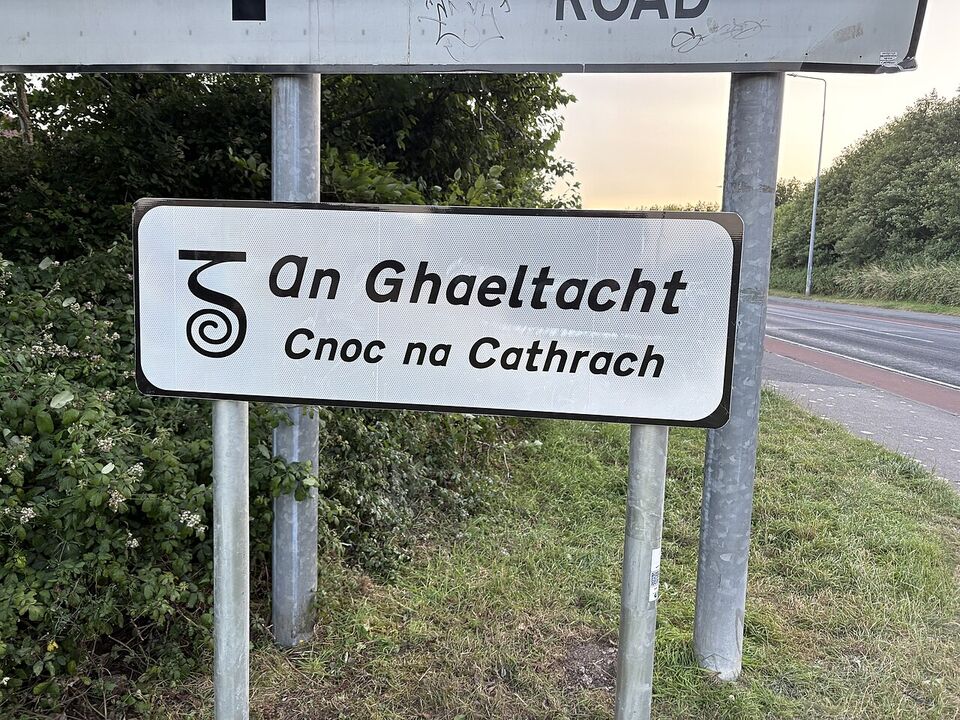
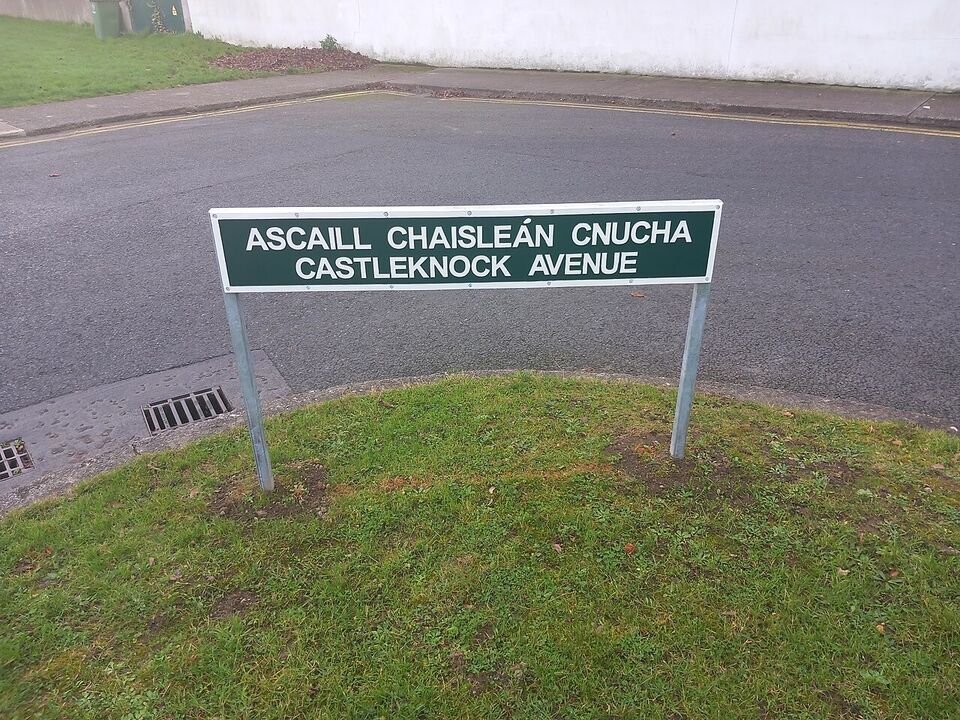
In most of Ireland, road signs show the English and Irish name of a place. Distances on the Republic's signs are in kilometers and speed limits are in km/h. In Northern Ireland, signs are in miles and mph.
In the Gaeltacht, road signs have been in Irish only since 1970. A 2005 order made the Irish names the official names of those places. The practical result is that a town you know as Dingle appears on the signs as An Daingean, and a sign for Galway city may say Gaillimh. A navigation app that shows both names will save you stress, and a printed map with English names helps too. If you are lost, ask someone and use the English name; they will understand.
A few words you will see on signs, shops and notices:
| Sign | Say it like | Meaning |
|---|---|---|
| An Lár | un LAWR | City or town center; follow it to reach the middle of town |
| Fáilte | FAWL-cha | Welcome |
| Aerfort | AIR-furt | Airport |
| Go mall | guh MAL | Slow, often painted on the road |
| Géill slí | GAYL SHLEE | Yield |
| Oscailte / Dúnta | US-kil-cha / DOON-ta | Open / closed |
| Fir / Mná | FIR / mnaw | Men / women, on restroom doors |
A traveler's phrasebook
Irish spelling does not follow English rules, so pronunciations here are approximations for an American ear, not exact sounds. Capital letters show the stressed part of the word. Learn two or three that you will use, such as hello, thank you and cheers.
| Irish | Say it like | Meaning | When to use |
|---|---|---|---|
| Dia duit | DEE-uh gwit | Hello (literally "God to you") | Greeting a person at any time of day |
| Dia is Muire duit | DEE-uh iss MWIR-uh gwit | The reply: "God and Mary to you" | If someone greets you in Irish |
| Conas atá tú? | KUN-us ah-TAW too | How are you? | Making conversation |
| Go raibh maith agat | guh rev mah UG-ut | Thank you | Shops, restaurants, buses |
| Le do thoil | leh duh HULL | Please | Asking for something |
| Slán | slawn | Goodbye (literally "safe") | Leaving a shop or pub |
| Slán go fóill | slawn guh FOLE | Goodbye for now | Parting from friends |
| Sláinte | SLAWN-cha | Health, used as "cheers" | Raising a glass in a pub |
| Céad míle fáilte | kayd MEE-leh FAWL-cha | A hundred thousand welcomes | Seen on welcome signs, B&B doors and tourism materials |
| Gaeilge | GWAYL-guh | The Irish language | Explaining what you are hearing |
| Garda / Gardaí | GAR-dah / gar-DEE | A police officer / the police | Reading news and signs; emergencies are 112 or 999 |
| Taoiseach | TEE-shukh | The head of the Irish government | Reading or hearing news |
A few notes. Dia duit is said to one person and is polite at any time of day. In pubs, you will hear Sláinte before the first sip. "Cheers" and "thanks" in English are used just as often, and the Irish versions are a courtesy, not a requirement. For the emergency number and the police, see our safety guide.
Insider tip
Pick three phrases and use them well. Saying Go raibh maith agat to a bus driver or a shopkeeper in the Gaeltacht earns a smile, and a pub toast of Sláinte is always welcome. Do not worry about perfect pronunciation. A friendly try is better than staying silent.
Place-name elements and road-sign names
Most Irish place names are anglicized Irish words. Learning the building blocks helps you read a map and guess what a place is like. Many names begin with one of these elements.
| Irish element | Say it like | Meaning | Seen in |
|---|---|---|---|
| Baile | BAL-yuh | Town or homestead | Ballina, Ballybunion, Ballycastle |
| Dún | doon | Fort | Dungarvan, Dundalk, Dún Laoghaire |
| Cill | kill | Church | Kilkenny, Killarney, Kildare |
| Inis | IN-ish | Island | Inis Mór, Inis Meáin, Inis Oírr (the Aran Islands) |
| Ard | ard | Height or high place | Ardmore, Armagh (Ard Mhacha) |
| Mór / Beag | more / byog | Big / small | Inis Mór is "big island" |
| Béal Átha | bale AH-huh | Mouth of the ford | Ballinasloe (Béal Átha na Sluaighe) |
| Loch | lokh | Lake or sea inlet | Lough in English spellings |
| Gleann | glann | Glen or valley | Glendalough |
Here are the Irish forms of some places you will see on signs in the Gaeltacht or on official maps. Check spellings on logainm.ie, the official place-names database, if you need exact forms.
| English name | Irish name | Say it like |
|---|---|---|
| Dublin | Baile Átha Cliath | BAL-yuh aw KLEE-uh |
| Cork | Corcaigh | KOR-kig |
| Galway | Gaillimh | GAL-iv |
| Killarney | Cill Airne | kil AR-nuh |
| Dingle | An Daingean | un DANG-un |
| Kilkenny | Cill Chainnigh | kil HAN-ig |
| Belfast | Béal Feirste | bale FER-shta |
| Limerick | Luimneach | LIM-nukh |
| Sligo | Sligeach | SHLIG-ukh |
| Derry | Doire | DIR-uh |
Derry is a sensitive name. In Northern Ireland, some people say Derry and others say Londonderry, and both are in use. Local usage varies by community, so follow the lead of the person you are talking to, and use the name on the signs and maps you are following.
Pronunciation traps
Irish pronunciation can look impossible, but a few rules unlock a lot. Some common traps follow.
- bh and mh often sound like "v" or "w". That is why Siobhán is pronounced "shiv-AWN."
- dh and gh are often silent or soft. Dún Laoghaire is pronounced "dun LEER-ee," not as it looks.
- ch is a throat sound, as in Scottish "loch," not as in "church."
- An s before e or i often sounds like "sh". Seán is "shawn."
- Names to know: Aoife is EE-fuh; Saoirse is SEER-shuh; Niamh is NEEV or NEE-uv; Caoimhe is KEE-vuh.
- Stress is usually on the first syllable, so say BAL-yuh, not buh-LAH.
Dún Laoghaire, An Daingean and Taoiseach are classic stumbling blocks. If a name defeats you, point at the sign, say it as best you can and let the other person say it back. Everyone expects visitors to struggle.
Irish English words you will hear
The English spoken in Ireland, called Hiberno-English, borrows from Irish and has its own words and rhythms. You will hear these everywhere, and none requires Irish.
| Word | Meaning |
|---|---|
| Craic (crack) | Fun, good company and banter. "What's the craic?" means "What's up?" |
| Grand | Fine, okay. "I'm grand" means "I'm fine," and "That's grand" can mean "That's alright" |
| Yoke | A thing, when the speaker cannot think of the name for it |
| Wee | Small; more common in Northern Ireland than in the Republic |
| Giving out | Complaining or scolding |
| Eejit | An idiot, often said with affection |
| Banjaxed | Broken or exhausted |
| Sound | Good or reliable. "He's sound" means he is a good person |
| Gas | Funny. "It was gas" means it was amusing |
| Mam / Da | Mom / Dad |
| The press | A kitchen cupboard |
| Chips / crisps | French fries / potato chips |
These words vary by region and by age, and the list here is the common stock. If someone tells you "you're a gas man," it is a friendly joke. For menu vocabulary see our food guide.
Respect and good manners with the language
Irish has a complicated history. For centuries it declined, and it has been revived through schools, media and state support. Many people feel strongly about it, so treat it as a living language, not a novelty. Some simple habits help:
- Say "Irish" or "Gaeilge," not "Gaelic." "Gaelic" more often refers to Scottish Gaelic or to Gaelic games such as hurling and football.
- Do not mock the spelling. It follows its own consistent rules.
- Try a greeting, but switch to English if the other person does. Do not insist on practicing Irish with people at work.
- Avoid saying you are "Irish" because of one ancestor. Say you have Irish roots. See our ancestry guide.
- Keep jokes about the language, accents and "the Irish" out of conversation.
- If you want to learn more, language classes (Gaeltacht courses) and online dictionaries exist. Look up words on focloir.ie and teanglann.ie, which are standard dictionaries.
A good last thought: you will hear more English than Irish on any trip, but the Irish names, toasts and signs are everywhere. A little knowledge changes how you read the landscape, and it is a polite way to show interest in the place you are visiting.
Add it to a route in the trip builder, or ask us to plan the hotels, trains and guides for you.