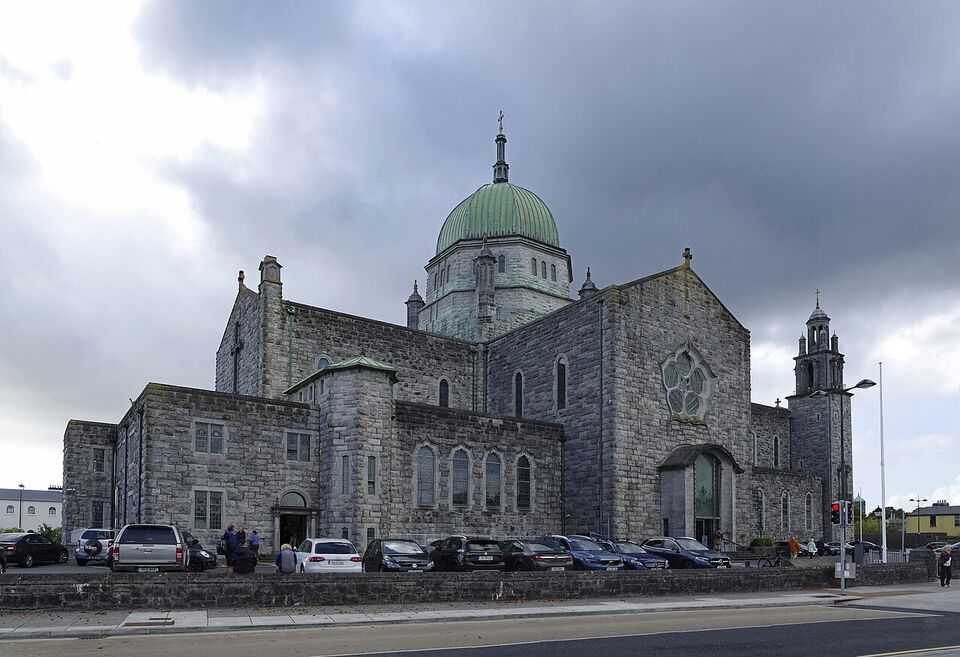
Overview
Galway (Gaillimh) is a compact university city of about 86,000 people on the River Corrib, where it meets Galway Bay. It is worth a stay of two nights for its pedestrian center, its live music and its seafood, and it works as the best base on the west coast. From here Connemara, the Aran Islands and the Cliffs of Moher are all a day trip, and you do not need a car for most of them.
The city has a long record of trade and festival. It was the principal Irish port for trade with Spain and France in the Middle Ages, was named a European Region of Gastronomy for 2018, shared the title of European Capital of Culture for 2020, and has been a UNESCO City of Film since 2014. It is also near the Irish-speaking region (Gaeltacht) of Connemara, and you will hear Irish spoken in shops and on the street more than in other cities. Almost everyone speaks English, and no one expects you to speak Irish.
This page covers getting there, the center, Salthill, music and food, festivals, where to stay, day trips, parking and a rain plan. For the wider coast, see the Wild Atlantic Way and our map of Ireland's destinations.
Getting to Galway from Dublin and Shannon
By train
Irish Rail runs Dublin Heuston to Galway Ceannt Station in just under 3 hours, with about six return services a day, according to the most recent public summary we found. Check irishrail.ie for the timetable and fares, which vary by time and how early you book. Ceannt Station sits beside Eyre Square, so you step off the train into the center. From Galway, trains also run to Ennis and Limerick, about five or six each way per day, and on to Cork via Limerick Junction and Mallow.
By coach
Citylink and Aircoach run scheduled coaches between Galway Coach Station (at Fairgreen, a few minutes from Eyre Square) and Dublin and Dublin Airport. Coaches are a good option from Dublin Airport because you avoid the city. Check the timetable and fares on citylink.ie, since schedules change by season and during large events.
By car
The M6 motorway links Dublin and Galway via Athlone. Plan roughly 2.5 to 3 hours of driving without stops, and check a route planner for your day, as traffic leaving Dublin on Friday evenings is heavy. Some motorways have tolls (the M50 around Dublin has a barrier-free toll, €2.60 to €3.80, or about $3 to $4, depending on how you pay), so ask your rental company how tolls are handled. See driving in Ireland and car rental.
From Shannon Airport
Shannon is about 90 km (56 miles) by road from Galway, mostly on the M18 motorway, roughly 1 to 1.25 hours. There is no train from the airport. Most visitors pick up a rental car at Shannon, which also has US preclearance for the flight home (CBP lists Shannon hours as 9 a.m. to 5 p.m.). If you do not want to drive, buses connect through Limerick or Ennis, but check the connections on the day. Ireland West Airport Knock is also about 86 km away, though it has fewer transatlantic links. See the flights guide and getting around.
The center: Eyre Square, Shop Street and the Latin Quarter
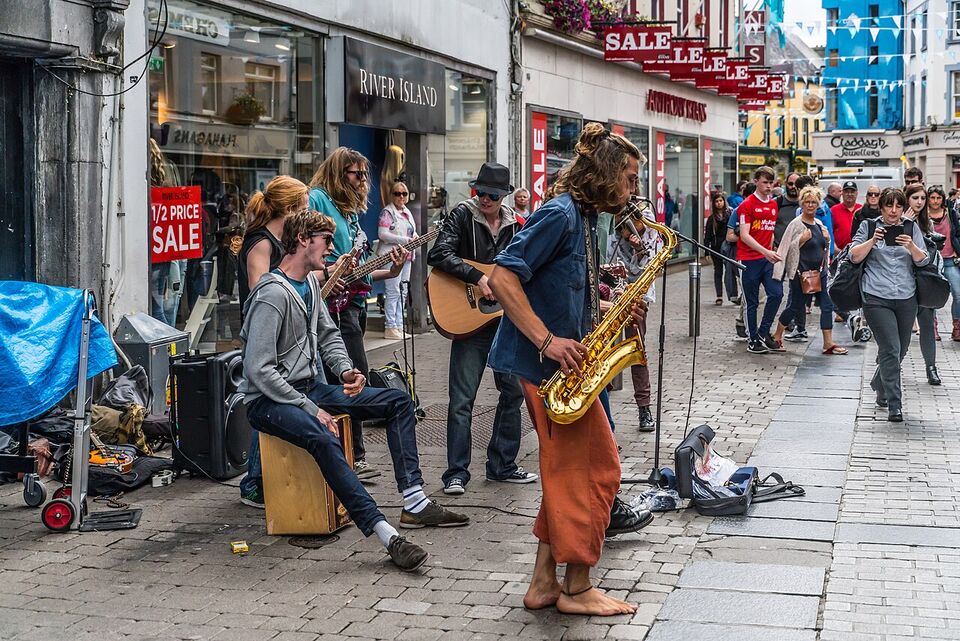
The center is small enough to see on foot in an afternoon. A typical walk begins at Eyre Square, passes through the pedestrian streets and ends at the river. The streets from Shop Street to Quay Street are the part visitors usually mean by the Latin Quarter, a tangle of narrow, medieval-looking lanes with shops, buskers, pubs and cafés.
Eyre Square
The park and square beside the station and the coach stops. This is also where the Christmas market sits in winter.
Shop Street
The busiest street in the center, with shops, pubs and street performers. Look for Lynch's Castle, a 16th-century townhouse built by the prosperous Lynch family and now a bank branch.
St Nicholas' Collegiate Church
Said to be the largest medieval church still in everyday use in Ireland. Check opening times before you go, because visiting hours depend on services.
Quay Street and the West End
The lanes between Quay Street and the river fill up at night. The West End, west of the river, is quieter and has more local restaurants.
Galway City Museum
The museum covers the city's heritage and has Irish art from the second half of the 20th century. Check hours and admission on the museum's own site.
Nora Barnacle House
A tiny house museum about the wife of James Joyce, described as the smallest museum in Ireland. Hours are limited, so confirm before you go.
The Spanish Arch, the Long Walk and the Claddagh
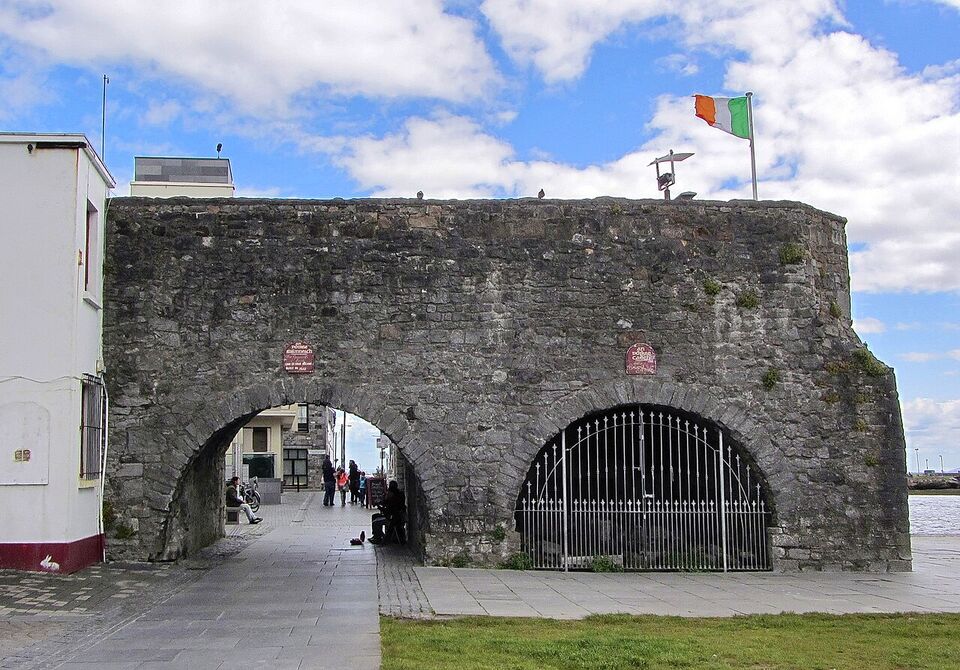
The Spanish Arch is what remains of a 16th-century extension to the city walls, built in the early 1500s, with the Irish name ceann an bhalla ("the end of the wall"). It overlooks the River Corrib where it flows into Galway Bay, and on dry days the grass and quay beside it fill with people. It is a reminder of the city's medieval trade with Spain and France.
From the Arch, a short walk along the water leads to the Long Walk, a row of colorful houses facing the river mouth. On the west bank is the Claddagh (An Cladach, "the shore"), now a residential district but for centuries an Irish-speaking fishing village outside the city walls. Its fisher families were governed by an elected "King of the Claddagh", who settled local disputes and had the privilege of a white sail on his fishing boat. The last holder of the title died in 1972, and it is now only an honorary, ceremonial title.
The area is also tied to the Claddagh ring, with its design of two hands holding a crowned heart. The ring is sold across the country and in many souvenir shops. If you want one, ask where it was made and buy from an established jeweler, not from the first tourist stall you pass.
Salthill and the promenade
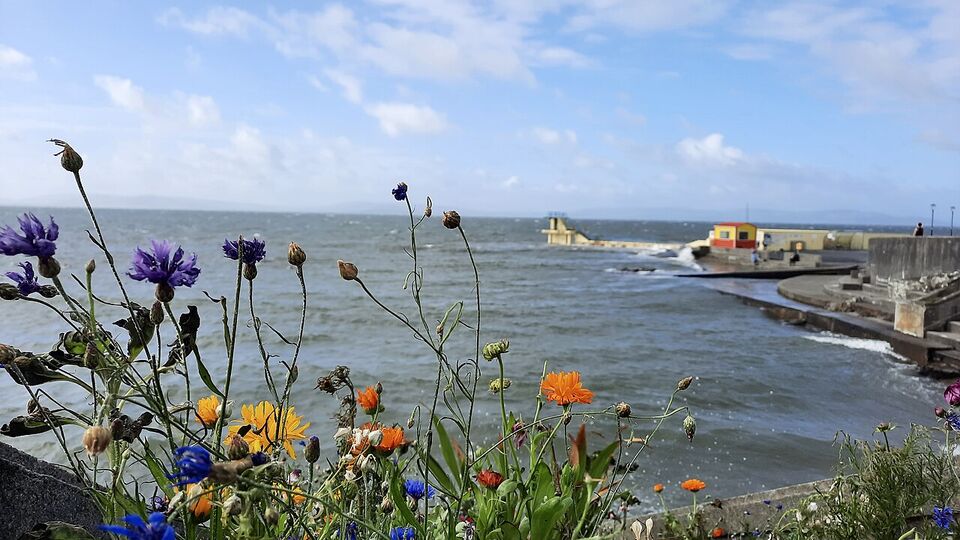
Salthill is a seaside suburb just west of the center, joined to it by the seafront and Grattan Road. Its promenade runs along Galway Bay and is one of the best free things to do in the city: a flat walk of roughly 1.5 miles (2 km) with views across the water toward County Clare on a clear day. The walk from the Spanish Arch is roughly 25 to 35 minutes at an easy pace. Local buses also serve Salthill, though route numbers change, so check the current map on transportforireland.ie.
Salthill suits families and anyone who wants a sea view, an amusement arcade or a long beach walk. It is quieter at night than the center. In winter, Leisureland hosts a pop-up ice rink: Galway Skates runs November 6, 2026 to January 3, 2027, according to a local travel blog, so confirm dates before you plan around it.
Watch out
The promenade is exposed. In a westerly wind, waves can reach the path at high tide, and in a storm the walkway may be closed. Check the weather and tide before you set out, and keep children away from the sea wall.
Live music and pubs
Galway is known for traditional music, and sessions (seisiún) take place in pubs most evenings, with the busiest nights on weekends. A session is a group of musicians playing traditional tunes together, usually on fiddles, flutes, tin whistles, concertinas, accordions and the bodhrán (a frame drum). It is not a show with a stage, and it begins when the players settle in, not at an exact time.
- Arrive early if you want a seat near the musicians. Evening sessions often start around 9 p.m., though times vary by pub.
- Keep conversation low while tunes are playing. Applaud at the end of a set, not each tune.
- Buy a drink as a courtesy, and do not request songs or join in unless invited.
- Ask before filming or taking close-up photos of the musicians.
- Look for pubs with live music and no cover charge. Many have none, and the better ones are not always the busiest.
The average pint of stout in Ireland was €6.08 (about $7) in November 2025, according to the Central Statistics Office, and prices in the center of a tourist city tend to run higher. The craic (craic, pronounced "crack"; good company and good fun) depends more on the room than the venue. For etiquette, rounds and pub food, see pubs, drinks and etiquette.
Insider tip
For the best chance of hearing proper traditional music, walk the side streets of the Latin Quarter and the West End in the early evening and listen from the doorway. Sessions vary night to night, so follow the sound of the tunes, not a name.
Food: oysters and seafood
Galway sits on a bay with a long record of oyster and shellfish harvesting, and seafood is the local specialty. Look for seafood chowder, oysters, mussels, smoked salmon and the catch of the day. Native oyster season is often said to start in September and run into spring, so ask what is in season. Menus in the center often list local suppliers.
The city hosts the Galway International Oyster Festival in late September. The 2027 dates are not confirmed, but a local festival calendar suggests September 24 to 26, so check the official listing before you plan. Outside festival time, a plate of oysters and a glass of stout is a classic combination.
- For a quick lunch: chowder and brown bread at a pub or café in the center.
- For dinner: reserve in the evening for weekends and festival weeks, especially on Quay Street and in the West End.
- For breakfast: a full Irish breakfast is standard, and most B&Bs include it.
Tipping is not required in Ireland. Many people round up or leave a little for good table service. Check your bill for a service charge first: a mandatory charge must be shown on the menu or signs. See food for dishes to try.
Festivals and events
Galway has a festival almost every month, and the biggest ones drive hotel prices up. Full dates are on the festivals page, and the ones that matter most for planning are these:
- Christmas market (2026): Eyre Square, November 6 to December 22, 2026, with free entry and more than 70 chalets. A Big Wheel and amusements stay until January 3, 2027. A local blog lists hours of Monday to Wednesday 12 to 8 p.m., Thursday to Saturday 10 a.m. to 10 p.m. and Sunday 10 a.m. to 8 p.m.; check the organizers for changes.
- Galway International Arts Festival (July): usually two weeks in July. A blog lists July 12 to 25, 2027, so check the festival site.
- Galway Film Fleadh (July): a film festival of about six days, held each July.
- Galway Races (summer): the 2027 festival is listed for Monday, July 26 to Sunday, August 1, 2027, at Ballybrit racecourse, with Ladies Day on Thursday, July 29. Galway Tourism says dates are liable to change. The week fills hotels and raises prices across the city.
- Galway International Oyster Festival (September): see above.
Save money
Book rooms as early as you can for race week and arts festival fortnight, or choose a different week. Outside festival dates, mid-week stays and shoulder-season months are noticeably cheaper. Compare options in where to stay.
Where to stay
We do not name hotels, because availability and quality change. Instead, choose a neighborhood by what you want to do, then check recent guest ratings on an independent site. For a sense of cost, Fáilte Ireland data showed an average hotel room rate of €174 (about $195) a night across the country in 2025. Galway rates rise sharply around festivals and weekends. Tiers below are for a double room per night: $ under $120, $$ $120 to $300 and $$$ over $300.
| Area | Best for | Watch for | Typical tier |
|---|---|---|---|
| Eyre Square and the station | Train arrivals, tours that leave from the square, short stays | Busy streets, some traffic noise | $$ |
| Latin Quarter and Quay Street | Walking to music and restaurants | Noise late at night, especially on weekends; ask for a quiet room | $$ to $$$ |
| West End and Dominick Street | Quieter evenings and local restaurants | A longer walk to Shop Street | $ to $$ |
| Salthill | Sea views, families, parking | A 25 to 35 minute walk or a bus to the center | $ to $$ |
| Hostels and guesthouses | Budget stays and solo travelers | Book early in summer | $ |
B&Bs often run roughly €60 to €150 a double (about $67 to $168), according to a travel cost guide, and usually include a cooked breakfast. If you book a short-term rental, note that registration rules are being introduced: a bill published on October 6, 2026 would require hosts to display a registration number on every listing, but it has not passed yet.
Day trips from Galway
Galway is the best day-trip base on the west coast. The table compares the four main trips, and each has its own guide.
| Trip | How | Time | Notes |
|---|---|---|---|
| Connemara | Self-drive or day tour | Full day | Kylemore Abbey is about 1 hour 25 minutes from Galway by the abbey's estimate; the national park visitor centre is closed Monday and Tuesday |
| Aran Islands | Ferry from Rossaveel; shuttle bus from Victoria Place, Galway | Full day | Rossaveel to Inis Mór takes 40 minutes; adult return €34 (about $38), shuttle €10 (about $11) return |
| Cliffs of Moher | Self-drive, tour or seasonal boat | Half to full day | Gate admission €15 (about $17) for adults in 2026, cheaper online; open 9 a.m. to 5 p.m. in November and December, closed December 24 to 26 |
| The Burren | Self-drive, usually with the Cliffs | Half day | Limestone landscape with its own plants and rock formations |
A seasonal Aran Island Ferries sailing runs from Galway city directly to Inis Mór and the Cliffs of Moher, leaving at 9:30 a.m. with a sailing time of 90 minutes. It does not run year-round, so check aranislandferries.com for winter timetables. The Inis Oírr winter timetable (September 30 to December 23, 2026) has a bus from Galway at 9:30 a.m. and a ferry at 10:30 a.m., with afternoon return sailings on most days, and no services on December 25 and 26. Inis Mór and Inis Meáin winter times should be checked on the ferry site. Children under 5 travel free but must be booked.
Day tours leave from Galway for all four destinations. Prices and winter schedules vary, and several skip days from November to March, so check the operator's site and ask what is included. Book a boat or tour with free cancellation, since wind and rain affect all of them. Our guide to the Wild Atlantic Way explains how the pieces fit together.
Parking and traffic
Do not plan to drive in the center. The main streets are pedestrian, and one-way systems and bus lanes make short hops frustrating. Park once and walk. Covered car parks near Eyre Square include Q-Park Eyre Square, the Corrib Centre and Fairgreen, according to the Christmas market organizers. For longer stays they list the Greyhound Track, Dyke Road and Galway Cathedral, and for shorter stays Mill Street and Bowling Green. Fees change, so check signs and apps for current rates.
- If you stay in the center, ask your hotel about parking before you book. Not all hotels have it.
- If you stay in Salthill, you can often park at your hotel and take a bus or walk into town.
- Rush hours are slow, and race week and summer weekends are slower. Avoid driving into the center at those times.
- Do not leave bags visible in a parked car anywhere in the city.
If you are collecting a rental car, do it on the day you leave Galway, not the day you arrive.
A rain plan
Galway has about 170 rain days a year, and November and December average 17 rain days a month. Daytime highs average about 52°F (11°C) in November and 48°F (9°C) in December. You will get wet at some point, and the city copes well. Here is a rain plan for a half day:
- Museums: Galway City Museum and the Nora Barnacle House, hours permitting.
- St Nicholas' Church and Galway Cathedral: both are open to visitors outside services.
- Theatre and cinema: the Druid Theatre Company, Taibhdhearc (the Irish-language national theatre, founded in 1928) and the Pálás arthouse cinema all host evening shows.
- Pubs and cafés: a long lunch with chowder, then a session.
- Shopping: Shop Street and the covered shopping centers.
If the rain is heavy, delay the Connemara day. Views of the Twelve Bens disappear in cloud and the road is less enjoyable. See when to go and packing.
One day and two days in Galway
- Day 1
The center and the sea
Walk from Eyre Square down Shop Street to the Spanish Arch, then along the Long Walk and past the Claddagh. Take the Salthill promenade in the afternoon, and have dinner in the West End. Look for a session late in the evening.
- Day 2
A day trip
Choose Connemara by car or tour, the Aran Islands by ferry, or the Cliffs of Moher and the Burren. Be back by early evening for dinner and music.
Two nights is the minimum, three is better, and a fourth night lets you do two day trips without rushing. For longer plans, use the trip builder.
Add it to a route in the trip builder, or ask us to plan the hotels, trains and guides for you.