Overview: the Algarve in one page
The Algarve is Portugal's southern coast, a strip of about 100 miles (160 km) running from the Spanish border in the east to Cabo de São Vicente in the west. It is known for sandstone cliffs, small coves, long sandy islands, golf courses and a long season of warm weather. It is also Portugal's most developed holiday region, with busy resort towns, so choosing the right base matters more here than almost anywhere else in the country.
We suggest thinking of the coast in three parts. The east (the Sotavento, or leeward side) is flat, calm and more traditional, centered on Tavira and the Ria Formosa lagoon. The center is the busiest, with Albufeira, Vilamoura, Carvoeiro and Portimão. The west (the Barlavento, or windward side) is rugged and windier, with Lagos, Sagres and the Atlantic coast. Our Lagos and West Algarve page covers that last part in more detail.
This page helps you pick a base, understand the beaches against the old towns, get there, decide on a car, time your visit and prepare for boat trips and local fees. For a detailed look at sand, safety and flags, read our beaches guide.
The coast in three parts
The east: Sotavento
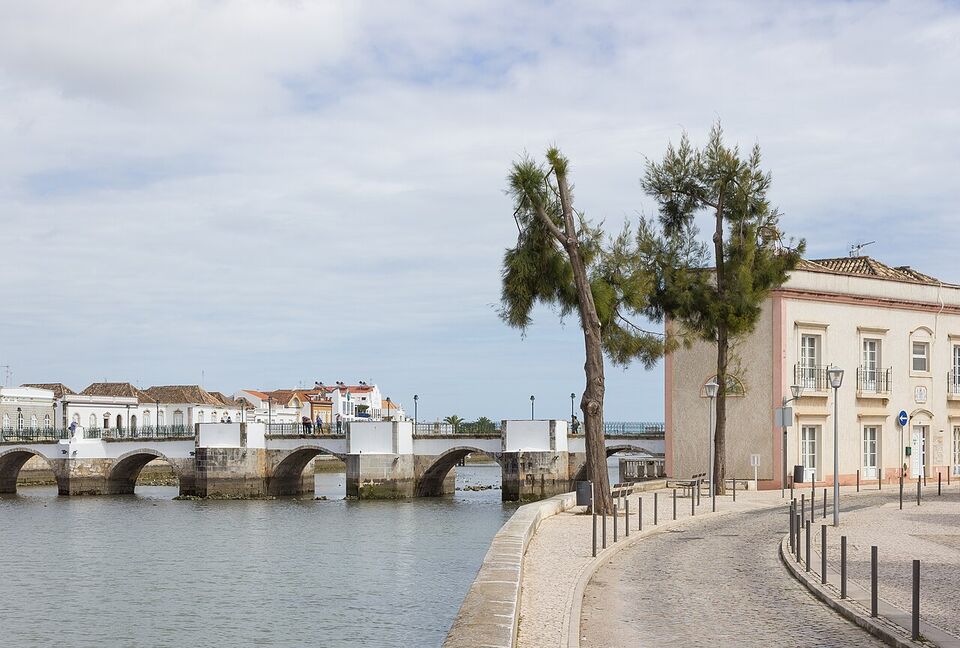
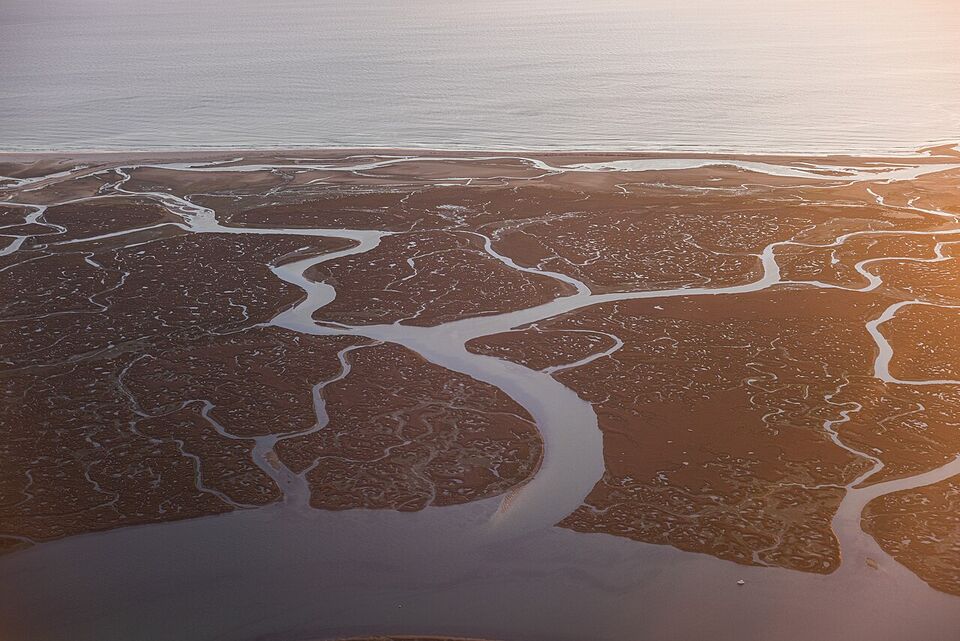
The eastern Algarve runs from Faro to the Spanish border at the Guadiana River. The sea is usually calmer here, and the beaches are long and shallow, often on barrier islands reached by a short boat ride. The Ria Formosa is a protected lagoon of channels, sandbanks and salt marsh that stretches along the coast near Faro, Olhão and Tavira. Tavira is a small town on a river, with a pedestrian bridge over the river, old churches and a relaxed feel. Beyond it, Vila Real de Santo António and Castro Marim sit near the border, where a ferry crosses to Ayamonte in Spain. Spain is one hour ahead of Portugal, which matters for ferry and train times.
This side suits families with young children, couples who want a quiet beach and travelers who prefer a more local atmosphere. It is usually less busy than the center, and prices tend to be lower than in the resort towns, though we have no 2026 figures to quote.
The center: the resort strip
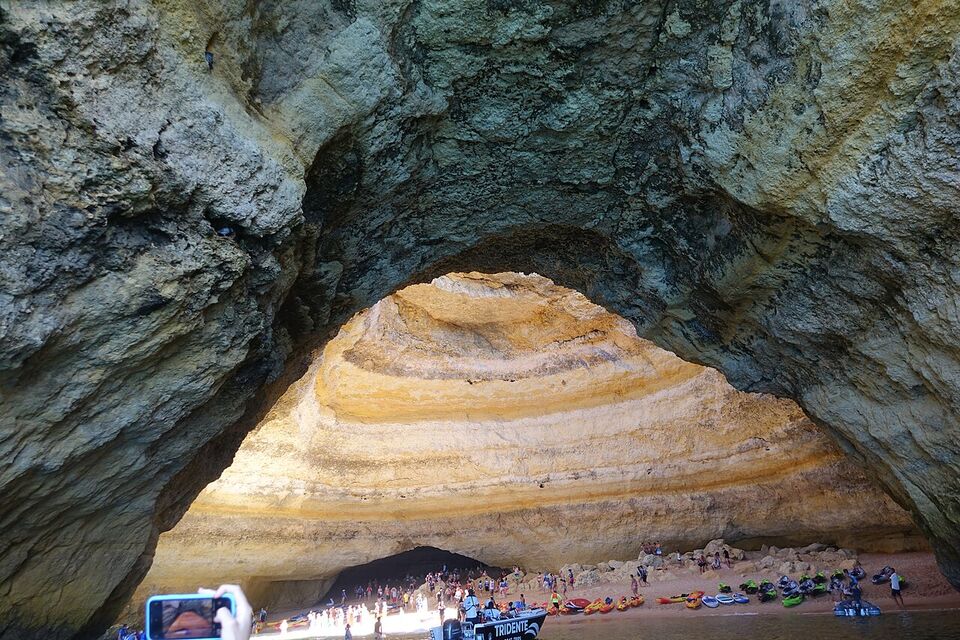
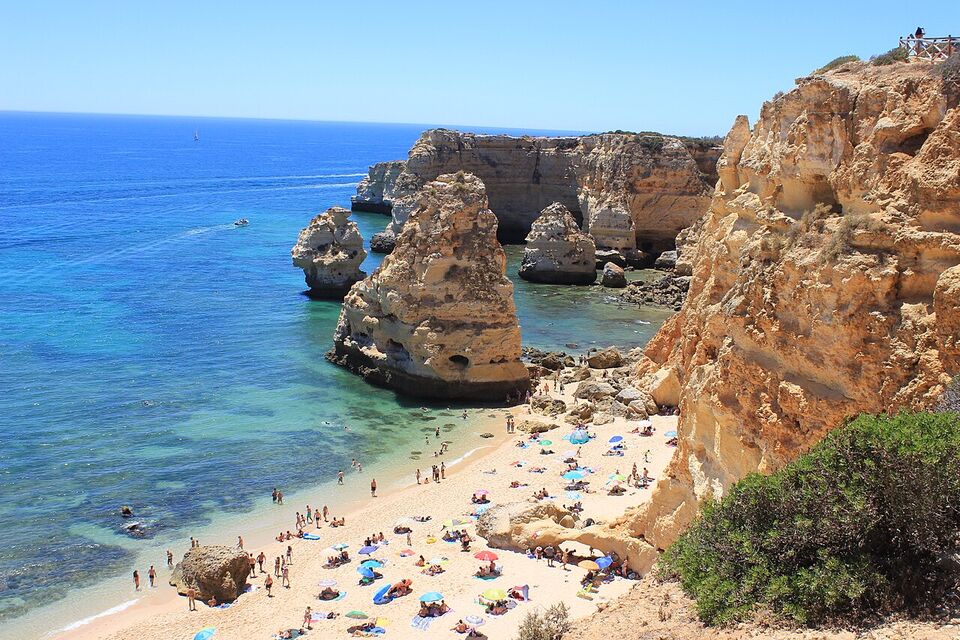
From Albufeira to Portimão, the coast is a mix of cliffs, caves and golden coves. Albufeira has a lively old center, a famous nightlife area and beaches reached by steps or a tunnel. Vilamoura is a planned resort around a large marina with golf courses. Carvoeiro is a smaller village around a small beach. Portimão is a working town, with Praia da Rocha a long beach beside it. Benagil and Praia da Marinha, with some of the coast's best-known cliff scenery, are a short drive from Lagoa and Carvoeiro, and a reference source says the Michelin Guide has praised Marinha.
This is where most package holidays are based. It is convenient, with many restaurants and hotels, and it is crowded in July and August. Choose it if you want easy services, nightlife and family facilities.
The west: Barlavento
West of Portimão, the coast becomes more rugged. Lagos is the main base, with a walled old town, a marina and nearby cliffs. Beyond Lagos, villages such as Luz, Burgau and Salema have smaller beaches, and Sagres and Cabo de São Vicente sit at the end of the country. The Atlantic is rougher and colder here, and the wind is stronger. This side suits hikers, surfers and travelers who like scenery more than resorts.
Where to base yourself
| Base | Feel | Best for | Car needed? |
|---|---|---|---|
| Faro | Small city, airport nearby, old walled center | Short stays, arrival and departure nights, the Ria Formosa | No |
| Tavira | Quiet, historic, riverside | Couples, slow trips, island beaches by boat | No for the town; yes for the wider coast |
| Albufeira | Busy, nightlife, big beaches | Groups, first-timers, families who want services | No |
| Vilamoura | Planned resort, marina, golf | Golf, families, easy hotels | Helpful |
| Carvoeiro / Lagoa | Village feel near cliffs and caves | Coves, boat trips, short drives | Helpful |
| Portimão / Praia da Rocha | Mixed, urban with a long beach | Transport links, restaurants, sardines | No |
| Lagos | Walled town, marina, social | Beaches within walking distance, cliffs, boat trips, nightlife | No for the town; yes for the far west |
| Sagres | Windy, remote, surf-focused | Surfing, cliffs, quiet, sunsets | Yes |
Hotel costs vary widely by season, so use tiers rather than exact prices. A simple guesthouse is typically $, a mid-range hotel or apartment $$ and a luxury resort $$$, with August rates well above those of May or October. The national average revenue per occupied hotel room was about €130 (about $146) in the second quarter of 2026, according to national statistics, but that figure covers the whole country and not the Algarve alone. See where to stay for how to choose.
Beaches versus old towns
The Algarve has two kinds of appeal, and many visitors underestimate how different they are. The beaches are the reason most people come: sandy coves under orange cliffs, long barrier islands and wide Atlantic strands. The old towns are quieter and cultural: Tavira, Faro, Silves and Lagos have castles, churches, markets and cafes.
A good plan mixes them. Spend mornings at a beach, when the light is soft and the crowds are thin, then move to a town for lunch and an afternoon walk. If you dislike crowds, avoid the central beaches in July and August, or arrive before 10 a.m.
Watch out
Cliffs along the Algarve can be unstable. Stay behind marked barriers, do not sit directly under overhangs and do not walk to the edge for photos. Rockfalls have injured beachgoers in the past. See our beaches page for flags, rip currents and sea-arch safety.
Parking and beach costs
Many popular beaches have paid parking in summer or limited spaces, and some have car-free access roads. Rules and prices change from year to year, so we cannot quote a figure with confidence. Check the local council (câmara municipal) website before you go, and carry coins for meters. Sunbeds and umbrellas at beach concessions are charged by the set, and prices vary by beach and season. Ask before you sit down.
How to reach the Algarve
By air
Faro airport is the gateway. EES (the Entry/Exit System) registration of fingerprints and a photo applies to non-EU visitors at Faro, as at Lisbon, Porto, Funchal and Ponta Delgada. Direct flights from the US are limited and seasonal, so most Americans connect through Lisbon or Porto, or through another European city. See our flights page for more. Time in Portugal is Western European Time, five hours ahead of New York most of the year, and four hours ahead for about two weeks in March and again from late October to early November when the US and EU clocks change on different dates.
From the airport, bus routes 14 and 16 run daily to Faro's bus station, and the train station in Faro is about 3.5 miles (5.7 km) away, near the bus station. There is no rail link to the terminal. Taxis, ride-hailing and rental cars are also available. The A22 motorway runs close to the airport and along the whole coast, and it has been toll-free since January 1, 2025.
By train
CP trains link Lisbon with Faro, and a regional line runs along the coast from Vila Real de Santo António through Faro to Lagos. The trip from Lisbon to Faro takes roughly 3 hours, although times and changes depend on the service, so check cp.pt. The coastal line is slow but useful, and it is a pleasant way to reach Tavira, Albufeira (the station is a few miles from the beach), Portimão and Lagos. Book long-distance tickets early for summer weekends.
By bus
Express coaches run from Lisbon to Faro, Albufeira, Portimão and Lagos, with typical journeys of roughly 3.5 to 5 hours depending on the stop. Rede Expressos (rede-expressos.pt) is the main operator, and FlixBus runs some routes. Local buses connect the main towns but are less frequent in winter. We have no confirmed fares.
By car
From Lisbon to the central Algarve is a drive of about 2.5 to 3 hours on motorways, and some stretches charge tolls. Your rental car will have a Via Verde device, and the rental firm bills the tolls afterward; Hertz, for example, charges €2.21 a day (about $2.48) up to €22.14 per rental (about $25), plus tolls. The A22 along the Algarve itself is free. Our driving guide has more.
Do you need a car?
It depends on your base. Lagos, Tavira and Albufeira all work without a car, using trains, buses, taxis and boats. If you want to see more than one area, reach quiet coves, visit inland villages or travel to Sagres, a car makes a big difference. Many beaches sit at the end of narrow roads that buses do not use.
If you drive, leave early for popular beaches in summer. Parking fills by 10 a.m. at the best-known spots. Fuel was costly in November 2026: mainland averages on November 9 were about €1.92 a liter for gasoline (about $8.15 a US gallon) and about €2.14 for diesel (about $9.05 a gallon).
Insider tip
A mixed plan often works best: base yourself in a walkable town, use public transport for the first days and rent a car for just two or three days of exploring. This avoids paying for parking and a car that sits unused.
When to go
The Algarve has one of the longest seasons in Europe. Using long-term averages from Faro airport, daytime highs reach about 61°F (16°C) in January, about 69°F (21°C) in April, about 80°F (27°C) in June, and about 85°F (29°C) in July and August. Rain falls on about five to seven days a month from November to March and on almost no days from June to August. The sea is about 61-63°F (16-17°C) in January and warms to about 72-75°F (22-24°C) in August and September.
- March to May: mild and green, with wildflowers. The sea is still cold, so it suits walking more than swimming.
- June: warm, long days and fewer crowds than July and August.
- July and August: hot, dry and busy. Book hotels and car rental well ahead, and expect crowded beaches.
- September and October: the warmest sea and fewer visitors. Many travelers find this the best time.
- November to February: quiet, mild, wetter. Some restaurants and boat operators close for part of the season.
The west coast is often windier and cooler than the south-facing beaches. For a country-wide view, see when to go.
Boat trips and the Benagil caves
Boat trips along the coast are among the most popular activities. They visit sea caves, arches and small beaches that are hard to reach by land. The best known is the Algar de Benagil, a sea cave with a hole in its roof, near Lagoa and Carvoeiro. Trips leave from several harbors, including Benagil, Carvoeiro, Portimão and Albufeira, and range from short speedboat rides to longer sailing tours.
The national maritime authority (AMN) introduced new rules for the cave in August 2024. Under those rules, nobody may land on or use the beach inside the cave, kayaks cannot be rented without a guide in that area, entering by swimming or on flotation devices is banned, the number of boats and kayaks in the cave is limited, visit times are limited, and each guide kayak may lead only six touring kayaks. Operators can face fines from €300 to €216,000 (about $336 to $242,000). A reference source says visits are limited to about two minutes per boat. The cave lies in a protected marine park.
We found no 2026 update to these rules, but they may have changed. Check the current rules on the AMN website and with the local port authority before you book. Choose a licensed operator, ask if they enter the cave and wear the life jacket they give you. Swimming into caves has led to rescues, so do not try it.
Watch out
Rules for caves, kayak rentals and boat access can change from one season to the next. A booking that promises a landing or a swim in Benagil may no longer be allowed. Ask the operator in writing what the trip includes, and prefer a refundable booking.
Money, taxes and restaurants
Cards are accepted in most hotels, restaurants and shops, but carry some cash for small cafes, markets, beach kiosks and parking meters. Many Algarve towns charge a small tourist tax per person per night, usually in the range of €1 to €2 (about $1.12 to $2.24), often higher in high season. A summer 2025 secondary report listed Albufeira at €2 from April to October, Portimão at €2 from April to October and €1 from November to March, and Faro at €2 from March to October with €1 in the low season and an exemption for children under 16. These figures may have changed, so check the local council or ask your lodging.
At restaurants, you may find bread, olives, butter and cheese on the table before you order. This is the couvert. It is charged only if you eat it, and you can decline it or ask the price. The Algarve is known for grilled fish, and for cataplana, a seafood stew cooked in a copper pot shaped like a clam. Seafood is often priced by weight, so ask the price per kilo before you order. Our food guide covers more.
Different from home
Tipping is optional and nothing like US norms. Rounding up or leaving a few euros for good table service is common.
Quieter inland villages and day trips
Within about 30 minutes of the coast, the Algarve changes character. The hills, orchards and old villages are cooler, quieter and cheaper. Most are best reached by car, but some can be visited by bus or taxi.
Silves
A former Moorish capital with a red-stone castle above a riverside town. It is an easy trip from the central coast and has a good cathedral and market.
Loulé
A busy town with a covered market, old streets and a mix of local craft shops. Go in the morning, when the market is busiest.
Monchique
A forested range with a hill town and spa area. It is noticeably cooler than the coast and is one of the places where wildfire danger needs attention in summer.
Estoi
A village with a pink 19th-century palace and gardens, and Roman ruins nearby at Milreu. A quiet stop for people who like history.
Alte and Querença
Whitewashed villages with a few cafes and walking routes. They suit travelers who want a calm day away from the beach.
The interior also connects to the Alentejo. If you are driving north, our Évora and Alentejo page covers the next stop, and our golf and surfing pages cover those activities.
Safety, health and practical tips
- Respect flags and lifeguard instructions on beaches, and swim only where it is clearly allowed. Rip currents occur on Atlantic beaches.
- Sun is strong from April to October. Use sunscreen, a hat and water, especially on boat trips with little shade.
- Pickpockets work crowded beaches, trains and nightlife streets. Do not leave bags unattended on the sand.
- Call 112 for emergencies. Our safety page explains more.
- In dry months, follow local fire rules, and check IPMA (ipma.pt) for daily fire-danger warnings.
- Many US mobile plans charge a daily fee in Europe; check yours before you fly.
The US State Department's advisory for Portugal was Level 1 (exercise normal precaution) on the US Embassy page in November 2026; check travel.state.gov. For other regions, see the regions overview.
Add it to a route in the trip builder, or ask us to plan the hotels, trains and guides for you.