The short answer
An American with a valid passport can enter Portugal without a visa and stay up to 90 days in any 180-day period. You do not need an ETIAS authorization yet, because that system is not in operation. What is new is the Entry/Exit System (EES): at your first entry to Europe's Schengen area, a border officer or a self-service kiosk will take your passport details, a photo and your fingerprints. After that, the process should be quicker on later visits.
This page sets out the rules in plain words and says which official site confirms each one. Rules at borders change, so use it to plan and then verify the key points before you fly with the three sources listed at the end: travel.state.gov, the EU's travel-europe.europa.eu site and the Portuguese authorities. The information here was checked in November 2026.
Watch out
Many websites sell "ETIAS applications" or "Portugal entry permits." ETIAS is not operating, and no payment is required to enter Portugal as an American tourist. If a site asks for money for an authorization, close it.
Passport rules
You need a valid US passport. The US Embassy in Lisbon says Americans must have a valid passport to enter, and that visas are required for stays longer than 90 days. The precise validity rule is where travelers get caught. Under the Schengen rules, many airlines and border officers expect your passport to be valid for at least three months after the day you plan to leave the Schengen area, and to have been issued within the last 10 years. We could not load the State Department's Portugal page when we checked, so treat the three-month figure as a safe planning rule, not a quotation: confirm it on travel.state.gov and with your airline.
A practical way to handle this: check your passport's issue date and expiry date before you book. If the expiry date is less than about six months past your trip, renew first. US passport processing times vary, and travelers who wait until they have booked flights are the ones who end up paying for expedited service. Carry a photocopy or phone photo of the photo page in a separate bag, and note that the US Embassy can help with a lost passport (see below).
Children need their own passports. If a child travels with only one parent, or with someone who is not a parent, carry a signed note from the absent parent or parents and a copy of the birth certificate. It is not a strict legal requirement for every border, but officers do sometimes ask, and airlines may too.
The 90-in-180 rule in plain words
The 90/180 rule is the same across the whole Schengen area, which includes Portugal, Spain, France, Italy, Germany and most other EU countries. It is not 90 days per country. Every day you spend in any Schengen country counts toward one shared total. The European Commission describes the limit as "up to 90 days within any 180-day period."
The rule is easier to apply with this routine. On any given day, look back 180 days from that date. Count how many days in that window you were inside the Schengen area. That number must be 90 or fewer. The day you arrive and the day you leave both count as days in the area. The window moves forward with you every day, so it is not a fixed "six-month block."
| Example | Days used | Result |
|---|---|---|
| Two weeks in Portugal, then 10 days in Spain and Italy | About 24 | Fine. All days count together. |
| Three months in Portugal (about 90 days), leave, return after 3 weeks | 90 in the last 180 | Too soon: you need earlier days to age out of the 180-day window first |
| 60 days in spring, return for 30 in autumn | 90 | Allowed if the two trips fall inside one 180-day window and total 90 or fewer |
| Month in Morocco or the UK mid-trip | Those days do not count | Days outside Schengen do not use up your allowance |
The EU runs a short-stay calculator on its migration and home affairs site, and it is worth using if your plans are anywhere near the limit. Since the EES began, the system also counts for the officers: it automatically detects overstayers. An overstay can lead to fines, an entry ban or trouble on later visits, and the EES makes it harder to talk your way out of one. If you want to stay longer than 90 days, see long stays and visas before you leave, because a long-stay visa has to be arranged in advance through a Portuguese consulate.
EES biometric registration, step by step
As of April 10, 2026, the EES replaces the stamping of passports. The European Commission says the system became fully operational on that date, after a progressive start that began on October 12, 2025. It registers your name, travel document details, a facial image, fingerprints, the date and place of entry and exit, and any refusal of entry. It covers non-EU short-stay visitors at the external borders of 29 European countries.
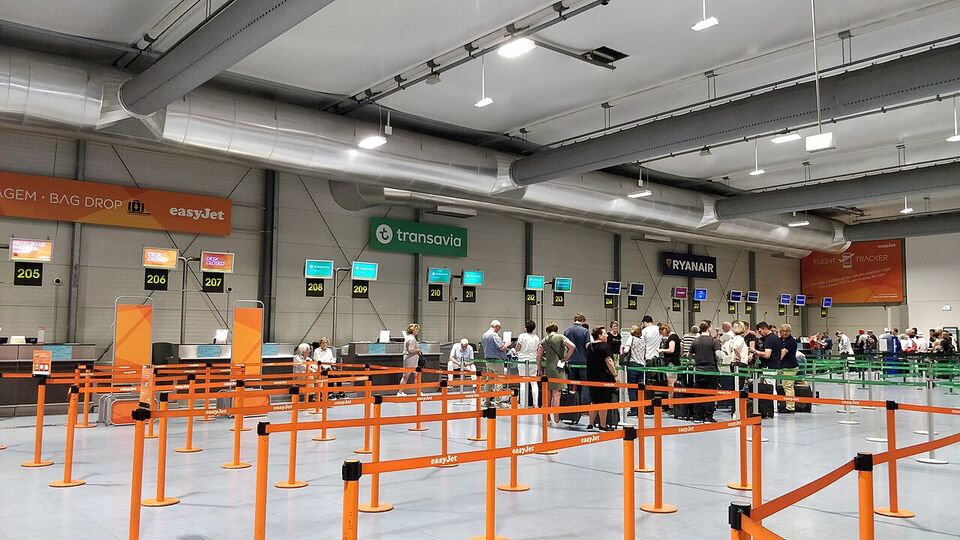
For Portugal, biometric registration applies at the five main airports: Lisbon, Porto, Faro, Funchal (Madeira) and Ponta Delgada (the Azores). You do it once, at your first entry to the Schengen area. If your first stop is Frankfurt, Paris or Madrid, you register there, not in Lisbon, and your flight on to Portugal is then an internal Schengen flight with no passport check. If you fly nonstop from the United States to Lisbon, Porto, Faro, Funchal or Ponta Delgada, you register on arrival.
- Follow the signs for passport control and take the non-EU line. Lines for EU, EEA and Swiss citizens are separate. US citizens use the line marked "All passports" or "Other nationalities."
- Use a self-service kiosk if one is open, or go to the officer's booth. The format depends on the airport and the day. If a kiosk is offered, staff will show you how to use it.
- Scan your passport. The photo page goes face down on the reader, or you hand it to the officer.
- Have your photo taken. Look at the camera without glasses or a hat, if asked. This is a live facial image, not your passport photo.
- Give your fingerprints. You place your fingers on a scanner. Clean, dry fingers read better.
- Answer questions. You may be asked a few short questions on a screen or by the officer, for example about the purpose of your trip. A border officer can ask for the address where you will stay and proof of return travel, so have your first hotel's name and your return ticket on your phone.
- Finish at the booth or gate. Once the officer has finished, you continue to baggage claim and customs.
On departure, the system checks you again at exit. At airports that use kiosks, you scan your passport and have your photo taken; fingerprints are normally taken at entry, but follow the instructions on the screen. Because the EES counts days automatically, the exit check is what stops your stay from showing as open-ended.
Different from home
At a US airport, you speak to an officer at a booth and your passport is stamped or scanned. With the EES, you may deal with a machine first, and the officer reviews the result. There is no stamp in your passport.
Queues at Lisbon and other airports
Queues at Lisbon have been long at times since the EES began. A Portugal News report from May 2026 said waits had sometimes run to several hours, while the European Commission denied that the EES was the cause. The same report said 360 extra border officers were due from July 2026. We do not have a current wait time for November 2026, so we give none: allow extra time and do not book tight connections.
A September 2026 report said the Commission had allowed some countries, including Portugal, to delay full implementation at problem crossings, so checks can be applied unevenly. Do not rely on that. Expect to give fingerprints and a photo, and never assume EES is suspended or optional. If an officer asks you to register, plan to do it: refusing can lead to a refusal of entry.
- Allow at least three hours between landing and any onward flight booked on a separate ticket.
- If you have a connecting flight to Madeira or the Azores on the same ticket, passport control is at your first Schengen airport. Leave plenty of time.
- Do your boarding-pass and hotel details before landing, and carry them on your phone, not in a checked bag.
- If you have mobility needs or a baby, ask staff for the priority line.
- For your departure flight, arrive earlier than you would at home: exit checks plus normal security can add time.
Airports in this guide: see Lisbon airport transfers for getting into the city after you clear the border, and flights to Portugal for which cities have US nonstops.
Children, families and special cases
Children are registered too. Under the EES rules as we understand them, children under 12 are not fingerprinted but do have a facial image taken, and people who physically cannot give fingerprints are exempt from that step. We could not confirm the age on a fetched page, so check travel-europe.europa.eu before you go. Families usually go through together, with a parent doing the kiosk steps for a young child. Bring all passports, and keep them where you can reach them.
If the kiosk does not work or does not read your passport, do not leave the line. Tell the nearest officer or staff member. Officers can register you at a staffed booth. If a kiosk says to see an officer, go to the booth rather than trying another machine. If a fingerprint scanner will not read your fingers, tell the officer; they have a procedure for this.
A refusal of entry is rare for Americans who meet the passport and stay rules. If you have a criminal conviction, ask a lawyer or the US Embassy before you go.
ETIAS: not required yet
ETIAS, the European Travel Information and Authorisation System, is a planned online travel authorization for visa-exempt visitors, including Americans. The European Commission's page, dated October 2025, says ETIAS is not in operation and that no applications for travel authorisations are being collected. The Commission says it will announce the start date "several months prior to its launch."
That is all we can state as fact. We do not give a start date or a fee, because neither was confirmed on an official page we could read in November 2026, and news articles disagree about the timing. Before you book, open travel-europe.europa.eu and look at the ETIAS page. When ETIAS does start, it will be an official government website or app, and applicants will apply online before travel. Anything else is a scam.
Customs: what you can bring into Portugal
Portugal follows the EU customs rules. For travelers arriving from outside the EU, limits apply to alcohol, tobacco and goods you carry for personal use, and large cash amounts must be declared when you enter or leave. We could not load the Portuguese customs page, so we do not give numbers here. The official place to check is the Portuguese tax and customs authority (Autoridade Tributária e Aduaneira) and visitportugal.com.
Some practical points hold in any case. EU rules restrict bringing meat and dairy products from outside the EU, so check before you pack them. Carry prescription medicine in its original packaging with a copy of the prescription, and keep it in your carry-on. Pets have their own rules (see traveling with a pet). Customs inspections are usually quick, and most arrivals walk through the "nothing to declare" lane.
When you buy goods in Portugal, you may be able to get a refund of the value-added tax (VAT). Visit Lisboa advertises "Tax Free Portugal" for the VAT exemption on purchases made by visitors from outside the EU. We do not have the refund rules or minimums, so ask the shop at the till and keep the paperwork. More in shopping and taking things home.
What you may bring home to the United States
US Customs and Border Protection (CBP) sets the rules at your arrival back in the US. These are the points that matter to most visitors, taken from the CBP site.
| Item | Rule |
|---|---|
| Duty-free exemption | $800 per person for a returning resident; usable once every 31 days, after at least 48 hours abroad |
| Tobacco within the exemption | No more than 200 cigarettes and 100 cigars |
| Alcohol | One US liter (33.8 fluid ounces) may be included if you are 21 or older and it is for personal use. More than a liter is dutiable and taxed even if you have not used up the $800. The law of your arrival state also applies. |
| Bakery items, certain cheeses | Generally allowed |
| Meat and meat products | Fresh, dried or canned meat from most foreign countries may not be imported; foods prepared with meat are not admissible |
| Cured ham, sausage (such as presunto and chouriço) | Generally not allowed; check cbp.gov and aphis.usda.gov before you buy |
Declare everything you buy, and keep receipts. If you carry wine or port, keep the bottles in checked luggage, wrapped, and remember the liter limit when you pack. The wine and port page has more about shipping a case home.
Save money
A bottle of port is 75 cl, so one bottle fits within the one-liter allowance; a second takes you over it. Over the limit, you pay duty and tax, not a ban. Declare it and pay at the desk; a small tax is cheaper than a fine for not declaring.
If something goes wrong
A lost or stolen passport is the most common problem. Report a theft to the police and go to the US Embassy in Lisbon (telephone +351 21 727 3300; see pt.usembassy.gov) for a replacement. The US consulate in Ponta Delgada serves the Azores by appointment: telephone +351 296 308 330, services on weekdays; after hours, call the Embassy in Lisbon. The State Department's emergency line for US citizens abroad is +1 202 501 4444. Enrolling in the Smart Traveler Enrollment Program (STEP) before you travel lets the Embassy contact you in a crisis.
For medical problems, the Portuguese SNS 24 health line is 808 24 24 24, and 112 is the EU-wide emergency number. More in safety in Portugal and health and medical care. The US advisory level for Portugal was Level 1, "Exercise normal precaution," on the US Embassy page in November 2026; check travel.state.gov for updates.
Where to verify each rule
Before you fly, check these three. They answer different questions, and no single site is complete.
- travel.state.gov: the State Department's country page for Portugal, with the passport advice, the advisory level and entry notes for US citizens. We could not load it when we checked, so read it yourself.
- travel-europe.europa.eu and the European Commission's migration and home affairs site: the official source for the EES and ETIAS, and for the short-stay calculator.
- The Portuguese authorities: border checks at airports are run by the Portuguese police. AIMA is the agency for residence permits, and we could not open its site in November 2026. If you plan a long stay, see long stays and visas. Hotels normally handle guest registration paperwork themselves.
Once you have your documents in order, go back to planning your trip to decide how to spend your days, and to phones, data and power for getting online when you land.
Add it to a route in the trip builder, or ask us to plan the hotels, trains and guides for you.