Overview
Madeira is a single steep volcanic island in the Atlantic, about 620 miles (1,000 km) southwest of Lisbon, with a mild climate, gardens, tunnels, waterfall-lined paths and cliffs that drop straight to the sea. Most American visitors give it four to seven nights. It is best for walkers, garden lovers and anyone who wants a gentle, scenic holiday that is easy to organize; it is not a beach destination in the way the Algarve is.
The island is roughly 35 miles (57 km) long and is crossed by a mountain ridge, so the weather and the pace change completely between the south coast (where Funchal sits), the north coast, the high plateau and the peaks. That is also why distances on a map mislead: a 20-mile (32 km) trip can take an hour on twisting roads. Madeira keeps the same time as Lisbon, so it is 5 hours ahead of New York for most of the year. The gap shrinks to 4 hours for about two weeks in March and again from late October to early November, because the US and Europe change their clocks on different dates.
It pairs well with Lisbon: see Portugal's destinations for how to combine it, and planning your trip for the overall frame. Madeira is an autonomous region of Portugal, so the euro, entry rules and EES border registration apply the same way as on the mainland. Funchal is one of the airports where EES biometrics are collected.
How to fly in
Madeira's airport (Funchal, FNC) is named after Cristiano Ronaldo and sits about 8 miles (13 km) northeast of the city. Most American travelers connect through Lisbon or Porto, then take a flight of about 1.5 to 2 hours. TAP, easyJet and other carriers serve Madeira from both mainland cities, and Wikipedia lists a seasonal United nonstop from Newark. Azores Airlines has also advertised Funchal fares from Boston and New York. Schedules and seasons change, so verify your routes on airline sites rather than relying on any list, and see our flights guide.
The runway is a tabletop built partly on tall concrete pillars, with cliffs and hills at both ends. Pilots need extra training to land there, and wind shear limits cause frequent delays, diversions and cancellations. A flight can divert to Porto Santo or the mainland and leave passengers to sort out the onward leg. This is a risk, not a reason to avoid the island, but it is a reason to build in buffers.
Watch out
Do not book a tight connection home on the day you leave Madeira. If strong wind closes the airport, you may be delayed a day or more. Keep the last night's hotel flexible, travel with insurance that covers delays, and do not schedule a cruise departure or an important event for the same day. Verify current conditions with your airline.
From the airport to Funchal, taxis and the airport bus are the usual choices, and the journey is about 8 miles (13 km), which we estimate at 15 to 25 minutes depending on traffic. Fares change, so check the airport website at aeroportomadeira.pt and agree a price or use the meter.
Where to stay: Funchal, the north or Calheta
Pick a base by what you want to do each day. Funchal is the safe first choice: it has the harbor, the old town, the cable cars and the market, plus the most restaurants and buses. The north is wilder, wetter and much quieter. Calheta, in the southwest, has a marina, a sandy beach and more sun than the north.
| Area | Best for | Weather feel | Trade-offs | Hotel cost |
|---|---|---|---|---|
| Funchal | First visits, no-car trips, restaurants, gardens, cable cars | Mild, sunny south coast | Hilly; traffic; some hotels are far from the old town | $ to $$$ |
| Câmara de Lobos and Cabo Girão area | Fishing village feel, cliffs, short drives to Funchal | Mild, can be windy | Fewer hotels; steep access | $ to $$ |
| Calheta and the southwest | Beach, marina, quieter evenings, Paul da Serra access | Sunniest part of the island, typically | Far from Funchal and the north; car or taxis needed | $$ |
| Porto Moniz and the northwest | Lava pools, dramatic coast, quiet | Cooler, wetter, windy | Remote; limited dining and transport | $ to $$ |
| Santana and the north coast | A-frame houses, laurel forest, walks from the door | Cloud and rain often | Slow roads; early dinners | $ to $$ |
| Eastern Madeira (Machico, Caniço, São Lourenço) | Near the airport, bays, coastal walks | Drier and windier | Further from the western sights | $ to $$ |
Hotel prices vary a lot by season and spike around New Year, Carnival and the Flower Festival. Funchal charges a tourist tax of about €2 (about $2.25) per person per night, and a separate cruise-passenger fee of about the same amount has been reported; check the Funchal council before you go, since rates change. Many Funchal hotels sit on the slope above the harbor, so ask about walking distance and whether a shuttle runs.
Funchal: the old town, cable cars and Monte
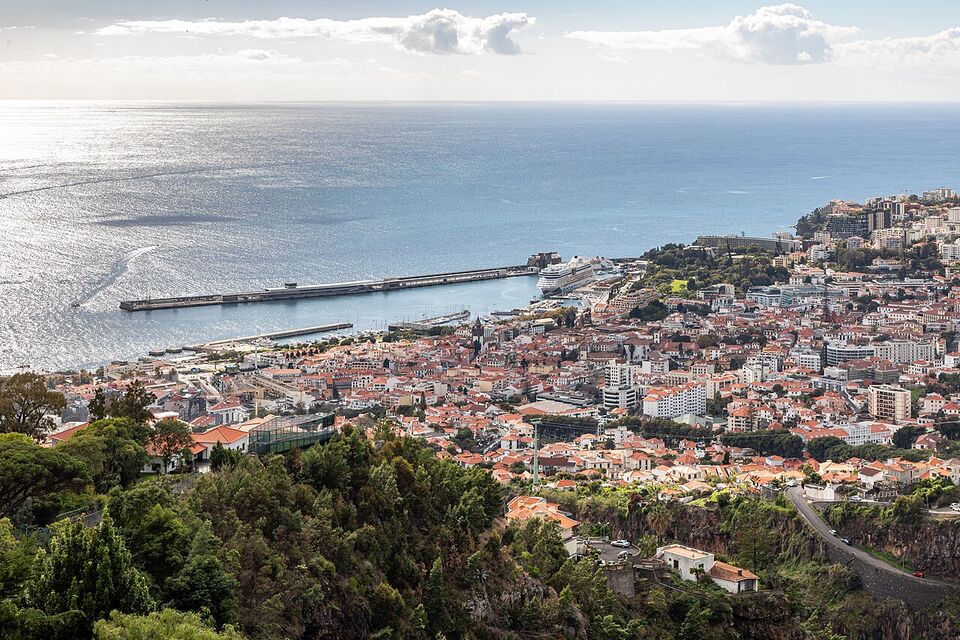
Funchal is a harbor city on a hillside amphitheater. The old town (the Zona Velha) has narrow lanes with painted doors, the Mercado dos Lavradores (the farmers' market) has fruit, flowers and fish, and the cathedral dates to the early 1500s. Give it a day, then use it as a base.
Funchal Cable Car to Monte
A gondola lifts you from the old town up to the hillside suburb of Monte, with views over roofs and bananas. A second cable car links Monte with the Botanical Garden. Ticket prices and hours change, so check the operator's site before you go, and watch for wind closures.
Monte
Monte has a hilltop church and the Monte Palace Tropical Garden. The traditional wicker toboggan ride (carro de cesto) down narrow streets is a quirky tradition with a fixed price; confirm the price and that it is running.
Botanical Garden
A hillside garden with views of the harbor, reachable by cable car from Monte, by bus or by taxi. Good for a lazy half day or a day with children.
Cabo Girão skywalk
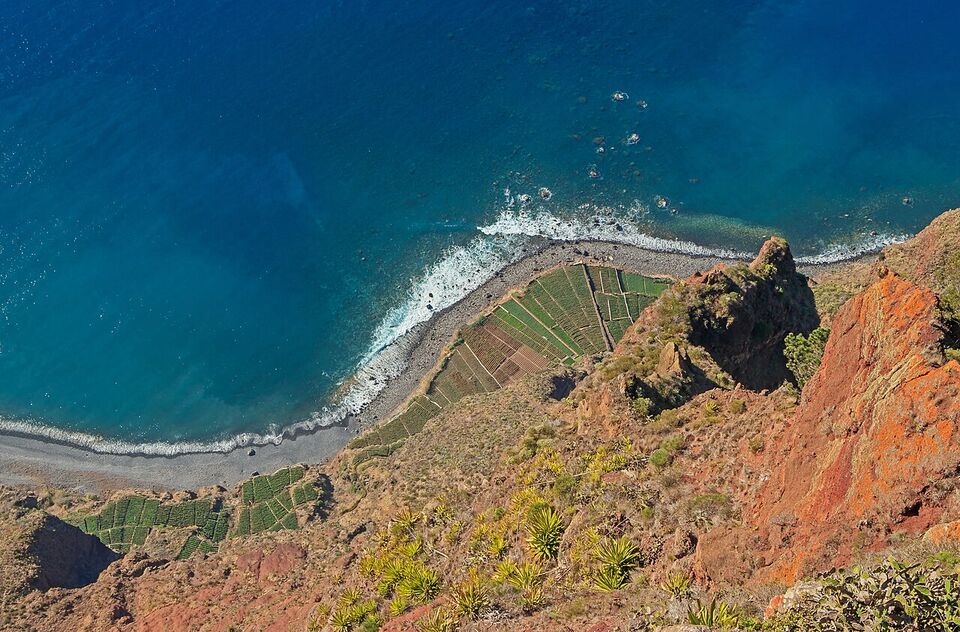
A viewing platform with a glass floor on one of the highest sea cliffs in Europe, at roughly 1,900 ft (580 m). Reach it by car or tour, then take the short walk or a small cable car. It is wind- and cloud-dependent; check before you go.
Mercado dos Lavradores
Come in the morning for tropical fruit (try the custard apple and passion fruit) and the fish hall. It is an easy first stop on a walking tour of the old town.
Hours and ticket prices change, so check each official website. For rain, the Funchal museums and the Madeira wine tasting rooms are the easiest fallbacks.
Levadas and trail rules
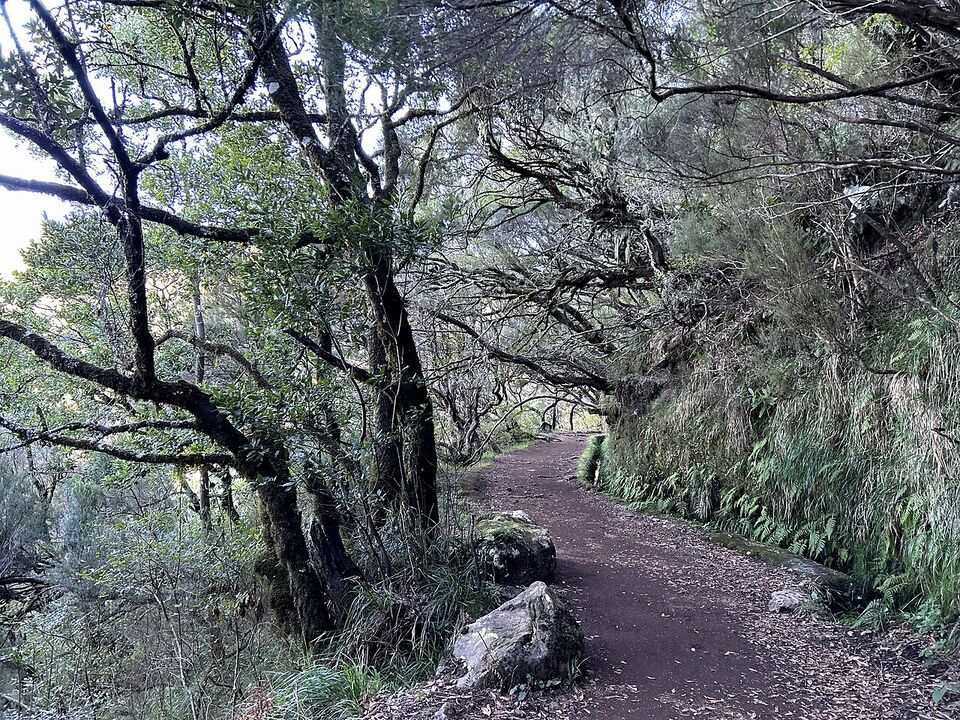
Levadas are narrow irrigation channels, built over centuries to carry water from the wet north to the dry south, with maintenance paths alongside. Walking them is the main reason many visitors come. Some are flat and easy; others run along cliff edges with drops and tunnels. The island's laurel forest (laurisilva) is a UNESCO natural site and covers much of the interior.
Booking and fees
Since January 1, 2026, access to the classified PR trails requires a mandatory online booking through the regional government's SIMplifica platform. You choose the trail, date and a 30-minute entry slot, and you pay at the time of booking. As published on the official Visit Madeira site in November 2026, the fees are:
| Ticket | Price | Notes |
|---|---|---|
| One trail | €4.50 (about $5) | Any classified trail except PR1 |
| Daily combined | €9 (about $10) | Two or more trails in one day, except PR1 |
| 3-day pass | €22.50 (about $25) | Check how it applies on the booking page |
| 7-day pass | €52.50 (about $59) | Check how it applies on the booking page |
| PR1 Arieiro to Ruivo section | €10.50 (about $12) | One way, between the Pedra Rija viewpoint and Pico Ruivo |
Fines for breaking trail rules can reach €10,000 (about $11,200). Rules, refund terms and any exemptions can change, so read the current notice at visitmadeira.com before you book. Residents are exempt from payment.
Which trails were open
The official site listed these classified walks as open on November 14, 2026: PR 18 Levada do Rei, PR 6.3 Vereda da Lagoa do Vento (about 1.1 miles or 1.8 km, roughly 1.5 hours), PR 6.1 Levada do Risco (about 0.9 miles or 1.5 km, easy, about 2 hours) and PR 6.4 Levada Velha do Rabaçal. PR 14 Levada dos Cedros (about 4.5 miles or 7.2 km, roughly 3 hours) was closed that day. Status changes daily with rockfall, fire damage and storms, so treat this as a snapshot.
Safety on the trail
- Wear shoes with grip. Wet stone and mud are slippery.
- Carry a headlamp or phone light for tunnels, plus a light waterproof layer.
- Do not walk in fog, high wind or after heavy rain on exposed sections.
- Check the official closure list the morning of your walk. Fires and rockfall have closed trails for long periods.
- Tell someone your route. Signal can be poor.
Insider tip
Book your slot first, then plan the transport. Early slots are best for clear views and parking. If a trail you wanted is closed, choose a flatter alternative nearby rather than ignoring the closure sign.
Pico do Arieiro to Pico Ruivo
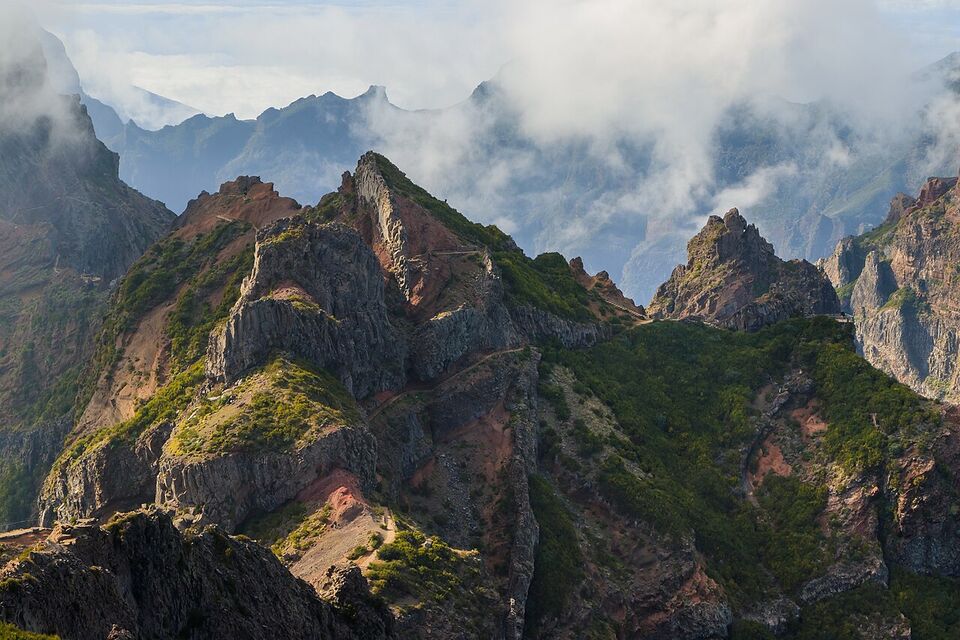
This ridge walk (PR1) links the island's third- and highest peaks, Pico do Arieiro at about 5,965 ft (1,818 m) and Pico Ruivo at about 6,106 ft (1,862 m). It is often described as the island's best hike, and also its hardest: it is long and exposed, with steep steps, narrow ledges, tunnels and sudden cloud, and it is a one-way route that needs a transport plan. It is for fit walkers with real hiking boots and a head for heights.
The route was closed for a long period after damage, and reports in 2026 said it had reopened with booking; the official fee for the Arieiro to Ruivo section is €10.50 (about $12). We could not confirm the current status of every section, so check the Visit Madeira trail notices before you plan around it. Allow a full day, start early, and carry food, water, a light, warm layers and rain gear: the summit can be 20°F (11°C) colder than Funchal and wrapped in cloud.
If you do not want the full walk, the shorter out-and-back section from Arieiro to the Pedra Rija viewpoint costs €4.50 (about $5) and gives some of the drama. Many visitors also simply drive up to the Arieiro summit for sunrise or the views above the clouds, where the crowd can be large on a clear morning.
Porto Moniz, the north and the west
The northwest corner is Madeira at its most dramatic. Porto Moniz has natural lava rock swimming pools filled by the sea, a small fishing village and a coastal road with waterfalls. Entry to the pools is paid and times vary; check locally. Calm days are best; rough seas close them.
Santana, on the north coast, is known for its triangular thatched houses. Further west, the high plateau of Paul da Serra and the Fanal forest have twisted, moss-covered laurel trees and are often in cloud. Calheta has a sandy beach created with imported sand and is among the sunnier parts of the island. Plan these as a loop by car or a guided tour, and start early: the roads are slow and weather moves fast.
Wine, bolo do caco and food
Madeira wine is fortified and aged, usually with heat, and it is made in styles from dry to sweet. You will see the grape names on labels: Sercial (driest), Verdelho, Boal and Malvasia (sweetest). Many producers in and around Funchal offer tastings; book ahead in high season and check each lodge's hours.
Bolo do caco is the local flatbread, cooked on a stone slab and served warm with garlic butter. Espetada is beef on a bay laurel skewer, cooked over a fire. Espada (black scabbardfish), often served with banana, is the odd local fish, and poncha is a rum drink with honey and lemon. Ask what is in season in the market.
Different from home
At many Portuguese restaurants, bread, olives, butter and cheese appear on the table without being ordered. This is the couvert. You are charged only for what you eat, and you can send it back or ask the server to take it away. Check the menu for the price. Tipping is optional and nothing like US norms; rounding up or leaving a few euros for good service is common.
Driving the tunnels and steep roads
Madeira's expressways use long tunnels through the mountains, which makes the coast fast to cross, but the older roads are narrow, steep and sometimes unlit. Funchal's hills are the toughest part for a nervous driver, with tight turns and parking that is difficult to find. If you are not used to driving a manual car on steep slopes, reserve an automatic and confirm it when you book. Our driving guide covers licences, tolls and rental basics.
- Use low gear on long descents to save the brakes.
- Leave extra time: a 20-mile (32 km) trip can take an hour.
- Avoid driving into the mountains in fog or heavy rain.
- Plan parking: in Funchal, a hotel with parking or a taxi often beats a rental.
- Bring your US licence and consider an International Driving Permit; check your rental company's terms.
The alternative is to rely on guided tours, taxis, ride-hailing and the buses. Buses link Funchal with most towns, though not with the most remote trailheads. A mix works well: stay in Funchal for a few days without a car, then rent for one or two days for the north and west.
Weather by altitude
Funchal's average high temperatures run from about 68°F (20°C) in January to about 80°F (27°C) in August, and lows range from about 57°F (14°C) in winter to about 69°F (21°C) in late summer. The sea is about 64°F (18°C) in February and March and about 75°F (24°C) in late summer to early autumn. Rain is concentrated from October to March, and June to August is the driest stretch, though the north and the mountains can be wet at any time of year.
Altitude changes everything. As a rough rule, the temperature falls several degrees for every 1,000 ft (300 m) you climb, so the peaks can be 15 to 20°F (8 to 11°C) cooler than the coast, with wind, cloud and rain when the coast is sunny. The south is usually sunnier than the north, and the east is drier and windier. Pack layers and a light waterproof jacket in every season; for general packing guidance see packing and for seasonal planning when to go.
| Zone | Typical feel | Plan for |
|---|---|---|
| Funchal and the south coast | Mild year-round, warm and dry in summer | Light layers, sun protection |
| North coast | Wetter, greener, cooler, frequent cloud | Rain jacket, grippy shoes |
| Mid-mountain villages | Cooler evenings, mist | Sweater, flexible plans |
| Peaks and Paul da Serra | Cold, windy, cloud and rain at any time | Warm layer, hat, waterproofs |
| Porto Santo (separate island, by ferry or air) | Dry, sandy beaches | A beach day or a quiet stay |
The New Year and Flower festivals
Madeira stages a year-round festival calendar. The official Visit Madeira site lists Christmas and New Year festivities in Funchal from December 1, 2026 to January 10, 2027, with lights, markets and a famous midnight fireworks display on December 31. Hotels fill early for this week, often months ahead, and prices rise. December 26 is a regional holiday in Madeira, as are Autonomy Day on April 2 and Madeira Day on July 1.
The Flower Festival (Festa da Flor) is scheduled for April 29 to May 30, 2027, with parades, carpets of flowers and exhibits. Carnival in Funchal is scheduled for February 3 to 14, 2027, with the main parade on February 5 and 6. The Atlantic Festival is scheduled for June 4 to 27, 2027, and the Wine Festival for August 22 to September 12, 2027. These come from the official calendar, which is subject to updates, so verify dates before booking flights.
A sample four-day plan
- Day 1
Funchal old town
Land, check in, walk the old town and market. Keep the first evening short; the island is a long way from home.
- Day 2
Monte and the gardens
Cable car to Monte, the tropical garden, then a descent by foot or the Botanical Garden link. Book a levada slot for the next day if the forecast is good.
- Day 3
A levada walk
Choose an open trail from the official list, take a morning slot, and finish with lunch in a village. Add Cabo Girão on the way back if the cloud lifts.
- Day 4
North and west loop
Drive or take a tour to Porto Moniz, the pools and the Fanal forest. Return via the south coast, with time to spare before any flight.
With a fifth day, add the Pico do Arieiro viewpoint at sunrise or the eastern peninsula at Ponta de São Lourenço. If you are combining the island with a ship, read the notes on port days in cruises; and if your trip includes the mainland, Lisbon is the natural gateway.
Add it to a route in the trip builder, or ask us to plan the hotels, trains and guides for you.