What to expect at a Portuguese table
Portuguese food is simple, generous and built on very good ingredients: fish grilled over charcoal, salted cod, olive oil, bread, pork, cheese, tomatoes, rice and a lot of garlic. It is not spicy, it is rarely fussy, and portions are often large enough to share. If you eat one pastry, one grilled fish and one bowl of soup in your first two days, you will already understand most of it.
Wikipedia's overview of the cuisine notes that Portugal has Europe's highest fish consumption per capita and that salted cod dishes are everywhere. The same overview describes olive oil as one of the bases of the cooking, and it describes soup as a regular part of both lunch and dinner. In practice that means menus are organized around fish, meat, soup and desserts, with rice, potatoes or both on the side.
Food is also cheaper and more varied than most Americans expect. A daily lunch special, a sandwich at a snack bar or a pastry with coffee costs far less than the same meal at home. Prices in this guide are typical ranges, not quotes: menus change, and tourist streets in Lisbon, the Algarve and Porto's riverfront cost more. For a trip-wide budget, see our budget guide and the notes on money, cards and tipping.
Different from home
Nobody rushes you at a Portuguese restaurant, and nobody brings the check until you ask. A two-hour dinner is normal. Plan evenings around the meal, not the other way around.
Meal times and how a day of eating works
Breakfast (pequeno-almoço) is light: a coffee, a pastry or a toasted ham-and-cheese sandwich (tosta mista), usually standing at a pastry shop counter or sitting at a café. Many people have a second coffee and something sweet in the middle of the morning.
Lunch (almoço) is the main meal for many Portuguese. It is generally served between noon and 2 p.m., typically around 1 p.m., and often lasts more than an hour. Dinner (jantar) is typically served around 8 p.m. Both meals normally include soup, and many restaurants run a fixed lunch menu (the prato do dia, dish of the day, or a menu do dia) with a main course, a drink and sometimes soup and coffee for one price. That lunch menu is usually the best value on any menu.
Between meals there is a snack, the lanche, around 4 or 5 p.m.: a pastry, a sandwich or a torrada (toast with butter) with coffee. If you are used to eating dinner at 6 p.m., plan an afternoon snack so you are not hungry and irritable when restaurants fill at 8 p.m. Kitchens in the busiest tourist districts often open earlier, and a few cafés serve food all afternoon, but a local favorite may be empty at 7 p.m. and closed on Sundays or Mondays. Check hours on the restaurant's page or door before you walk across town.
Fish and seafood
Portugal is an Atlantic country, and the fish is the best reason to eat out. The usual rule is simple: the closer you are to the coast, the fresher the menu, and the simpler the preparation, the better the fish.
Bacalhau (salted cod)
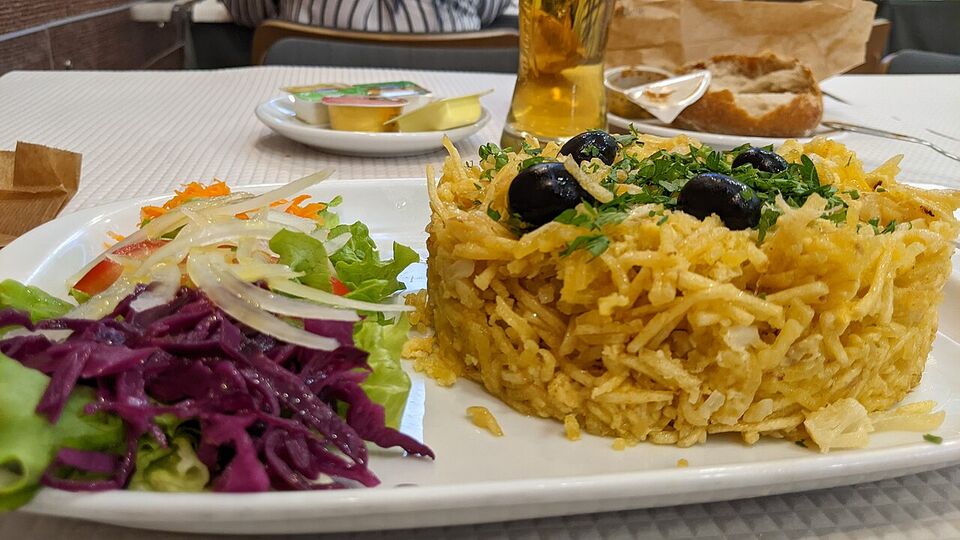
Bacalhau is cod that has been salted and dried, then soaked before cooking. It is often said that there are hundreds of ways to cook it, and it appears on almost every traditional menu. Wikipedia's cuisine article describes bacalhau dishes as pervasive among fish recipes, and our other sources agree. A few preparations you will see:
- Bacalhau à Brás: shredded cod scrambled with eggs, onion and thin fried potato straws. It is the easiest introduction.
- Bacalhau com natas: baked with cream and potato, creamy and comforting.
- Bacalhau à Gomes de Sá: baked or layered with potato, onion, olives and boiled egg, a dish tied to Porto.
- Pastéis de bacalhau (also called bolinhos de bacalhau): fried cod croquettes, served as a starter or snack. They are literally "codfish pastries," which is the name Wikipedia's cuisine article gives them.
Good bacalhau is flaky and tastes clean, not harshly salty. If you want to try it without committing to a whole plate, order the croquettes or a half portion.
Grilled sardines and other grilled fish
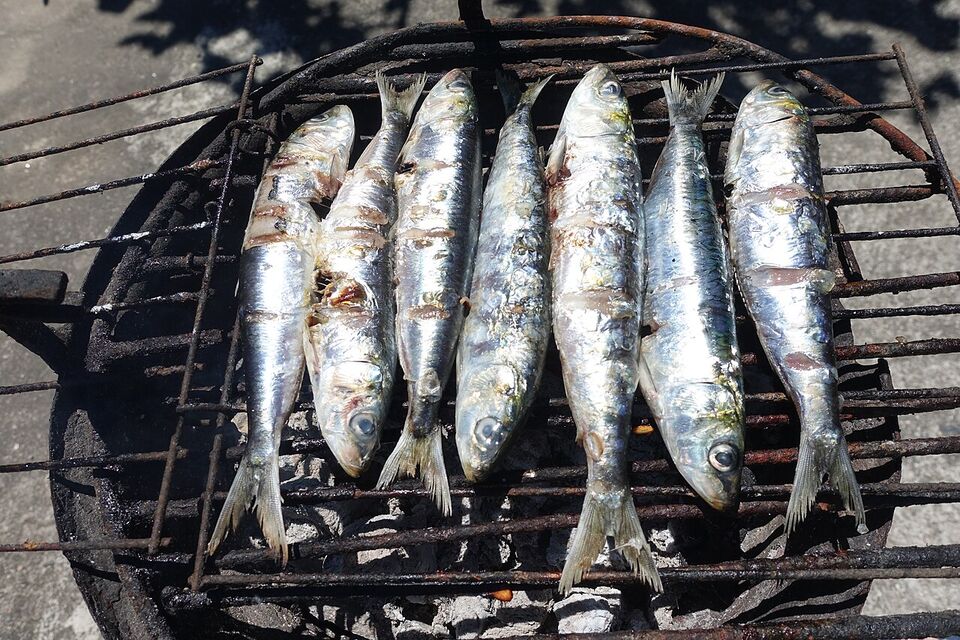
Grilled sardines (sardinhas assadas) are one of the country's signature dishes. Fresh sardines are typically at their best from about June to September, with the biggest celebrations around the festival of St. Anthony in Lisbon (June 12-13) and St. John in Porto (June 23-24). In those weeks, charcoal grills appear on sidewalks and in neighborhood squares, and people eat sardines on a slice of bread (sardinha no pão) with grilled peppers and a glass of wine. Both of those June days are tied to municipal holidays, so shops close and streets get crowded; see our festivals guide for the calendar.
Outside the season, ask whether the sardines are fresh or frozen (frescas ou congeladas). Out of season, other grilled fish are a better choice: sea bream (dourada), sea bass (robalo) and mackerel (sarda) are all common, and the waiter will usually tell you what came in that morning. Grilled fish is served whole with boiled potatoes, salad and olive oil; ask for it sem espinhas (without bones) only if you do not mind some loss of flavor.
Octopus, seafood rice and cataplana
- Polvo à lagareiro: octopus roasted with olive oil, garlic and potatoes. When it is done well it is tender, not rubbery.
- Arroz de marisco: a soupy seafood rice, closer to risotto than to Spanish paella, cooked with tomato, shellfish and coriander. It is usually served in a pot for sharing, and many restaurants make it for two people or more.
- Cataplana: a hinged copper pot, shaped like a clam shell, that steams seafood (or pork and clams) with tomato, peppers and wine. It is the signature dish of the Algarve and is usually served for two.
- Clams (amêijoas) in garlic, olive oil, white wine and coriander (the dish called à Bulhão Pato), shrimp (gambas) and barnacles (percebes) are common starters. Wikipedia's cuisine article lists the clam dish by name.
Seafood is priced by weight
The most common surprise on a Portuguese bill is seafood sold by the kilo. Whole fish, lobster, crab, prawns and some shellfish are often listed as preço por kg or ao peso, which means the price on the menu is per kilogram (a little over 2 pounds), not per plate. A single fish for two people can weigh 700 grams to a kilo or more, so the final cost can be well above what the number first suggests.
Do this before you order: ask the waiter to show you the fish, ask the weight, and ask roughly what the total will be (Quanto fica?). Reputable restaurants weigh the fish at the table or tell you the price without fuss. If a restaurant will not tell you, choose something priced per plate.
Watch out
Never order shellfish from a platter "for the table" without a price. Ask the total first, especially for lobster, crab, barnacles and tiger prawns, which can cost much more than an entire plate of fish.
Meat, soups and everyday snacks
Soups and stews
Caldo verde (green broth) is the most famous soup. It is a puréed potato, onion and garlic base with thinly shredded collard greens and a slice of chouriço (smoked sausage) on top. Wikipedia notes that the sausage is often added but may be left out, which makes the soup vegetarian-friendly in theory; always ask, since the broth may still be made with meat. It is a good, inexpensive start to dinner.
Cozido à portuguesa is a boiled dinner of several meats, sausages and vegetables, mostly a winter dish. It is a large communal plate, best ordered by a group that is hungry. In the colder months, you may also find bean stews (feijoada) and rice with duck (arroz de pato).
Bifana, prego and the sandwich culture
A bifana is a pork cutlet marinated in garlic and white wine and served in a soft roll with mustard and a slurp of its own sauce. A prego is the same idea with a beef steak. Both are cheap, filling snacks at snack bars and beer halls, and for many Portuguese a bifana at a counter is lunch.
Francesinha
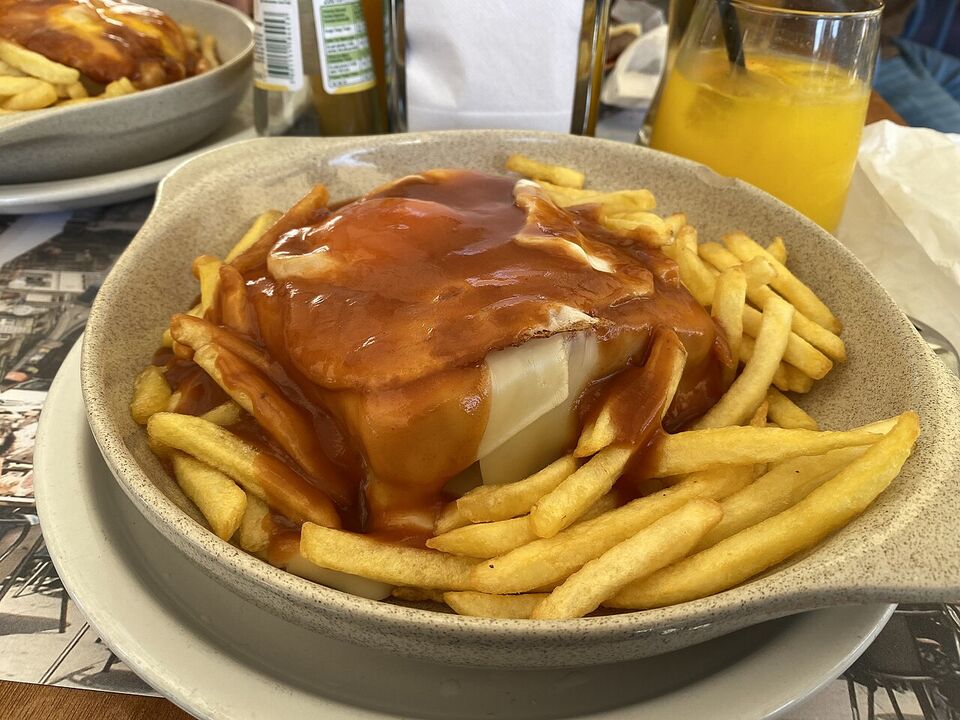
The francesinha ("little Frenchie") is the dish of Porto. It is a toasted sandwich stacked with cured ham, sausage and steak, covered in melted cheese and a hot tomato-and-beer sauce, and often topped with a fried egg and served with fries. It is heavy, so share one or skip dinner after it. Wikipedia's article ties the sandwich to the Porto region, and it is easiest to find in Porto and the north. See our Porto guide for the city.
Roast pork and other meat
Roast suckling pig, leitão à Bairrada, is a specialty of the Bairrada area near Coimbra. In the Alentejo, pork is the center of the cooking, often paired with clams in the dish carne de porco à alentejana. Grilled chicken (frango) is a very good value, sometimes with a piri-piri hot sauce. Beef steaks (bife) are often served with fries, rice, salad and a fried egg.
Pastries and coffee
Pastéis de nata and other sweets
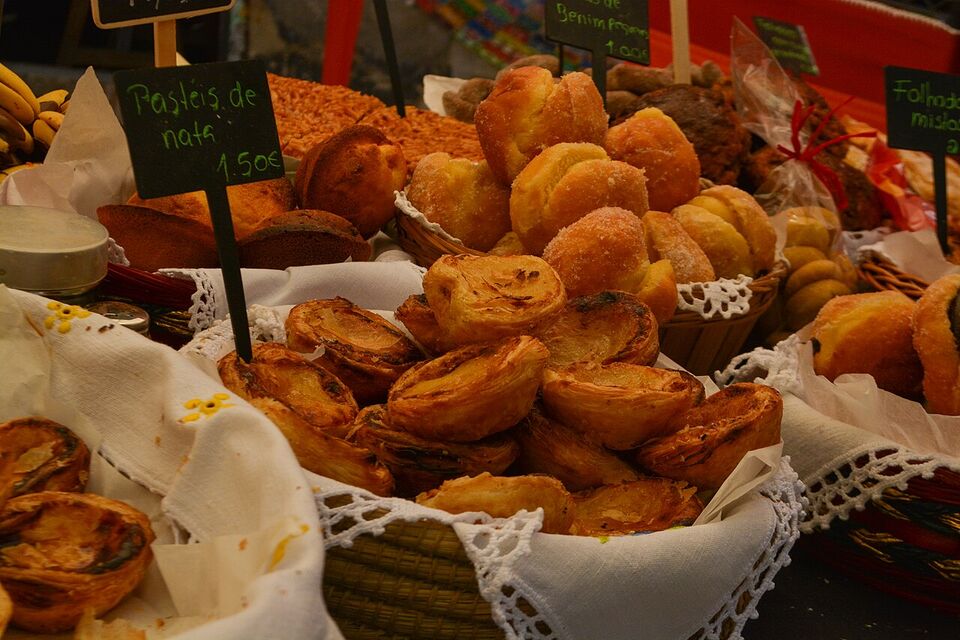
The pastel de nata (plural pastéis de nata) is a small custard tart with a crisp, flaky shell and a lightly burnt top. It is one of the national symbols of Portuguese cooking and a common part of breakfast. The tart traces back to the Lisbon neighborhood of Belém, where the Pastéis de Belém pastries were first sold just outside the Jerónimos Monastery, according to Wikipedia. You can also find good versions at ordinary neighborhood pastry shops, where the pastry is simply the pastry of the day. Add cinnamon and powdered sugar if you like, and eat it warm.
The best advice is not about a specific shop. Choose a bakery with a steady stream of locals, look for tarts still warm from the oven, and pay for the pastry at the counter. Prices vary a lot by town and shop, and famous or touristy shops charge more. Check the price on the board.
Other sweets you will see in glass cases: pão de ló (a moist sponge cake), arroz doce (rice pudding with cinnamon), pudim de ovos (egg pudding), leite-creme (a custard with a burnt sugar top), queijadas (small cheese or egg tarts) and bolo de arroz (a small rice-flour cake). Many convent sweets use egg yolks and sugar, and their names, such as barriga de freira (nun's belly) and toucinho do céu (bacon from heaven), come from the monasteries where they were developed.
Ordering coffee
Coffee words are different in Portugal. A small espresso is um café or uma bica (the Lisbon word, and the Porto word is cimbalino). A galão is a tall glass of milky coffee, a meia de leite is half coffee and half milk in a cup, a pingado is an espresso with a drop of milk and an abatanado is a longer espresso, close to an Americano. Order at the counter or at the table; a counter coffee is typically cheaper than a table coffee in some places.
Coffee prices differ by town and neighborhood, so check the board. Also see our guide to port, wine and drinks for the rest of the drinks menu.
Cheese, cured ham and sausage
Portuguese cheese is often eaten on its own, before or after a meal, rather than cooked into dishes. Wikipedia's cuisine article mentions three that you are likely to meet: queijo da Serra (from the Serra da Estrela, made from sheep's milk, strong and sometimes served soft enough to spoon), queijo São Jorge (from the island of São Jorge in the Azores, a firm and tangy cow's-milk cheese) and requeijão (a soft whey cheese). Fresh cheese (queijo fresco) is a light, mild option, and you will also see goat and sheep cheeses from the Alentejo and other regions.
Cured ham (presunto) and smoked sausages such as chouriço and alheira (a sausage from Trás-os-Montes made with bread and game or poultry rather than pork alone) are easy to find at markets and delicatessens. Order a mixed board (tábua de queijos e enchidos) to share.
Watch out
Cheese you can usually bring home, ham you generally cannot. US Customs and Border Protection (CBP) says travelers may bring bakery items and "certain cheeses" but may not import fresh, dried or canned meats or meat products from most foreign countries. Cured ham and sausage are generally not allowed into the US; check cbp.gov and aphis.usda.gov before you buy. Declare all food at the border to avoid a fine.
For souvenirs that travel safely, see our shopping and bringing things home guide.
Regional specialties
Portugal is small, but its food changes a lot from region to region. This table is a short map, not a full list.
| Region | Try | Notes |
|---|---|---|
| Lisbon | Grilled fish, petiscos (small plates), pastéis de nata, ginjinha | Lisbon's snack bars, tascas and beer halls are where bifanas and pregos are common |
| Porto and the north | Francesinha, tripe (tripas à moda do Porto), bacalhau, roast veal, vinho verde | Hearty, meat-forward cooking; the Douro valley adds wine-region lunches |
| Centre (Coimbra, Bairrada) | Leitão (roast suckling pig), chanfana (goat cooked slowly in red wine), eel stews, Serra da Estrela cheese | Wikipedia lists chanfana and the Bairrada pig among the region's famous dishes |
| Alentejo | Pork with clams, bread-based soups and stews (açorda), sheep cheese, olive oil | Rustic, bread-and-olive-oil cooking; red wine country (see our Évora and Alentejo guide) |
| Algarve | Cataplana, grilled fish, clams, octopus, figs and almonds, medronho (strawberry-tree spirit) | Most coastal towns have seafood restaurants; see the Algarve guide |
| Madeira | Espetada (beef on a skewer over wood), bolo do caco (a flat bread served with garlic butter), black scabbardfish (espada) often with banana | Espetada is very popular on the island, according to Wikipedia; see the Madeira guide |
| Azores | Cozido das Furnas (a stew cooked underground by volcanic heat on São Miguel), alcatra (beef in red wine and spices, from Terceira), São Jorge cheese, limpets (lapas) | The Azores are one hour behind Lisbon; see the Azores guide |
The Azorean alcatra is a clay-pot beef dish from Terceira that Wikipedia describes as marinated in red wine, garlic and spices. Visitors to São Miguel's Furnas valley often eat the cozido there, since the cooking happens in the ground by the hot springs.
How to read a menu
Portuguese menus are usually organized in this order: entradas or petiscos (starters and small plates), sopas (soups), peixe (fish), carne (meat), pratos vegetarianos (vegetarian dishes, if any), sobremesas (desserts) and bebidas (drinks). Handwritten boards often list the day's special.
- Dose is a full portion; meia dose is a half portion, often big enough for one person.
- Para dois means "for two" and usually means a large dish meant to be shared.
- Ao peso or preço por kg means priced by weight (see above).
- Prato do dia is the daily special, usually the best deal and the freshest cooking.
- Vinho da casa is the house wine, normally inexpensive and drinkable. Ask for it by the glass (copo), the carafe (jarro) or the bottle.
- Grelhado is grilled, assado is roasted, frito is fried, cozido is boiled and no forno is baked.
Portions are often large. If you are unsure, ask É para uma ou duas pessoas? ("Is it for one person or two?") before you order. A single order of a main course with rice and potatoes can feed two light eaters.
The couvert
When you sit down, a waiter may place bread, butter, olives, a small cheese, sausage, a fish pâté or other small dishes on the table without you asking. This is the couvert (pronounced "koo-VEHR"). It is not a gift and it is not a trick: the items are listed on the menu with a price, and you pay only for what you actually eat. If you do not want it, tell the waiter or simply do not touch it, and ask them to take it away (Não queremos o couvert, obrigado).
Two practical rules keep this relaxed. First, check the price listed for each item, because a small cheese or a plate of ham can cost much more than the bread. Second, if the bill includes something you did not touch, say politely that you did not eat it. Restaurants that serve the couvert normally take the item off without fuss. For more on how this fits with other restaurant habits, see our etiquette guide.
Insider tip
If you want to start a meal with olives or cheese, the couvert is a good way to do it. If you are not hungry, decline it before the first bite. Once bread is torn or olives are eaten, it goes on the bill.
Paying, tipping and cash
The check does not arrive until you ask for it. Catch the waiter's eye and say A conta, por favor ("the check, please"), or make a writing motion in the air. Many restaurants take foreign cards, and contactless payments are common. Small cafés, markets and some village restaurants may be cash only or have a minimum for card payments, so carry some euros. If a waiter offers to charge you in dollars instead of euros, decline and pay in euros; our money guide explains why.
Tipping is optional. A few coins or rounding up to the next euro or two is a friendly gesture at a coffee counter, and rounding up or leaving a few euros for good table service is common at sit-down restaurants. Nothing like the American 18 to 20 percent is expected. Check the bill to see whether a service charge is already listed.
Vegetarian and special diets
Traditional Portuguese cooking centers on fish and pork, and plain vegetarian dishes are not always on the menu. The most common problem is hidden meat: soups can be made with ham bone or sausage, beans are often cooked with chouriço, and rice may be cooked in fish or meat stock. Be specific when you order. Useful phrases:
- Sou vegetariano (a man) or Sou vegetariana (a woman): "I am vegetarian."
- Sem carne, sem peixe, sem presunto, por favor: "without meat, without fish, without ham, please." Fish is sometimes not thought of as "meat," so name it.
- Tenho alergia a...: "I am allergic to..."
Reliable choices include omelets (omeleta), salads, vegetable soups without sausage, grilled vegetables, mushroom dishes, cheese plates, rice with vegetables, fried eggs with potatoes and bread-and-garlic dishes. In Lisbon and Porto, vegetarian and vegan restaurants are increasingly easy to find, and many cafés serve vegetable tarts and sandwiches. In villages and the interior, you may do better with a deli lunch of bread, cheese, fruit and olives. Vegans will need to plan more; dairy, eggs and honey are in many pastries.
Markets, shops and eating on a budget
Most towns have a municipal market (mercado municipal) with fish, vegetables, cheese, meat, flowers and sometimes small eateries. Visit in the morning, when stalls are fullest, and bring some cash. Some famous markets, such as Porto's Bolhão and Funchal's Mercado dos Lavradores, are popular with visitors as well as locals; check current hours before you go. Supermarkets and delis are good for picnic supplies, and tinned fish (conservas), which Wikipedia links to the sardine canneries that developed along the coast, is a convenient souvenir.
The cheapest good meals are the daily lunch special, a snack-bar sandwich, a pastry-shop lunch and a market picnic. These are very rough ranges for planning, not quotes, and they vary a lot by place and season:
| Meal | Typical range | Notes |
|---|---|---|
| Coffee and a pastry at a pastelaria | €2 to €4 (about $2.25 to $4.50) | Cheaper standing at the counter |
| Bifana or prego at a snack bar | €3 to €6 (about $3.40 to $6.70) | Add a beer or soft drink |
| Prato do dia lunch | €9 to €15 (about $10 to $17) | Often includes a drink and coffee |
| Mid-range dinner, per person | €20 to €40 (about $22 to $45) | With wine and dessert, in Lisbon, Porto or the Algarve |
| Whole fish or shellfish by weight | Varies widely | Ask the price per kilo and the total before you order |
Save money
Make lunch your main meal. The fixed lunch menu is the best value of the day, and you can have a light dinner of soup, bread and cheese. Skip bottled water in favor of tap water if the waiter says it is fine, and order the house wine instead of a labeled bottle.
Tourist-trap signs
You will eat well in Portugal without much effort, but the busiest tourist streets in Lisbon, Porto and the Algarve also have restaurants that rely on passing trade. These are the usual signs of one:
- A tout stands outside and waves menus at passers-by.
- The menu is a long photo spread in six languages, with paella, pizza, burgers and "Portuguese tapas" all on the same page. Paella is Spanish; if the kitchen cooks everything, it probably does not cook any of it well.
- Prices are not shown, especially for fish, shellfish or "market price" dishes.
- Sangria and cocktails are advertised more loudly than the food.
- Nobody who looks local is eating there, even at the normal lunch hour.
The cure is easy: walk one or two streets away from the main sights, look for a handwritten day's menu and a room with locals at lunch, and check the price list before you sit down. Our Lisbon and Porto guides suggest which neighborhoods to explore for a meal.
Eating in the islands
Madeira keeps Lisbon time; the Azores are one hour behind Lisbon, so a 1 p.m. lunch in Lisbon is noon in Ponta Delgada. Madeira leans on grilled meat on skewers, fish and tropical fruit, while the Azores focus on beef, dairy, stews and seafood. Both are covered in our Madeira and Azores guides.
Add it to a route in the trip builder, or ask us to plan the hotels, trains and guides for you.