Overview: a coast of small stops
The towns north of Lisbon along the Atlantic make one of the easiest and most varied outings in the country: a walled village, a fishing town known for giant winter waves, a major Catholic pilgrimage site, and two great medieval monasteries. They are all within about 90 miles (145 km) of Lisbon and within about 45 miles (70 km) of each other, which is both their appeal and the trap. On paper they fit into one day; in practice each deserves more time than a quick stop.
Our advice is to choose a pair. Óbidos and Nazaré work well together by car, since one is walking and chocolate and the other is sea and fish. Fátima, Batalha and Alcobaça make a second natural group, a pilgrimage and two monasteries, best with a car or a guided tour. If you have time for a night on the coast, you can do both in two relaxed days, and our regions guide shows how this fits with the rest of the country.
This page covers each stop in turn, then how to link them by bus and car, a table of options, and what not to attempt. For the wider list of outings from the capital, see day trips from Lisbon.
Options at a glance
| Option | Best for | How | Time | Notes |
|---|---|---|---|---|
| Óbidos only | A relaxed half day, first-timers without a car | Bus from Lisbon | About 4 to 5 hours on site | Arrive early or stay late; midday is crowded |
| Óbidos and Nazaré | Walled town plus sea in one day | Car; or bus with a change | Full day | About 30 miles (50 km) between them; bus links are slower |
| Nazaré only | Waves in winter, beach in summer, fish lunch | Bus or car | Half to full day | No direct train to town |
| Fátima, Batalha, Alcobaça | Pilgrimage and monasteries | Car, tour, or several buses | Full day | Check monument closing days |
| All of it, with a night | Two relaxed days | Car, with a night in Óbidos or Nazaré | Two days | Our suggestion if you want more than one stop |
| Guided tour | No driving, several stops linked | Organized day tour | Full day | Short stops; check what is included before booking |
Óbidos
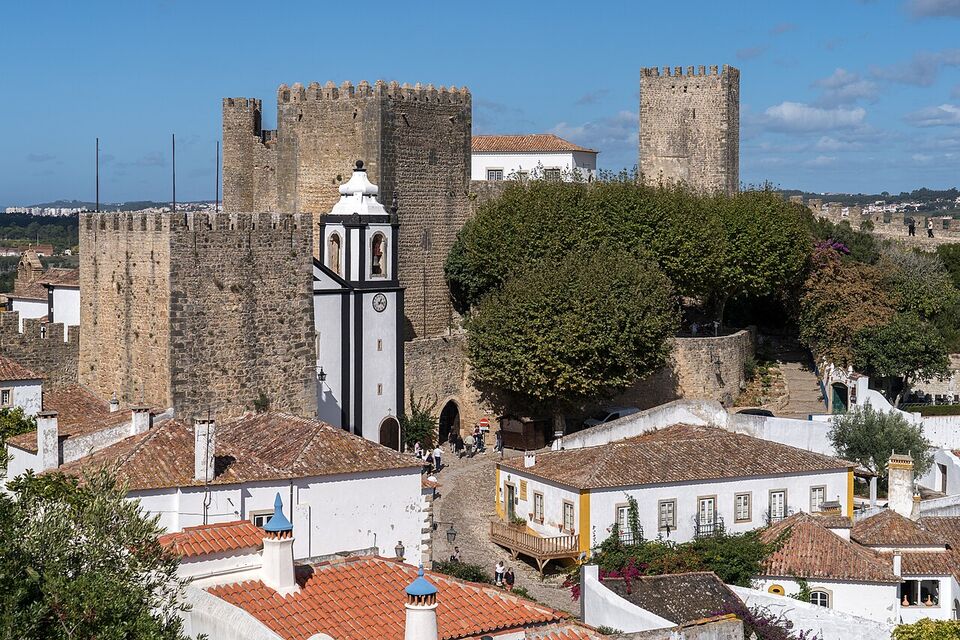
Óbidos is a small town inside medieval walls, with whitewashed houses trimmed in blue and yellow, narrow cobbled lanes and a castle at one end that is now a guesthouse. It sits about 50 miles (80 km) north of Lisbon. The main street, Rua Direita, runs from the gate at the south end to the castle, and nearly everything is within a few minutes' walk of it.
Walking the walls, and safety
You can walk along the top of the town walls. It is one of the best ways to see the roofs and the surrounding countryside, but the wall-walk has long stretches with no railing on the drop side, and the steps are worn. Do not let young children run ahead, wear shoes with grip, and skip the wall walk in rain, ice or strong wind. Entry points and any fee are set by the municipality, which we could not confirm, so check at the tourist office or on the town's site. Anyone who is nervous about heights should enjoy the town from the ground instead.
Watch out
The wall walk has steep drops and, in places, no continuous railing. Treat it as a narrow, uneven path above a fall, not a promenade. It is not suitable for toddlers on foot, strollers or anyone unsteady.
Chocolate in a cup and other tastes
Óbidos is known for ginja (sour cherry liqueur), traditionally served in a small edible chocolate cup. The liqueur known as ginja de Óbidos is an EU-protected product. The shops sell it by the shot; it is a simple tradition to try once, and it is strong, so non-drinkers can ask for the chocolate cup with something else. Many shops give small tastes. Prices vary, and we did not confirm any, so look at the board before you buy.
Festivals and markets
The town runs a calendar of events, which the town hall publishes on obidos.pt. It lists the FÓLIO book festival, a chocolate festival, an opera festival, a medieval market and Holy Week among others. Dates change every year, so check the official site before planning around any of them.
The one we can confirm for this winter is Óbidos Vila Natal 2026, the Christmas village, which runs from November 27, 2026 to January 3, 2027. This year's theme is Pinocchio and the World of Puppets, and the official announcement points to advance tickets on the town's site. Expect heavier crowds, higher hotel prices and tighter parking during the event. Plan accordingly, and if you want it quiet, go in the weeks before it opens.
Crowds and timing
Óbidos gets busy between about 11 a.m. and 4 p.m., when day-trip buses and tour groups arrive. Come early, or stay for the evening when the lanes empty out. If you stay a night, you get the quiet hour before breakfast and the lamp-lit streets after dinner. Storm weather matters here: on November 11, 2026 the council closed schools and non-essential services because of Storm Charles. Check forecasts and local notices in autumn and winter.
Getting there
The simplest route is a direct bus from Lisbon, typically about an hour to an hour and a quarter. The usual operators run from a Lisbon coach terminal, and we could not confirm which one or the current times, so check Rede Expressos or the regional operator before you travel. Rail goes via the Oeste line, which is slower and has had interruptions: the service between Torres Vedras and Caldas da Rainha is due to resume on November 15, 2026, according to the town hall's news. By car, it is roughly an hour on the motorway, and tolls may apply; see our driving in Portugal guide.
Nazaré
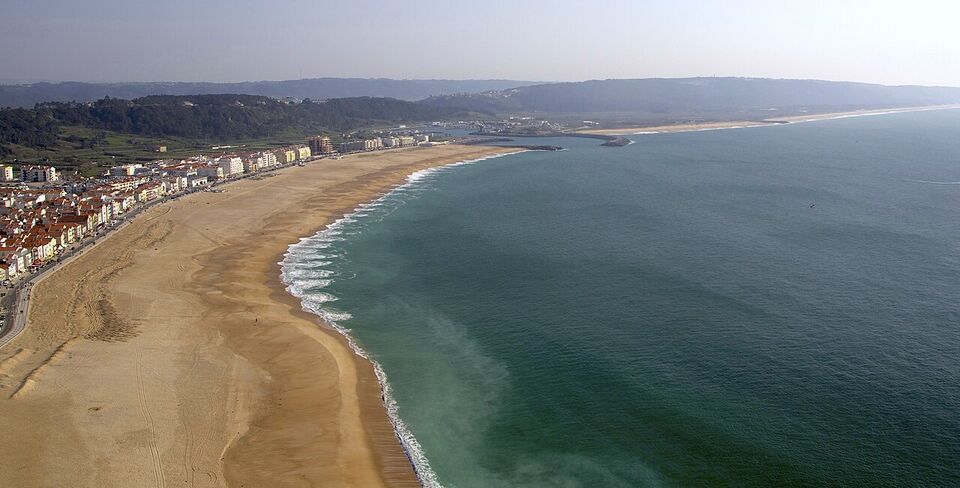
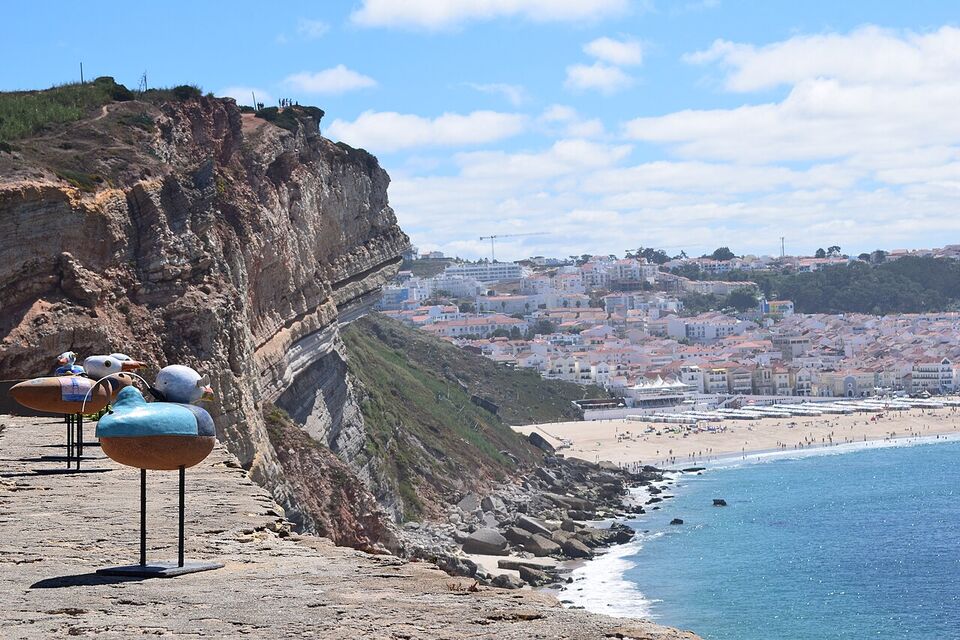
Nazaré is a beach town and fishing port about 75 miles (120 km) from Lisbon, with two parts: a long sandy beach and promenade at sea level, and the Sítio, a clifftop district above it with a chapel, a lookout and a fort. In summer it is a busy family beach. In winter it is a place to watch the Atlantic.
The Sítio, the funicular and the beach
A historic funicular connects the lower town to the Sítio. We could not confirm its current operating hours or fare, so check at the town tourist office before you plan around it. If it is not running, the climb is steep, and there are buses and taxis. The Sítio's viewpoint looks down on the town and the beach, and is a good first stop for orientation.
The main beach is wide, and in the warm months it is full of umbrellas. As on any Atlantic beach, currents can be strong and conditions change, so swim only where lifeguards are on duty and follow the flag colors. Our beaches guide explains the flag system.
How the big waves work, and where to watch
Nazaré's giant waves come from the sea floor. A deep undersea canyon runs toward the coast and funnels and amplifies large winter swells from storms far out in the North Atlantic. When a big swell arrives, waves break far taller than usual off the headland. Big-wave surfers are towed in by jet ski, and the waves can be many times the height of a person. The best-known viewing spot is the headland next to the lighthouse at the Fort of São Miguel Arcanjo, which looks straight over the break.
The season is typically autumn to early spring, but a giant day depends on a particular combination of swell size, direction and wind, and it can be calm for weeks. The organized winter big-wave competition has no confirmed dates in our sources, so check the organizer's website and local forecasts rather than planning around it. If you see a surf forecast with a very large swell, treat it as a possibility, not a promise.
Lighthouse and safety rules
The area near the lighthouse draws crowds on big days. Follow the barriers and the instructions of the authorities, stay behind the fences, and do not climb down to the rocks to get closer. Waves can surge much higher than expected and sweep people off rocks, and sneaker waves and spray are a danger even when the swell looks moderate. Do not turn your back to the sea, do not take children onto exposed rocks, and be ready for access to be closed. If an area is cordoned off, it is for a reason.
Watch out
Never go to the rocks or onto the beach below the fort to get a closer view of big waves. The best view is from the official lookouts, behind the barriers. On big days, police and civil protection may close areas without notice.
Grilled fish and the local dress tradition
Nazaré is a place to eat fish. Look for grilled sardines in the season (typically summer), grilled fish by weight, and caldeirada (fish stew). In summer, you may still see fish laid out to dry on racks on the beach, a long local tradition. Restaurants put bread, olives and other items on the table as a couvert; you are charged only for what you eat, and you can send the rest back, so check the menu for the price.
The town is also known for its traditional dress, in which women wore several layers of short skirts, often described as seven, in bright colors, and men wore checked shirts and dark caps. You will mostly see it in shops, shows and the older generation, and it is a local tradition rather than a costume. Photograph people only with permission.
Getting there
Nazaré has no train station in the town itself, so the usual route is by bus from Lisbon, about 1.75 to 2 hours (check operators and times) or by car in roughly 1.5 hours. Local buses typically link it to Alcobaça, a short ride away, and to Óbidos with a change at Caldas da Rainha; check the current services. Hotels book out in summer weekends and for big-wave events, so reserve early.
Fátima
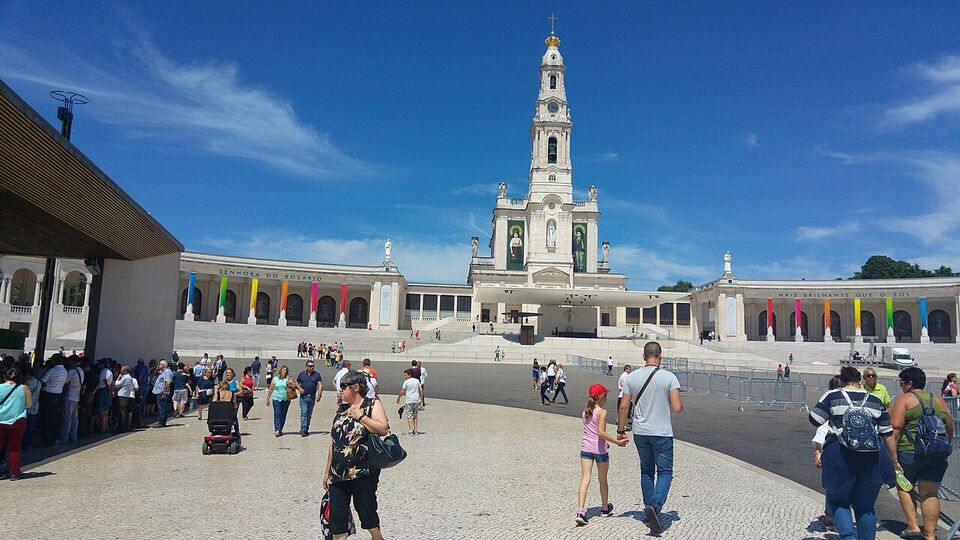
Fátima is one of the major Catholic pilgrimage sites in the world, built around the 1917 reports of apparitions to three shepherd children. It sits inland, about 80 miles (130 km) north of Lisbon. The Shrine of Fátima has a vast open esplanade, the Chapel of the Apparitions, the Basilica of Our Lady of the Rosary and a large modern church, as well as a museum. Entry to the grounds is normally free; check the Shrine's site for the museum.
Visiting respectfully
This is a working place of worship, and the people around you may be there for the most important days of their lives. Dress modestly (cover shoulders and knees), keep your voice low, do not use flash or photograph people praying, and follow the instructions of the ushers. Some pilgrims approach the chapel on their knees along a marked path; do not walk on that path or crowd them. Services are held in many languages, and the Shrine publishes a daily schedule. The schedule posted for November 14, 2026 listed a Mass in Portuguese at 7:30 a.m. in the Basilica and the Rosary at 10:00 a.m. at the Chapel of the Apparitions. The Shrine adopted its winter schedule on November 1, 2026.
Dates of the large gatherings
The biggest pilgrimages are traditionally on May 12 and 13 and October 12 and 13, with hundreds of thousands of people. We could not confirm the 2027 programme, so verify the dates on the Shrine's official calendar. The first Saturday of each month is also a devotional day; the next is December 5, 2026. On these days, hotels fill, prices rise, roads close and a day trip is much harder, so most visitors avoid them unless they are making the pilgrimage.
If you are not religious, you can still visit as a respectful guest. Expect to spend one to two hours. The town of Fátima outside the Shrine is largely devoted to shops and religious souvenirs. The Shrine's website lists a pilgrim's itinerary and its pastoral programme.
Alcobaça and Batalha
These two monasteries, both UNESCO World Heritage sites, are among the largest Gothic buildings in Portugal. We did not confirm current ticket prices, hours or closing days for either, so check the official museums and monuments site, museusemonumentos.pt, before you go; state monuments commonly close one day a week and on a few holidays, and a long trip is wasted if you arrive on a closing day.
Alcobaça Monastery
A very large church and monastery founded in the 12th century by Cistercian monks. The church is known for its plain, tall interior and for the tombs of King Pedro I and Inês de Castro, a famous love story. The monastery buildings include a huge kitchen. It was one of the stops on the medieval pilgrim route toward Santiago, which our Camino guide covers.
Batalha Monastery
Built to mark a 14th-century victory, with elaborate stonework, royal cloisters and the roofless Unfinished Chapels. Its details are among the finest in the country. Allow time for the cloisters.
The two sit about 12 miles (20 km) apart, and it is about 9 miles (14 km) from Nazaré to Alcobaça. By car you can see both and still reach the coast. By bus, they are separate connections, and the timetables are not made for tight schedules, so an overnight helps.
Linking the stops by bus and car
By car, a natural loop from Lisbon is Óbidos, then Nazaré, then Alcobaça, Batalha and Fátima, and back to Lisbon. Rough legs are Lisbon to Óbidos about 50 miles (80 km), Óbidos to Nazaré about 30 miles (50 km), Nazaré to Alcobaça about 9 miles (14 km), Alcobaça to Batalha about 12 miles (20 km), Batalha to Fátima about 12 miles (20 km), and Fátima to Lisbon about 80 miles (130 km). Those add up to more driving than the map suggests, and each stop needs parking and a walk. Rental cars carry a Via Verde toll device; the company bills the tolls, typically with a daily fee. Some former toll roads are now free, but many motorways still charge. See driving for the detail.
By bus, you can reach each of the five from Lisbon, but onward links between them are patchy and often go through hubs such as Caldas da Rainha, Leiria or Alcobaça. A second option is to choose one base, such as Óbidos or Nazaré, and make shorter hops. Rail is least useful here: the Oeste line serves Óbidos, but Nazaré, Alcobaça and Batalha are not conveniently on the main line. Check the Rede Expressos, regional bus and CP sites for what runs on your day.
Insider tip
If you have only a day and no car, take the bus to Óbidos in the morning and spend the day there, or take a guided day tour that covers Fátima, Batalha and Nazaré. Both avoid the connections that eat time. Check what the tour includes and how long you get at each stop.
Sample plans
- One day, car
Óbidos and Nazaré
Leave Lisbon by 8 a.m. Spend the morning in Óbidos before the groups arrive, drive to Nazaré for a fish lunch, walk the Sítio and the beach, and return. This is a full day, so keep the Alcobaça stop for another trip.
- One day, car
Fátima, Batalha and Alcobaça
Start at the Shrine of Fátima for morning Mass or quiet time, drive 12 miles (20 km) to Batalha, then to Alcobaça, and end with an early dinner on the coast. Check closing days first.
- Two days
Silver Coast with one night
Day one: Óbidos, then Nazaré, sleep in Nazaré. Day two: Alcobaça and Batalha, then Fátima if you wish, and return to Lisbon. Our where to stay guide covers choosing a base.
- One day, no car
Óbidos by bus
Take an early bus, walk the town and the walls, have lunch, and take the bus back in the afternoon or stay for dinner.
What not to try in one day
The map invites you to do everything, so here is what we would not attempt.
- All five stops in a single day. That is about 190 miles (305 km) of driving including the return, and stops of 20 minutes each. Pick two groups at most.
- Fátima on a major pilgrimage date. Roads close and the town fills. Avoid May 12 and 13 and October 12 and 13 unless you are going as a pilgrim.
- A bus-only Silver Coast circuit. The connections are too thin for a one-day loop.
- Chasing a giant wave on a deadline. You may see flat water. Go for the town, and treat big waves as a bonus.
- Arriving at monasteries without checking closing days.
- Driving back in the dark on coastal roads in storm weather. Winter storms can close roads and services, as Storm Charles did on November 11, 2026.
The area also pairs well with the Camino route, which passes through Alcobaça; see the Camino Portugués guide if you are walking.
- Choose two groups of stops at most, and check the weather.
- Check monument closing days on museusemonumentos.pt.
- Check bus times and the last return to Lisbon.
- Book a night in Óbidos or Nazaré if you want a slower pace.
- Check the Shrine of Fátima calendar if your date is near May or October.
- Bring modest clothes for Fátima and layers for the coast.
Add it to a route in the trip builder, or ask us to plan the hotels, trains and guides for you.