How to visit the Acropolis
You need a timed ticket, and the best way to get one is online at the official Hellenic Heritage store, tickets.hh.gr. The adult price is €30 (about $34), the same all year, and the ticket lets you in during a one-hour window you choose when you book. Go in the first slot of the morning or in the last two hours before closing, and bring water and a hat.
The Acropolis is the most visited site in Greece, and the rules have tightened in recent years to cut crowding and protect the marble. This page covers prices, free categories, how to book, hours, which entrance to use, what you will see and what to expect in the heat. For the rest of Athens, see Athens Sights, and for planning the city, Athens.
Ticket prices and who gets in free
| Ticket | Price | Notes |
|---|---|---|
| Adult (all nationalities, 18 and over) | €30 (about $34) | One price all year since April 1, 2025; up from €20 |
| Under 18 | Free | All nationalities; bring ID or a passport copy |
| EU citizens under 25 | Free | Not available to US citizens |
| EU citizens 65 and over | €15 (about $17) | October 1 to May 31 only; not available to US citizens |
As an American adult, you pay the full €30. US seniors and students do not get a discount, as far as we could find, but check the ticket site for the current categories. The old multi-site ticket for the Athens monuments was abolished in April 2025, so the Acropolis ticket covers the Acropolis only, plus the south slope route described below. Other Athens sites, such as the Ancient Agora (€20) and the Temple of Olympian Zeus (€20), need their own tickets.
Different from home
There is no walking up and buying a ticket at the gate at busy times; you buy for a specific hour, and you enter in that hour. Also, the Acropolis is extremely crowded on free days (March 6, April 18, May 18, the last weekend of September, October 28, and the first and third Sunday of each month from November through March), so we would pay €30 on any other day and enjoy the space.
Booking: timed entry and the official site
Each ticket is tied to a one-hour entry window. You can stay as long as you like once inside, but you must enter during your slot, and there is no published grace period, so arrive at the start of the hour. Daily visitor numbers are limited, and the busiest slots sell out in the high season, so book as soon as you know your dates.
Buy from the official store, tickets.hh.gr; site details (prices, hours, access) are on hh.gr. Third-party sites that sell timed tickets and bundles charge more than €30, sometimes much more; a guided ticket or audio guide may be worth it, but you should know what you are paying for. Be wary of any site or street seller that is not clearly the official one, and beware of sites that look like the official store.
- Changes: According to guides, you can change the date and time online up to two hours before your slot, twice per ticket, but tickets are non-refundable. Confirm the rules at checkout.
- When slots go on sale: As of November 10, 2026, slots were on sale daily through March 31, 2027; summer 2027 slots had not yet been released. We do not know the release date, so check the site a couple of months ahead.
- Phones and printing: Save the ticket QR code to your phone, with a screenshot in case of poor signal at the gate.
- Passports: Carry ID if you are claiming a free or reduced ticket.
Watch out
Older guidebooks and some websites still show the old €20 price for the Acropolis. Use the price on the official ticket store (€30). Type the address (tickets.hh.gr) yourself rather than following a link in an ad or a reseller email.
Opening hours by season
| Period | Hours | Last entry |
|---|---|---|
| April 1 to August 31 | 8 a.m. to 8 p.m. | About 20 minutes before closing |
| September 1 to October 31 | Closing time moves earlier by stages, from about 7:30 p.m. in early September to about 6 p.m. in late October | About 20 minutes before closing |
| November 1 to March 31 | 8 a.m. to 5 p.m. | 4:40 p.m. |
The site is closed on January 1, March 25 (Independence Day), May 1, Orthodox Easter Sunday (May 2, 2027) and December 25 and 26. Hours can change for events or works, so confirm on the ticket store the week you go. In winter, the site closes early and it gets dark by about 5:30 p.m., so the late-afternoon plan does not work from November to February.
The best time to go
The two best windows are the first slot (8 a.m.) and the last two hours before closing. In the morning, the light is soft and the tour groups have not arrived. By 10 a.m. in summer, the marble is hot and the paths are full. In the late afternoon, the heat eases and the light turns golden on the Parthenon, but remember that the last entry is about 20 minutes before closing.
- Summer: First slot, with water and a hat. Be off the rock by 11 a.m. and spend midday in the Acropolis Museum or the hotel.
- Spring and fall: Any morning slot is fine; late afternoon is lovely if you can time it.
- Winter: Mid-morning is comfortable, crowds are small, and rain is possible, so bring a jacket. The marble is slippery when wet.
Weekdays are usually quieter than weekends, and days when cruise ships are in port at Piraeus can be busy by 10 a.m. If you can choose, a midweek morning is a good bet.
Which entrance to use
There are two ways in. The main entrance is on the west side, reached from Theorias Street near the top of the pedestrian path from Dionysiou Areopagitou. It is the entrance most tours use and it is the busier of the two. The south slope entrance, at the junction of Thrasyllou and Dionysiou Areopagitou, is closer to the Acropolis Museum and is generally less crowded.
Which one you use depends on where you stay and what you plan. If you are coming from Plaka, the main entrance is a short, steep climb. If you are coming from Makrygianni or Koukaki (or have just visited the Acropolis Museum), the south entrance is easier, and the route up goes past the Theater of Dionysus and the Odeon of Herodes Atticus. Your ticket is for a time slot, not a gate, but the gate staff may direct you; if you are unsure which entrance your slot applies to, check the instructions in your ticket email.
Wear shoes with good grip. The marble is polished and slippery, especially going down, and high heels are discouraged.
What you will see on top
The climb from the gate is a slope of stone steps and ramps. The monuments appear in a rough order, and you can see everything in about 90 minutes to two hours.
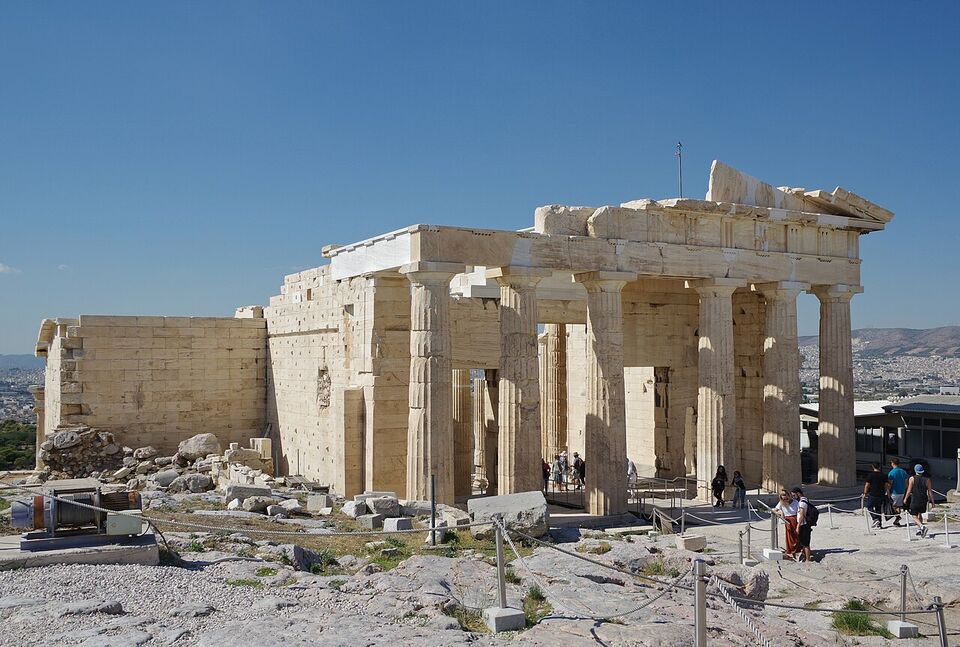
- The Propylaea: The monumental gateway at the top of the ramp, built in the 430s BC. This is where you queue to go through.
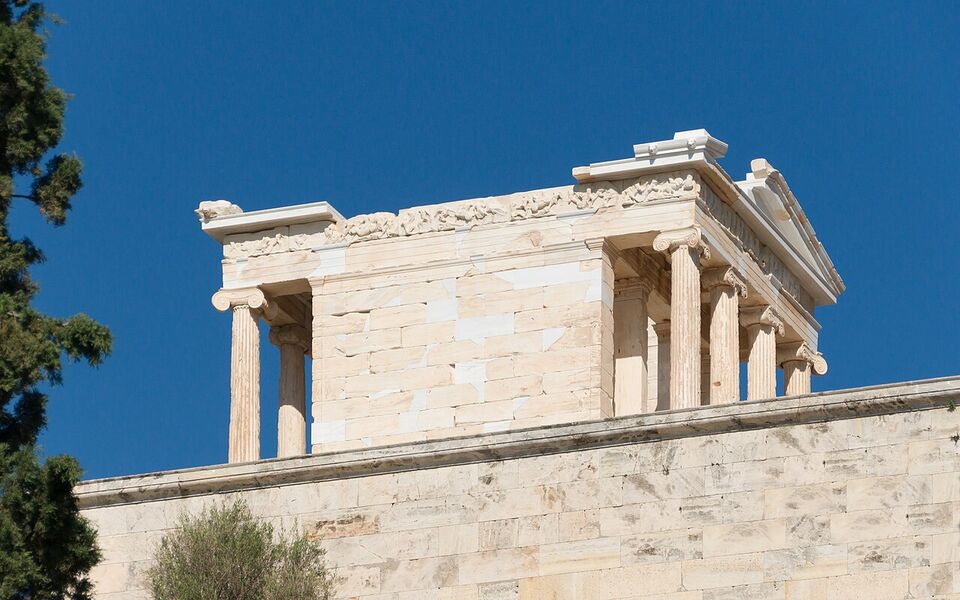
- Temple of Athena Nike: A small, elegant temple on the bastion to the right of the Propylaea, with a view of the city and the sea.
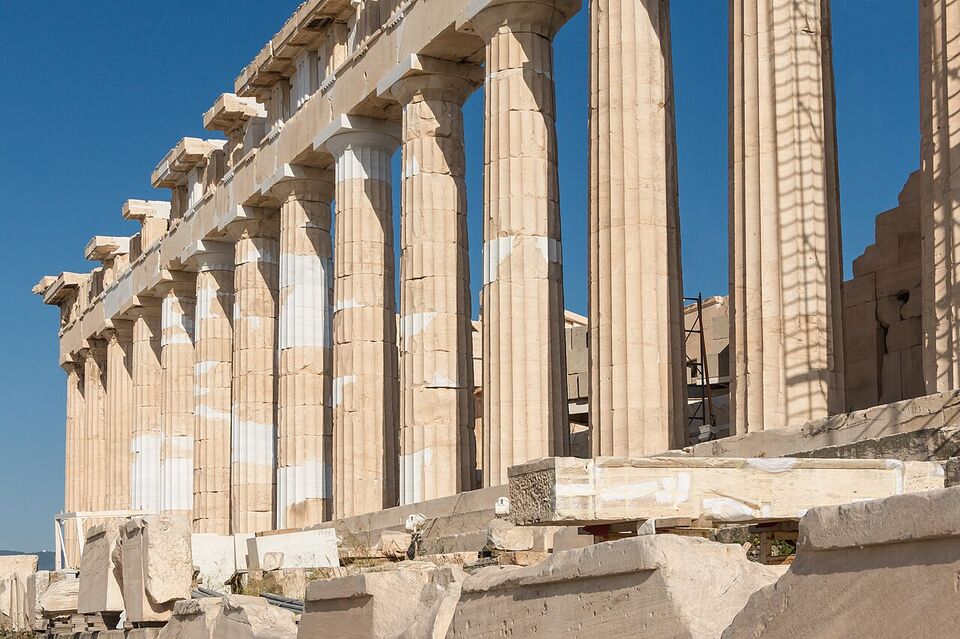
- The Parthenon: The big one, a temple to Athena built in the 5th century BC. It has been under restoration for decades, so expect scaffolding and cranes on parts of it. You cannot go inside, but you can walk around.
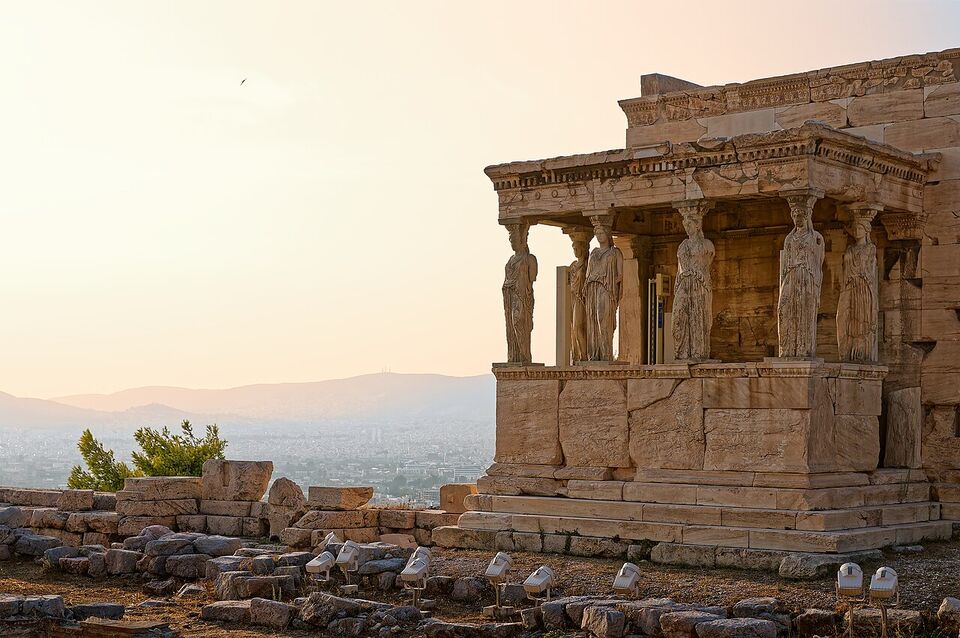
- The Erechtheion: The temple with the Caryatids, the female statues that serve as columns. The statues you see on the porch are copies; the originals are in the Acropolis Museum.
- The edge of the rock: The views over the Agora, Plaka and the Temple of Olympian Zeus are as good as the monuments.
The south slope: Theater of Dionysus
On the way up or down the south slope, you pass the Theater of Dionysus, the birthplace of Greek drama, where the plays of Aeschylus, Sophocles and Euripides were first staged. You can walk into the seating area and stand on the stage. The adjacent Odeon of Herodes Atticus, the stone Roman theater, is open only for performances (for example, during the summer festival), so you cannot enter it on a regular day. Check the ticket store to confirm that the south slope is included in your timed ticket for your date.
Heat closures
In severe heat waves, the Culture Ministry closes the Acropolis during the hottest hours, usually from about noon to 5 p.m. This has happened in July in recent years (for example, July 17, 2024), and the closure is announced the same day or the day before. Summer afternoons in Athens regularly exceed 95°F (35°C), and heat waves can push past 104°F (40°C).
If you have an afternoon slot booked on a day when a closure is announced, the rules for rebooking are not something we could confirm. Contact the ticket store if your visit is affected. The simplest way to avoid trouble is to book the first morning slot, which will almost always remain open.
Insider tip
There are few shaded areas on the rock and no cafe inside. Bring a refillable water bottle, wear a hat and sunscreen, and eat something before you go up.
Accessibility
The Acropolis is hard on the knees and harder on wheels. The paths are uneven marble, worn smooth and sloping. According to the official site, there is a lift on the north side of the rock, about 300 m (330 yards) from the site exit, for visitors with reduced mobility (and for a parent alone with two or more infants); it comes out north of the Erechtheion. The north and south slopes are wheelchair accessible with an attendant's help. Ask the staff at the entrance how to reach it, and expect rough stretches at the top. We recommend contacting the site in advance (through the ticket store or the Ministry of Culture) to confirm what is available for your date and to ask about the access route.
The Acropolis Museum, at the foot of the hill, is fully accessible, and it is a good alternative for travelers who cannot do the climb. See Athens Sights for the museum's hours and prices.
What you cannot bring
Rules are set by the Ministry of Culture and enforced by guards, who will ask you to leave things behind or to stop doing something. You should expect the following; confirm the current list on the ticket store before you go.
- Large bags and backpacks may be refused or have to be stored. A small day bag is fine.
- Tripods, drones and professional filming equipment need a permit.
- Sharp objects and glass bottles. Plastic water bottles are fine.
- High heels and hard-soled shoes; the Ministry asks visitors to wear flat, rubber-soled shoes.
- Food, loud music and sitting on the ancient stones.
Never touch the monuments or take a stone from the site. Taking any stone, shard or marble from an archaeological site is illegal, and antiquities offenses can mean prosecution. Dress is casual, but covered shoulders are courteous. Read more on Greek Etiquette.
Combining the Acropolis with the Acropolis Museum
The Acropolis and the Acropolis Museum are a natural pair, but they are separate sites with separate tickets: €30 for the Acropolis and €20 (about $22; check the museum site) for the museum. There is no combined price. The museum is about a five-minute walk from the south entrance.
The most comfortable plan is the Acropolis at 8 a.m., then a break for breakfast or coffee in Makrygianni, then the museum at 10 or 11 a.m. In summer, you can also reverse the order: the museum at midday and the Acropolis in the last two hours of the day. Allow about four hours for both. The museum has long stayed open late on Fridays, which can give you an evening option; check the museum site for current hours. For a broader plan, see our Ancient Sites and Museums guide, and if you are traveling with a limited budget, see Money in Greece.
- Book your slot on tickets.hh.gr.
- Check the weather and heat alerts the day before.
- Wear flat, grippy shoes.
- Bring water, a hat and sunscreen.
- Carry ID if you are claiming a free ticket.
Add it to a route in the trip builder, or ask us to plan the hotels, trains and guides for you.