Overview
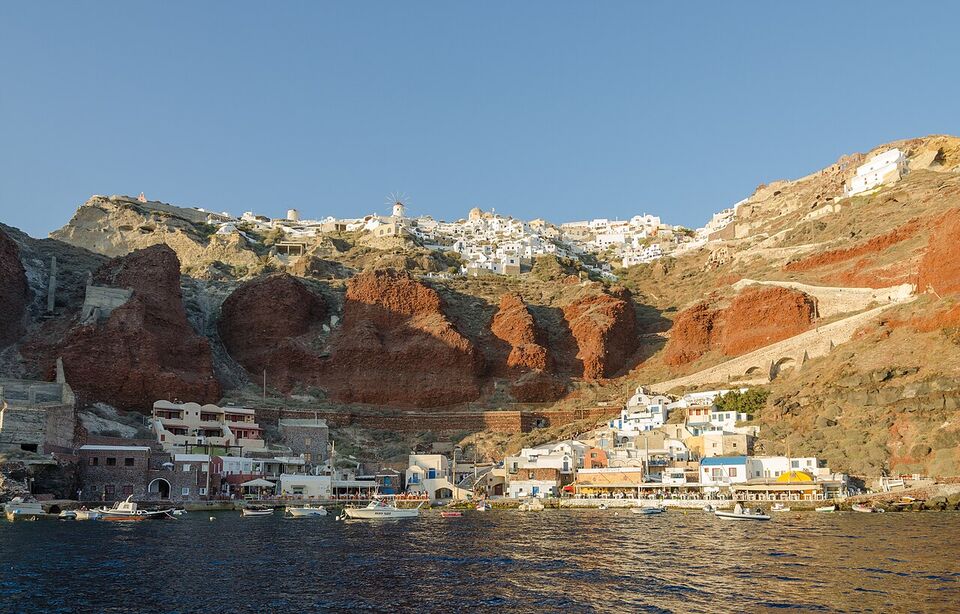
Santorini is a crescent of volcanic cliffs around a flooded crater, with white villages perched on the rim and black, red and pale beaches on the outer coast. It is the most photographed island in Greece and one of the busiest, so the useful question is not whether to go but how: where to sleep, when to see Oia, and which days to avoid. For most first trips we suggest three nights, a room on the caldera edge (the rim of the crater, facing the water), and one slow morning in Oia.
The island is small: about 11 miles (18 km) long. The main towns run along the caldera rim, with Fira (the capital) in the middle, Oia at the northern tip and Imerovigli and Firostefani in between. The beach towns, Kamari and Perissa, face east on the outer side, and the inland villages of Pyrgos and Megalochori sit among vineyards. Everything is linked by buses, taxis and rental cars, but the traffic is slow in summer.
Santorini is part of the Cyclades. If you are choosing between islands, see Santorini vs Mykonos and which island suits you, and for the wider group the Cyclades guide. The sections below take the practical decisions in the order most people face them.
Different from home
The "view" is the product here. Rooms cut into the cliff, with a plunge pool and a caldera view, cost several times what an identical room without the view costs a few hundred yards back. Many caldera hotels have steep steps and no car access, so luggage is carried by hand or by the hotel's porters. Ask before you book.
When to go and the season
The season runs roughly from April to October. Late April to June and September to mid-October are the sweet spot: warm enough to swim by June, with fewer people and lower prices than July and August. At the Thira weather station (about 600 ft or 183 m above the sea) July highs average about 86°F (30°C) and rain is almost zero; the same station records about 67°F (19°C) in April and about 73°F (23°C) in October. The meltemi, the dry north wind of summer, can be strong in July and August and can delay high-speed ferries.
In winter, Santorini is quiet. Many hotels, restaurants and shops close from November to late March, and the beach resorts at Kamari, Perissa and Perivolos mostly shut at the end of October. Caldera hotels in Fira and Oia stay open longest, but only a fraction of the tavernas in Fira operate in the cold months, and the airport bus runs far less often. Ferry schedules thin out too. If you are traveling in the off-season, our when to go page covers the weather month by month, and November and December cover what is open then.
Where to stay
The caldera villages are the classic choice, and each has a different feel. Fira and Oia are the busiest; Imerovigli and Firostefani sit between them and are quieter at night. The island's eastern and southern beach towns are cheaper, flatter and easier with a car, but they do not have the caldera view. For general advice on booking, see where to stay in Greece.
Oia
The famous village of blue domes and white lanes. It is beautiful but the lanes are packed from late morning to sunset, and shops and restaurants are priced for the crowd. Stay here if the setting matters more than convenience, and expect about 30 minutes by bus to Fira and a walk from the stop.
Imerovigli
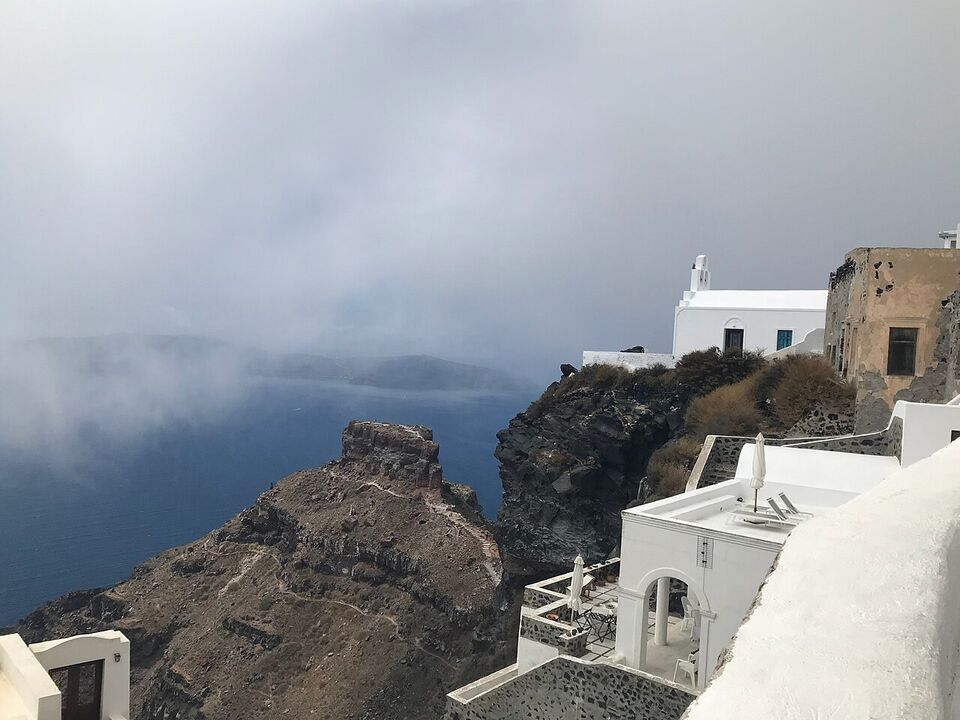
The quietest of the caldera villages, with sunset views to the west and Skaros rock in front. It is about 2 miles (3 km) from Fira. Good for couples who want views without the Oia crowd, but not for anyone who needs shops or a short walk to a beach.
Firostefani
A short walk along the cliff path from Fira, with the same caldera views and fewer people. A good compromise: you can reach Fira's buses, restaurants and cable car on foot and still have a calmer evening.
Fira
The most practical base. Fira is the island's bus station, has the most restaurants and shops, and the widest range of prices, from simple rooms inland to cliffside suites. It is also the busiest and noisiest, especially on cruise-ship days.
Kamari and Perissa
Beach towns with long seafront promenades and a lot of tavernas. Good for families and anyone who wants to swim from the doorstep and pay less. They are flat, so luggage and strollers are easy, but sunset is on the other side of the island and many places close in winter.
Pyrgos and Megalochori
Quiet, traditional villages without the caldera crowd. Pyrgos sits on the island's highest village hill and has views both ways; Megalochori has lanes shaded by old houses and is close to several wineries. A car or scooter helps.
Save money
Cliff-edge rooms are cheapest in late April, May and October. If you want the view for less, stay inland or in Fira and walk to the rim for sunset. Remember the climate resilience fee: it is charged per room per night, paid at check-out, and in the April-October season is €5 (about $6) for a 3-star hotel and €10 (about $11) for a 4-star hotel (2026 rates; see money).
Oia, sunset and the crowds
Oia is the one place on Santorini where crowd management is a real part of the plan. The sunset (about 8:30 p.m. in June, about 5 p.m. in December) pulls thousands to the castle ruins at the end of the village, and the lanes behind fill from late morning. Rails, steps and walls become standing places, people queue for the same blue-dome view, and in summer you may find the best spots taken more than an hour before the sun goes down.
Our suggestion is to see Oia in the morning and watch the sunset somewhere else. Morning in Oia, before about 10 a.m., is calm enough for photographs and to walk the whole village. Then go back to Imerovigli, Firostefani or Fira for the sunset: the caldera sunset view works from anywhere on the west rim, and a restaurant terrace with a booked table is more comfortable than a wall.
- Imerovigli: the best alternative to Oia, with a clear view west over the water and Skaros rock; the edge walkway fills in the half hour before sunset.
- Fira and Firostefani: easier to reach by bus, with many terraces. Reserve a table if you want to be at the rail.
- Akrotiri lighthouse and Faros: the southwest tip of the island has an open view and far fewer people, though it is a drive.
- Pyrgos: the hilltop at the top of the village gives a wide sunset with a small crowd.
- Sunset sailing cruise: a catamaran trip puts you on the water facing the cliffs, but check the cost, as shared trips with dinner often cost more than a restaurant meal.
Insider tip
If you do stay for the sunset at the castle ruins, arrive at least 90 minutes ahead in summer, wear shoes with grip (the marble paving is slick), and do not plan to catch a bus straight afterward: the lines for the last buses to Fira can be long. Book a taxi in advance or plan dinner in Oia and take the bus after the first rush.
Fira, the cable car and the old port
Fira is where the caldera meets the island's busiest streets. Its cliff walkway offers views over the crater and the volcanic islets, and it has the archaeological museum and the largest choice of restaurants. It is the transport hub: buses to Oia, Kamari, Perissa and the airport and most other places start here.
Below the town is the old port, Ormos Firon (also called Skala), where cruise-ship tenders (small boats that carry passengers from the ship to shore) and volcano-trip boats land. The cable car links the port to the top of the cliff in a few minutes. The alternative is a zigzag stair path of about 560 to 600 steps, shared with mules, and the stair can be slippery and smelly in the heat. In late July 2026 the municipal port fund closed the stair path (the Karavolades stairs) after a wall on a private building collapsed, and as of November 2026 we found no reopening date. Ask locally, and plan to use the cable car.
The cable car runs from early morning to late evening in summer (in 2025, 7 a.m. to 11 p.m.) with a gondola about every 20 minutes at peak and capacity of 1,200 passengers an hour. The fare in 2025 was €10 (about $11) one way for an adult and €5 (about $6) for a child. Check the 2026 fare and the winter hours on the operator's site (scc.gr) before you go. On days when a large ship is in port, expect a long line at the lower station in the morning and early afternoon.
Watch out
Ferries do not use the old port. They dock at Athinios, a separate harbor at the bottom of a steep road about 6 miles (10 km) from Fira. In March 2026 a rockfall briefly shut that road, and scientists note the slope remains unstable. Leave extra time on departure day, and check with your hotel or the ferry operator if there are warnings.
The Fira-Oia hike
The walk along the caldera rim from Fira to Oia is about 6 miles (10 km) and takes three to four hours at an easy pace. It passes through Firostefani and Imerovigli, then along the ridge toward Oia, with the sea on one side and island hills on the other. Part is paved, part is rock path with steps, and there is little shade.
The most useful tips are about timing and heat. Start at 7 or 8 a.m. in summer so that you arrive in Oia before midday, take at least a liter and a half of water per person, and wear a hat and shoes with a firm sole. In July and August we suggest skipping it, or doing only the Fira to Imerovigli section. Buses run back from Oia to Fira, so you do not need to loop. The walk is also pleasant in spring and autumn, when the path is greener and the light is softer. For other hikes see outdoors.
Akrotiri, the Bronze Age town
Akrotiri is the main archaeological site on the island, at the south end. It is a Bronze Age town buried by volcanic ash in the eruption that tore apart the island around 1600 BC. The streets, multi-story houses, storage jars and wall paintings (the frescoes themselves are in the Athens museum) survive under a large protective roof, which also means the site stays cool and shaded, a bonus in summer.
Plan 1.5 to 2 hours. It sits about 7 miles (11 km) from Fira and about 40 minutes by bus or 25 minutes by car. The 2026 ticket is €20 (about $22), or €10 (about $11) reduced, bought on tickets.hh.gr (site details are on hh.gr). From April to October it opens daily at 8 a.m. and closes at 8 p.m. in summer, earlier in September and October (6 p.m. by late October); on Mondays and Thursdays it closes at 3:30 p.m. From November to March it is open 8:30 a.m. to 3:30 p.m. and closed on Tuesdays. Admission is free on the first and third Sunday of each month from November through March (next: November 15 and December 6 and 20, 2026). For other ancient sites in the country see ancient sites. The site is not far from the Red Beach area, so some visitors pair the two.
Volcano and hot springs boat trips
The standard half-day excursion sails from the old port in Fira (or from Athinios or Oia, depending on the operator) to Nea Kameni, the volcanic island in the middle of the bay. You land on black lava rock, walk a 20 to 30 minute path up to the crater rim, and look into steaming vents. Most trips then go on to the hot springs at Palea Kameni, where you jump in the water and swim to a small orange-stained cove. Many add a stop at Thirassia, a quiet island with a cliff village and tavernas.
Prices vary by boat type and season. We would expect a shared half-day excursion to run roughly €25 to €60 (about $28 to $67) per person, with a landing or entry fee at Nea Kameni sometimes charged separately; confirm what is included. Private and catamaran trips cost much more. The hot springs are warm only close to the shore, the water is murky and sulfurous, and it can stain light swimsuits, so wear an old one.
- Bring a hat, water and closed shoes with grip: the lava path has no shade and loose stones.
- Check the weather: strong winds can cancel or shorten trips, and the sea at Palea Kameni is rough in a meltemi.
- Book a morning slot in summer for lower heat and smaller crowds at the crater.
Wineries and food
Santorini's volcanic soil, low rainfall and sea winds give it a distinct wine tradition. The main grape is Assyrtiko, a high-acid white that is dry and mineral. Vines are trained into low baskets called kouloura, which protect the fruit from wind. The island also makes Vinsanto, a sweet wine from sun-dried grapes, which is a good dessert pairing and a common thing to buy to take home.
The best wine districts are inland and on the south and east side, around Pyrgos, Megalochori, Exo Gonia and Vothonas. Many wineries offer tastings from late morning with a view; a tasting of several wines usually costs in the range of €20 to €40 (about $22 to $45), and sunset tastings cost more. Book ahead in July and August. If you plan to taste at more than one winery, hire a driver or join a small tour, since the alcohol limit for drivers is 0.05% and the roads are narrow. Outside wine, look for fava (a yellow split-pea puree), small tomatoes, white eggplant and capers on local menus. For general food guidance see food and drinks.
Beaches
Santorini's beaches are volcanic, so they are dark, hot and pebbly, and are good for sun and views more than for long swims. The sand is black or reddish, and sunbeds cost about the same as elsewhere in the Cyclades. Water is cooler than the Aegean average in early summer. For general beach rules, including MyCoast, see beaches.
Perissa and Perivolos
A long, wide strip of dark sand, backed by tavernas and bars. It has the most facilities and the easiest access by bus, and the dark sand gets hot at midday. Many places close in late October.
Kamari
A pebble beach under Mesa Vouno mountain, with a long seafront walk and a pleasant evening scene. Sunbeds are on the sand and the water is deep close to the shore.
Red Beach
The cliffs that give the beach its color are unstable. The beach was closed after rockfalls linked to the early 2025 earthquakes, and we could not confirm full reopening. Check locally before going; boat tours pass below the cliffs and you can see them from the water.
White Beach and Vlychada
White Beach is reached mainly by boat and has few facilities. Vlychada has odd pale cliffs and a small fishing harbor. Both are quieter than the east coast.
Swimming spots below the caldera, such as the rock platforms near Oia, exist but have no lifeguards and can be rough. Use caution, and never swim below crumbling cliffs.
Cruise ships, fees and the best hours
Santorini is one of the most visited cruise ports in the Mediterranean, and cruise passengers can make Fira and Oia feel full in the middle of the day. Ships anchor in the bay and passengers come ashore by tender, mainly in the morning, and the crowd is usually densest between about 10 a.m. and 4 p.m. when they are on shore. Most leave before sunset.
The island has tried to limit the pressure. For 2026 it capped cruise arrivals at 8,000 passengers a day, counting each ship at full capacity, and the Berth Allocation System scheduled fewer calls than in 2025. Cruise passengers pay a fee for each port call where they go ashore, added to the onboard account: in Santorini and Mykonos it is €20 (about $22) from June to September, €12 (about $13) in April, May and October, and €4 (about $4.50) from November to March. For more on cruising, see cruises.
Independent visitors benefit from the caps. Check the day's arrivals on the port authority or tender-schedule sites; some local blogs publish them. If three or more big ships are in port, go to the south of the island that day or start your sightseeing at 7 a.m.
Safety and the 2025 earthquakes
In late January 2025 Santorini and nearby islands experienced a strong earthquake swarm, and the authorities declared a state of emergency in February 2025. Activity eased from mid-February 2025, scientists reported no sign of an imminent eruption, and tourism operates normally. Visitors are advised to follow official alerts: Greece sends emergency messages to phones through the 112 system, and you can call 112 for emergencies in English.
In practice, the points to keep in mind are physical. Rockfalls on the cliff roads and at Red Beach continue to be a risk, as the Athinios road incident in March 2026 showed. Do not step over barriers, and be careful on cliff paths. For general travel safety, see safety.
Getting there and getting around
By ferry
Ferries from Piraeus take about 5 hours by high-speed boat and up to 8 hours or more by conventional ferry, depending on stops, with deck fares from about €40 (about $45) one way. Ferries also link Santorini with Naxos, Paros, Ios and Mykonos, and in season with Crete (the fast boat to Heraklion takes under two hours). All arrive at Athinios port. A bus or taxi from Athinios to Fira takes about 20 to 30 minutes. In winter, high-speed boats mostly stop and the conventional ferry runs less often. See ferries for booking advice, and book summer sailings weeks ahead.
By plane
Flights from Athens take under an hour and are run by Aegean (with Olympic) and Sky Express. The airport is on the east side of the island, about 4 miles (6 km) from Fira, with buses, taxis and hotel transfers. Summer flights fill and prices rise, so book early; see flights for getting to Athens from the US.
On the island
Buses run from Fira to Oia, Kamari, Perissa, Akrotiri and the airport, and cost a few euros a ride; summer buses are crowded and may be full at the stop. Taxis are scarce in July and August: arrange a transfer ahead or share rides. A rental car or scooter gives freedom but brings problems: tight lanes, scarce parking in Oia and Fira, and a high rate of scooter and ATV accidents. If you rent one, carry the International Driving Permit (see driving), and wear a helmet. See getting around for more on local transport.
A simple plan for three nights
- Day 1
Fira and the caldera edge
Arrive, check in at your caldera base, walk the cliff path from Firostefani to Imerovigli and watch the sunset from the rim.
- Day 2
Oia in the morning, wine in the afternoon
Take an early bus to Oia, walk the village before 10 a.m., return by midday, then taste wine in Pyrgos or Megalochori in the late afternoon.
- Day 3
Akrotiri and a beach or the volcano
Go to Akrotiri in the morning, then swim at Perissa or join a volcano and hot springs excursion in the afternoon.
If you only have two days, skip the beach day. If you are adding Mykonos, read Santorini vs Mykonos for the ferry link.
Add it to a route in the trip builder, or ask us to plan the hotels, trains and guides for you.