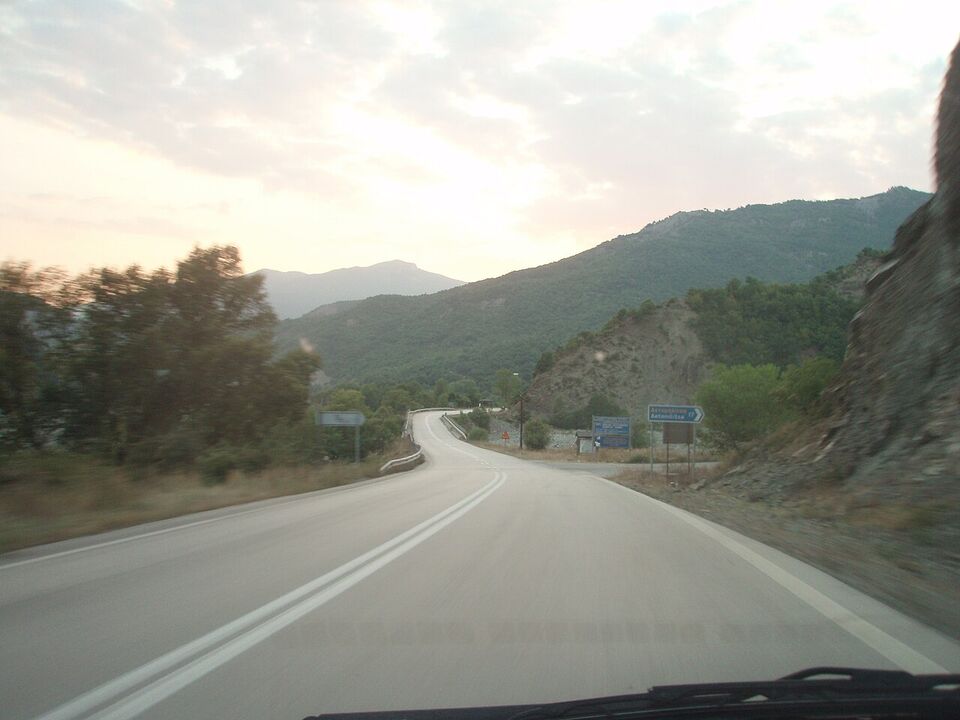
Overview: should you drive in Greece?
Driving in Greece is easier than its reputation, and it is the best way to see some places. In Athens, skip it. Traffic is heavy, parking is scarce and the metro, taxis and your feet cover the city. On Crete, in the Peloponnese and on larger islands such as Naxos, a car turns a trip from tied to bus timetables into one where you set your own pace.
This page covers what an American needs: the permit, renting, insurance, scooters and ATVs, road conditions, tolls, fuel, parking, speed limits and ferries. For other ways to move, see Getting Around Greece. For the sea, see Greek Ferries and Island Hopping.
International Driving Permit
Carry an International Driving Permit (IDP) with your US driver's license. The State Department advises it, rental companies routinely ask for it, and police can fine you if you are stopped without one. Some sources say that US license holders can drive for tourist stays without an IDP, but the safe rule is to have both, because the rental desk decides whether you drive away, and an insurer may argue after an accident.
Get the permit from AAA before you leave. In most cases you apply in person at an AAA office or by mail with two passport-style photos, a copy of your license and a fee of about $20 (check AAA for the current price). It is valid for one year. It is not a license on its own: you carry it with your US license, and you keep both when you drive.
Watch out
An IDP is a translation of your license, not a replacement for it. If your license is expired or restricted, the IDP does not fix that. Check the name and date on both before you leave.
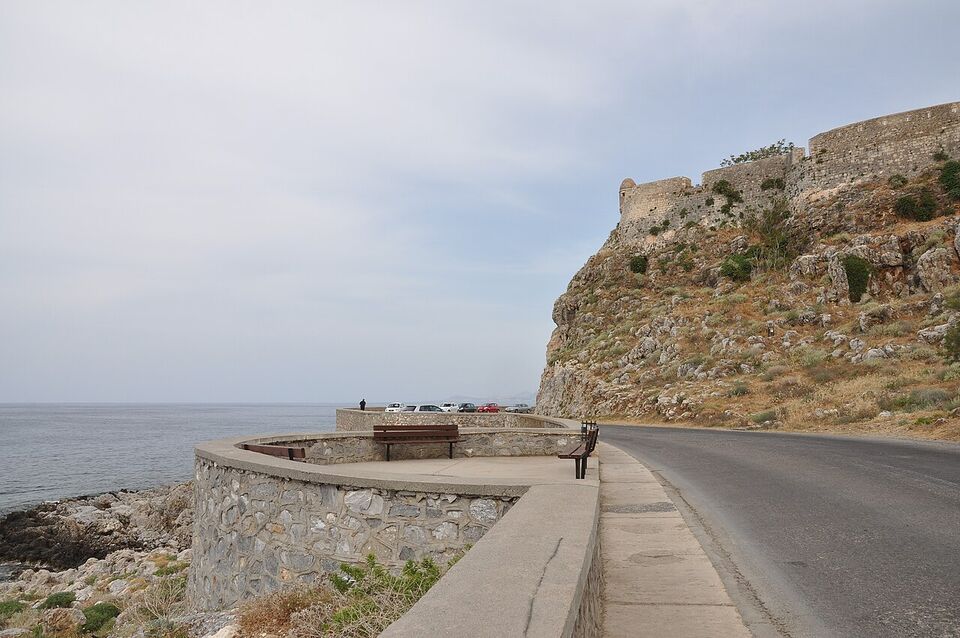
Renting a car
Age, license and booking
Most rental firms set a minimum age of 23 and want the license held for at least one year. Some rent from 21, and many add a young-driver fee under 25. Drivers over about 70 or 75 can face age limits or fees at some firms, so ask. You need a credit card in the main driver's name for the deposit, not a debit card in most cases.
Book ahead for July and August, and earlier still for automatic transmissions. Most cars in Greece are manual, and automatics cost more and sell out first. Rent the smallest car that fits your party. Narrow village streets, hairpin turns and tight parking all favor a compact car. Pick up at the airport for Crete and large islands, and avoid picking up in central Athens.
Insurance
Rentals usually include a collision damage waiver (CDW) with a high excess, often several hundred euros. The desk will offer a "full" or zero-excess upgrade for a daily fee. Read what it covers: tires, glass, undercarriage and mirrors are often excluded from basic cover, and these are the parts most often damaged on gravel roads to beaches. Some US credit cards offer rental coverage abroad, but many exclude certain countries, vehicle types or rentals over a number of days, and some are secondary coverage. Check your card's terms for Greece before you rely on it.
Take photos or a short video of the car at pickup, including the wheels, roof and interior, and note every scratch on the rental form. Check the spare tire and the fuel level. Return the car with the same fuel level, and keep the receipt.
Save money
Compare the final price, including insurance, young-driver fees, one-way fees and airport surcharges, rather than the daily headline rate. A cheap rate with a high excess can cost more after an incident than a pricier rental with full cover.
Scooters and ATVs
Scooters and quad bikes (ATVs) are everywhere on the islands, and they are a leading cause of tourist injuries in Greece. Take the risks seriously. The roads are narrow and often gravelly, drivers pass close, and many riders have never ridden before.
- License: a scooter or moped needs a motorcycle license category (A1 or similar) or the motorcycle endorsement on your IDP. A US car license alone is not enough. Rules for ATVs have been tightened: in June 2026 the deputy transport minister announced that renting a quad will require five years of license holding. Ask the rental firm what is required and check the current Greek rules.
- Helmets: compulsory for the driver and passenger. Rental firms must provide helmets, and police fine riders without them.
- Age: minimum ages apply for different engine sizes, and the same June 2026 announcement bars minors from riding electric scooters anywhere in Greece.
- Insurance: accidents on scooters and ATVs are often excluded from travel insurance or car-rental cover. Read your policy before renting. Medical evacuation costs can be large (see Health and Medical Care).
- Fines and damage: riding without a helmet or the right license can bring a fine, and the rental firm may hold you liable for damage in full.
If you have not ridden a motorcycle at home, we suggest a taxi, a bus or a small car instead. Safety advice more generally is on Is Greece Safe?.
Roads and driving conditions
Greece drives on the right, with the steering wheel on the left, as in the US. The main motorways between big cities are modern. Beyond them, expect narrow two-lane roads, tight bends, steep drops without barriers and slow trucks. A distance of 60 miles (100 km) can take two hours on the mountain roads of Crete, the Peloponnese or Epirus.
Local drivers often overtake on bends and ride close behind you. Many drive on the hard shoulder to let faster cars pass. If a car behind you flashes its lights, that usually means "I want to pass"; move over if it is safe. Keep your pace and let them go. On the islands, roads to beaches may be gravel or dirt, and rental contracts often exclude damage on unpaved roads.
Roads can be bad in winter: rain makes mountain roads slippery, and snow closes high passes in central and northern Greece. Drive in daylight when you can. Distances and times between main places are in our getting-around guide, and the rest of the picture is in Crete and the Peloponnese.
Navigation
Google Maps and Apple Maps work well. Download offline maps for islands and mountains where signal drops. Place names on road signs appear in Greek and Latin letters, but spellings differ from one sign to another (for example Kalambaka, Kalampaka). Match by sound, and follow the number of the road.
Tolls
Greece has toll motorways between its main cities, and the plazas are spaced along the route so you pay in small chunks. Typical car tolls are a few euros per plaza, and a long trip such as Athens to Thessaloniki adds up to around €25 or more in total. Toll rates rise a little each year, including a rise in January 2026, and they differ by operator, so check the operator's site for the current price on your route.
Main toll roads for visitors:
- Athens to Thessaloniki (the A1 motorway): several plazas on the way north.
- Athens to Corinth and Patras (Olympia Odos) and the Peloponnese motorways: plazas on the way out of Athens and farther along.
- Attiki Odos (the Athens ring and airport road): toll points on the route.
- Egnatia Odos (across northern Greece): several plazas.
Pay by cash or card at the plaza. Many plazas have lanes for cash and card, and lanes for an electronic tag; use a lane marked for cash or card, not the tag lane. Some roads use free-flow billing in places, in which case you pay online or at a kiosk within a few days; your rental firm will explain how this works for its cars, and may charge you for unpaid tolls plus a fee. Keep a few euros in coins handy.
Fuel prices
Fuel is expensive. In early November 2026, unleaded petrol averaged about €2.13 a liter and diesel about €2.14 a liter, so roughly €2.10 a liter, or about $9 per US gallon (a gallon is 3.78 liters). Island prices are often higher. Fuel stations are staffed in Greece; the attendant fills the tank, and you say how much ("gemato, parakalo" for full). Many stations close at night, and in remote mountain areas and small islands they are scarce, so fill up before long drives.
Know which fuel your car takes. Unleaded is "amolyvdi" (αμόλυβδη), and the usual grade is 95. Diesel is "petrelaio kinisis" or simply "diesel". Putting the wrong fuel in a rental is expensive and not covered.
Parking
Parking in central Athens is tight. Paid street parking operates in "blue zones" and other municipal areas, usually by app or street machine, and illegal parking brings fines and sometimes towing. Garages cost more but are safer. Many Athens hotels do not have parking, so ask before booking if you have a car. We suggest not keeping a car in central Athens at all.
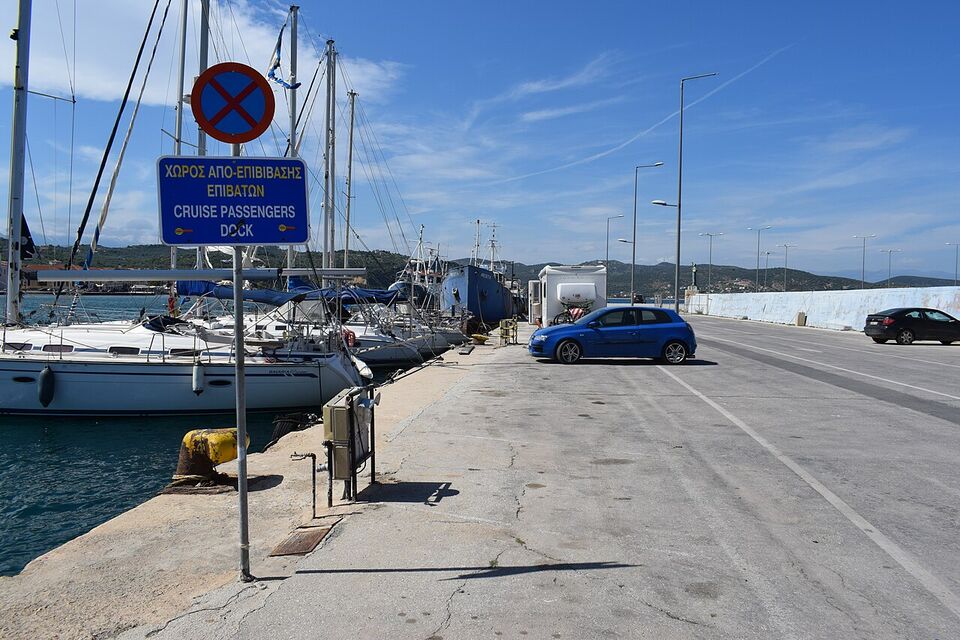
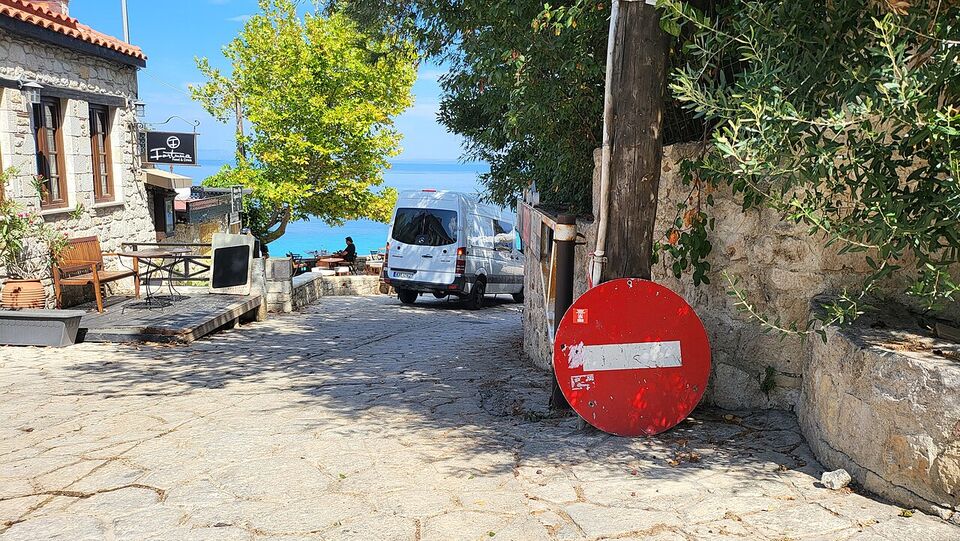
On the islands, parking at beaches and harbors is limited in summer. Many villages have a parking lot at the entrance and a car-free old town. Park in marked spaces. Read the signs and street markings, because free, paid and no-parking spaces are marked differently from town to town; a yellow line is generally a no-parking sign. Do not leave valuables, passports or luggage visible in the car; break-ins targeting rental cars happen, and the State Department warns about passports being stolen from them.
Speed limits, alcohol and police checks
| Road | Limit |
|---|---|
| Towns | 50 km/h (31 mph), 30 km/h in some zones |
| Rural roads | 90 km/h (56 mph) |
| Expressways | 110 km/h (68 mph) |
| Motorways | 130 km/h (81 mph) |
Speed limits are in km/h. Your US rental car will show both on the speedometer, but many show only km/h. Speed cameras and patrols operate, and fines vary with the speed, from about €40 to several hundred euros. Seat belts are compulsory, and using a phone in your hand while driving is illegal.
The alcohol limit is 0.05% blood alcohol, and 0.02% for new drivers and motorcyclists. Police run random breath tests, particularly in summer and at night. In a US state with a 0.08% limit, the difference matters: one or two drinks over a meal can put you at risk. The simple answer is not to drive after drinking.
If police stop you, they will want your license, IDP, passport copy and the rental papers. Keep those in the car (leave your passport at the hotel but carry a photo copy or photo of the page). Be polite and calm. If you have an accident, call 112 (English spoken), and the car rental firm. Do not sign anything you do not understand. More safety details are in our safety guide.
Greek driving habits
Some local habits surprise Americans. Many drivers treat lane markings as suggestions, turn from the wrong lane and pull out with little warning. Scooters weave between cars in towns. Drivers often stop in the road to talk or drop off a passenger, and horn use is common but not hostile. The best response is to leave space, stay predictable and avoid reacting.
Roundabouts are common. Traffic in the roundabout generally has priority, but check the signs, because rules are not always followed. Pedestrian crossings are respected less than in most US cities, so do not assume a car will stop. At night, unlit rural roads, animals and slow farm vehicles are a hazard, particularly on islands, so leave long drives for daylight.
Stop signs are red octagons, as at home, and a triangular "yield" sign is common. The word for stop is the same in Greek and English signs: ΣΤΟΠ. Road signs also use international symbols. Watch for speed-limit changes at the edge of villages, where limits fall to 50 km/h and the road often narrows.
Breakdowns and accidents
Call the rental company first for a breakdown; the number is on the key tag or the contract. Most firms include roadside help or sell it as an add-on. Know your plate number and location. Keep a reflective vest and warning triangle in the car, which are required equipment and are normally supplied by the rental firm.
After an accident, make sure everyone is safe and call 112 if there are injuries or if you cannot move the car. Take photos of the scene, the cars and the plates, and exchange details with the other driver. Report it to the rental company at once. In many cases you also need a police report to claim on insurance, so ask the police to attend or file a report at the nearest station. Do not leave the scene.
For scooter or ATV accidents, call 112 or 166 for an ambulance. Hospitals on small islands are limited, and serious cases are moved to Athens or Crete by air. Having medical evacuation insurance makes a difference, as the State Department notes. See our health guide.
Where a car is worth it
Use the following as a guide rather than a rule:
- Crete: yes, for most trips. Bus lines run along the north coast, but beaches such as Elafonisi and Balos, and the mountain villages, need a car or a tour. See Crete.
- Peloponnese: yes. A loop from Athens through Corinth, Nafplio, Mycenae, Epidaurus and Monemvasia is easier with a car. See the Peloponnese.
- Naxos and Paros: a car for one or two days helps on Naxos, whose beaches and villages are spread out. Paros is manageable with buses and taxis.
- Santorini and Mykonos: optional. Buses and taxis work for the main spots; parking in Oia, Fira and Mykonos Town is tight in summer.
- Delphi and Meteora: a car gives freedom, but buses and tours work. See Delphi and Meteora.
- Athens: no. Use the metro and taxis, and collect your rental car when you leave the city.
One more option is a driver or tour for a single day, which costs less than a rental plus fuel and parking if you are a nervous driver or only need one day away. Sights such as day trips from Athens are often easier on a tour than behind the wheel.
Car ferries and rental contracts
Taking a rental car on a ferry is often forbidden or needs written permission. Many contracts void insurance on the ferry or on islands other than the one you rented on. Read the contract. If you plan to island-hop, a better plan is to rent a car on each island for the days you need it. Cars on conventional ferries are priced by length and booked with the passenger ticket; see our ferries guide.
When you return a rental on an island, plan time for the drop-off. Rental firms usually meet you at the airport or port, and some charge a fee for after-hours returns. For a quick summary of the best places to drive on a first trip, see Plan Your Trip to Greece.
Add it to a route in the trip builder, or ask us to plan the hotels, trains and guides for you.