Overview
Thessaloniki (Salonica to older guidebooks) is Greece's second city and the best base for northern Greece. It has a long seafront promenade, Roman and Byzantine monuments, a serious food culture and a university crowd that keeps the cafes and bars busy into the night. It sits on the Thermaic Gulf, about 300 miles (500 km) north of Athens, and fits well after a few days in the capital.
The north is a different Greece from the postcard islands. Summers are hot but winters are properly cold, with Thessaloniki's January highs around 49°F (9°C) and lows near freezing. Food leans toward pies, grilled meat and tsipouro (a grape spirit) more than seafood on a beach. And the sights are spread out: one big city, then day trips to a royal tomb site, the home mountain of the gods and the three-fingered Halkidiki peninsula.
This page covers the city first, then Vergina, Pella, Mount Olympus, Halkidiki and Mount Athos, then how to get there and how to build a plan. For the capital see our Athens guide, for the other mainland highlights Delphi and Meteora, and for the mountains to the west Epirus and the Zagori villages.
Is the north worth the detour?
For most first-timers, the Cyclades and Athens fill a week or ten days. The north makes sense as a second trip, or as a final stretch for travelers who care about food, history that is not only classical, and beaches without a ferry ride. It is also cheaper than the islands in July and August, and it stays open year-round, because Thessaloniki is a working city rather than a resort.
It is a poor fit if you want a quick sunset-and-caldera trip, or if you only have a few days. A reasonable test: if you would rather eat well and walk a city than swim, Thessaloniki wins. If you want a swim and a long lunch, Halkidiki does that, but you need a car.
Different from home
Distances in the north are bigger than they look on the map, and public transport between sights is thin. Plan on a rental car for Halkidiki and Vergina, or book small-group tours. For driving rules and the permit you need, see our driving guide.
Thessaloniki in two days
The waterfront and the White Tower
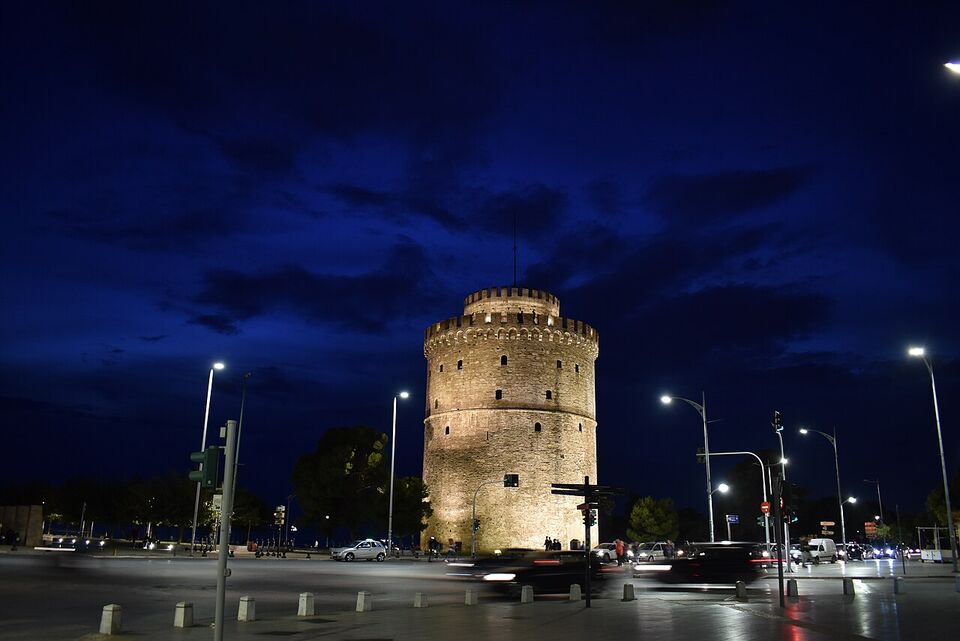
The White Tower (Lefkos Pyrgos) is the city's symbol, a 15th-century Ottoman tower on the seafront that now houses a museum about the city's history. The promenade (Nea Paralia) runs along the bay for several kilometers, with gardens, a playground area, the bronze Alexander the Great statue and plenty of benches. It is the place to be at sunset and the easiest way to understand the layout: the sea on one side, the old town climbing the hill on the other.
The White Tower costs €8 (about $9) full, €4 (about $4.50) reduced (2026 price). It is open daily 8:30 a.m. to 3:30 p.m. from November 1 to March 31 and in April, then 8 a.m. to 9 p.m. from May 1 to October 31; last admission is 20 minutes before closing, and it is closed January 1, March 25, May 1, Easter Sunday, December 25 and 26. Buy tickets at tickets.hh.gr; details are on hh.gr. The White Tower is not on the winter free-Sunday list.
Aristotelous Square and the center
Aristotelous Square is the open heart of the center, a wide plaza that opens to the sea, framed by arcades and cafes. It hosts the Christmas tree and the New Year's Eve fireworks, and it is where protest marches and festivals gather. From here the grid of streets behind it has most of the shopping, and Ladadika, the old oil-warehouse district near the port, has tavernas and bars.
The Rotunda and the Arch of Galerius
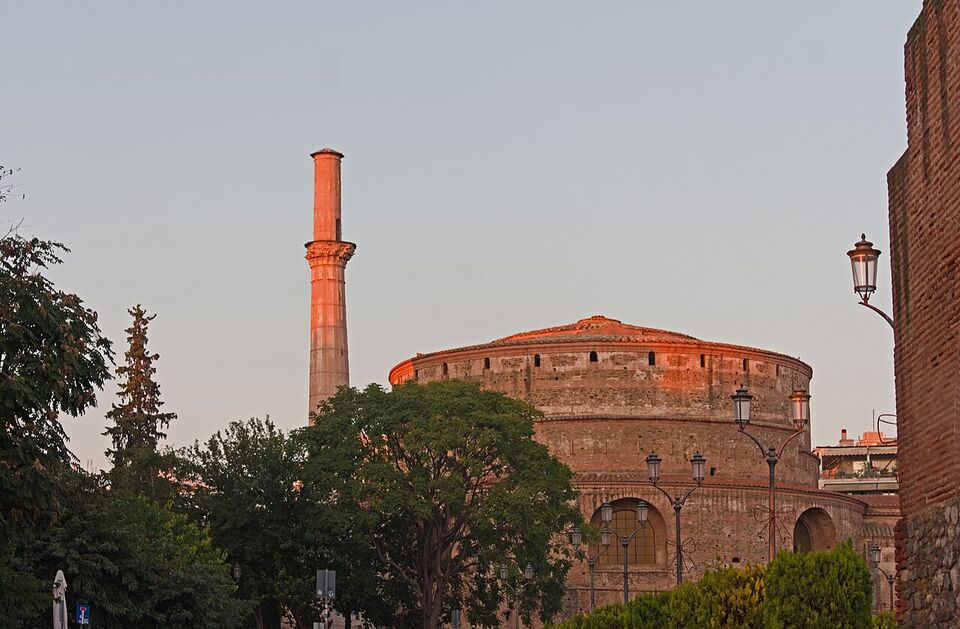
The Arch of Galerius and the Rotunda date from the early fourth century, when the Roman emperor Galerius made Thessaloniki one of his seats. The arch is a short stretch of carved pillars and reliefs on a busy street, the Rotunda is a huge round brick building that has been, in turn, a possible imperial mausoleum, a church and a mosque. It is now a monument you can enter: €10 (about $11) full, €5 reduced, 8:30 a.m. to 3:30 p.m. from November 1 to March 31 (closed Tuesdays), and 8 a.m. to 8 p.m. in summer. Galerius's palace complex is just downhill; parts are open to walk through and parts are fenced.
Byzantine churches and the UNESCO list
Fifteen early Christian and Byzantine monuments across the city are on the UNESCO World Heritage List (inscribed 1988). Three are easy to fit in: Hagios Demetrios (Agios Dimitrios), the largest church in Greece dedicated to the city's patron saint, with a crypt that holds Roman-era remains; Hagia Sophia, a near-neighbor of Aristotelous Square with a mosaic dome; and the Acheiropoietos, one of the oldest surviving churches in the city. Dress modestly, with shoulders and knees covered, and expect services to close some churches to sightseeing at certain hours.
Ano Poli, the Upper Town
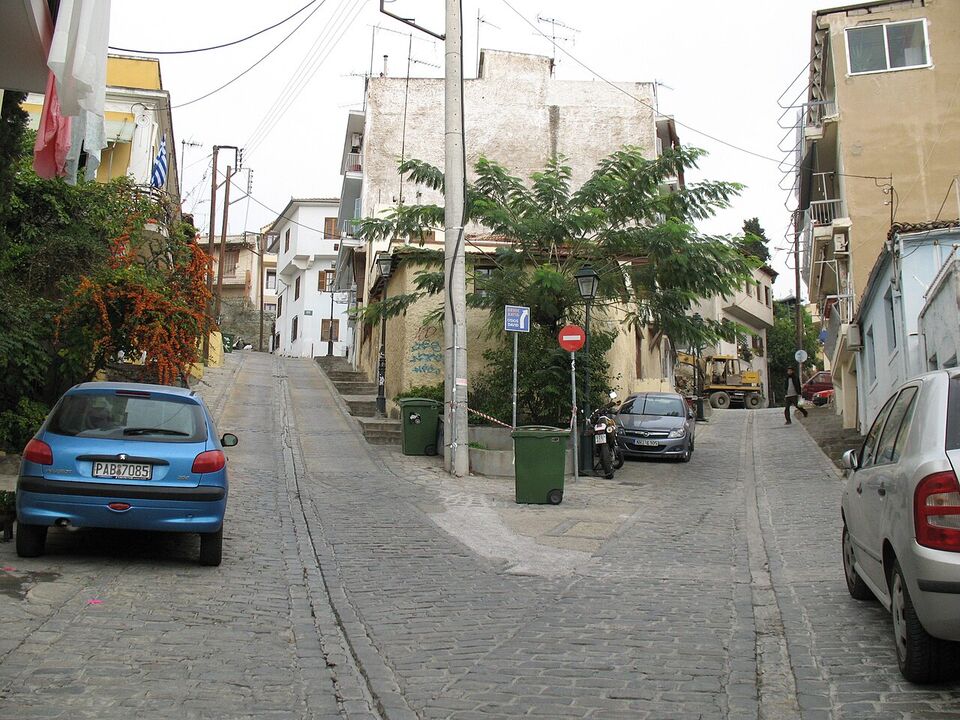
Ano Poli is the old hilltop quarter that survived the 1917 fire. It has narrow lanes, Ottoman-era houses, Byzantine walls and the Heptapyrgion (the "Seven Towers" fortress at the top). Walk up through the district in the morning, then come back down for lunch. The views over the Thermaic Gulf are the reason to go, and the old walls make a loop of about two hours if you do not linger.
Museums
The Archaeological Museum of Thessaloniki holds finds from Macedonian sites, including gold from the tombs at Derveni. The Museum of Byzantine Culture sits across the road. Both are state-run or similar bodies whose prices change, so look up the current tickets before visiting.
White Tower and waterfront
The best first hour in the city. Walk the promenade toward the port or the bay, with a stop at the tower and the museum inside it.
Rotunda and Arch of Galerius
Late Roman monuments a few minutes apart. Pair them with the Navarinou area for cafes.
Hagios Demetrios
The city's patron church, with a crypt and mosaic fragments. Modest dress is expected.
Ano Poli and Heptapyrgion
Steep lanes, old walls and city views. Go early or late in summer and wear real shoes.
Archaeological Museum
Gold and bronzes from Macedonian tombs, a good preview before Vergina.
The metro and getting around the city
Thessaloniki opened its first metro line on November 30, 2024, after more than a decade of excavation turned up so many ancient finds that some stations became museums. Line 1 runs from the New Railway Station through the center to Mikra in Kalamaria, with an extension added in August 2026 (about 18 stations in all, as the operator lists them). Venizelou station shows a stretch of excavated Byzantine road, so it is worth stepping off even if you do not need the train.
Trains run from early morning until about midnight, and the operator has said it plans all-night service on Friday and Saturday nights; check current hours on the metro operator's site. The metro does not reach the airport, and the operator has said an airport link is not a priority.
| Ticket | Price | Notes |
|---|---|---|
| Single urban ticket | €0.60 (about $0.67) | Valid 70 minutes |
| Single suburban ticket | €0.80 (about $0.90) | Longer zones |
| 24-hour ticket | €2.50 (about $2.80) | Metro or city buses; excludes special lines |
| Airport bus | €2 (about $2.24) | Flat fare on lines X1 and X2 |
The metro and buses need separate tickets, so a metro ride followed by a bus ride is two fares. Cards are accepted in many places, but check whether tap-to-pay works on the line you use.
Insider tip
The center is walkable. A 20-minute walk links the White Tower, Aristotelous Square and Ladadika. Use the metro for the New Railway Station and the outer districts, not for the tourist core.
Food: bougatsa, koulouri and the markets
Thessaloniki has the reputation of being Greece's food city, and the reasons are practical rather than mystical: strong Anatolian, Balkan and Jewish influences, a university city's appetite, and a local habit of eating small plates with tsipouro. Start the day with bougatsa, a warm pastry made with thin phyllo filled with cream (sweet, dusted with sugar and cinnamon), cheese or minced meat. Eat it with a fork at a bakery counter, or carry a slice in a paper tray.
Then a koulouri, a ring of bread covered with sesame seeds, sold from street carts and bakeries for a euro or so. The Thessaloniki version is chewier than the Athens one. For a sweet, look for trigona Panoramatos, cone-shaped phyllo pastries filled with custard.
The Modiano market, a covered hall near Aristotelous Square, and the older Kapani market on the nearby streets sell fish, meat, spices, cheese and olives. They are good for a wander in the morning, when the stalls are full, and for lunch, when counters serve mezedes (small plates). Ladadika and the streets north of it have ouzeri and tsipouradika, where a small bottle of tsipouro comes with a plate of small dishes.
Prices are generally lower than Athens or the islands. Tipping is customary but modest: round up or leave a euro or two on a casual meal. More on ordering is in our Greek food guide and drinks are covered on Greek wine, ouzo and coffee.
Vergina and the royal tombs
Vergina (ancient Aigai) is about 50 miles (80 km) southwest of Thessaloniki, an easy day trip of about an hour each way. The site's royal tombs sit inside a great earth mound, and the museum was built over them in 1993. Archaeologists in 1977 found a tomb with gold and silver objects that many link to Philip II, Alexander the Great's father; scholars still debate which tomb is whose. The site is on the UNESCO World Heritage List (1996).
Inside, the museum is dim and cool, and the tombs are displayed where they were found. Look at the gold larnax (chest), the ivory heads and the weapons. The palace of Aigai, a short drive away, reopened to the public in January 2024 after a long restoration, and is worth adding if you have a car.
Tickets and hours
The Aigai ticket is €20 (about $22) full, €10 (about $11) reduced (2026 price). From November 1 to March 31 it is open 9 a.m. to 5 p.m. and closed on Tuesdays; from April 1 to October 31 it is open daily 8 a.m. to 8 p.m. (closing earlier in steps from September), with Tuesday opening at noon. Last admission is 20 minutes before closing. It is closed January 1, March 25, May 1, Easter Sunday, December 25 and 26. Admission is free on the first and third Sunday of each month from November through March (next: November 15 and December 6, 2026). Buy at tickets.hh.gr.
Pella
Pella, the capital of Macedon and Alexander's birthplace, is about 24 miles (40 km) west of Thessaloniki. The site has house foundations and some mosaics, and the museum holds the best finds, including pebble mosaics. Combined with Vergina, it makes a long but satisfying day with a car. Without one, a small-group tour from Thessaloniki is the simplest way.
Mount Olympus
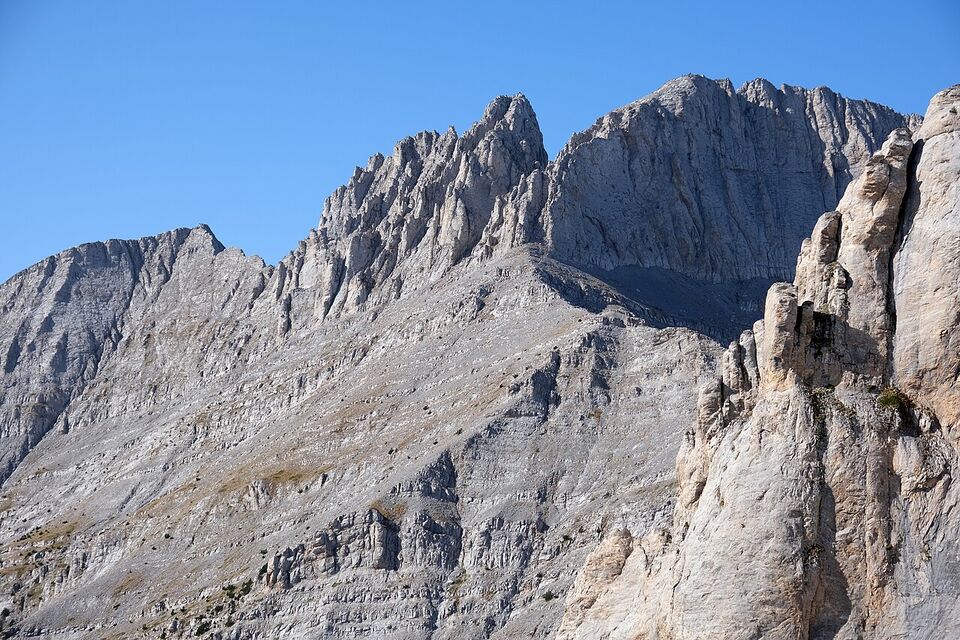
Mount Olympus, the mythical home of the gods, is Greece's highest mountain. Its top, Mytikas, stands at 9,573 ft (2,918 m). The mountain is 55 to 60 miles (90 to 100 km) southwest of Thessaloniki, and the usual base is the small town of Litochoro on the lower slopes, about 20 miles (30 km) from the Prionia trailhead.
You do not need to climb to enjoy Olympus. The Enipeas gorge walk from Litochoro is a half-day hike into woodland, and a drive to Prionia (about 3,600 ft, or 1,100 m) opens other trails. Reaching the top is a different matter: the standard approach is a night at a refuge, such as Spilios Agapitos at about 6,900 ft (2,100 m), then a scramble to Mytikas. The final stretch is exposed. We suggest going only with experience, good weather and, if in doubt, a certified guide.
Refuges and season
The national parks authority (NECCA) published a refuge list in January 2026, and these dates may change. Spilios Agapitos is listed as open from early May to the end of October, Giosos Apostolidis from early June to the end of October, and Petrostrouga from early May to the end of October. Other huts operate year-round by arrangement. Book by phone and confirm opening before you travel.
The high summit is usually snow-free from about late June to September. Winter and early spring bring snow and avalanche risk; climbing then is mountaineering. Weather changes quickly, and thunderstorms in the afternoon are common in summer. The hiking section of the outdoors guide explains heat, water and safety.
Watch out
Do not treat Mytikas as a day hike. Plan two days, start early, carry a layer for the cold and for storms, and turn back if clouds build. Mountain rescue in Greece is by the fire service, reachable on 112.
Halkidiki: beaches near Thessaloniki
Halkidiki (also Chalkidiki) is a three-pronged peninsula, about an hour or two from Thessaloniki. The three prongs are Kassandra, Sithonia and Mount Athos. Kassandra, the closest to the city, is the busiest, with big resorts, bars and long sandy beaches around Kallithea, Afytos and Pefkochori. Possidi has a sand spit that reaches into the sea.
Sithonia, the middle prong, is quieter and greener, with pine forests running down to coves, and a coastal road that rewards a slow drive. Beaches near Vourvourou, Sarti and the southern tip are popular. Sithonia's coastal road is slow, so give it a full day to explore.
Halkidiki had 93 Blue Flag beaches in 2026, the most of any region in Greece after Crete's 154. Sea water is mild from late June through September; the season for hotels and beach bars runs roughly May to September or early October, and many places close outside it.
The peninsula has no airport or railway of its own, so the practical way in is a rental car from Thessaloniki's Makedonia airport, then the A24 motorway toward Nea Moudania, with other roads fanning out from there. A car is the right choice. Without it you depend on KTEL buses and taxis, which are slow and costly for cross-peninsula trips.
Mount Athos
Mount Athos is an autonomous monastic state on the third prong of Halkidiki, with about 20 ruling monasteries, a tradition of Orthodox monks living there for more than a thousand years and a UNESCO listing (1988). Entry rules are unlike anywhere else in Greece. Women are barred by law, and men need a permit, called a diamonitirion.
For men: the permit
The permit comes through the Pilgrims' Bureau in Thessaloniki. Non-Orthodox visitors are limited to about 10 permits per day (Orthodox visitors have a bigger quota), the Athos pilgrims' office lists the permit (diamonitirio) at €30 for visitors (€10 for students), and the permit is for specific dates, usually four days. You then collect the permit at the pilgrims' office in Ouranoupoli, the village at the border, and take the ferry in. Bookings are generally made months ahead, and up to six months ahead for popular dates; off-peak notice can be shorter.
Rules were tightened in 2025: one report said foreign pilgrims faced a monthly cap of 300 permits from June 14, 2025. The official pilgrims' information page confirms the 10-a-day quota, the four-day validity and the six-month booking window, but we could not confirm the 2025 monthly cap, so ask the Pilgrims' Bureau directly and treat that figure as dated. Bring your passport; dress is modest; and you stay in monasteries on the monks' schedule, with early-morning services and simple meals.
For everyone: boat cruises
Women, and men who do not want to commit to a pilgrimage, can see the monasteries from the water. Sightseeing boats sail from Ouranoupoli (and a few other harbors) along the western coast, passing monasteries built into cliffs and hillsides. They do not land and need no permit. The cruise lasts a few hours and runs seasonally, usually in the warmer months; confirm the date, price and departure when you book.
Insider tip
If you are traveling as a couple or family and want to see Athos, the cruise is the realistic option, and it can be paired with a Halkidiki beach stay. For the monastery visit itself, start the permit process as early as you know your dates.
Getting there
Flying
Aegean (with Olympic) and Sky Express fly from Athens to Thessaloniki in about an hour. International carriers also serve Thessaloniki's Makedonia airport, about 10 miles (16 km) from the center. From the airport, the bus costs €2; a taxi is faster and costs more. We have not confirmed fixed taxi rates, so ask the driver for a price or use the meter.
Train
Hellenic Train runs Athens to Thessaloniki. Expect about 4.5 to 5.5 hours; line works sometimes add bus sections, as happened in June 2026 on the Lianokladi stretch. Check the timetable and traffic notices on hellenictrain.gr or by phone at 14511, and buy tickets online. Greece's rail network is being rebuilt after the damage from the 2023 storms and the 2023 Tempi crash, with new trains on order, so conditions keep changing.
Driving and buses
The A1 motorway runs from Athens to Thessaloniki in about five hours, with tolls along the way. KTEL intercity buses also make the trip; fares are modest, but check the KTEL site. In general the plane is quickest and the car most flexible.
Save money
Book the Hellenic Train or a flight a few weeks ahead for the best fares. Outside the city, a rental car split between two travelers is often cheaper than separate tours.
When to go and how to plan
Thessaloniki's summers are hot, with July highs near 90°F (32°C). Winters are cool and wet; November averages a high of 60°F (16°C) and about 12 rainy days. May, June, September and October give the best mix of warm days, open sights and moderate crowds. Thessaloniki also holds its International Film Festival in early November (November 5-15 in 2026).
Here is a simple plan that works with a rental car:
- Day 1
Thessaloniki center
White Tower, waterfront, Aristotelous Square, Rotunda and Arch of Galerius. Lunch at Modiano market. Dinner in Ladadika.
- Day 2
Churches and Ano Poli
Hagios Demetrios, Hagia Sophia, then up to Ano Poli for views. Museum in the afternoon.
- Day 3
Vergina and Pella
A long day trip by car or tour. Start early.
- Optional
Olympus or Halkidiki
Add one or two days for Litochoro and the Enipeas gorge, or a night in Sithonia, before returning.
If you are linking this to a longer trip, see our trip-planning guide for how many days to give each region, the destinations overview for the big picture, and our getting-around guide for trains, buses and rental cars across Greece. For things to do on the water, our beaches guide covers Greek beach rules and Blue Flag beaches.
Add it to a route in the trip builder, or ask us to plan the hotels, trains and guides for you.