Overview: Rhodes first, then the smaller islands
Rhodes is the main island of the Dodecanese, the chain of islands in the south-east Aegean close to the Turkish coast. Its medieval Old Town is one of the best-preserved walled cities in Europe, and its coasts offer sandy beaches, windsurfing and a long season that starts earlier and lasts longer than in the Cyclades. The smaller islands (Symi, Kos, Patmos, Leros, Kalymnos) each have a distinct character, so what you see after Rhodes depends on what you want: harbor scenery, history, pilgrimage or climbing.
The Dodecanese are farther from Athens than the Cyclades, so most visitors fly to Rhodes rather than take a ferry. For a broader choice of islands, see Which Greek Island Is Best for You? and Greece's Destinations. Prices below are in euros with dollars at €1 = US$1.12.
Getting there and getting around
Flights
Rhodes has an international airport with direct seasonal flights from many European cities and daily flights from Athens, which take under an hour (Aegean with Olympic, and Sky Express). Kos also has an international airport. Kalymnos, Leros and Karpathos have small airports with flights from Athens; Patmos and Symi have none. Americans usually fly into Athens first; see Flights to Greece.
Ferries
Blue Star Ferries runs the long route from Piraeus to Rhodes, about six sailings a week, taking from about 13 hours to over 24 hours depending on stops. It is an overnight option for those who like ships, but flying is much faster for the same budget. Between islands, local operators run catamarans and ferries (the Dodekanisos Seaways boats link Rhodes, Symi, Kos, Patmos, Leros and others) and run all year, though at much reduced frequency in winter. Timetables for the next season are published gradually, so check operators close to your dates. Read Greek Ferries and Island Hopping for general advice and Getting Around Greece.
Watch out
Do not assume you can hop between Dodecanese islands on any day. Some connections run only a few times a week, and strong wind can cancel them. If you need a flight out, leave a day in hand or fly the last leg.
On the island
Rhodes is about 50 miles (80 km) long. A rental car is the easiest way to see Lindos, the beaches and the interior, and the main coast roads are good. Buses run from Rhodes Town to Lindos and other main places, and taxis are common but pricey over long distances. Read Driving in Greece for the permit and insurance rules. Fuel costs about €2.10 a liter in November 2026 (about $9 a gallon).
Rhodes Old Town
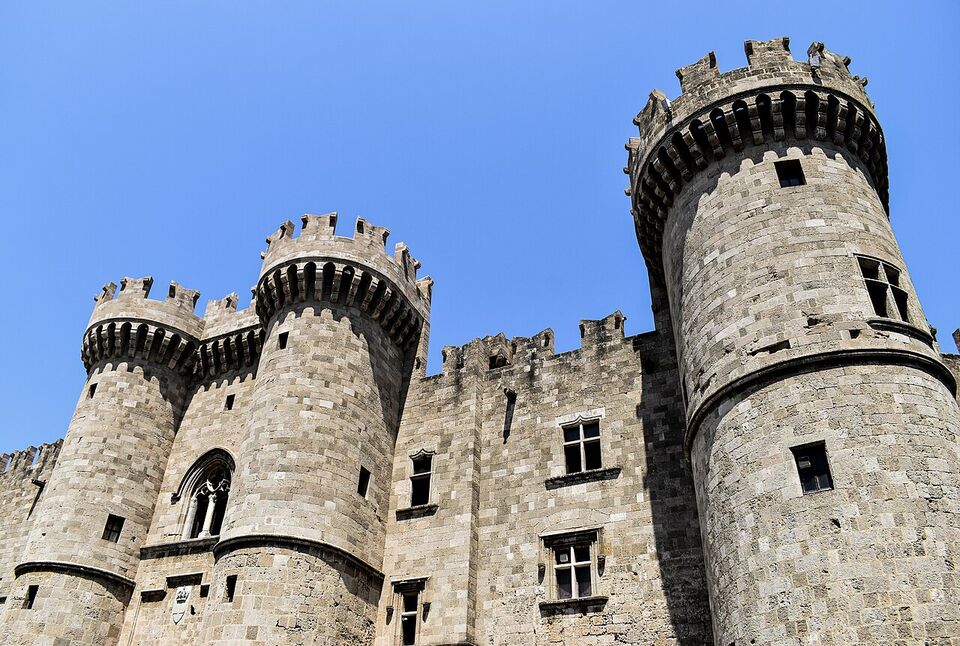
The Old Town of Rhodes is a UNESCO World Heritage site, a walled medieval city built by the Knights Hospitaller, who ruled the island from 1309 to 1522. Ottoman and Italian layers followed. It is still a living quarter with shops, small hotels, restaurants and houses behind stone walls. The main sights lie in the upper part, the Knights' Quarter, and the lower part is the market district, with mosques, a Jewish quarter and small squares.
Street of the Knights and the Palace of the Grand Master
The cobbled Street of the Knights runs uphill from the Archaeological Museum, which fills the former Knights' hospital, to the Palace of the Grand Master. The street is lined with the "inns" where knights of different nationalities lived, each marked by a crest. The Palace of the Grand Master, a large fortress-palace, was rebuilt in the 1930s by the Italians and now displays mosaics, furniture and exhibitions. The palace ticket is €20 (about $22) full, €10 (about $11) reduced (2026 price; the fortification walls are a separate €5 ticket). Hours are daily 8 a.m. to 8 p.m. from April 1 to October 31; from November 1 to March 31 they are 8:30 a.m. to 3:30 p.m., and the palace is closed on Tuesdays. It is also closed January 1, March 25, May 1, Easter Sunday, December 25 and 26. Buy online at tickets.hh.gr; details are on hh.gr.
Walls, harbor and food
You can walk part of the medieval walls on a guided route. Mandraki harbor outside the walls has the three windmills and the site where the ancient Colossus is said to have stood (it did not straddle the harbor). In the evening, the Old Town fills with diners. Restaurants near the Street of the Knights are expensive; go a few lanes away, near the Jewish Quarter or the Hippocrates Square, for lower prices and more local choices.
Insider tip
Cruise ships dock at Rhodes on many days, and the Old Town is at its fullest from 10 a.m. to 4 p.m. Go early in the morning or after 5 p.m., and ask your hotel which days big ships are in port. The cruise passenger fee at Rhodes is €5 ($6) in summer and €1 ($1) from November to March. More on cruises is at Greek Island Cruises.
Lindos
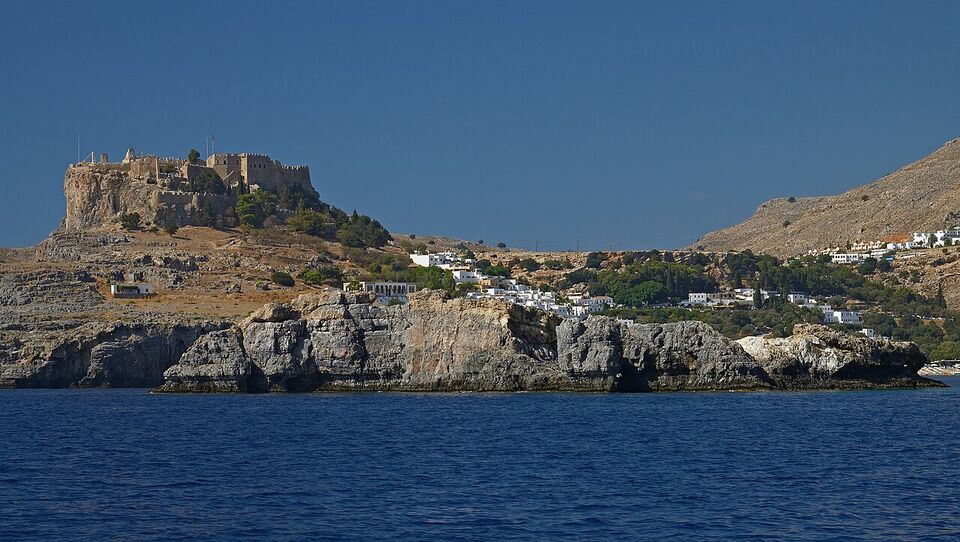
Lindos is a hillside village of white houses and narrow lanes, set above a curved bay on the east coast, about 30 miles (50 km) south of Rhodes Town (roughly an hour by car or bus). Above the village rises the acropolis, a rock crowned with a Doric temple of Athena Lindia, a Hellenistic stoa and later castle walls built by the Knights. The view over St. Paul's Bay and the sea is the main reason to climb.
- Ticket: €20 (about $22) full, €10 (about $11) reduced (2026 price). Hours are daily 8 a.m. to 8 p.m. from April 1 to August 31, closing earlier in steps through September and October (6 p.m. by late October); from November 1 to March 31 they are 8:30 a.m. to 3:30 p.m. and the site is closed on Tuesdays. Last admission is 20 minutes before closing, and the Ministry can close the site in heat waves. Free days are listed at hh.gr: the first and third Sunday of each month from November through March (next: November 15 and December 6, 2026), plus March 6, April 18, May 18, the last weekend of September and October 28.
- The climb: It takes 10 to 20 minutes up steps and polished stone, in the sun. Wear shoes with grip and bring water. Parts of the site may be under restoration.
- Donkeys: Donkeys carry visitors up the village path for a fee. Animal-welfare groups have criticized the trade, particularly in heat and for heavier riders. We suggest walking, taking the early hours when it is cool, or using a taxi to reach the base of the path. If you do ride, choose an operator who rests the animals in shade and does not overload them.
- Timing: The village is crowded from late morning. Arrive when the acropolis opens, or come in the evening.
St. Paul's Bay is a small, round cove with a chapel, a short walk from the village; tradition says the apostle Paul landed here. It is a pretty place to swim, but it is small and fills up in July and August.
Beaches
Anthony Quinn Bay
A small, clear-water cove with rocks and pines, named for the actor who filmed here. It is better for snorkeling than lying on sand, and it gets very crowded in midsummer.
Tsambika
A wide sandy beach under a hill with a small monastery on top. The water is shallow and warm, so it works well for families. It has organized sunbeds.
Prasonisi
A sandbar joins the main island to a tiny islet. Wind from one side creates waves on one coast and calm shallow water on the other, which is why windsurfers and kitesurfers come. It is windy and exposed, and pleasant in the morning in summer.
Lindos and Pefkos
Lindos Main Beach is easy but crowded. Pefkos is a smaller resort to the north with small coves.
West coast
The west coast faces the wind and the sunsets. It is cooler in July and August and rougher for swimming on some days.
The east coast is generally calmer in the meltemi months (June to September), and the west is windier. Sea temperature at Rhodes runs roughly 74°F (23°C) in June, 81°F (27°C) in August and 75°F (24°C) in October. For rules on sunbeds and Blue Flag beaches, see Beaches in Greece.
Symi: the day trip
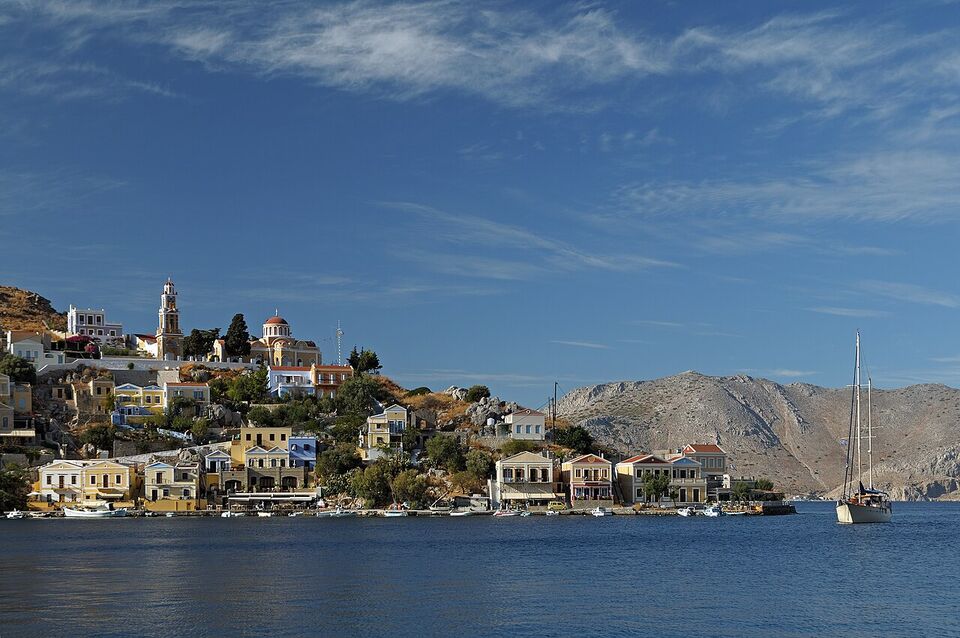
Symi is a small, rocky island north of Rhodes. Its harbor, Gialos, is lined with colorful neoclassical houses climbing the hill, and the lanes above lead to the old village of Chorio. Most visitors come on a day excursion from Rhodes: excursion boats and the local Dodekanisos ferries take roughly an hour, and many trips include a stop at the Panormitis monastery on the island's southwest. A day trip gives you time for lunch, a swim and the stairs of the Kali Strata, the main stepped street.
Staying overnight means seeing the harbor in the evening when the boats have left. Rooms are limited and cost more in peak season, and the island has few sandy beaches. Check that the boat schedule matches your return plans, and remember that the last boat back can fill up in summer.
Kos and the Asklepion
Kos is a flatter, greener island with long beaches, a bike-friendly town and a good set of ruins. The main site is the Asklepion, a healing sanctuary on a hillside above Kos Town, about 2.5 miles (4 km) away. It is associated with Hippocrates, the doctor traditionally called the father of medicine, and has terraces, columns and sea views. Entrance is an archaeological-site ticket (check the price and hours on hh.gr); hours are shorter in winter.
Kos Town has a medieval castle, a large harbor and an old agora, and the island has long beaches such as those at Tigaki and Marmari. Kos has an international airport with seasonal European flights, so it is an alternative entry point to the Dodecanese. Ferries link Kos with Rhodes, Patmos, Kalymnos and Leros, and there are short sailings to Bodrum in Turkey; entry rules for non-EU travelers apply on those routes, so check the current requirements before booking.
Patmos: monastery and cave
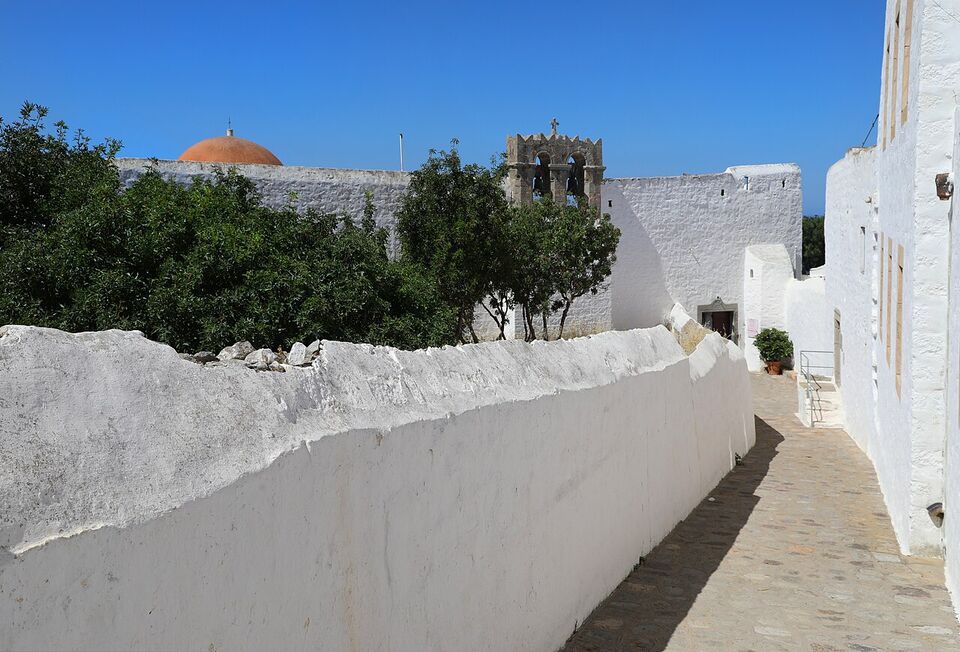
Patmos is the quiet pilgrimage island of the Dodecanese. Tradition says St. John wrote the Book of Revelation here, and two sites are listed together by UNESCO: the Cave of the Apocalypse and the fortified Monastery of St. John the Theologian above the main village (Chora). The two sights are a short bus ride or a walk apart.
- Cave of the Apocalypse: A small chapel built around a cave where John is said to have received his vision. It is small and can be crowded; there are set opening hours.
- Monastery: A massive, castle-like building with courtyards, a museum of icons and manuscripts, and a view over the island. Allow about an hour.
- Dress code: Cover shoulders and knees. Shorts and sleeveless tops are not allowed, for either men or women. Bring a light scarf or wrap, and expect to be refused at the door if you are not dressed properly.
- Getting there: Patmos has no airport. It is reached by ferry from Rhodes, Kos, Leros and other islands, and from Piraeus on long routes. Check schedules; services are thinner outside summer.
The village of Chora is a whitewashed town of mansions with little traffic. The beaches (Psili Ammos, Kambos) are small and quiet. Patmos suits couples and people who like a slow pace. It is not a good island if you want a lot of activities or nightlife.
Leros and Kalymnos
Leros is a quiet island with a distinctive Italian modernist architecture from the 1930s, visible in the town of Lakki, plus a castle above Agia Marina. It is a destination for people who want a different kind of island and little tourism. Kalymnos is famous among rock climbers: the island has hundreds of bolted sport-climbing routes on its limestone cliffs, with the most popular areas near Masouri and Arginonta on the west coast. Climbers come from spring to autumn; July and August are very hot. Gear rental and guides are available locally. Kalymnos also has a sponge-diving heritage, and the main town, Pothia, is a working harbor.
Both islands are reached by ferry from Kos, Rhodes and Piraeus, and by flights to Kalymnos and Leros from Athens (limited). For outdoors planning more widely, see Hiking, Sailing and the Outdoors.
Where to stay and what to eat
For a first visit, the best base is Rhodes Town or the Old Town itself: you can walk to the main sights, eat well in the evening, and take buses or tours from there. A hotel inside the walls is atmospheric but means dragging bags over cobbles and some noise from lively squares; a hotel in the new town is easier for cars. Lindos is a good second base if you want quiet evenings and early starts at the acropolis, but it has steep lanes, limited parking and no through traffic. Families often choose the east-coast beach resorts, which have organized beaches and shallow water, and these mostly close from late October to April.
The Dodecanese share the Greek table but have their own touches: pitaroudia (chickpea fritters), fresh fish, honey, and soumada, an almond drink. Rhodes also has a wine region on the slopes of Mount Attavyros and in the interior, and the local Athiri white grape is worth a glass. See Greek Food and Greek Wine, Ouzo and Coffee for what to order and how tavernas work. Watch for places that push a set menu on the Street of the Knights; look at the menu and prices before sitting.
Choosing between islands
If you only have time for one island after Rhodes, decide by mood. Choose Symi if you care most about scenery and a short trip. Choose Kos if you want easy flights, wide beaches and a bike-friendly town. Choose Patmos if you want quiet and a place with real religious history. Choose Kalymnos only if you climb. Leros is for those who want to be away from tour groups altogether.
When to go and how long to stay
Rhodes has a longer season than the Cyclades. The sea is warm from June through October, and the sunny, dry weather often runs from late April to late October. July and August are hot (around 88°F, or 31°C, by day) and busy; May, June, September and October are better for sightseeing. Winter days are mild, around 61°F (16°C), and wetter than summer. In winter, the Old Town and Rhodes Town stay lively; most beach resorts at Lindos, Pefkos and Faliraki close. On the smaller islands, many hotels and restaurants close from late October to April. See When to Go to Greece and Greece in November.
Wildfires are a risk in summer. In July 2023 a large fire on Rhodes led to the evacuation of thousands of visitors from the south-east coast. If you travel in July or August, know your hotel's evacuation plan, keep your passport and phone charged, and follow the emergency number 112. Safety guidance is at Is Greece Safe?.
- 4 days
Rhodes only
Day 1 Old Town; day 2 Lindos and a swim; day 3 Prasonisi or Tsambika; day 4 Symi or the interior (Filerimos, Kamiros, Seven Springs).
- 8 days
Rhodes and Kos or Symi
Four nights on Rhodes, then two or three nights on Symi or Kos, with a Patmos day trip only if the ferry times allow.
- 10 days
Rhodes, Kos and Patmos
Four nights on Rhodes, three on Kos, three on Patmos. Fly home from Kos or Rhodes.
Practical tips and costs
- Hotels: $ under $120 a night for a double, $$ $120 to $300, $$$ over $300. All hotels collect the climate resilience fee at check-out, per room per night (2026 rates run from €2 to €15 from April to October). See Where to Stay in Greece.
- Sites and tickets: The Palace of the Grand Master, Lindos and the Asklepion are state sites. Buy through the Ministry's e-ticket store and avoid markup resellers. Free days at state sites in 2026-27 are described in Ancient Sites and Museums.
- Money: Cards work almost everywhere, but carry cash for small bakeries, beach cantinas and local buses.
- Heat: Plan sites for the morning, bring water, and cover up. Sites often close for several hours in heat waves.
Different from home
Time zones and daylight saving differ from the US. Greece is 7 hours ahead of New York most of the year, but daylight saving ends on different dates, so for a couple of weeks the gap is 6 hours. This matters when you call home or check in for a flight.
Add it to a route in the trip builder, or ask us to plan the hotels, trains and guides for you.