Overview: why go beyond Santorini and Mykonos
If you want the Greek islands without the cruise-ship crowds and caldera prices, start with Naxos and Paros, then add Milos, Sifnos or Folegandros depending on what you like. They share the white cubes, blue domes and narrow lanes that make people picture the Cyclades, but they cost less, feel more like places where people live, and are easier to move between than most first-timers expect. For the two famous islands, see our guides to Santorini and Mykonos, and the side-by-side comparison at Santorini vs Mykonos.
The Cyclades are the island group in the central Aegean, south-east of Athens. There are about two dozen inhabited islands, and most visitors see only a handful. The practical rule of thumb: pick one or two islands per week. Each ferry day eats half a day, and the schedules are tight enough that a missed boat can cost you a night's hotel.
This page covers the main islands in turn, then how the ferries link them, how to choose between them, and what changes by season. Prices are in euros with US dollars at €1 = US$1.12.
Naxos: the easiest first choice
Naxos is the largest Cyclades island and the one with the most to do besides the beach. It has a walkable old town, long sandy beaches, farmland that feeds the island (potatoes, cheese and citrus are local specialties), and a mountainous interior with marble villages. That variety is why it works for families, couples and groups with different interests.
Naxos town (Chora) and the Portara
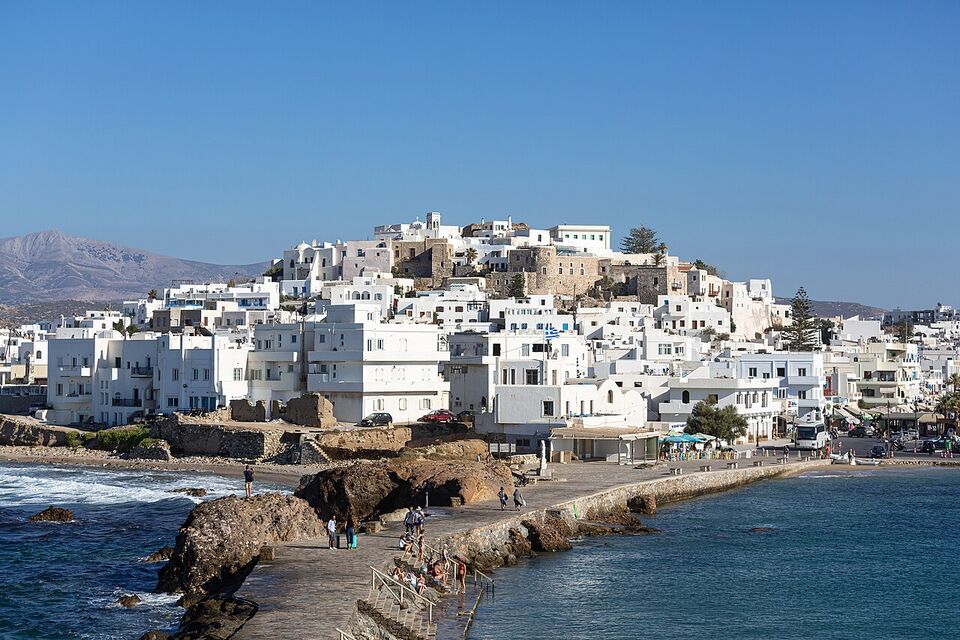
Ferries arrive at Naxos town, also called Chora. The old Venetian quarter climbs a hill behind the harbor, with a castle (kastro) at the top and a maze of lanes below. Stay in or near Chora if you do not want a car: the harbor, the beach of Agios Georgios and many tavernas are within walking distance.
The Portara (the great doorway) stands on a small islet reached by a causeway at the edge of the harbor. It is the marble frame of an unfinished temple, usually linked to Apollo and begun in the sixth century B.C. There is no ticket and no gate; people go at sunset, so go earlier in the evening or just after sunrise if you want it quiet.
Villages: Halki and Apiranthos
Halki, in the fertile Tragaia valley, was once the island's main town. It has Venetian towers, Byzantine churches, and a distillery that makes kitron, a liqueur from the citron fruit. Apiranthos, higher in the mountains, is built of marble and slate with marble-paved lanes, small museums and a stone-built feel that looks nothing like the whitewashed villages near the coast. The two fit into one half-day drive; add the marble-quarry area or Filoti, a large mountain village, if you have time.
Beaches
The west coast has the long beaches, in a run south of Chora: Agios Georgios, Agios Prokopios, Agia Anna and Plaka. They get busier as you near town and quieter as you go south. Mikri Vigla is the island's wind and kitesurfing area. Alyko, at the southern end, is backed by dunes and juniper trees. On the meltemi days of July and August, the west coast is more exposed to the wind than sheltered bays, so ask where the water is calm before you set out. For more on choosing a beach and the rules about sunbeds and Blue Flag beaches, see Beaches in Greece.
Mount Zas and walking
Mount Zas, at 3,294 ft (1,004 m), is the highest point in the Cyclades. The walk from the village of Filoti takes a few hours round trip and is mostly a steady climb on a clear path; start early, carry water and skip it in strong wind. Naxos also has marked paths between villages, and many of the old marble-paved trails are pleasant on spring mornings. For general guidance on hiking in Greece, see Hiking, Sailing and the Outdoors.
Insider tip
Naxos is big enough that a day without a car feels limiting, but narrow mountain roads and parking in Chora are not easy. Rent a small car for two or three days of your stay rather than the whole trip, and hire a taxi or take the bus for the rest.
Paros and Antiparos
Paros is smaller than Naxos and sits close to it, so it is the natural partner. It has two harbor towns, a famous mountain village, some of the best-known beaches in the group, and a more polished, boutique-hotel feel than Naxos. It also has more nightlife, concentrated in Naoussa.
Parikia and Naoussa
Parikia is the main port and usually where ferries arrive. The old town has a Venetian castle built from ancient marble and an early Christian church, Panagia Ekatontapiliani, one of the oldest in Greece. It is practical, with plenty of rooms and transport, and has a fine town beach.
Naoussa, on the north coast, is a fishing harbor with a Venetian fort in the water, small boats and a long row of waterfront tavernas and bars. It is the island's social center and the best place to stay if you want evenings out. Nearby beaches include Kolymbithres, with its sculpted rocks, and Monastiri.
Lefkes and the Byzantine Road
Lefkes is a hillside village of white houses, a large church and shaded lanes. A paved path, known as the Byzantine Road, runs from Lefkes to the village of Prodromos and takes roughly an hour on foot. It is one of the easiest village walks in the group and has a good payoff for little effort. The marble quarries near Marathi, which supplied the stone for ancient sculpture, are also on Paros if you want something off the beaches.
Antiparos
Antiparos is a small island just to the south-west. Boats cross from Paros (from Pounta, on the southern coast, in only a few minutes; a longer route runs from Parikia). Antiparos has a relaxed village, a few beaches and a cave with stalactites. Many people go for a day and stay for dinner; others stay for the quiet. Check the boat times to avoid a late return.
Paros has very frequent ferries from Piraeus, Naxos, Mykonos and Santorini, and an airport. The Paros-Naxos link runs many times a day in summer and drops to only a few in the cooler months (see the section on seasons below).
Milos: coves, volcanic rock and boat trips
Milos is a volcanic island whose coast has been carved into pale rocks, caves and small beaches. It is better for swimming and boat trips than almost any other Cyclades island, and it is quieter than Santorini even in July. It is also where the ancient statue now called the Venus de Milo was found in 1820; it is in the Louvre, but there is a small archaeological museum in Plaka.
Sarakiniko
Sarakiniko is a white, smooth volcanic landscape that slopes into the sea. It looks like a lunar surface and is free to visit. It has little shade and no facilities, so go early or late and wear shoes with grip, as the rock is slippery and can be hot. Do not jump from the cliff edges; every summer there are injuries.
Kleftiko by boat
Kleftiko, on the south-west coast, is a set of sea caves and arches that you cannot reach by road. Most visitors take a half-day or full-day boat trip from Adamas or Pollonia, with stops for swimming. Prices vary a lot by boat type and by season, so check the operator's own site or ask at your hotel. Smaller boats reach the caves more easily; larger boats carry more people. Boats run in good weather only, and in strong meltemi they may be cancelled or sail a different coast, so book a day when you have a buffer afterward.
Plaka and the villages
Plaka is the island's hilltop main village. It has a ruined Venetian castle area, a handful of small museums and the island's most photographed sunset viewpoints, so it fills at the end of the day. Nearby are the ancient catacombs, an early Christian burial site, and the ancient theater. Down at the water, the fishermen's houses at Klima have brightly painted doors that open straight onto the sea.
A car or scooter is close to essential on Milos: sites and beaches are spread out. Read our guidance at Driving in Greece before renting.
Sifnos: food, pottery and walking
Sifnos has a reputation as the cooking island of the Cyclades. The classic dish is revithada, chickpeas baked slowly in a clay pot overnight in a wood oven, usually served on Sundays, along with mastelo (lamb or goat baked with dill and wine) and sweets made with almonds and honey. For more on what to order, see Greek Food.
Pottery has been made here for centuries, and some workshops still turn pots in the traditional way: you can watch the potters in villages and at the beach of Vathi. Sifnos is also a good walking island, with a network of stone-paved footpaths linking villages and chapels. The paths are mostly short and signed, which makes it one of the easier islands for walkers who do not want a long climb. The main settlement is Apollonia, with the hillside villages of Artemonas and Kastro, the medieval town on a cliff. The beaches (Platis Gialos, Vathi, Faros) are good rather than spectacular.
Sifnos is small, quiet and mostly closes in winter. It suits couples and people who like to eat and walk; it is not a good choice if you want big nights out.
Folegandros: Chora and the cliffs
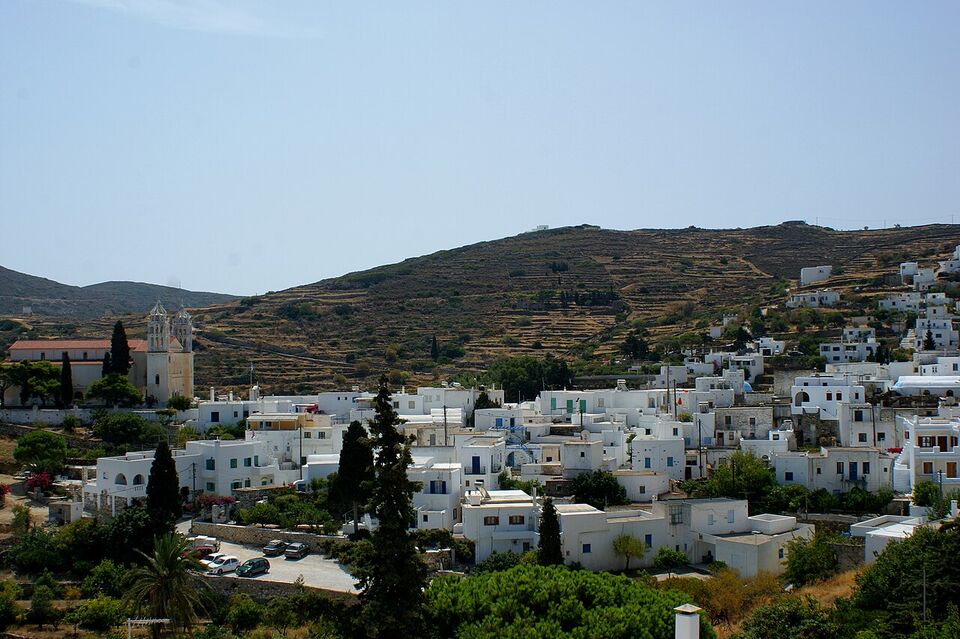
Folegandros is a small island with a very photogenic main village. Chora sits on the edge of a cliff roughly 200 meters above the sea, with three linked squares, flower-filled lanes closed to cars, and a white church (Panagia) that you can climb to by a zigzag path. It is a place for walking, eating, and watching the light on the cliffs, not for resort activity.
The island has a few beaches, some reached on foot or by boat, and a well-known walk from Chora to the beach of Agios Nikolaos on the coast. There is no airport, and ferry services are limited and heavily affected by weather, so plan some slack, especially if you must catch a flight home. Folegandros is a good second or third stop in a trip, not a short-notice add-on.
Ios, Syros and Tinos
Ios
Ios has a reputation for loud nightlife, mostly in Chora in July and August, but it has a calmer side too. Mylopotas is one of the longest beaches in the group and has water sports and bars. In June and September Ios is far quieter and good for swimming. If you hope to avoid late-night noise in peak season, do not book a hotel in the middle of Chora.
Syros: the year-round capital
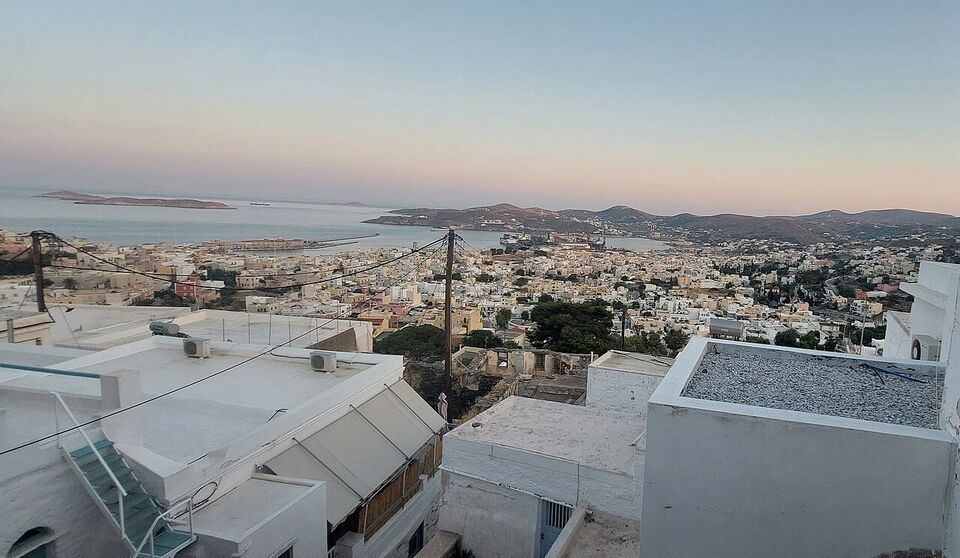
Syros is the administrative capital of the Cyclades, and its main town, Ermoupoli, is the reason to go. It was a major commercial port in the 19th century and has neoclassical mansions, a town hall on Miaouli Square, a small opera house and a marble-paved center. Above it, Ano Syros is a Catholic hilltop settlement with a different character. The town is lived in year-round, with schools, offices, restaurants and a university presence, which makes Syros one of the few Cyclades islands that works well in November or March.
Tinos
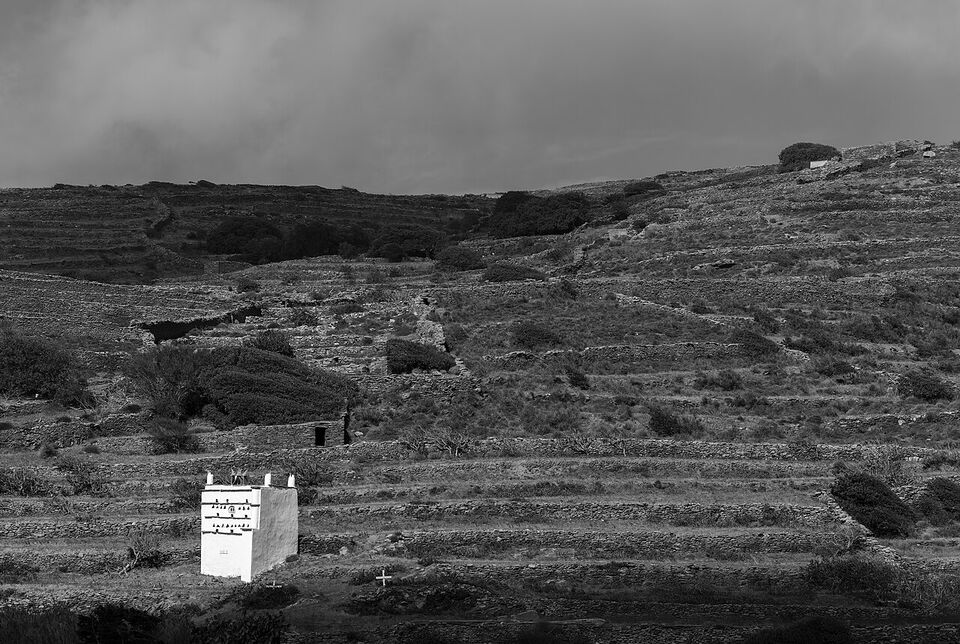
Tinos is known for religion and craft. The Church of Panagia Evangelistria is one of Greece's most important pilgrimage sites, with the largest crowds on August 15 and around March 25 (see Festivals in Greece). The island also has more than a thousand dovecotes in the north, marble-carving villages such as Pyrgos, and a quiet food culture. It is a good choice if you want an island that is mainly Greek visitors.
How the ferries connect the islands
Most Cyclades trips use Piraeus (the port of Athens) or Rafina (closer to the airport on the east side of Attica). Both have conventional ferries (slower, cheaper, with decks and indoor seating) and high-speed boats (faster, more expensive, more affected by wind). Timings below are typical ranges from booking sites; check the operator for your date. Fuller guidance is in Greek Ferries and Island Hopping.
| Route | Typical time | Notes |
|---|---|---|
| Piraeus to Syros | About 2 to 4 hr | Frequent year-round; a good gateway |
| Piraeus to Paros | 3 to 4.5 hr | Many sailings in summer; first departure early morning |
| Piraeus to Naxos | About 3 hr 15 min to 5 hr 30 min | High-speed or conventional |
| Piraeus to Milos | Roughly 3 to 7 hr | Fast boats in summer only; fewer in winter |
| Piraeus to Sifnos | Roughly 2.5 to 5 hr | Often continues to Milos or Folegandros |
| Piraeus to Ios | Roughly 3.5 to 7 hr | Often continues to Santorini |
| Piraeus to Santorini | 5 to 8 hr (up to 9.5 with stops) | Fastest high-speed boats under 5 hr |
| Naxos to Paros | About 40 to 60 min | Many a day in summer, 2-3 off-season |
| Paros to Antiparos | A few minutes (from Pounta) | Small passenger and car boats |
Deck fares to the Cyclades start from about €40 ($45) one way and can top €100 ($112) on high-speed boats in peak season. Short hops between neighboring islands cost less. You can book on the operators' own sites or through a reseller; resellers add a fee. In summer, book popular sailings weeks ahead, especially if you travel with a car. Winter timetables are thinner and published gradually from November.
Watch out
The meltemi wind (June to September, strongest in July and August) delays or cancels ferries, and high-speed boats are hit first. Do not book a ferry the same day as an international flight home. Build in a buffer day, or fly the last leg back to Athens.
Flying is possible between Athens and Naxos, Paros, Milos and Syros, usually in under an hour (Aegean with Olympic, and Sky Express). Folegandros, Ios and Sifnos have no airport. For the overall picture, see Getting Around Greece.
How to choose
The islands differ more in mood than in sights, so choose by what you want from the days.
Families
Naxos has long, shallow sandy beaches, easy driving and a town with many family restaurants. Paros has good beaches too (Golden Beach, Santa Maria) and is simple to reach by ferry.
Couples
Naoussa gives you evenings out; Folegandros and Sifnos give you quiet, walks and good dinners. Milos works if you like boat days and swimming.
Walkers
Sifnos has the best-signed footpath network, Naxos has the high-mountain route to Mount Zas, and Paros has the Byzantine Road. Plan walks in the morning, outside July and August midday.
Swimmers and boat people
Milos has the most varied coast and the best boat trips. Choose a hotel near Adamas or Pollonia for easy departures.
Nightlife
Ios is the party island in summer. Naoussa is a smoother evening scene. Both are much quieter outside peak weeks.
Culture and year-round life
Ermoupoli offers architecture and a working town. Tinos offers pilgrimage, craft and village life.
A sample pairing: Naxos plus Paros for a relaxed week; Paros plus Milos for beaches and boats; Syros plus Tinos for something different. If you also want Santorini, add it last, then fly or take a fast ferry on. We do not recommend four islands in ten days. For a wider view of the options, see Which Greek Island Is Best for You?.
Seasons: when to go
The Cyclades season is roughly May through October. June and September are the best months for many people: warm seas, fuller ferry schedules than in spring, and fewer crowds than July and August. July and August are hot, busy and expensive, and the meltemi can make some beaches rough. Our month-by-month comparison is at When to Go to Greece.
- April to mid-May: Cool water, green hillsides, wildflowers and good walking. Some hotels and many beach tavernas are still opening, and ferries run fewer sailings.
- Late May to June: The sweet spot for swimming plus space. Full services have mostly started.
- July and August: Highest prices, strongest wind, and all ferries and rooms booked far ahead.
- September to mid-October: Warm sea, calmer wind, lower rates. By late October many places close.
- November to March: Many hotels and beach businesses close, ferries run far less often (one end-of-season report has Paros-Naxos dropping from many daily sailings to about two or three a day; check the operator), and high-speed boats mostly stop. Syros and Naxos town stay lived-in. If you travel then, read Greece in November.
Different from home
A Greek island "season" is a real on-off switch. Rooms, rental cars and ferries that exist in July may not exist in March. Check that your hotel, your restaurants and your ferry are all running on your dates before booking.
Where to stay, costs and practical tips
Stay near the main harbor town on your first island if you depend on ferries and buses, and consider a base near a beach on the second. Hotels fall into broad tiers: $ rooms under about $120 a night outside peak, $$ boutique hotels from $120 to $300, and $$$ over $300, which in July and August means cliff-edge or beachfront properties on Paros, Milos and Folegandros. Guests also pay the climate resilience fee at check-out, per room per night. The 2026 rates run from €2 ($2) to €15 ($17) from April to October, depending on the hotel's star rating, and less in winter. More on lodging in Where to Stay in Greece.
Save money
Travel in June or September rather than July or August, take conventional ferries instead of high-speed boats, and stay in the main town rather than on the beach. A conventional ferry is slower but often costs noticeably less and is less likely to be cancelled by wind.
Getting around: buses on Naxos, Paros and Milos link the main towns and beaches but thin out in the evening. Taxis are limited and are hard to find at peak times; arrange them ahead. If you rent a car or scooter, you need the International Driving Permit; read Driving in Greece and Is Greece Safe? first, because scooter crashes are a major cause of tourist injuries and are often not covered by insurance. Carry some cash for small tavernas and ferry-side kiosks, although most places take cards.
Pack light: ferry decks are windy and cobbled lanes are hard on rolling suitcases. Many island hotels will meet you at the port. See Greece Packing List for a list.
Sample itineraries
- One week
Naxos and Paros
Three nights on Naxos (Chora, beaches, Halki and Apiranthos by car), the ferry to Paros, then three nights in Naoussa or Parikia, with a half day on Antiparos. Fly or ferry back to Athens on the last day.
- Ten days
Paros, Milos, Sifnos
Four nights on Paros, a ferry to Milos (check connections first) for three nights with a Kleftiko boat trip, and three nights on Sifnos. Fly home from Milos to Athens if the ferry times are awkward.
- Four days
Syros and Tinos
One of the few combinations that works in shoulder months: two nights in Ermoupoli, a short ferry to Tinos, and the ferry back to Piraeus.
For the bigger picture of Greece, including Crete, Rhodes and the Ionian islands, see Greece's Destinations and Crete.
Add it to a route in the trip builder, or ask us to plan the hotels, trains and guides for you.