Overview
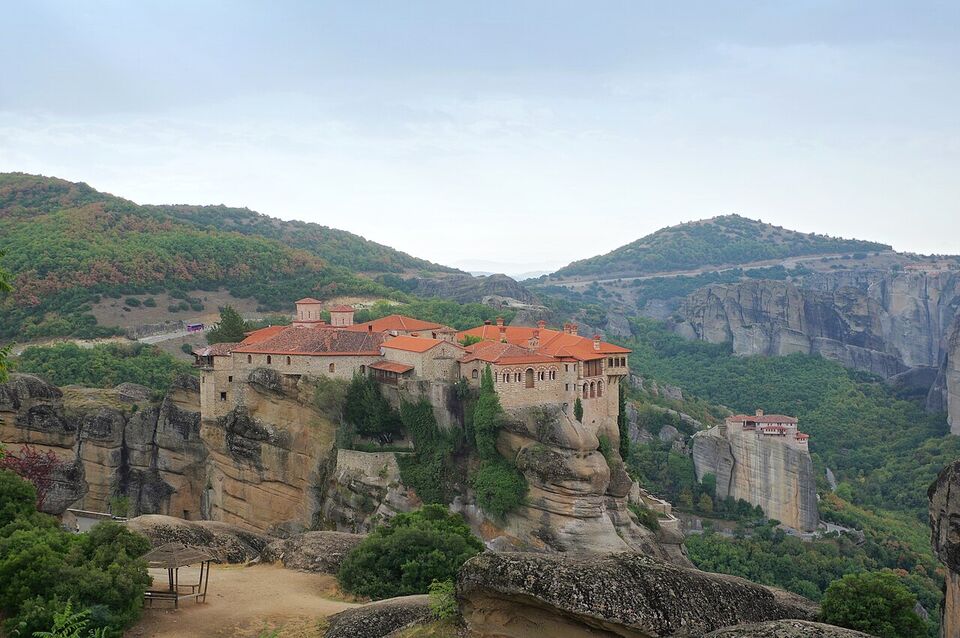
Delphi and Meteora are the two great sights of central Greece. Delphi is an ancient sanctuary and museum on the slopes of Mount Parnassus, about 110 miles (180 km) northwest of Athens. Meteora is a group of monasteries built on sandstone pillars, about 220 miles (355 km) north of Athens near the town of Kalambaka. Together they make a satisfying two-to-three-day trip from Athens, and they are best taken in that order, driving north.
The question most travelers face is how to do it: bus, train, car or tour. The short answer is that Delphi works as a long day trip and Meteora needs a night. If you want both without driving, a three-day plan with a bus to Delphi, a night there, and the KTEL bus on to Kalambaka is workable but slow. A rental car makes the loop far easier.
Prices are 2026 prices from the Ministry of Culture's visitor site for Delphi, and from the local Meteora tourism site for the monasteries. Euro amounts are converted at €1 = US$1.12.
Delphi: the sanctuary
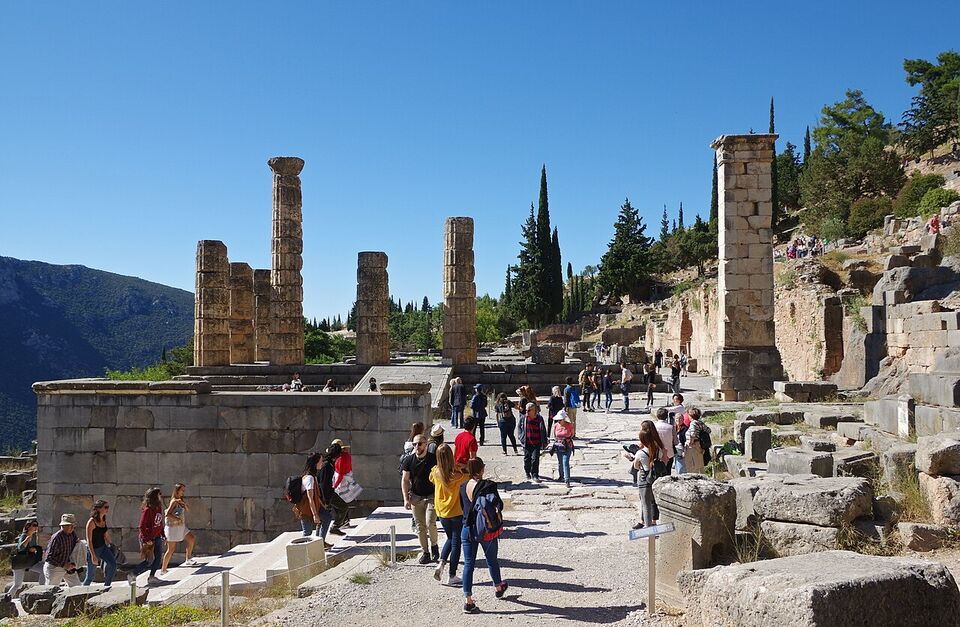
For about a thousand years, Delphi was where Greeks came to consult the oracle of Apollo, who spoke through a priestess, the Pythia. The ancients considered it the center of the world. The site climbs a steep hillside above a valley of olive trees, and it is one of the most scenic of Greece's ancient sites, as well as one of the most important.
What to see
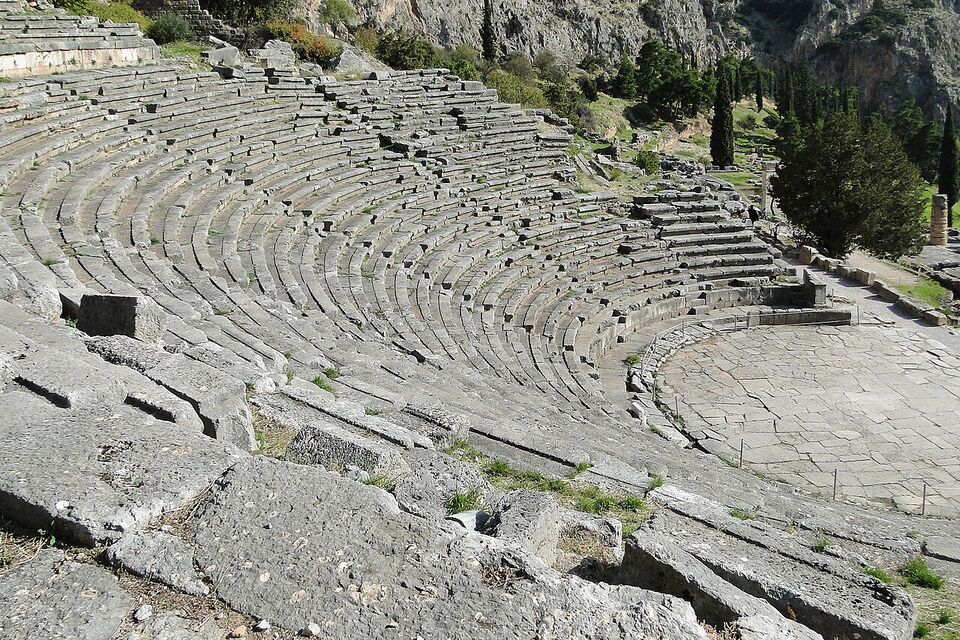
You enter by the Sacred Way, a stone path that zigzags uphill past the foundations of treasuries built by Greek city-states. Among them is the Treasury of the Athenians, which has been restored and is the most complete building. Higher up are the Temple of Apollo, where the oracle sat, the theater, and at the top the stadium, where the Pythian games were held. Allow 1.5 to 2 hours for the sanctuary and as much again for the museum.
A short walk down the road from the main site, the sanctuary of Athena Pronaia has the circular Tholos, the most photographed building at Delphi, three marble columns on a round base. Whether the Castalian Spring beside the road is open depends on rockfall safety work, so check locally.
The museum
The Archaeological Museum of Delphi sits beside the site and is included in the ticket. Its most famous object is the bronze Charioteer, a rare surviving Greek bronze statue from the early 5th century BC (roughly 470 BC). There is also the Sphinx of Naxos, a marble sphinx on a tall column, and sculptures from the treasuries. Do the museum first if you want context, or after the climb if your legs are tired. Many visitors find the museum easier when the sanctuary is crowded.
Tickets and hours
| Item | Details |
|---|---|
| Ticket (site and museum) | €20 (about $22); reduced €10 (about $11) |
| April 1 to August 31 | Daily 8 a.m. to 8 p.m. |
| September | 8 a.m. to 7:30 p.m. (Sept 1-15); 8 a.m. to 7 p.m. (Sept 16-30) |
| October | 8 a.m. to 6:30 p.m. (Oct 1-15); 8 a.m. to 6 p.m. (Oct 16-31) |
| November 1 to March 31 | Daily 8:30 a.m. to 3:30 p.m. |
| Closed | January 1, March 25, May 1, Orthodox Easter Sunday, December 25 and 26 |
Last admission is 20 minutes before closing. Free admission applies on March 6, April 18, May 18, the last weekend of September, October 28 and on the first and third Sunday of each month from November through March (next: November 15 and December 6 and 20, 2026). Buy tickets at the gate or on the official store, tickets.hh.gr; site details are on hh.gr. The museum's own page lists Tuesdays from April to October as 10 a.m. to 5 p.m., so on a summer Tuesday plan the museum for later in the day. In summer, arrive by 8 a.m. to avoid tour buses and midday heat; in winter, the short day means you must arrive early.
Watch out
From November to March the site closes at 3:30 p.m. and the last entry is 20 minutes before that. A bus that gets in at 1:30 p.m. leaves you little time. Plan a night in Delphi or arrive by car in the morning.
Arachova and the Parnassus area
Arachova is a stone mountain town about 6 miles (10 km) before Delphi on the road from Athens, at roughly 3,000 ft (950 m). It is known for its steep streets, weaving and cheese, and as a base for skiers at the Parnassos ski resort in winter (the season depends on snow). It is livelier than Delphi at night and has more places to stay and eat, so many visitors sleep here and drive to Delphi in the morning. Hotels are more expensive in winter and on weekends.
Delphi town is smaller, strung along the road on the hillside with views down to the Gulf of Corinth. It has restaurants and hotels, and you can walk to the site. It is quieter in the evening than Arachova.
On the drive, a detour to Hosios Loukas, an 11th-century Byzantine monastery with fine mosaics, adds about an hour. Check its hours and ticket before you go. It suits travelers who like Byzantine art.
Meteora: the monasteries
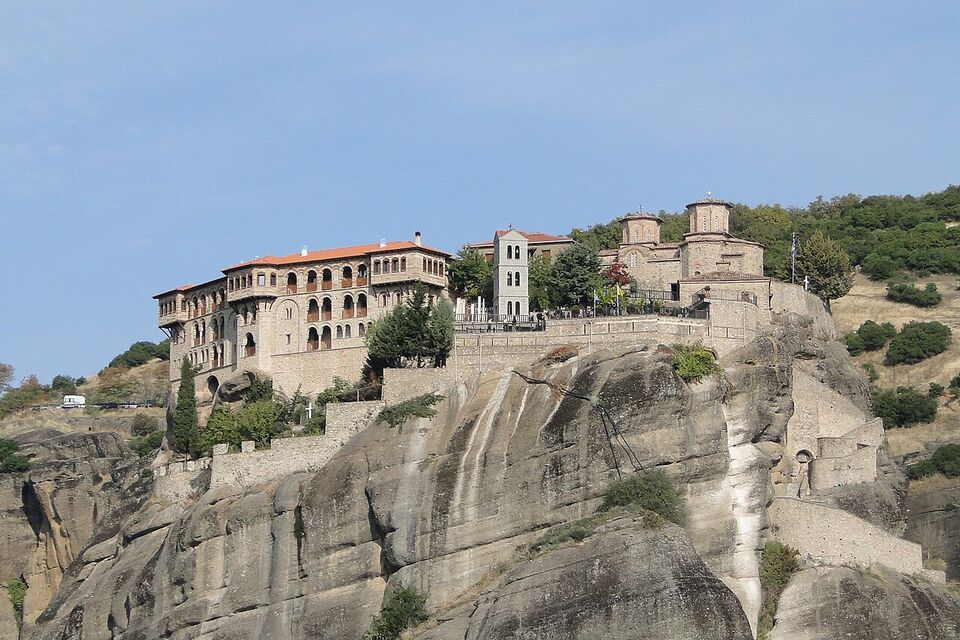
Meteora is a forest of sandstone pillars that rise abruptly from the plain of Thessaly, and the monasteries sit on top of them. Monks began to settle here in the 14th century, and at the peak there were more than 20 monasteries. Six remain open to visitors, and they are Greece's best-known Orthodox monasteries after Mount Athos. The scenery is the main draw: the road winds beneath the rocks, and the views from the terraces are wide.
Meteora is a UNESCO World Heritage site and the monasteries are working religious communities, so dress and behave accordingly. See our etiquette guide for general rules.
Tickets, days and dress
Each monastery charges €5 (about $6) per person, paid in cash at the entrance. Hours and closed days differ for each, and the monasteries can change them without notice, especially around religious holidays. The table lists the schedule on the local Meteora tourism site (2026); St. Stephen's and Roussanou start their full summer timetable on May 15. Confirm on the day.
| Monastery | Summer (Apr 1-Oct 31) | Winter (Nov 1-Mar 31) | Closed |
|---|---|---|---|
| Great Meteoron (Megalo Meteoro) | 9:30 a.m.-3 p.m. | 9:30 a.m.-3 p.m. | Tuesday (winter: Tuesday to Thursday) |
| Varlaam | 9 a.m.-4 p.m. | 9 a.m.-4 p.m. | Friday (winter: Thursday and Friday) |
| Roussanou | 9 a.m.-4:30 p.m. (Sunday to 4 p.m.) | 9 a.m.-2 p.m. (Sunday to 4 p.m.) | Wednesday |
| Holy Trinity (Agia Triada) | 10 a.m.-4 p.m. | 10 a.m.-4 p.m. | Thursday |
| St. Stephen's (Agios Stefanos) | 9 a.m.-1:30 p.m. and 3:30-5:30 p.m. | 9 a.m.-1 p.m. and 3:30-5 p.m. | Monday |
| St. Nicholas Anapausas | 9 a.m.-5 p.m. | 9 a.m.-4 p.m. (Sunday from 9:30) | Friday |
Because the closed days differ, on any single day at least one or two are shut. On Thursday and Friday in winter, only a few are open. Sunday is the busiest day. The dress code is strict: women need skirts below the knee and tops covering the shoulders; men need long trousers; sleeveless tops are not allowed for anyone. Wrap-around skirts are available at the entrances, but do not count on them for large groups. Photos inside churches are usually not allowed.
Which to see
Great Meteoron
The oldest and largest, with a museum, a kitchen and a church with painted walls. Many steps. The best choice if you can see only one.
Varlaam
Next door to the Great Meteoron, with a fine church and a museum. Often combined with it on the same morning.
Holy Trinity
Perched on an isolated pillar. It appeared in a 1981 James Bond film. The climb is steep but short.
Roussanou
Built at the edge of a rock and easy to reach by a bridge. Good for photographs.
St. Stephen's
Reached by a short bridge, with the fewest steps. It has a long midday break, so check the hours.
St. Nicholas Anapausas
A narrow monastery on a tall rock, with painted walls. Many steps and a small space, so it fills quickly.
Most visitors see three monasteries in a morning, for about €15 (about $17). Allow 45 to 60 minutes at each of the large ones. The road between them is steep. Your own car, a taxi or a tour is the practical way to hop between monasteries; a local bus from Kalambaka serves some of them in season, but its 2026 timetable was not published where we looked, so ask at your hotel.
Kalambaka and Kastraki
You stay in Kalambaka or in the smaller village of Kastraki, both at the foot of the rocks. Kalambaka is the town, with the bus station, restaurants and most hotels; Kastraki is quieter, higher and closer to the rocks, with views from some guesthouses. Both are a 10 to 20 minute drive from the nearest monasteries. Rooms range from $ guesthouses to $$ hotels with rock views, and prices rise in spring and autumn. Our where to stay guide explains the tiers.
Book ahead for Easter week and August. The hotels charge a climate resilience fee at checkout (2026 rates from €0.50 to €15 per room per night depending on stars and season), separate from the room price.
Getting there from Athens
By bus (KTEL)
KTEL Fokidas runs buses from the Liosion terminal in Athens to Delphi in about 3 hours, with a few departures each day. For Meteora, the dependable option is the KTEL bus from the Liosion terminal via Trikala to Kalambaka, about 4.5 to 5.5 hours. Buses are cheap, roughly €15 to €35 for long routes; check the current fare on the KTEL site. Timetables are thinner in winter, so confirm the return before you book. There is no direct bus between Delphi and Kalambaka, so you must go back via Athens or Lamia, or hire a car.
By train
Hellenic Train serves the line north of Athens, but rail to Kalambaka has had long disruptions since the 2023 storms. In the latest information we found (a local tourism post first published in February 2024), there were no direct trains to Kalambaka: travelers took the Athens-Thessaloniki line to Paleofarsalos and then a Hellenic Train bus to Kalambaka, a journey of about 5 hours with a risk of missed connections. Work was said to be continuing, with a return of trains expected by late 2026, but the current status is unclear. Check hellenictrain.gr or call 14511 before planning on it.
By car
To Delphi it is about 110 miles (180 km), 2.5 hours. From Delphi to Kalambaka it is about 160 miles (255 km) and 3 to 3.5 hours via Lamia and Trikala. From Athens to Kalambaka direct it is about 220 miles (355 km), roughly 4 hours on the motorway, which has tolls. Read our driving guide before renting. A car also lets you reach the Meteora viewpoints at sunset.
By tour
One-day tours from Athens run by bus and take most of the day (about 12 hours), mostly in transit, so you spend only a few hours at the rocks. Two-day tours include Delphi on the way. Prices vary widely by operator and season, and rates were not published in one place, so check what is included (entry tickets, a guide, lunch). We suggest a two-day tour over a one-day tour if you are not driving.
The two-day loop and a better three-day plan
- Day 1
Athens to Delphi, then north
Leave Athens by 7 a.m., stop in Arachova for coffee, and reach Delphi by 10 a.m. Spend the late morning and early afternoon at the sanctuary and museum. In summer, finish by 3 p.m. and drive to Kalambaka (about 3 to 3.5 hours). In winter, the site closes at 3:30 p.m., so you arrive after dark.
- Day 2
Meteora, then Athens
See two or three monasteries in the morning, check the closed days first, then drive back to Athens (about 4 hours), arriving in the evening.
That plan works but is tight. We suggest three days instead:
- Day 1
Athens to Delphi
Reach Delphi at midday, see the museum, then the sanctuary, and sleep in Delphi or Arachova.
- Day 2
Delphi to Kalambaka
Take a slow morning, then drive to Kalambaka (3 to 3.5 hours). Catch sunset at a viewpoint.
- Day 3
Meteora
Visit the monasteries open that day, hike a short path if you like, then drive back to Athens.
Hikes and sunset spots
Old monks' footpaths link Kastraki and Kalambaka to the monasteries; you can walk to the Great Meteoron in roughly one to two hours depending on the route. Some paths are steep and rocky; wear sturdy shoes and carry water, and avoid midday in summer. The hermit caves of the "Holy Spirit" rock are visible from the paths. Trails are signed in places but not everywhere, so pick up a local map in Kalambaka. See our hiking guide for general tips.
The monasteries close by about 4 p.m. in winter and by 5:30 p.m. at the latest in summer, so sunset is separate. Common spots are the Psaropetra lookout (Fishermen's rock) on the monastery road, which has a wide view across the valley, and the road above Kastraki. Arrive 30 to 45 minutes before sunset, bring a layer, and take a flashlight for the walk back. Local sunset tours exist if you do not drive.
Insider tip
If you can only see Meteora in one morning, check the closed days and choose a day when the Great Meteoron and Varlaam are both open. Avoid Sunday if possible, as that is the busiest day.
Different from home
Meteora's monasteries are active religious sites, not museums. The entrance fee is small and paid in cash, and there is no online booking; the monks and nuns set the hours, so plans can change at short notice.
When to go
April to June and September to October are the best months for both sites. July and August are hot at Delphi, and Meteora is crowded; go early. Winter is clear and quiet but cold, and the shorter hours (Delphi closes at 3:30 p.m.; the Great Meteoron is closed three days a week) limit what you can see. Snow is possible at Arachova and at Meteora from December to February. Our when to go guide and day trips guide help you compare. For more ancient sites, see our ancient sites guide; for the north, see Thessaloniki and Northern Greece.
Add it to a route in the trip builder, or ask us to plan the hotels, trains and guides for you.