Do you need a car in Switzerland?
For most Americans on a first trip, no. Switzerland has one of the densest public transport networks anywhere, and the trains, buses, boats and cable cars are the main way to see the country. Trains connect Zurich, Lucerne, Interlaken and Geneva, a bus or a small railway usually picks up from there, and several of the places people most want to see, including Zermatt, cannot be reached by car at all.
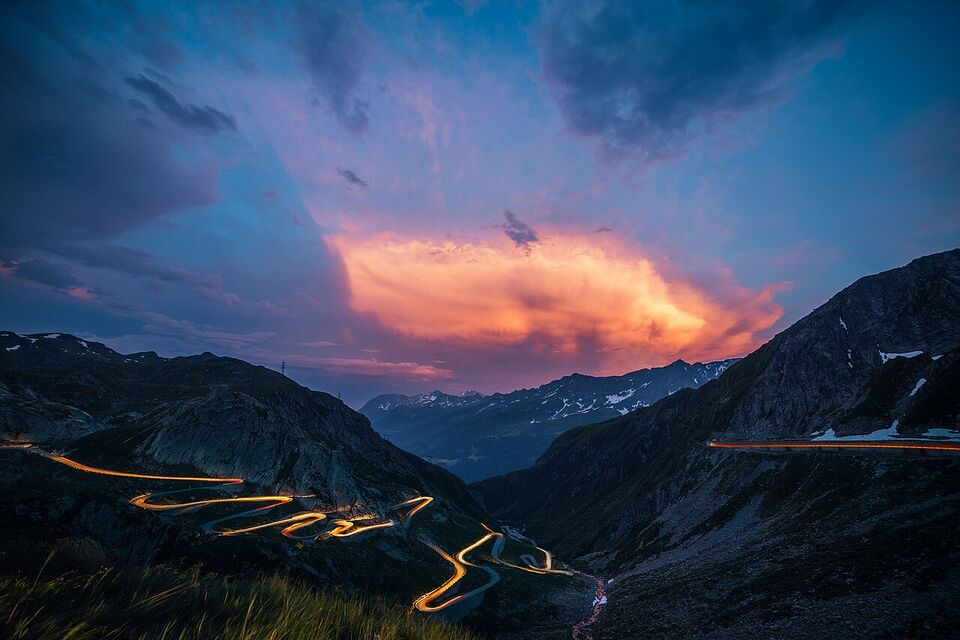
A car helps in a few situations: a family with a lot of luggage and small children, a trip built around remote valleys or farm country, a trip that crosses into France, Italy or Germany, or a stay in a village with a thin bus timetable. Even then, we suggest renting only for the days you need it. Cities are awkward and costly to park in, and the scenic drives that tempt people (the high passes) are closed for roughly half the year.
A good rule: if your plan is a loop of Zurich, Lucerne, the Bernese Oberland, Zermatt and Geneva, use trains and consider the Swiss Travel Pass or a Half Fare Card. See getting around Switzerland for how the system works, and compare your total rail spend with a rental before you decide.
Different from home
In the US a car is the default and transit is the exception. In Switzerland it is the other way around: rail timetables are tightly connected, platforms are announced in advance, and a car often costs more time than it saves once you add parking and city traffic. The one thing that feels familiar is that Switzerland drives on the right.
Renting a car
Zurich and Geneva are the usual pickup points. Zurich Airport has a car hire centre in the terminal complex and is served by the A51 motorway, so you can be on the road soon after landing. Geneva airport sits about 4 km (2.5 miles) from the center. For a trip that starts and ends in different cities, ask about the one-way fee when you book, because it can be large.
Basel EuroAirport is unusual: it lies on French territory and has a Swiss sector and a French sector. If you rent there, check which side you are collecting from. A car from the French side may not have a Swiss vignette or winter equipment, and a rental contract may restrict where you can take it. We could not confirm how this works at Geneva, so ask the rental company and get the answer in writing.
- Bring your US license, your passport and a credit card in the driver's name.
- Ask whether an International Driving Permit is required or just recommended. In the US these permits are issued by AAA and a similar national association.
- Ask about age limits and young-driver surcharges, which vary by company (we have no confirmed figures).
- Ask whether the car already carries the 2026 vignette, and if it will be valid for the dates you drive.
- Ask whether the car may enter other countries, and if there is a cross-border fee.
- Check what insurance your credit card or home policy already provides, and what the rental desk adds.
- If you can only drive an automatic, book early and confirm it. Manual cars are the default in much of Europe.
Prices change by season and by pickup location, so we give none here. Compare the total, including fees, taxes, a second driver and one-way charges, rather than the headline daily rate.
The motorway vignette
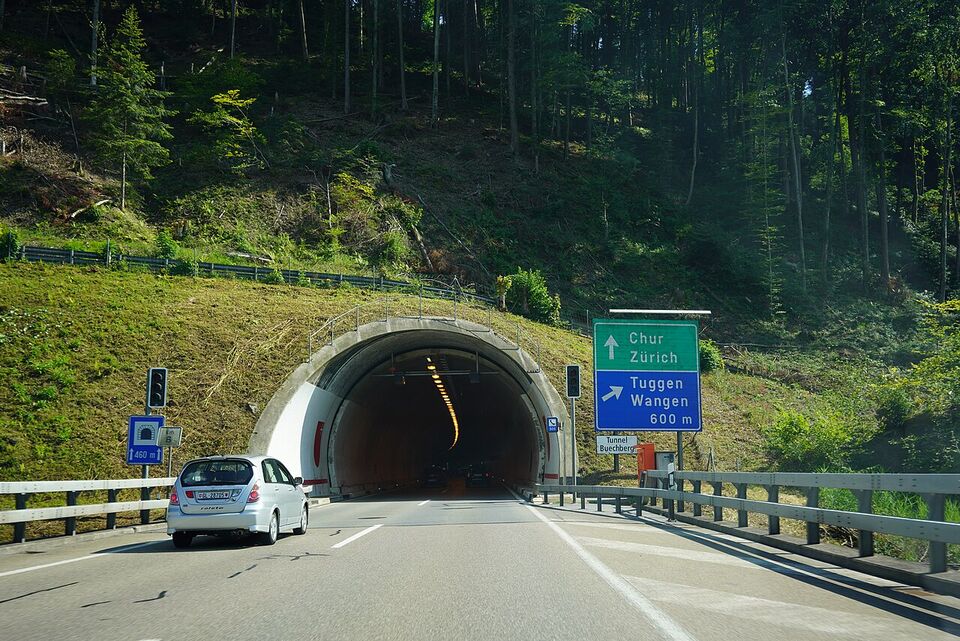
To use Switzerland's motorways, a car needs a vignette. It is either a sticker on the windshield or an electronic version tied to the license plate (the e-vignette). Both cost CHF 40 (about $48). The 2026 vignette is valid from December 1, 2025 to January 31, 2027, which means it covers a little more than 13 months.
The e-vignette is sold at e-vignette.ch, run by the Federal Office for Customs and Border Security. Because it is linked to the plate rather than a sticker, you can buy it before you arrive. The official customs page notes that buying abroad can cost more depending on the exchange rate and card fees. A 2027 vignette should be on sale from about December 1, 2026; we have not confirmed its price, so check e-vignette.ch if you are traveling in 2027.
Rental cars registered in Switzerland usually come with the vignette already on the windshield. That is the normal arrangement, but we could not confirm it for every company, so ask at the desk and look for the sticker before you drive away. If you rent in France or Germany and drive into Switzerland, the car almost certainly needs one, and you buy it yourself.
Watch out
Do not drive on a motorway without a valid vignette. We have no confirmed figure for the fine, but controls exist and a missing vignette is not worth the risk. Buy it at the first opportunity, at the border or online, and check that the sticker is on the windshield and not in the glove box.
Rules of the road and speed limits
You drive on the right and overtake on the left, as at home. Distances and speeds are in kilometers. The usual limits are 50 km/h (31 mph) inside towns, 80 km/h (50 mph) outside built-up areas, 100 km/h (62 mph) on expressways and 120 km/h (75 mph) on motorways. These are the general limits; posted signs override them, and many roads have lower local limits, especially near villages, schools and tunnels.
Speed cameras are widespread, both fixed and mobile, and Swiss traffic enforcement has a reputation for strictness. We have not confirmed the current fine scale, so treat any speeding ticket as potentially costly and keep a margin under the limit. Rental companies typically pass tickets and an administrative fee to the driver, sometimes months after the trip, so a camera ticket may reach you at home.
- Roundabouts: traffic already in the circle usually has priority; look for the yield sign on the approach.
- Trams and buses: in cities, trams and postbuses often have priority. Postbuses on narrow mountain roads usually get right of way on bends.
- Alcohol: the legal limit is low and enforced; the simplest rule is not to drink and drive. Public transport is excellent for evenings.
- Pedestrian crossings: drivers are expected to stop for people waiting to cross; do not assume they will not step out.
We have not confirmed every rule on an official page, so use this list as orientation and ask your rental company for its handbook or a list of local rules.
Mountain passes and tunnels
Switzerland has dozens of alpine pass roads, and most of the high ones close for the winter. They also close without much notice if snow or avalanche risk requires it. The best live source is the pass information service alpen-paesse.ch; the Touring Club Switzerland (tcs.ch) and the federal roads office (astra.admin.ch) also publish road information. Status changes daily, and a pass that is open in the morning can close in the afternoon.
The table below is a snapshot of what alpen-paesse.ch showed around November 13-14, 2026. It is a picture of mid-November, not a forecast. For spring, we only have one confirmed reopening date: the Grosse Scheidegg is expected to reopen on Whit Saturday, May 15, 2027, when bus services start. For the others, the usual pattern is late May to June for the high passes, but that varies with snow, so check the live status in spring.
| Pass | Status in mid-November 2026 | Notes |
|---|---|---|
| Furka | Closed for the winter | Closed from October 28; a car shuttle train runs through the Furka Base Tunnel (see below) |
| Susten | Closed for the winter | Reopens in late spring or summer; check before you go |
| Grimsel | Closed for the winter | Closed from November 6; the road stays open as far as KW Handegg |
| Gotthard pass road | Closed for the winter | From November 5; the Gotthard road tunnel is separate (see below) |
| Nufenen | Closed for the winter | Closed from November 5; the Ticino side stays open as far as All'Acqua |
| Klausen | Closed for the winter | Closed from November 12 |
| Great St. Bernard | Closed for the winter | Pass road closed from October 19 |
| Grosse Scheidegg | Closed for the winter | Expected to reopen May 15, 2027 for bus services |
| Julier | Open all year | Winter equipment mandatory; chains may be required |
| Bernina | Open all year | Winter tires obligatory |
| Simplon | Open all year | Car shuttle trains also exist; check the operator |
| Brünig, Lukmanier, Maloja, Ofen | Open all year | Winter tires obligatory on year-round passes |
| Albula and Flüela | Open (Albula snow-covered, with ice risk) | Both normally close for the winter later in the season (the pass site lists about January for the Flüela); check before you go |
The Gotthard pass road (the old scenic route over the pass) is different from the Gotthard road tunnel, which is the main north-south link between central Switzerland and Ticino. The tunnel is a separate route that stays open in winter, though traffic can build up at peak holiday times. Because pass closures do not affect the tunnel, a winter drive to Lugano and Ticino usually goes through it. We could not confirm the current traffic arrangements, so check tcs.ch or the road authority before a weekend or holiday drive.
Insider tip
If a pass you want is closed, the usual alternatives are a tunnel, a car shuttle train or a rail connection that carries you through. Do not plan a time-critical connection, such as a flight, on the assumption that a high pass will be open.
Winter driving, tires and chains
On the passes that stay open all winter, the information service says winter tires are obligatory for the whole winter period, and that snow chains may be required for a short time depending on conditions, or the pass may close completely. The Julier page says winter equipment is mandatory in the winter months. Treat those notices as the rule for mountain roads.
For the rest of the country, we could not find a single national rule on an official page we were able to open, so do not rely on a general rule. What matters in practice is that the car is fit for the conditions. Rental cars in winter are normally fitted with winter tires, but ask, and ask whether chains are in the trunk and how to put them on. If you have never fitted chains, practice before the pass, not on it.
- Check the forecast on MeteoSwiss and the road status on alpen-paesse.ch or tcs.ch before every mountain drive.
- Keep fuel above a quarter tank in winter; mountain roads can back up when a pass closes.
- Expect early darkness: in December, daylight in Zurich lasts about 8 hours 30 minutes, and in deep valleys it is shorter.
- Carry a phone charger, water and warm clothes in case you are held up.
If you only want to see the mountains in winter, there is no need to drive. See skiing in Switzerland and when to go for how the seasons work, and November in Switzerland for what is open in the quiet month.
Car trains and shuttles
Switzerland carries cars through mountains on trains, which can replace a closed pass or a long detour. You drive onto a flatbed or into a car wagon, stay in your car or sit in the train, and drive off at the other end.
- Lötschberg (Kandersteg to Goppenstein): a car-transport service through the Lötschberg Tunnel; the journey takes about 20 minutes, and cars stay with their passengers on open-sided wagons. It links the Bernese Oberland with the Valais. At peak times it runs frequently, but check the operator, BLS, for the current timetable and price.
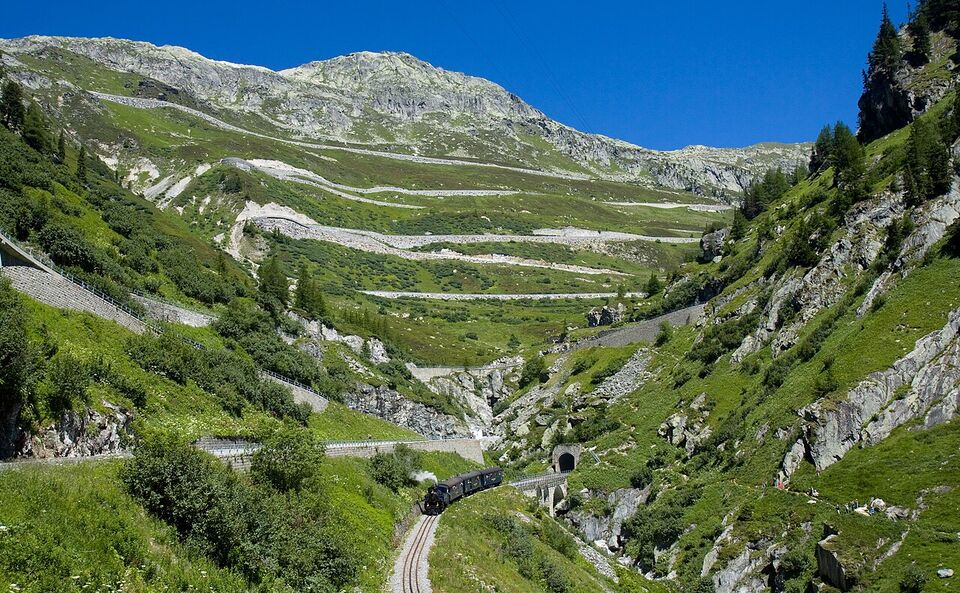
- Furka (Realp to Oberwald): the Matterhorn Gotthard Bahn runs a car shuttle through the Furka Base Tunnel, which matters in winter when the Furka Pass road is closed. A second shuttle runs between Andermatt and Sedrun.
- Vereina: a car-carrying railway tunnel in Graubünden, linking Klosters with the Lower Engadine. Vehicle transport for the Flüela and Vereina can be reached by phone at +41 81 288 37 37.
- Simplon: car trains also exist; check with the operator.
We have no confirmed prices or timetables for these services, and reservation rules can change, so check the operator's site for your date. If you are driving your own rental, confirm that the rental agreement allows using the car trains.
Parking and car-free villages
Several of the best-known mountain villages are closed to ordinary cars, and the standard solution is to park in a valley base and take a train or cable car up.
Zermatt
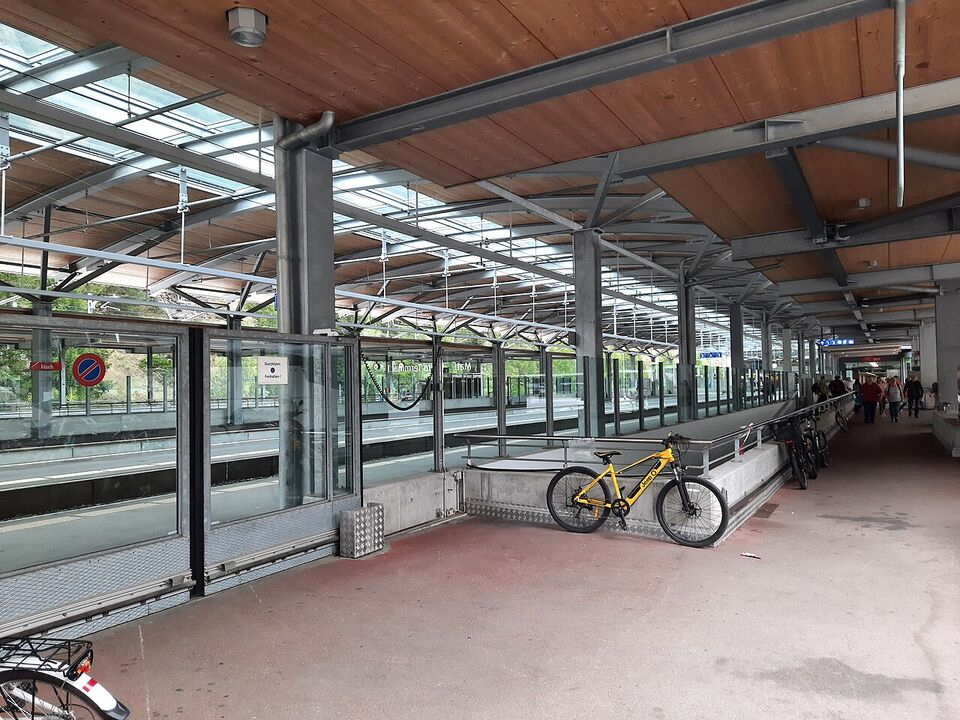
Zermatt is car-free. The usual approach is to drive to Tasch, park there and continue by the shuttle train or a taxi; trains also run to Zermatt from Visp and Brig. We have no confirmed parking or shuttle prices, so check the Matterhorn Gotthard Bahn and Zermatt Tourism before you go.
Wengen and Mürren
These villages above Lauterbrunnen are reached by rail and cable car rather than by road. As we understand it, you park in the Lauterbrunnen valley (Lauterbrunnen or Stechelberg) and go up. Check the operator for the current timetable, since some links close for works in autumn.
Other car-free resorts
Several other resorts restrict cars. Ask your hotel where to park and how luggage transfers work before you arrive. See where to stay for how to choose a base without a car.
In cities, parking is the harder problem. Street parking is limited, and many central car parks charge by the hour. Look for the zone type on the sign: in areas called "blue zones", parking is generally time-limited and requires a parking disc (usually supplied by the rental company or sold at kiosks), while other zones use pay machines. Rules differ between towns, so read the signs and leave the car where the sign says you can.
The one parking price we have confirmed is at the Lindt Home of Chocolate in Kilchberg: CHF 1 (about $1.20) for 30 minutes, CHF 12 (about $14) for five hours and CHF 50 (about $60) as the daily rate. For a city stay, ask your hotel about its garage, and compare that with the cost of keeping a rental for days you will not use it. Some machines and barriers take only coins or Swiss cards, so carry some francs.
Save money
If you are staying in Zurich, Lucerne or Geneva for several nights, return the car and use public transport inside the city. Many hotels give guests a transport card, and Geneva hotel guests receive a free transport card for the length of their stay. Picking the car up again on the day you leave saves parking fees.
Fuel, tolls and borders
Fuel is sold by the liter. A US gallon is about 3.8 liters, so multiply the per-liter price by 3.8 to compare. We have no confirmed pump prices for November 2026, so check a price site or the station sign. Most pumps take foreign credit cards, but some unstaffed stations and older pumps work best with a chip-and-PIN card, so keep a backup card or some francs. Check whether your rental runs on petrol or diesel before you fill up.
The only national road charge for cars is the vignette; there are no tolls on regular motorways. A few tunnels and some mountain roads may have their own fees, so look at the signs. Heavy vehicles have a separate system.
Switzerland is in the Schengen area, so ordinary land crossings to France, Italy, Germany, Austria and Liechtenstein usually involve no routine passport check, though spot checks happen and customs controls still exist, because Switzerland is not in the EU customs area. Carry your passport, and see entry and customs for what you can bring. The Entry/Exit System (EES) applies at the outer border of the Schengen area, such as at the airports, and is fully in force since April 2026.
- Neighboring countries have their own motorway charges, vignettes and low-emission rules; check them before you cross. Do not assume the Swiss vignette covers them.
- If your rental car is Swiss-registered, check with the company about taking it abroad, including any extra fee.
- Euros are accepted at some border-area shops, but you get francs in change, and the rate is rarely good.
- Do not bring meat or dairy products from the US into Switzerland.
For trips that cross borders, beyond Switzerland covers the neighboring countries.
International Driving Permit questions
Many Americans ask whether they need an International Driving Permit. We could not find a clear answer on an official page we could open, and the Swiss and rental-company positions can differ. Practical advice: bring your US license and carry an IDP if the rental company asks for one or recommends it, since it costs little and is easy to get before you leave. Contact the company before you travel, and keep the answer in writing.
Also bring your passport and the rental agreement in the car, and check that your credit card covers the deposit. If something goes wrong, the emergency numbers are 112 (the European emergency number, which works in Switzerland), 117 for police, 118 for fire and 144 for an ambulance. In the mountains, 1414 reaches Rega, the air rescue service, or you can use 112. See safety in Switzerland for more.
Common mistakes
- Assuming a pass road is open. Check live status the day you drive, and have a fallback by tunnel or train.
- Renting for the whole trip. Rent only for the days you drive out of town; cities and car-free villages make a car a burden.
- Forgetting the vignette on a car rented outside Switzerland.
- Driving into Zermatt. You can drive only to Tasch.
- Underestimating the time. Winding roads, tunnels and holiday traffic make map estimates optimistic. In winter, add margin.
- Ignoring cameras and signs. Posted limits matter, and fines arrive later through the rental company.
For a ready-made plan that mostly avoids driving, see plan your trip, and for mountain trips by train and cable car, mountain excursions.
Add it to a route in the trip builder, or ask us to plan the hotels, trains and guides for you.