Overview
Lucerne (Luzern on signs and timetables) is the easiest place in Switzerland to see what people picture when they think of the country. A covered wooden bridge crosses the Reuss River where it leaves the lake, steamers cross to the foot of two mountains, and the old town is small enough to walk end to end in an hour. For most first-time visitors it deserves one full day in town and a second for a mountain.
The city sits at 1,490 ft (454 m) at the northwest corner of Lake Lucerne, in German-speaking central Switzerland, within sight of Mount Pilatus and Mount Rigi. People speak Swiss German here, and everything in town is also written in standard German, so you will see Bahnhof (station), Schiff (boat) and Altstadt (old town) on signs. English works almost everywhere you will go as a visitor.
This page covers the main sights, the lake, a rain-proof plan, the mountain day trips, the hotel tax, and how Lucerne compares with Interlaken and Zurich as a base. For the wider picture, see the Switzerland's Destinations overview and the Day Trips in Switzerland page.
Lucerne, Interlaken or Zurich as a base
All three work, and the right one depends on what you want to see most. Lucerne is the compromise: a real old town and good museums, with Pilatus, Rigi, Stoos, Engelberg and Interlaken all reachable by public transport. Zurich is the better arrival city and the better choice for a night at either end of a trip. Interlaken puts you closest to the Jungfrau region but has little else.
| Base | Best for | Mountains within a day trip | Drawbacks |
|---|---|---|---|
| Lucerne | First trip; sights, boats and mountains in one place; rainy-day options | Pilatus, Rigi, Stoos, Stanserhorn, Titlis (Engelberg); Interlaken and the Jungfrau region as a long day | Busy old town in summer; lake and mountains often cloudy in winter |
| Interlaken | Jungfrau region, Lake Thun and Lake Brienz, paragliding | Jungfraujoch, Schilthorn, First, Harder Kulm | Fewer museums and less to do in bad weather; see the Interlaken and the Jungfrau Region page |
| Zurich | Arrival and departure nights, museums, shopping, an airport 13 trains an hour from the main station | Rigi and Pilatus are possible but long; Lucerne is the better launch point | A big city rather than a Swiss postcard; see the Zurich page |
A common first-trip pattern is Zurich on arrival, Lucerne for two or three nights, then on to Interlaken or Zermatt. If you only have a week, we suggest one base for each of two regions rather than a hotel change every night, and the Swiss Travel Pass page explains how a pass fits that kind of route.
Zurich Airport has its own station with about 13 trains an hour to Zurich main station, a journey of roughly 10 minutes. From there, trains continue to Lucerne. Look up the current departure times and fares in the SBB app, because we cannot give a reliable journey time from an official page.
The Chapel Bridge and the Water Tower
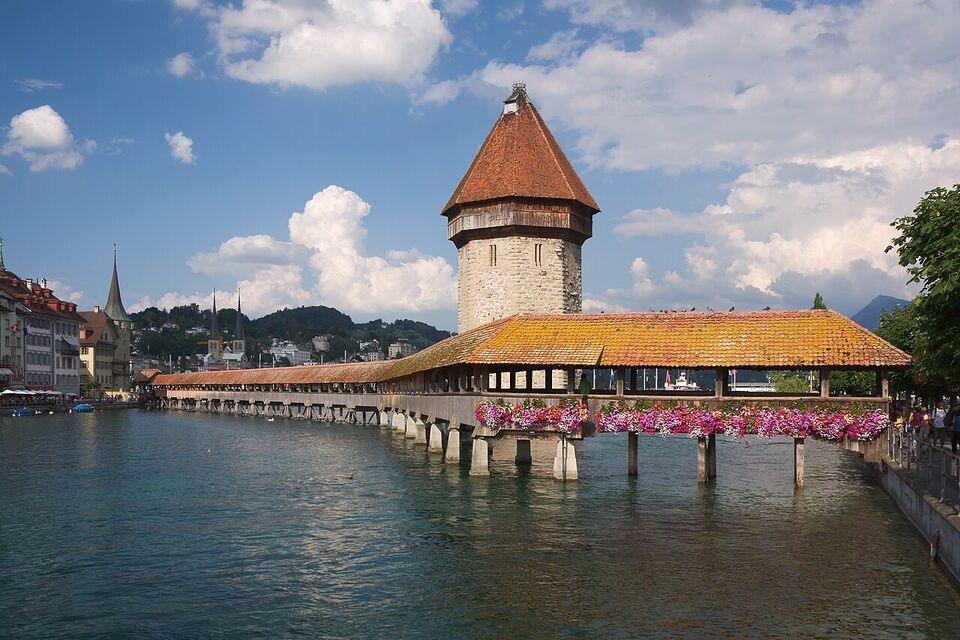
The Chapel Bridge (Kapellbrücke) is Lucerne's symbol. It is a covered wooden footbridge about 669 ft (204 m) long that crosses the Reuss at an angle, with flower boxes along the roof line. It was first built in 1333 and is often called the oldest covered bridge in Europe, but "oldest" needs a qualifier: on August 18, 1993 a fire (said to have been started by a discarded cigarette) destroyed much of the structure and about two thirds of the painted panels under the roof. The bridge was rebuilt afterward, so a large part of what you walk on today is new timber.
The octagonal Water Tower (Wasserturm) stands in the river alongside the bridge. It is a stone fortification from the 13th century and is older than the bridge itself. It was part of the city defenses, not a tower for water supply, despite the name. Inside the bridge you will see a series of triangular paintings from the 17th century showing events from Lucerne's history, some of them original and some restored or reproduced after the fire.
Access is simple: the bridge is a public walkway and is free to cross. We could not confirm from an official source whether visitors may enter the Water Tower or whether any part of the bridge is under repair, so check the city's page on luzern.com before building a plan around either. For photographs, the bridge looks best in early morning, before the tour groups arrive, and again at dusk when it is lit.
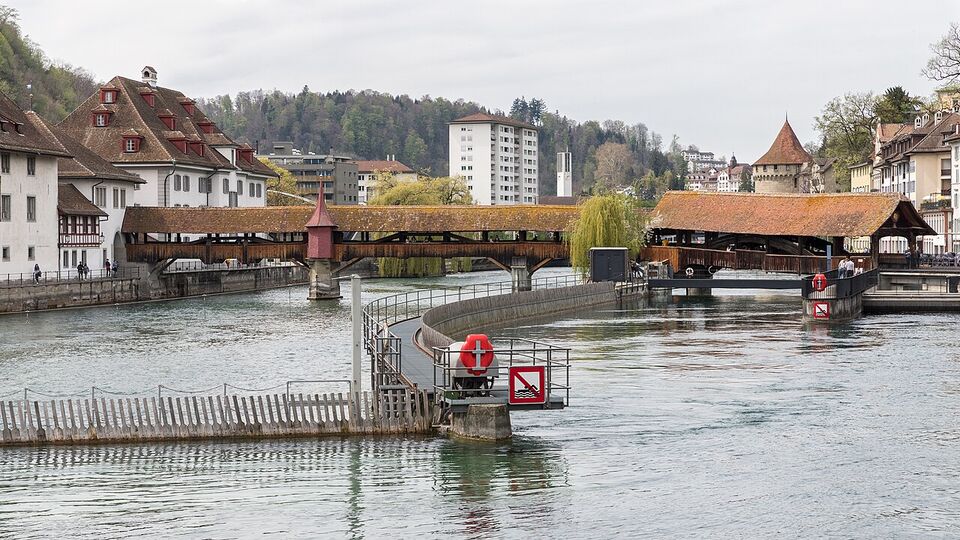
The second covered bridge, the Spreuer Bridge (Spreuerbrücke), is a short walk downstream. It dates from 1408 and zigzags across the river. Its roof carries a series of 17th-century "Dance of Death" paintings by Kaspar Meglinger, a plague-era theme that is far more somber than the flower boxes next door. It is quieter than the Chapel Bridge and worth five minutes.
Old town, Lion Monument and the city wall
The old town (Altstadt) lies on both banks of the Reuss. On the north bank, narrow lanes lead to painted house fronts, small squares and the town hall on the quay. The Jesuit Church of St. Francis Xavier stands right on the river, and its interior is richly decorated. We did not find its opening hours in an official source, so look for the posted schedule at the door.
The Hofkirche (Court Church, locally the Hofchile) stands on the hill above the lake. Its twin towers are older than the church itself, which was rebuilt in 1633 in late Renaissance style.
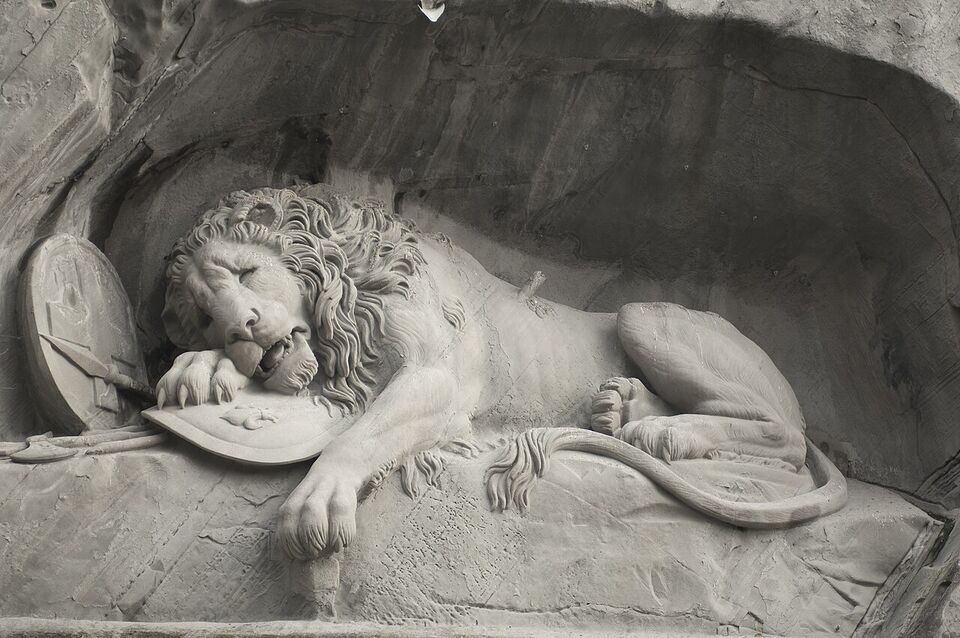
The Lion Monument (Löwendenkmal) is a short walk from the old town, in a small park off the Löwenplatz. A dying lion, carved into a rock face by the sculptor Bertel Thorvaldsen, commemorates the Swiss Guards killed in 1792 when a mob stormed the Tuileries Palace in Paris during the French Revolution. It is free to see and is usually a 20-minute stop. The sculpture is melancholy rather than triumphant, and it helps to know the story before you arrive.
The Museggmauer is a medieval city wall with towers along the hill on the northern edge of the old town. It is one of the best free views over the roofs, the lake and the mountains. The wall and its towers are seasonal and the timing differs by tower, so we cannot give opening dates. Check the current schedule on luzern.com. If the towers are shut, the lanes below the wall still give a good ridge-line walk.
Insider tip
Cross the Chapel Bridge before 9 a.m. or after the day-trip buses have left, and use the Spreuer Bridge as a quiet detour. Lucerne's old town is small, and the crowds cluster in the same three or four spots near the river and the Löwenplatz.
The lake and the Lake Lucerne boats
Lake Lucerne (Vierwaldstättersee, "lake of the four forest cantons") is not one simple oval. It is a cross-shaped lake with fjord-like arms, and the boats are as much a part of getting around as they are a sightseeing trip. The Lake Lucerne Navigation Company (SGV) runs the scheduled boats, and its own site calls the one-hour city cruise a top city-trip activity, with views of Rigi, Pilatus and the Bürgenstock.
The Swiss Travel Pass, the Flex version and the Swiss Transfer Ticket are valid on scheduled boat services at no extra cost. The Half Fare Card gives 50% off. Dining and special cruises cost extra, and a table in the onboard restaurant can be reserved if you want to eat. Seats on the open decks cannot be reserved.
The piers matter when you are in a hurry. According to the operator, boats to Weggis, Vitznau (for Rigi), Brunnen and Flüelen leave from Pier 1; boats to Alpnachstad (for Pilatus) leave from Pier 2; boats to Küssnacht and to the Bürgenstock leave from Pier 3. The piers are by the railway station, so you can step off a train and onto a boat in a few minutes.
The lake has a winter timetable with far fewer sailings, and the operator publishes seasonal timetables and operating information on its site. One fixed date: the steamboat Gallia returns to its "Legends of Lake Lucerne" dinner cruise from May 15 to September 15, 2027. Do not assume the full summer timetable is running in November or in the early spring.
For Americans the lake gives a good use of a pass day: a morning boat to Vitznau, a cogwheel train up Rigi, and a descent by a different route back to the lake. The Lakes and Boats page compares the other big Swiss lakes.
Museums, the KKL and a rain-proof day
Lucerne gets a lot of cloud. The city records on the order of 130 days a year with measurable precipitation, and July and August are among its wettest months. The good news is that the city has real rainy-day options, and the lake and peaks often reappear after a morning of drizzle.
- Swiss Museum of Transport (Verkehrshaus). A large museum on the lakeshore on the northeastern side of town, with locomotives, cars, ships and aircraft. Families tend to stay half a day or more. Check opening hours and ticket prices on the museum's own site; we did not confirm either. The Swiss Travel Pass offers free entry to many museums, so check whether this one is on the current list.
- KKL Luzern (Culture and Convention Centre). A building by the lake designed by Jean Nouvel. It has one of the world's leading concert halls, with acoustics by Russell Johnson, and it houses the Museum of Art Lucerne (Kunstmuseum Luzern).
- Rosengart Collection. A small art museum in the city center with a modern-art collection. We did not confirm its hours or prices, so check luzern.com.
- Richard Wagner Museum. In the villa at Tribschen, where Wagner lived and worked from 1866. Reached on foot or by bus along the lake; it suits people who care about music.
The Swiss Travel Pass includes free entry to more than 500 museums, which helps a rainy-day plan. Because a few museums close on Mondays, check hours the day before. The Lucerne tourism site has a "Wind & rain" section of indoor tips, and the city's Visitor Card, issued by many hotels, is said to include discounts; see the hotel section below for how to ask.
A simple rain-proof day: a late start with a museum in the morning, lunch indoors, an afternoon at the KKL or a boat ride if the rain eases, and the covered bridges in the evening (they are roofed, so they work in drizzle). Keep the mountain for a clear day and check the operator's webcam first.
Watch out
Do not buy a mountain ticket the evening before and hope. Cloud over Lucerne is often cloud over Pilatus, and the lifts close in strong wind. Check the operator's webcam and status page the morning you go, and keep the afternoon flexible.
Day trips from Lucerne
Lucerne's strength is the choice of mountains within easy reach. The cards below summarize them, and the Mountain Excursions page compares these with the Jungfraujoch, Gornergrat and others. Prices and closure dates here come from the operators' own sites or from the shared fact sheet for this guide, and the operators set them, so confirm before you go.
Pilatus
The steepest cogwheel railway in the world climbs from Alpnachstad on the lake, with a second route by gondola and aerial cableway from Kriens on the edge of Lucerne. Summit at 6,801 ft (2,073 m).
Rigi
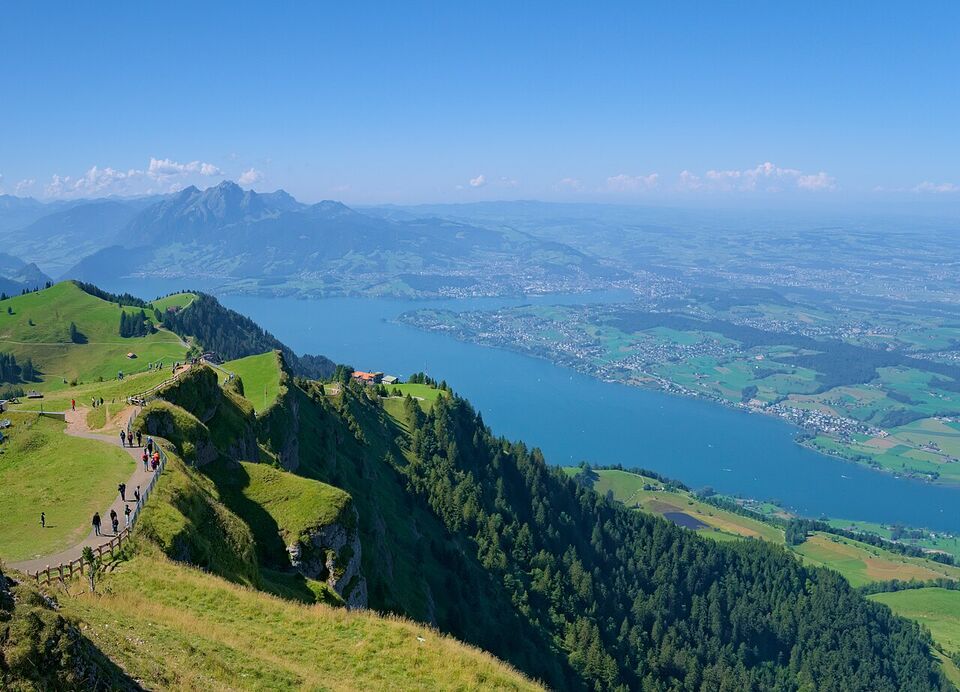
Europe's first mountain railway climbs "the queen of the mountains" from Vitznau, and other lines go up from Arth-Goldau and Weggis. Summit area about 5,900 ft (1,800 m).
Titlis (Engelberg)
A rotating cable car, glacier cave and snow at 10,623 ft (3,238 m) at the summit. Major rebuilding is under way; see below.
Stoos
A steep funicular from Schwyz-Morschach up to a car-free village with ridge walks. Included in the Swiss Travel Pass.
Stanserhorn
The CabriO cable car has an open upper deck. Included in the Swiss Travel Pass. A seasonal break starts after late November.
Bürgenstock
Boats leave from Pier 3 for the Bürgenstock shore. We did not confirm the cliff paths or the lift on the resort's own site, so check it before you plan around them.
Pilatus in detail
The operator, Pilatus-Bahnen, lists a summer excursion (May to November) at CHF 84 (about $100) per adult for a return trip from Kriens or from Alpnachstad, and CHF 42 (about $50) with a Swiss Travel Pass, Half Fare Card, GA or Half Fare Travelcard. The same CHF 42 (about $50) applies to children 6 to 15; under-16s with an SBB Junior Travelcard travel free, which is the same concept as the Swiss Family Card. A winter excursion (December to April) from Kriens costs CHF 60 (about $71), or CHF 30 (about $36) at the discounted rate. Dogs pay CHF 14 (about $17) for a return trip.
The classic way to do it is the round trip: boat from Lucerne to Alpnachstad, the cogwheel railway up, and the gondola and aerial cableway down to Kriens, then a bus into town. The operator's "Golden Round Trip" (May to October) runs from CHF 115 (about $135) to CHF 136.80 (about $165) depending on class and what is included. The operator recommends reserving a seat on the cogwheel railway.
Timing is the trap. On November 14, 2026 the cogwheel railway was running, with the first uphill train from Alpnachstad at 9:55 a.m. A third-party closure list we checked, which we treat as a guide only, shows the cogwheel railway operating until November 29 and the Kriens gondola closed from October 19 to November 27. The winter price list covers only the Kriens route, so we cannot say whether the cogwheel runs in December. Check pilatus.ch the morning you travel.
Rigi in detail
Rigi is the easier choice for pass holders because the lifts are included. The site says it is home to Europe's first mountain railway plus eight other mountain railways, so there are several ways up and down. A popular loop is a boat to Vitznau, the cogwheel railway to the top, and a different line down to Arth-Goldau or Weggis. Rigi also has a mineral-bath complex that is open when it is too cold to enjoy the summit.
November is maintenance season. The Rigi site shows an overview of company vacations and maintenance for the month. The third-party guide lists the Kräbel to Rigi Scheidegg cableway closed November 2 to 13 and the Weggis to Rigi Kaltbad cableway closed November 16 to 27 (open on weekends), with no closure listed for the Vitznau to Rigi Kulm cogwheel line. Check rigi.ch before you set out.
Titlis, Stoos, Stanserhorn and the Bürgenstock
Titlis is the biggest and most developed of the group. A reseller list shows a day ticket of about CHF 108 (about $130) for an adult, which we treat as a rough figure only. The operator's information page states that the Rotair rotating cabin is out of operation from August 17 to December 12, 2026, and that summit construction (a new summit station and tower) is planned from December 13, 2026 until about the end of 2029, with parts of the summit closed. Conditions may change at short notice, so check titlis.ch before booking. Titlis is not covered by the Swiss Travel Pass at no cost; ask about the discount rather than assuming one.
Stoos and the Stanserhorn are the quiet picks. Both are included in the pass. The same third-party guide shows the Stanserhorn operating until November 22 before a winter break, and the Stoos funicular and the Morschach to Stoos cableway closed from November 23 to December 4 except on weekends.
Save money
If you hold a Swiss Travel Pass, use your free mountain days on Rigi, Stoos or the Stanserhorn, and pay the half-price rate for Pilatus. A pass also covers the boats, so a Vitznau boat plus a Rigi railway costs nothing extra on a pass day. The Swiss Travel Pass page has the 2026 pass prices.
When to go and what the weather does
Lucerne is mildest and driest-feeling from late spring to early autumn, but summer is also the busiest and one of the wettest periods. Winter is gray and quiet, with a Christmas market at Franziskanerplatz and a Christmas tree market on the Schweizerhofquai listed by the city, though we did not find dates. Early February brings the Lucerne Fasnacht carnival, which starts on the Thursday before Ash Wednesday at 5 a.m. with a loud wake-up called the Urknall. We could not confirm the 2027 dates, so check luzern.com. The Festivals and Holidays page covers other events.
| Month | Average high | Average low | Rainy days |
|---|---|---|---|
| January | 39°F (4°C) | 29°F (-2°C) | 10 |
| April | 60°F (15°C) | 41°F (5°C) | 11 |
| July | 77°F (25°C) | 58°F (15°C) | 13 |
| October | 58°F (14°C) | 44°F (7°C) | 10 |
| November | 47°F (8°C) | 36°F (2°C) | 10 |
These are 1991-2020 averages for Lucerne at 454 m, and "rainy days" means days with at least 1 mm (0.04 inch) of precipitation. On a mountain, expect it to be much colder and windier than the table. The When to Go to Switzerland page has the national picture, and the Switzerland in November page covers the closures and gray weather of that month.
Where to stay and the hotel tax
For a first visit, we suggest staying near the station and the lake, or in the old town, so that boats, trains and the bridges are all on foot. Hotels in Lucerne are expensive by American standards, and we found no official source for nightly rates, so check dates on a booking site. As a rule, expect festival weekends, the Christmas market period and summer to cost more. The Where to Stay in Switzerland page covers how to choose a type of hotel.
The cantonal tourist tax in Canton Lucerne doubled at the start of 2026, from CHF 0.50 to CHF 1.10 (about $1.30) per person per night, according to a report on the government's plan. It is usually added to the hotel bill, and children may pay less or nothing. Check the exact amount with your hotel.
Lucerne has a Visitor Card, shown on the city's website, which many hotels issue to guests. We did not read its benefits, so ask your hotel whether it issues the card and what it includes before you rely on it for transport or museum discounts.
Different from home
Tour coaches need a pre-booked stopping voucher in central Lucerne (CHF 100 (about $120) per coach, according to the city's tourism site), and stopping without one is not allowed. This does not affect you if you arrive by train, boat or in a private car, but it explains why tour groups appear in predictable waves at fixed stops such as the Löwenplatz.
Getting there and around
Lucerne is a rail hub. Trains run from Zurich and the Zurich Airport station, and the Luzern-Interlaken Express, run by the zentralbahn, links Lucerne with Interlaken over the Brünig route. We could not confirm times, fares or whether the express needs a seat reservation, so check the SBB app and zentralbahn before relying on them. See Scenic Trains for the panoramic routes and Trains and Transit in Switzerland for how tickets and passes work.
In town, you can walk almost everywhere. Buses run on the passepartout fare network, which covers the cantons of Lucerne, Obwalden and Nidwalden, so day tickets and passes follow the zones. The boat piers, the station and the bridges are all within a ten-minute walk of each other.
If you drive, a Swiss motorway vignette costs CHF 40 (about $48) and the 2026 sticker is valid to January 31, 2027 (see Driving in Switzerland). Parking in the center is expensive and limited, and we found no official price list, so use a garage and walk. Many visitors do better without a car in Lucerne.
A two-day plan
- Day 1
Bridges, old town and the lake
Walk the Chapel Bridge early, cross to the Spreuer Bridge, then climb the lanes toward the Museggmauer if it is open. After lunch, see the Lion Monument and the Hofkirche, and finish with the one-hour lake cruise from the pier by the station. If it rains, swap the cruise for the Swiss Museum of Transport or the KKL.
- Day 2
A mountain, weather permitting
Check the Pilatus and Rigi webcams at breakfast. On a clear day, take the boat to Vitznau, ride the cogwheel line up Rigi, and come down a different way. On a cloudier day, choose the lower Stoos or Stanserhorn, or stay in town and visit the museums. Have dinner back by the water.
- Optional third day
Titlis or Interlaken
Engelberg and Titlis are a long day with construction and weather risk. A train to Interlaken is a better stretch if your pass is running and the Jungfrau region is next on the route.
For families, the Families page has more on pacing, and the Swiss Family Card lets children 6 to 15 travel free on the pass when a parent holds one.
Add it to a route in the trip builder, or ask us to plan the hotels, trains and guides for you.