Overview
Geneva is worth one to two days, and most visitors see it either on arrival or on the way to the Alps. It sits at the southwestern tip of Lake Geneva, where the Rhône leaves the lake, and it is surrounded on most sides by France. It is the second-largest city in Switzerland, with about 204,000 people in the city proper at the end of 2020, and it is the most populous city in French-speaking Switzerland.
What sets Geneva apart is the mix. It has a lake and a fountain, a small old town on a hill, a Protestant Reformation history and a large international community. The Geneva tourist office counts more than 400 non-governmental organizations and 40 international organizations in the city, among them the European headquarters of the United Nations, the Red Cross, the World Health Organization and the World Trade Organization. Visitors who come for the lake find the diplomacy; visitors who come for the diplomacy find the lake.
This page covers the lake and the Jet d'Eau, the old town, the Reformation Wall, International Geneva, the main museums, CERN, lake cruises, French-speaking habits, the airport and its French sector, where to stay and day trips. If you are comparing it with other bases, read our pages on Lausanne and Montreux, Bern and Zurich.
The lake and the Jet d'Eau
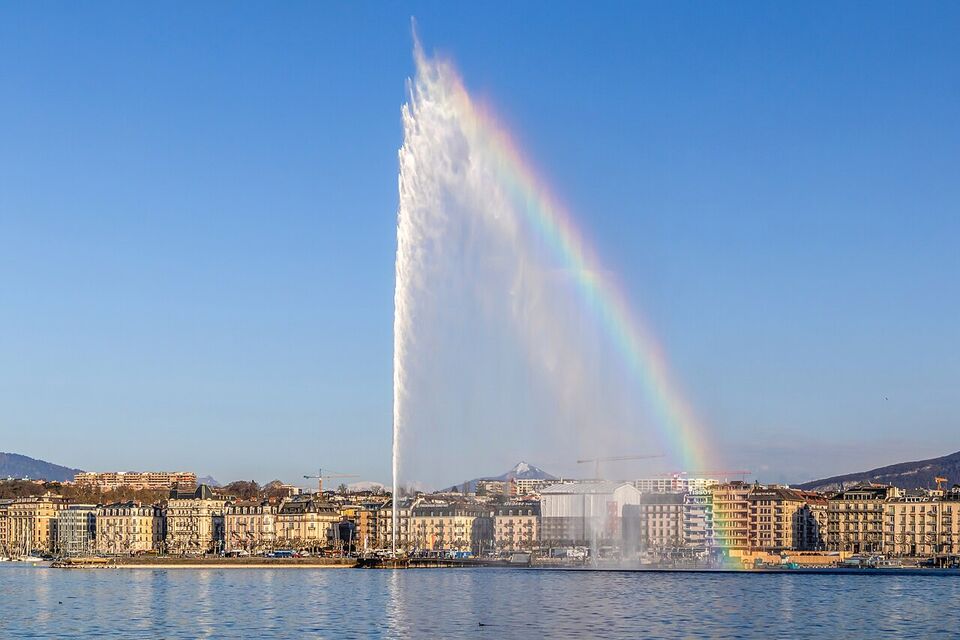
The Jet d'Eau is a fountain in the harbor that shoots water 460 feet (140 m) into the air at about 500 liters a second and a speed of 125 mph (200 km/h), according to Geneva Tourism. It is the symbol of the city and is visible from many points along the shore. You can walk out along the jetty to stand close to the base, and in a breeze you will get wet.
Check before you plan around it. The jet is not on all day, every day of the year. It is normally turned off in strong winds (Geneva has a cold northeast wind called the bise) and may be off in very cold weather or for maintenance. We could not confirm the current season or schedule, so check geneve.com on the day. If it is off, the walk is still pleasant.
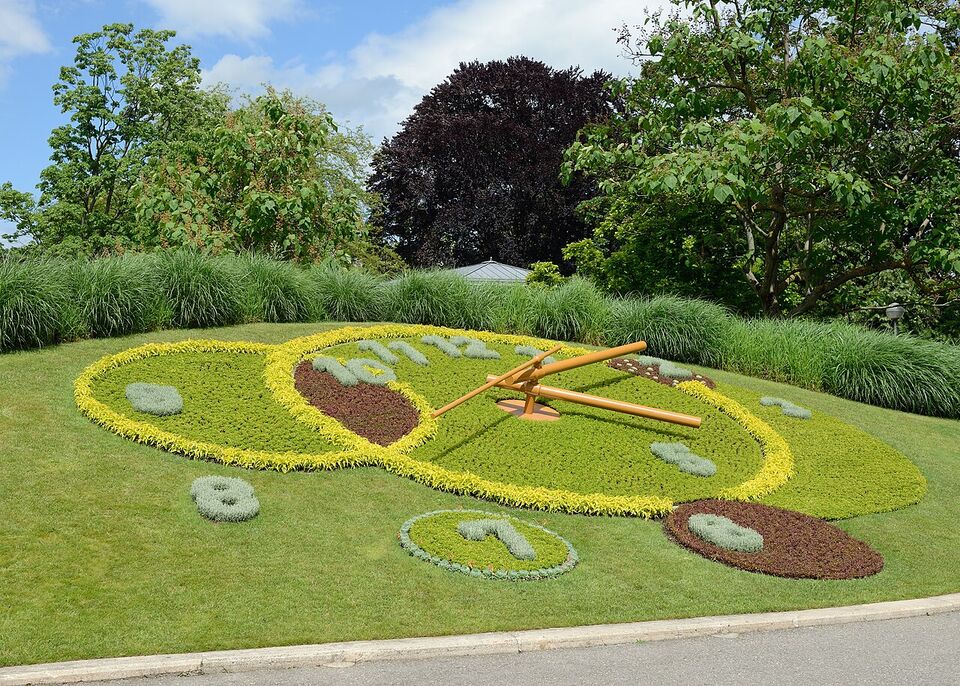
The lake itself is called Lake Geneva in English and Lac Léman in French, and you will see both names on signs and boats. The shoreline has long promenades, public gardens, bathing platforms and small jetties. The best-known are the Quai du Mont-Blanc on the right bank, with views toward the Alps on a clear day, and the Jardin Anglais, where the Flower Clock sits at the water's edge. The Flower Clock is a working clock set in a bed of plants, and it is a photo stop rather than a destination.
The yellow Mouettes
The Mouettes (“seagulls”) are small yellow shuttle boats that cross the harbor between the two banks, and the tourist office suggests crossing by Mouette as part of a one-day tour. They are a cheap way to get on the water for a few minutes. Check the winter timetable, since not all lines run all year.
The old town and Saint-Pierre Cathedral
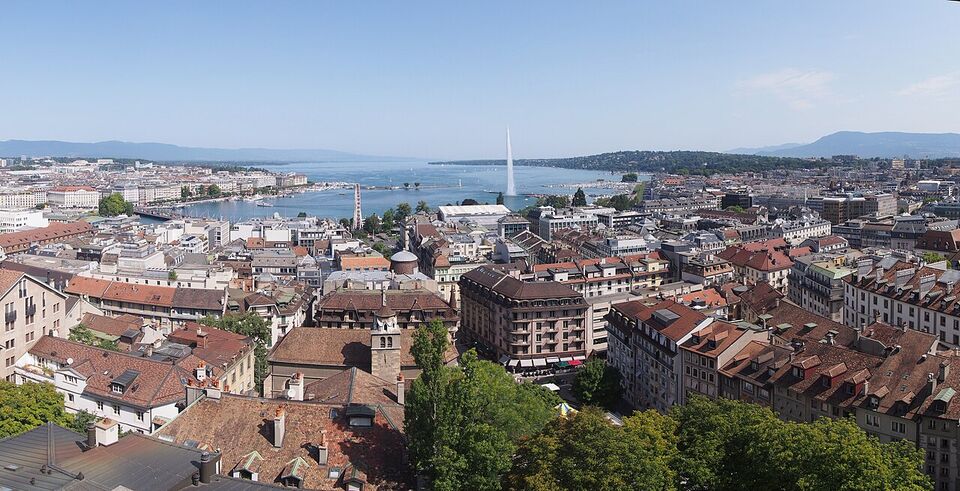
The old town is on a hill on the left bank, above the lake. Geneva Tourism calls it the largest historical city center in Switzerland, with cobbled lanes, small squares and some narrow passages between buildings. It is compact, steep in places and best done on foot in an hour or two, with stops.
It is dominated by Saint-Pierre Cathedral (Cathédrale Saint-Pierre), the church where the Protestant Reformation took hold in Geneva. John Calvin became the spiritual leader of the city in 1541 and made it into what later writers called a “Protestant Rome.” The cathedral's plain interior reflects that history. The towers can usually be climbed for a view over the lake, but we could not confirm the current hours or ticket price, so check the cathedral's own site.
The Reformation Wall
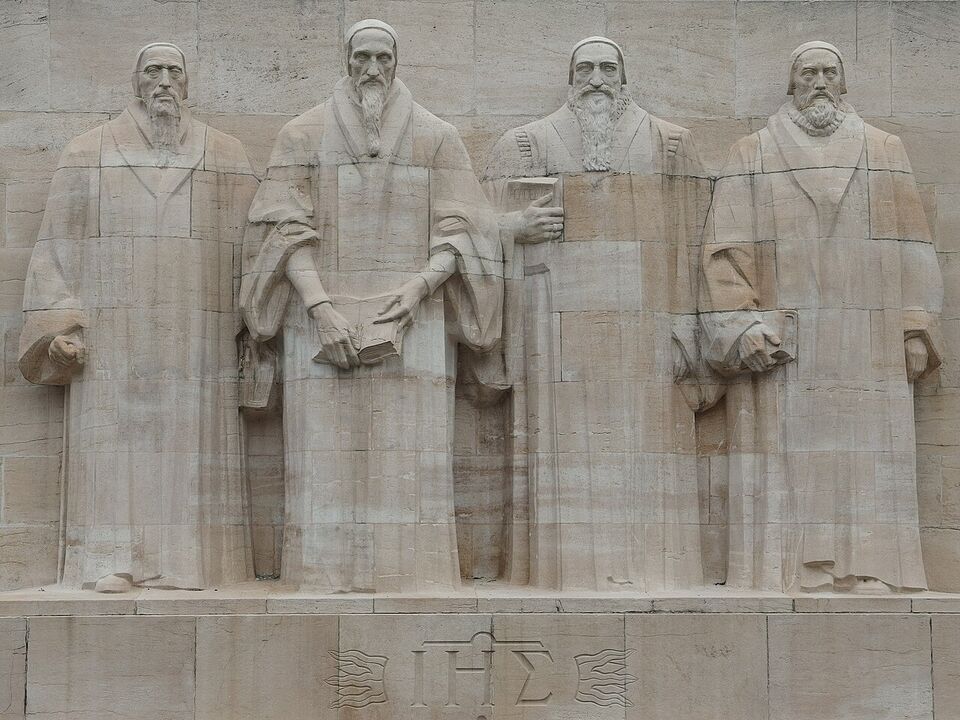
The Reformation Wall (Mur des Réformateurs) is a long stone monument in the Parc des Bastions, near the university, with four large figures of the Reformation (Calvin, Farel, Beza and Knox) carved in relief. It is free and open at all times, and it is an easy ten-minute stop before or after the old town. The park also has giant outdoor chess boards that locals use year round.
Insider tip
Walk the old town downhill. Start at the cathedral at the top, wander the lanes toward the Place du Bourg-de-Four, and finish at the lakeside, where the boats and the fountain are. You will use gravity instead of fighting it.
International Geneva: the UN, the Red Cross and CERN
The international district lies on a hill north of the center, a short bus or tram ride from the station. At its heart is the Palais des Nations, the European seat of the United Nations, which stands in a large park with the Alley of Flags leading to its gates.
Geneva Tourism says the Portail des Nations is a new visitor center at the entrance of the Palais des Nations, and it is the place to start. We could not confirm the current rules for visits and guided tours. Expect to need to register in advance and to show a passport at security; check ungeneva.org for the schedule, and do not turn up without a booking and assume you will be let in. Tours can be canceled when meetings run.
The International Red Cross and Red Crescent Museum is nearby and is another way to see this side of the city. Check its hours on its own site.
CERN
CERN is the European particle physics laboratory, founded in 1954 and located just outside the city on the French border. Its Science Gateway is a visitor center with exhibitions, science shows, lab workshops and guided tours. Admission is free, but registration is required, and some activities are booked separately. Visit visit.cern for hours, current events and how to book. A tram line links the city center with CERN, but check the route and fares with the city transport operator before you go.
Museums
Geneva is a good city for a rainy day. We list the main museums and what each is known for; check each museum's website for hours and prices, which we did not confirm. Swiss museums are commonly closed on Mondays, and Geneva's are no exception, but the day varies.
- Musée d'Art et d'Histoire (MAH). The city's large art and history museum, with fine art, archaeology and decorative arts. The best choice if you have time for one general museum.
- Patek Philippe Museum. A museum of watches and watchmaking from the Geneva maker, with a long collection of timepieces. It is popular with watch lovers and has limited opening days, so check the hours before you go.
- International Red Cross and Red Crescent Museum. A museum about humanitarian work, close to the UN district.
- MAMCO. The museum of modern and contemporary art, in a former factory district. Good if you like current art.
- Natural history and science museums. Useful for families on a wet day; Geneva Tourism lists several.
The Geneva City Pass, sold by the tourist office, is valid for 24, 48 or 72 hours and gives free or discounted entry to about 60 activities, including museums and cruises. We could not confirm its price. It makes sense only if you plan to visit several paid sights in a short time, so add up what you want first.
Lake cruises
Boats leave from the quays near the Jet d'Eau. Short sightseeing cruises stay near Geneva, while longer trips cross the lake to Lausanne, Montreux and the vineyard towns. The Belle Époque paddle steamers, which are preserved historic boats, run on the lake too. Montreux uses one for a holiday cruise from November 20 to December 24, 2026, so at least that boat is scheduled to work in winter 2026-27.
The frequency of boats falls sharply in winter, and some lines stop. We could not confirm the 2026-27 timetables for Geneva, so check the lake operator's site before you plan a boat day. The Swiss Travel Pass covers many boats; see our Swiss Travel Pass page and our lakes page, and check the operator's pass rules before you buy.
French-speaking habits, and the mistakes Americans make
Geneva is the largest French-speaking city in Switzerland, and French is the language of daily life. Many people speak good English, especially in the international district, so you will not be stranded. But the idea that everything is in English is the most common mistake, and it can make small encounters go badly.
Watch out
Do not open with English and no greeting. Say bonjour when you enter a shop, a cafe or a ticket office, and merci, au revoir when you leave. Then ask, in French, Parlez-vous anglais? (Do you speak English?). The tone changes completely.
- Assuming signs are bilingual. Most are in French only. Learn sortie (exit), entrée, gare (station), billet (ticket) and quai (platform or quay).
- Looking for the wrong city names. This is Genève, not Genf, and the main station is Genève-Cornavin. On French-language signs Bern appears as Berne and Basel as Bâle, so match the French spelling to your ticket.
- Misreading the numbers. In much of French-speaking Switzerland, 70 is septante and 90 is nonante, where France says soixante-dix and quatre-vingt-dix. Geneva still uses quatre-vingts for 80, while some other cantons say huitante. It helps when prices are read aloud.
- Over-tipping. Service is normally included in menu prices; rounding up or leaving a few francs for good service is appreciated but not expected.
- Expecting shops to be open on Sunday. Most are closed except at stations and the airport, so check before you rely on it.
Our phrases page has a short list of French, German and Italian words for travelers, and our etiquette page covers greetings and meals.
Getting in from the airport, and the French sector
Geneva Airport (GVA) is about 2.5 miles (4 km) from the center and has its own railway station, with trains to Genève-Cornavin, the city's main station, and to other cities in Switzerland. Buses also stop at the airport. We could not confirm the journey time or the fare, so check the SBB app; it is a short ride. If you are staying in an approved hotel, your free Geneva Transport Card is valid on the Cornavin-airport train, so ask your hotel for it when you book. Do not count on collecting a free ticket at the airport.
SWISS flies from New York JFK to Geneva, and United flies from Newark and from Washington Dulles, according to airport reference pages. Check the airlines for the winter 2026-27 timetables, since nonstop routes change. Our flights page lists the options into Zurich as well.
The French sector
Geneva Airport has an unusual feature, called the French Sector. Under a long-standing agreement between France and Switzerland, a part of the airport can be reached directly from French territory, so that people in the nearby French region can fly without passing through Switzerland or its customs. It is an old arrangement that still exists, although passport control was dropped after Switzerland joined Schengen in 2008.
For travelers, it matters in a few ways:
- Flights from France may arrive in the French sector. If you are connecting or heading to a Swiss hotel, follow the signs to Switzerland.
- Buses to Annecy and to Chamonix, which runs seasonally, leave from the airport. Check the operator for winter schedules.
- If you rent a car, check which side of the airport you are collecting from. A car rented on the French side is prepared for France and may not carry a Swiss motorway vignette. The vignette costs CHF 40 (about $48) for the 2026 sticker, valid to January 31, 2027, and it is required on Swiss motorways. Ask the rental company before you leave.
- Customs officers at the road crossings can still stop and check bags. See our driving page and entry page.
When you enter the Schengen area from the US, you go through passport control and the Entry/Exit System registration at the first Schengen airport you reach. For details see our entry page. Allow extra time on arrival; waits vary by airport and day.
The free Geneva Transport Card, trams and buses
Guests in approved hotels, hostels and campsites in Geneva receive a free transport card for the length of the stay. It is valid in zone 10, which covers the city and nearby areas, and on the Cornavin-airport train. The tourist office confirms this on its official pages. If you are staying in an apartment rental, check whether the property qualifies.
The tram, bus and trolleybus network is efficient, and the center is small enough to walk. If your hotel does not give you the card, buy tickets at the machines at stops; they take francs and euro change, and the Swiss Travel Pass covers the city network. For rail fares see our getting around page.
Save money
Ask for the transport card at check-in, not at checkout. It is valid for the whole stay, so ask whether you can have it on arrival, and keep it with you when you ride, since inspectors check.
Where to stay
Geneva is an expensive city for hotels, and many are aimed at business travelers and diplomats. Prices can change by the day with conferences, so check several dates. We could not confirm 2026-27 room rates, so treat these tiers as a rough guide: most central hotels fall in the $$ to $$$ range, with hostels and some small guesthouses cheaper. Choose by neighborhood.
- Les Pâquis. Near the station and the lake, with many restaurants and a mixed, lively street life. Good for first-time visitors who want to walk. It can be noisy at night.
- The old town and Rive. Quiet, historic and expensive, with the best walking. Fewer hotels.
- Carouge. A separate town with a gentle Mediterranean feel, reached by tram. Good for cafes and small shops. Geneva Tourism describes its charm in those terms.
- The international district. Near the UN and many embassies. Convenient for a conference, quiet in the evenings.
- Near Cornavin station. Best for early trains and the airport, with plenty of mid-range hotels.
Our where to stay page explains how to compare hotel types across Switzerland.
What to eat
The city has 13 starred restaurants, according to Geneva Tourism, and the dining ranges from fondue by the lake to fine dining in the vineyards west of the city. For a simple meal, look for the lunch special (plat du jour), usually posted on a board, which is better value than ordering a la carte. Fondue is a winter dish; the tourist office lists lakeside fondue spots. See our food page and our chocolate page. The Geneva area also makes wine, and you can visit the vineyards on a local bus or bike trip; see our wine page.
Geneva in winter and at Christmas
Average highs in Geneva are 48.7°F (9.3°C) in November and 41.2°F (5.1°C) in January, with lows around freezing, and November has about 10 days with at least 1 mm of rain. July highs average 80.1°F (26.7°C). Summer is the lake season, while winter is quieter and colder, with the bise wind making it feel colder.
Two events fall in late 2026. Noël au Quai, the main Christmas market, runs on the Quai du Mont-Blanc from November 19 to December 24, 2026, with free entry and a new ice rink by the lake. The Fête de l'Escalade runs December 11 to 13, 2026, and recalls an attack on the city in the night of December 11-12, 1602. A chocolate cauldron (marmite) is smashed in the tradition. December 12 is listed as a local holiday in Geneva by one source, but the tourist office presents it as a festival, so do not assume shops are closed. See our December page and Christmas markets page.
Day trips from Geneva
Lausanne
The Olympic city, with an old town and cathedral on the hill. Reached by train or lake boat. See our Lausanne and Montreux page.
Montreux and Chillon
A longer train ride along the lake to the castle and the promenade. Check the SBB app for times. Same page as Lausanne.
Annecy
A French lake town with an old center. Buses link the airport with Annecy; check the operator. Bring your passport and euros. Euro prices are shown at €1 = US$1.12 on our site.
Chamonix
The valley beneath Mont Blanc. Seasonal buses run from Geneva Airport. Cable cars and trains have seasons and maintenance closures, and we could not confirm the winter status, so check the operators first.
Mont Salève
The ridge on the French side that gives views over Geneva and the lake. Check access and the lift status before you go.
Switzerland and France are both in Schengen, so you do not normally pass a passport check, but carry your passport, since random checks happen. Swiss customs rules still apply when you come back: you may bring in goods worth up to CHF 150 (about $180) per person without paying Swiss VAT, and you owe Swiss VAT above that. Meat, dairy and alcohol have their own limits, so check bazg.admin.ch, and do not bring meat or dairy from the US. For more, see our beyond Switzerland page and day trips page.
A one- or two-day plan
- Day 1
Lake, old town, museum
Walk to the lake and out toward the Jet d'Eau if it is running. Cross the harbor by Mouette. Spend the middle of the day in the old town and the cathedral, and see the Reformation Wall. Choose one museum for the afternoon, such as MAH or the Patek Philippe Museum, and have dinner in Pâquis or the old town.
- Day 2
International Geneva or CERN
Spend the morning at the Portail des Nations or CERN, with registration made in advance. In the afternoon, take a lake cruise or a tram to Carouge. In December, finish at Noël au Quai.
For help with cards, cash and mobile data, see our money page. The US Consular Agency in Geneva is at Rue François-Versonnex 7, 1207 Geneva. Its hours are limited to a few part days a week, so call ahead.
Add it to a route in the trip builder, or ask us to plan the hotels, trains and guides for you.