Overview: a high valley that feels different
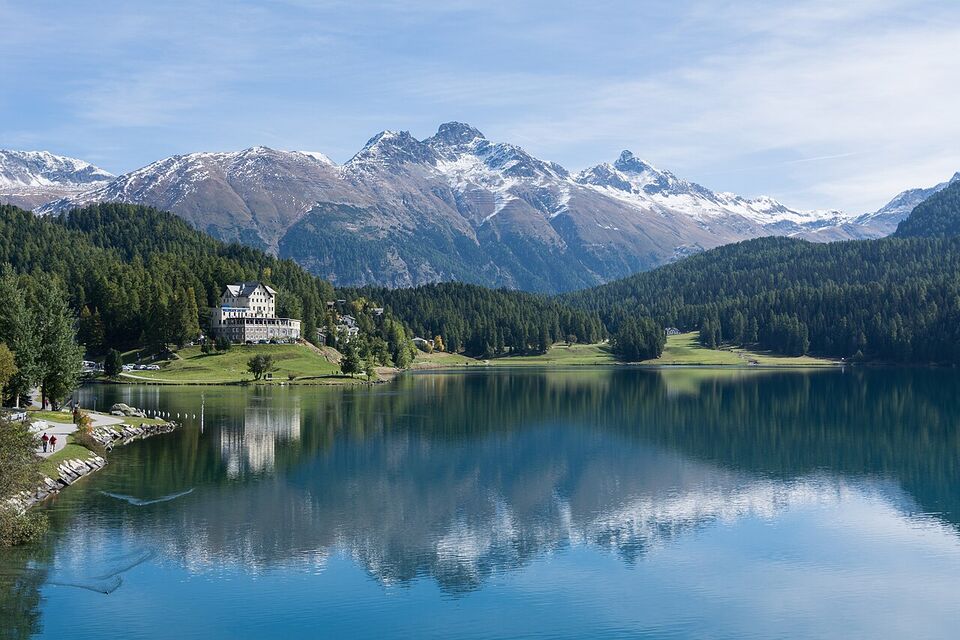
The Engadine (Engadin in German, Engiadina in Romansh) is a long, high valley in the canton of Graubünden, in the southeast corner of Switzerland. Its floor sits at roughly 5,600 to 6,000 ft (1,700 to 1,800 m), far higher than most Swiss valleys, and the Inn River runs through it toward Austria. The upper valley has a chain of lakes, wide meadows, larch forests and a lot of sunshine. Peaks and glaciers of the Bernina group rise to the south.
It feels different from the Bernese Oberland or Lucerne for several reasons. The valley floor is broad and open rather than a steep gorge. Houses are low, with thick walls and small, deep-set windows, often decorated with painted or scratched plaster patterns called sgraffito. Signs are in two or three languages, with Romansh among them. And the main resort, St. Moritz, has been a high-end destination since the 19th century, which shapes prices and the style of hotels.
St. Moritz is the name most Americans know, but the Engadine is a region of villages: Pontresina, Samedan, Celerina, Silvaplana, Sils, Zuoz and, further down the valley, Guarda and Scuol. This page covers the lakes and villages, the viewpoints, the Swiss National Park, the Romansh language, the trains that cross the region, and the practical question of when to go. For where the Engadine fits in a wider route, see the regions guide and when to go.
Different from home
Think of the Engadine as a mountain valley at the altitude of a Colorado resort town, with the service and prices of a luxury destination. Altitude matters: sun is strong, nights are cold even in summer, and you may feel the height on your first day if you arrive from sea level.
Getting to the Engadine
By train from Zurich
The usual route is by train from Zurich to Chur, the capital of Graubünden, then on the Rhaetian Railway (Rhätische Bahn, RhB) over the Albula line to St. Moritz. This second leg is a narrow-gauge railway through spiral tunnels, over the Landwasser Viaduct near Filisur and under the Albula Pass through a tunnel at about 5,955 ft (1,815 m). The line is part of a UNESCO World Heritage area, the Rhaetian Railway in the Albula and Bernina landscapes, which was listed in 2008. You do not need a special ticket for the scenery: the regular trains use the same track as the panoramic trains. Journey times vary by train, so check the SBB app for your date and expect one change, usually at Chur. A new timetable starts on December 13, 2026. See the getting around guide for how tickets work.
On the Bernina Express and Glacier Express
Two panoramic trains pass through. The Bernina Express runs between Chur or St. Moritz and Tirano in Italy; the Glacier Express runs between Zermatt and St. Moritz. Both need seat reservations on the panoramic trains, even with a Swiss Travel Pass. They are covered in more detail below and on the scenic trains page.
From Lugano and the south
From Lugano, the Bernina Express links by bus along Lake Como to Tirano, then by train over the Bernina Pass to St. Moritz or Chur. Drivers can cross the Maloja Pass from Italy. See the Lugano and Ticino guide for the Ticino side.
By car
The Julier, Maloja and Bernina passes stay open all year, according to the Alpine pass information site checked on November 13-14, 2026, but winter tyres are obligatory on year-round passes and chains may be required. The Albula and Flüela passes are open for now but can close for winter. For Lower Engadine, the Vereina car shuttle (telephone +41 81 288 37 37) runs from Klosters through the Vereina Tunnel. Passes can change in a day, so check alpen-paesse.ch or the pass pages before you leave. Rules and costs for driving are in the driving guide.
St. Moritz and Lake St. Moritz
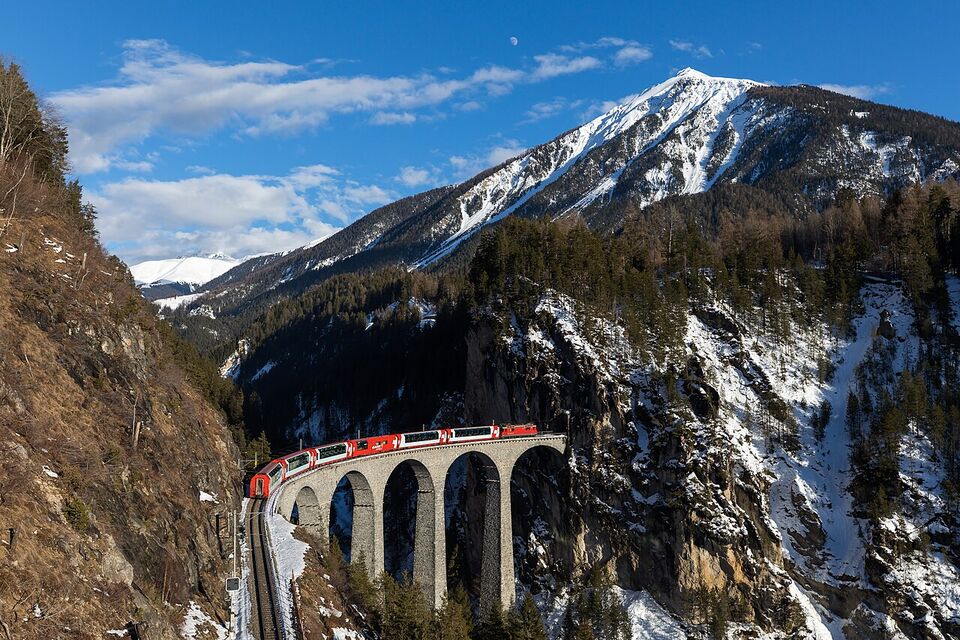
St. Moritz (Romansh: San Murezzan) sits at the edge of its lake. The town is split into St. Moritz Dorf, on the hill above the lake with the shops and hotels, and St. Moritz Bad, the spa district at the southwest end of the lake. The lake is a short walk from both. In summer there are lake paths, sailing and swimming for the hardy. In winter the surface freezes and becomes a venue.
The best-known winter event is White Turf: horse racing, skikjöring (horses pulling skiers) and trotting on the frozen lake. The 2027 edition is the 120th, with racing days on February 7, 14 and 21, 2027 and family days on February 6, 13 and 20. The organizer reports over 35,000 visitors, and the event dates back to 1907. Book lodging early for those weekends; see the festivals guide for other Swiss events.
The Engadine tourism site lists a calendar of winter events: the women's FIS Ski World Cup in St. Moritz on December 18, 2026, the year-end SINFONIA concerts on December 28, the FIS Para Alpine World Cup on January 9, 2027, the world's largest open-air curling tournament (Coppa Romana) in Silvaplana on January 10, Swiss Pond Hockey on January 15, the Engadin La Diagonela cross-country race on January 16, "Amusements on the Lake" from January 18 to February 21, cross-country World Cup races from January 22 to 24, and bobsleigh and skeleton World Cup races on the Olympia Bob Run from January 22. Check engadin.ch for current dates before planning around one.
Corviglia, the main ski area above St. Moritz, hosts the World Cup courses. For a non-skier, the town is a place for walks, spas and window-shopping, not for cheap meals.
Pontresina, Morteratsch and the glacier viewpoints
Pontresina (about 5,820 ft, 1,774 m) is a village at the mouth of the Bernina valleys. It is a good base for hikers and for visitors who want calmer surroundings than St. Moritz. Trains of the Bernina line leave from here toward the Bernina Pass and Italy.
Morteratsch glacier
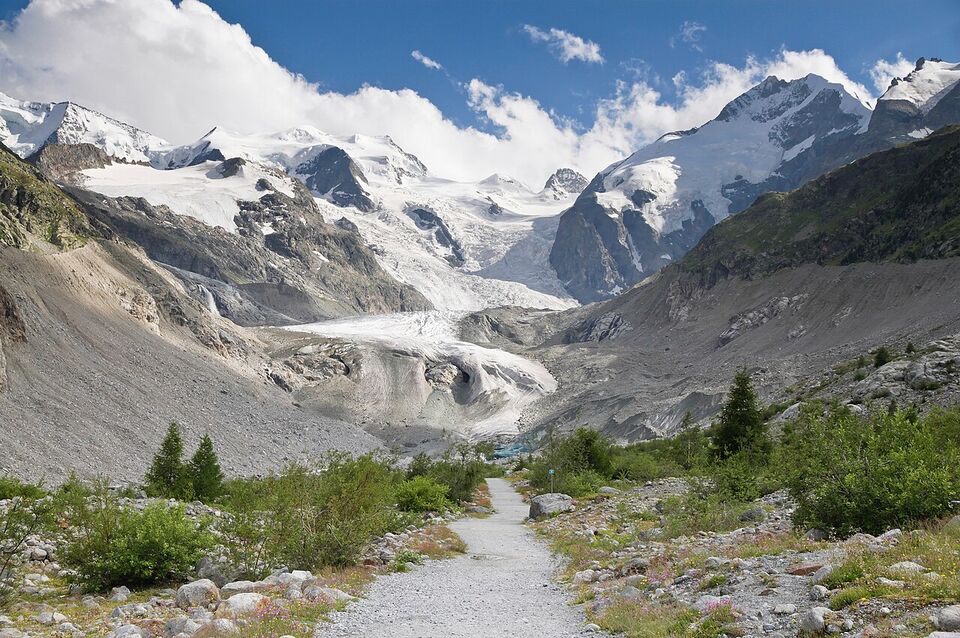
From Morteratsch station a path leads toward the glacier tongue. The glacier is retreating, and signs along the walk mark where the ice reached in earlier decades. Piz Bernina, the highest summit of the Eastern Alps at just over 4,000 m, is visible from the valley.
Diavolezza
A cable car rises from the Bernina Diavolezza station (6,867 ft, 2,093 m) to a terrace facing the Bernina group and its glaciers. There is a hot jacuzzi at 3,000 m with a mountain view, listed on the Engadine tourism site. Diavolezza is also a ski area; a ski-season calendar site lists a planned season of October 24, 2026 to May 3, 2027, but dates depend on snow.
Muottas Muragl
A funicular climbs from the valley floor to a viewpoint over the lakes of the Upper Engadine and the Bernina peaks. It is a popular sunrise and sunset spot. Opening dates and times vary by season, and closures are common in autumn and spring, so check the operator before you go.
Corvatsch
The Corvatsch area above Silvaplana offers views across the lakes. In winter, Friday evenings bring Snow Night, which the Engadine site calls the longest illuminated slope in Switzerland. A ski-season calendar site lists a planned 2026-27 season of November 21, 2026 to April 25, 2027.
Lift and railway dates are the least stable part of an Engadine trip. Autumn and spring closure dates for Muottas Muragl, Diavolezza and Corvatsch for 2026-27 were not published where we looked, so treat any date above as planned, not guaranteed. The official operators and engadin.ch list the current schedule.
Insider tip
Stand-alone viewpoints are best on a clear morning. Check the webcams on engadin.ch the night before, then decide which valley to visit. Weather in the Bernina group changes faster than in the valley.
Silvaplana, Sils and the Maloja
West of St. Moritz the valley opens into a string of lakes: Champfèr, Silvaplana and Sils. The villages of Silvaplana and Sils (Romansh: Segl) are quieter than St. Moritz and have wide lakeside paths. Silvaplana is known for water sports, and the lake surface hosts winter events such as the Coppa Romana curling tournament. Sils hosts the Sils Choir Weeks in December and June, and the Engadine tourism site lists more than 100 outdoor classical concerts every summer in Pontresina and Sils.
The road continues over the Maloja Pass, which marks the end of the Upper Engadine. From the pass the road drops steeply toward the Italian-speaking Val Bregaglia and, further on, Italy. The Maloja Pass is open all year, per the pass information site, with the winter-tyre rule noted above. For a flat walk, the paths along Lake Sils and Lake Silvaplana are among the easiest in the region.
The Swiss National Park
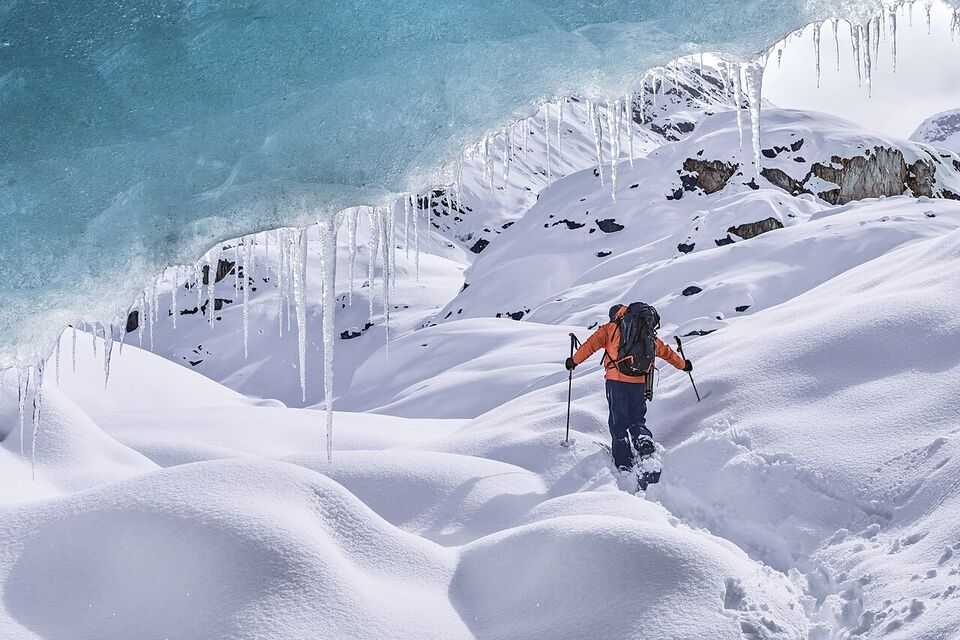
The Swiss National Park lies near Zernez, in the Lower Engadine, and is the country's only national park. It protects a mountain landscape where nature is left alone, with strict rules. In general, visitors must stay on marked trails, dogs are not allowed, and picking plants, camping and fires are not allowed. Rules and visitor-center hours can change, so confirm them and the hiking season on the park's own site before you go.
The park is a day trip from the Upper Engadine by train and PostBus, or a stop on the way down the valley. Hikes there are best in summer and early autumn, when trails are snow-free. If you want wildlife, note that animals are shy; binoculars help. For hiking in general, see the hiking guide.
Romansh: the fourth national language
Switzerland has four national languages: German, French, Italian and Romansh. Romansh is the smallest, with about 0.5 percent of residents naming it as a main language in the 2021 federal statistics. It is spoken mainly in Graubünden, which is the only trilingual canton, and it is an official language there. At the federal level, German, French and Italian are the working languages, and Romansh is used in dealings with people who speak it.
In the Engadine you will see Romansh on road signs, station names and menus, next to German. Two regional forms are used here: Puter in the Upper Engadine and Vallader in the Lower Engadine. A common greeting you will hear and see is allegra (hello); the tourism office uses it as its email address. Many place names have both a German and a Romansh form: St. Moritz is San Murezzan, Sils is Segl and Celerina is Schlarigna. Station signs on the RhB often show both.
The Engadine tourism site lists "500 ans lingua scritta", an open-air play on July 28, 2027 marking the written history of the language, and Chalandamarz, a March 1 custom that goes back to the Roman calendar. Most people in tourism speak English, so you will not struggle, but a few words of Romansh or German are welcome. For other languages in the country, see the phrasebook.
The Lower Engadine: Guarda, Zuoz and the villages
If the Upper Engadine is the busy part, the villages down the valley are the quieter side. Many have traditional houses with painted or scratched decoration and heavy wooden doors.
- Zuoz is a historic village in the Upper Engadine, listed on the tourism site as the location of the Engadin Art Talks (January 22, 2027) and the Concours Hippique show-jumping event in early August.
- Guarda is a small Lower Engadine village known for its well-preserved houses with sgraffito decoration. It is a calm stop for a walk rather than a place with many sights.
- Scuol is the main village of the Lower Engadine, and a base for the Swiss National Park area and for spa visits.
To visit by public transport, take the RhB toward Scuol-Tarasp from Pontresina or Samedan, or use the PostBus network. We recommend checking the SBB app for connections because they vary by day.
The Bernina Express and the Albula line
The Bernina Express is one of the most famous scenic trains in Switzerland, but you can also ride the same track on regular trains. It runs between Chur or St. Moritz and Tirano in Italy, and the journey takes about four hours. It crosses the Bernina Pass at 7,392 ft (2,253 m) at Ospizio Bernina, passes Lago Bianco, stops at Alp Grüm (6,860 ft, 2,091 m), the first station south of the Alps, and descends through hairpins to Poschiavo, an Italian-speaking Swiss town, and Brusio, where the line makes a full spiral on a viaduct. The line has 196 bridges and 55 tunnels and is part of the UNESCO listing.
- Reservation. The panoramic cars require a seat reservation, which you can buy with your ticket or add as a small supplement. Regional trains on the same track need no reservation. Fees change, so check rhb.ch.
- Season. In summer the Bernina Express can run as a separate train; in autumn, winter and spring, panoramic cars are attached to regional trains. Check rhb.ch for the dates that apply to your trip.
- Italy. Tirano is in Italy. Both Switzerland and Italy are in the Schengen area, so there is no routine passport control on this line, but carry your passport.
- Onward to Lugano. From Tirano, a bus runs along Lake Como to Lugano, which links to the Gotthard Panorama Express.
The Glacier Express connects St. Moritz with Zermatt in about eight hours, via the Albula line and the Oberalp Pass at 6,670 ft (2,033 m). Seat reservation is mandatory, even with a pass. Late autumn has a maintenance break, so check dates. See the scenic trains page for the comparison and the Zermatt guide for the other end.
Skiing versus summer hiking
| Season | What you do | What to check |
|---|---|---|
| Winter (December to March) | Downhill skiing at Corviglia and Corvatsch, cross-country on groomed tracks, events on the lakes, horse-drawn carriages, winter walks | Snow conditions, lift dates, event dates and hotel availability |
| Spring (April to May) | Late skiing on high slopes; lake and valley walks at low level | Many lifts and some trains close for maintenance; hotels close between seasons |
| Summer (late June to September) | Hiking, lakes, glacier viewpoints, cycling, outdoor concerts, the Swiss National Park | Trail conditions after snow; crowds in July and August |
| Autumn (October to November) | Quiet walks and the Bernina Express | Lift and railway maintenance; some restaurants closed |
The Engadine tourism site offers ski and cross-country passes from CHF 55 (about $65) per person per day, and a "Sleep+Ski" offer at participating hotels at a fixed price of CHF 55 (about $65) per day. Both can only be booked for the entire length of your stay. A ski-season calendar site shows a planned St. Moritz-Engadin ski season of October 24, 2026 to May 2, 2027, but those dates depend on snow. For lift passes, lessons and the choice of resort, see the skiing guide.
Cross-country skiing is a big part of the Engadine. The Engadin Ski Marathon, the largest mass sports event in Switzerland, takes place in early March, with Marathon Week listed from March 6, 2027. If you do not ski, you can still walk or ride in winter; the tourism site lists winter hiking, snowshoeing, ice sports and horse-drawn carriages.
Why it is expensive, and how to spend less
The Engadine's reputation for cost is deserved, and St. Moritz is the peak of it. Swiss hotels as a group are among the most expensive in Europe, and a resort with strong winter demand and limited beds charges more. Hotel prices change by date, so we do not give nightly figures. Use the tiers as a rough guide: $$$ is the norm for hotels in St. Moritz in high season, $$ is possible in Pontresina, Samedan and the Lower Engadine, and $ options are mainly hostels and simple rooms.
Save money
Base yourself in a village such as Pontresina, Samedan or Zuoz instead of St. Moritz, and use the train and PostBus network (the Swiss Travel Pass covers them, with reservation supplements on panoramic trains). Look at the budget tips for general ways to cut costs. Eat a main meal at midday, when set menus are often cheaper than dinner, and carry a picnic for the trail.
- Tourist tax. Hotels add a per-person, per-night tax, usually a few francs. Check what your hotel charges.
- Cash and cards. Cards are widely accepted, but carry some francs for mountain huts and small shops.
- Altitude. If you sleep at 6,000 ft (1,800 m) and are not used to it, drink water and take it easy on the first day.
For the full picture of how prices work in Switzerland, see the money guide.
Autumn and spring: closures to expect
In autumn and spring the Engadine goes quiet. Many mountain railways and cable cars pause for maintenance between the summer and winter seasons, and some hotels and restaurants close for a few weeks. Maintenance dates for the Engadine lifts and mountain railways vary each year, so check each operator and engadin.ch. The Engadine's own events list shows Christmas markets on November 28, 2026, so the winter season starts late in the autumn.
Road conditions also change. On November 13-14, 2026, the Albula and Flüela passes were open but snow-covered or at risk of winter closure, while the Julier, Maloja and Bernina passes stay open all year. Winter tyres are obligatory on year-round passes. For snow and avalanche information, see slf.ch; for forecasts, see meteoswiss.admin.ch.
Where to stay
Choose by the type of trip, not only by price.
- St. Moritz suits events, shopping, spa days and ski access. It is the most expensive base.
- Pontresina and Celerina suit hikers and cross-country skiers, with easy train links to the Bernina line.
- Samedan is a practical valley base with train links and a quieter feel.
- Silvaplana and Sils suit lake walks, water sports and Corvatsch skiing.
- Zuoz and the Lower Engadine suit travelers who want villages with traditional houses and fewer crowds.
Book early for February and July to August. For general advice on choosing hotels and regions, see where to stay.
Add it to a route in the trip builder, or ask us to plan the hotels, trains and guides for you.