Overview
Swiss food is built on dairy, potatoes, bread and cured meat, and it changes with the language you hear around you. In the German-speaking north and east you get rösti, sausages and veal in cream sauce. In the French-speaking west you get fondue, perch from the lake and leek-and-potato stews. In Ticino, the Italian-speaking south, you get polenta, risotto and grotto cooking. Eating your way across the country is one of the easiest ways to feel the differences between the regions.
This guide covers the dishes worth looking for, the habits that surprise Americans in restaurants (water, service, closing days), how to handle dietary needs, and how to eat well without spending a restaurant-sized sum at every meal. For cheese and chocolate as souvenirs and visits, see Chocolate and Cheese. For what to drink with all this, see Wine and Drinks.
One note on prices: Switzerland is expensive for food, and menu prices vary a lot by town and by season. We give no menu prices here that we could not confirm. Menus are posted outside nearly every restaurant, so read the board before you sit down.
Cheese fondue
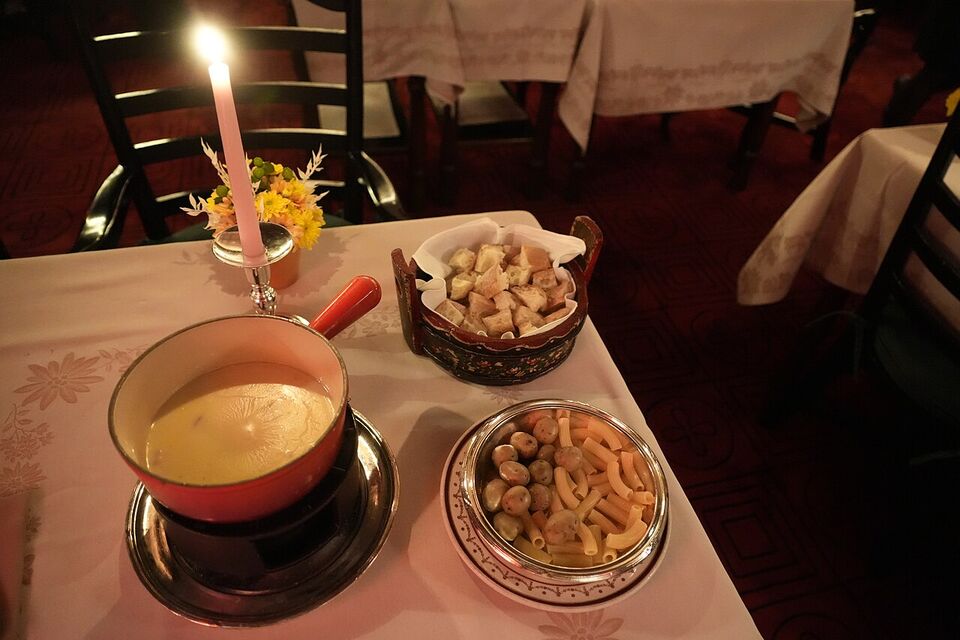
Fondue is melted cheese, usually a blend of hard mountain cheeses such as Gruyère and Vacherin, cooked with white wine and eaten hot with cubes of bread. The pot is called a caquelon and sits over a small flame at the table. Each person spears a piece of bread on a long fork, swirls it through the cheese and eats it. The dish is described in a Zurich manuscript from 1699 and was promoted as a national dish in the early twentieth century, so it is old, but it is also a deliberate piece of national branding.
It is meant to be shared and to be slow. A pot for two is a full meal with bread, and many people add a plain green salad or pickled onions and gherkins to cut the richness. Fondue is a convivial dish for a cold evening, not a daily staple, which is how the Swiss treat it too.
Types you will see
- Classic or moitié-moitié (half and half): two cheeses, typically Gruyère and Vacherin Fribourgeois. This is the standard order in French-speaking Switzerland.
- House blends: restaurants in German-speaking areas often use their own mix, sometimes with Appenzeller or Emmentaler added.
- Add-ins: some places offer fondue with tomato, truffle or bacon and onion. Christmas market stalls in Montreux list several of these, for example. If you want the classic, order it by name.
Fondue etiquette
- Stir the pot in a figure eight when your turn comes, so the cheese does not catch on the bottom.
- Do not double-dip. Once the bread is in your mouth, use your own plate fork for eating and the long fork only for dipping.
- Many tables joke that losing your bread in the pot has a penalty, such as buying the next round. It is a game, not a rule, so treat it lightly.
- The crust of toasted cheese on the bottom of the pot is a treat. It is usually shared at the end, scraped up with a fork.
- Tradition says to drink hot tea, white wine or a small glass of fruit brandy with fondue, and to avoid cold drinks and sparkling water because they are said to sit heavy. Nobody will stop you from ordering what you like.
Watch out
Fondue in a heat wave is a mistake. It is heavy, hot and served at a table over a flame, and many restaurants in lowland cities take it off the menu in summer. If your trip is in July or August, plan fondue for a mountain evening or save it for another trip. Autumn through early spring is the natural season.
Raclette
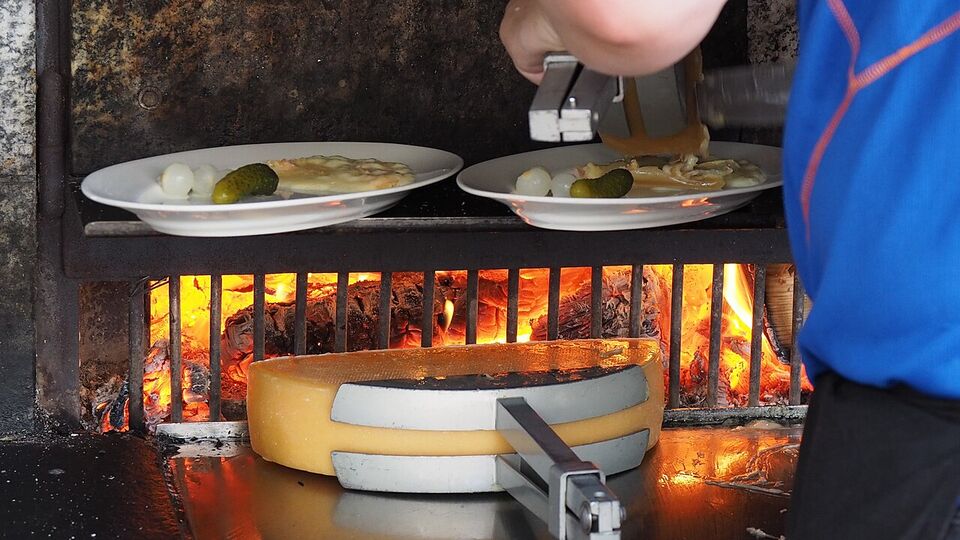
Raclette comes from the Valais, the canton in the southwest around Zermatt and Verbier. Traditionally half a wheel of cheese is held against heat, and as the surface melts it is scraped onto your plate. Many restaurants now use a small electric grill, and you will often see this at Christmas markets. It is served with skin-on boiled potatoes, pickled gherkins and small pickled onions, and it is often paired with Fendant, a Valais white wine. A refill of cheese is normal, so the usual way to order is by the portion, and the server brings the next scrape when your plate is empty. Check the menu to see whether refills are offered.
The cheese is protected under the AOP label (Appellation d’Origine Protégée, a protected designation of origin) when it is Raclette du Valais, and Montreux’s Christmas market lists it by that name in 2026. Look for the label if you care about origin. For a quick tasting, many Swiss train stations and festivals sell raclette on a bread roll or on potatoes as a hot snack.
Rösti and everyday classics
Rösti
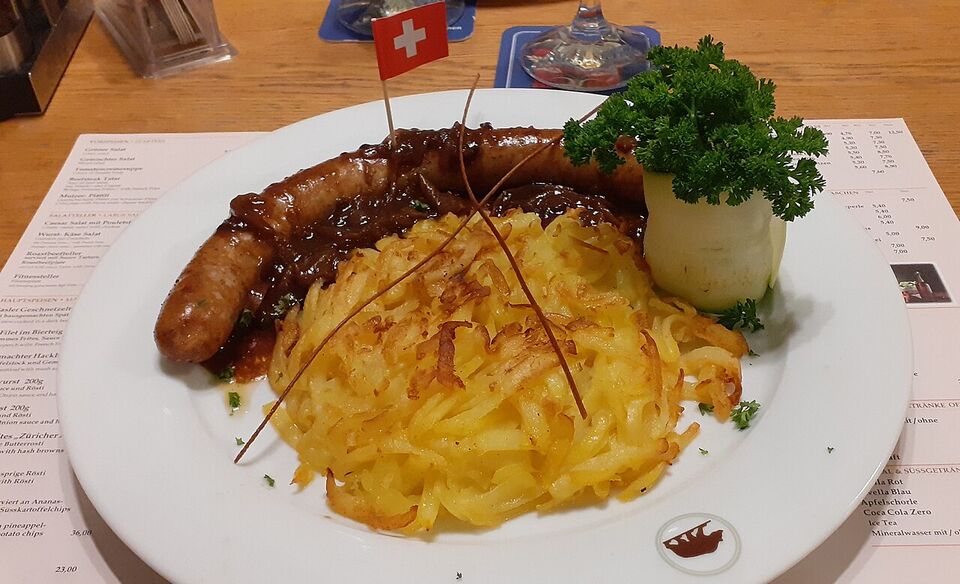
Rösti is a fried cake of grated potato, crisp outside and soft inside. It began as a farmhouse breakfast and now turns up as a side dish or a main course, usually with cheese, fried onions, a fried egg or bacon. The word gives its name to the Röstigraben, the “rösti ditch” that Swiss people joke about as the cultural line between the German- and French-speaking parts of the country. In practice, rösti is eaten across Switzerland. The Bernese and Zurich versions differ in how the potatoes are cooked: Bern traditionally uses boiled potatoes, while Zurich uses grated raw ones.
Zürcher Geschnetzeltes
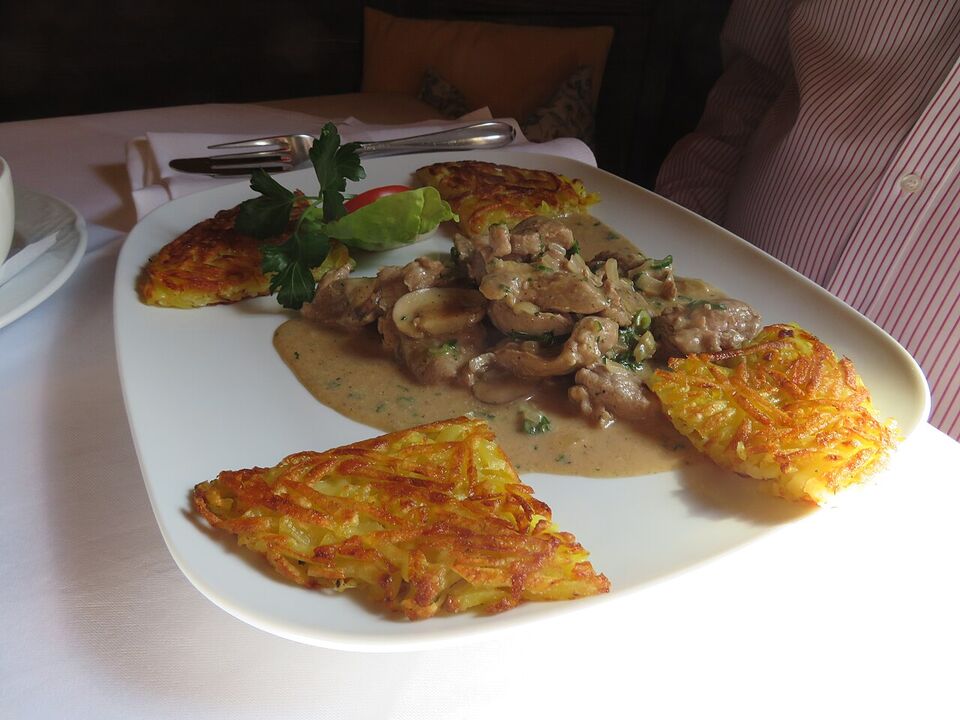
Zürcher Geschnetzeltes is sliced veal in a cream and white wine sauce, usually with mushrooms, and almost always served with rösti. It is rich and mild, the kind of dish that suits a gray day in Zurich. If you do not eat veal, ask whether the kitchen offers a chicken or mushroom version.
Birchermüesli
Muesli was invented in Switzerland by a nutritionist, Max Bircher-Benner, in the early twentieth century. Birchermüesli is soaked oats with grated apple, nuts, yogurt or milk and fruit, and it is a standard breakfast and bakery snack. It is nothing like the dry cereal sold in the US.
Other dishes worth knowing
- Älplermagronen: “herdsman’s macaroni,” made with pasta, potatoes, onions, bacon and melted cheese and served with applesauce. It is simple and filling.
- Cervelat: the “national sausage,” often grilled over a fire. A Bratwurst from a street stand is a common cheap lunch.
- Cordon bleu: a breaded cutlet filled with ham and cheese, popular on lunch menus.
- Cheese tarts: savory tarts, such as the Appenzeller cheese tart (Käsefladen), are common bakery and lunch items. See Appenzell.
Regional dishes by language area
Ticino: polenta, risotto and grottos
Cornmeal polenta and risotto with mushrooms or saffron are the staples, often alongside luganighe, a local sausage. A grotto is a rustic restaurant, traditionally set in a former wine cellar at the edge of a wood, with stone tables outside. Grottos are best in warm weather and some close in winter, so check. See Lugano and Ticino.
Valais: raclette and dried meats
Besides raclette, look for air-dried beef and sausages on a mixed board and, in autumn, the brisolée: roasted chestnuts with cheese and cured meats, served with new wine. The tradition is a seasonal one, so ask whether it is running.
Bern: the Bernese platter
The Berner Platte is a big winter plate of sauerkraut or beans with boiled and smoked pork cuts and sausages. It is a dish to share and to eat hungry. See Bern.
Geneva: longeole and cardoon
Longeole is a pork sausage from the canton of Geneva flavored with fennel seeds. The Geneva cardoon, a thistle relative baked as a gratin, is a Christmas dish in many local homes. See Geneva.
Vaud: perch and papet vaudois
Fried perch fillets (filets de perche), served with fries or potatoes, are the lakeside classic. Papet vaudois is a stew of leeks and potatoes served with a cabbage sausage. See Lausanne and Montreux.
Graubünden: barley soup, capuns and nut cake
Look for barley soup, capuns (dough parcels wrapped in chard), pizokel (small dumplings) and the Engadine walnut cake, Nüsstorte. This is mountain food made to fuel a day outdoors. See the Engadine.
Basel has its own flour soup and cheese onion tart, eaten early on carnival mornings, and a spiced honey biscuit called Basler Läckerli that keeps well as a gift. See Basel.
Bakeries, Coop and Migros
For breakfast and picnic lunches, bakeries are the best value in the country. A Gipfeli is the Swiss croissant, smaller and less buttery than a French one. Zopf is the braided bread traditionally baked for Sunday. Sandwiches, savory pastries and slices of tart are all easy to find.
The two big supermarket chains, Coop and Migros, are on almost every main street and in most stations. Both sell sandwiches, salads, hot dishes and sushi, and many branches have a seating area or a self-service restaurant with a hot counter. Smaller Coop Pronto and Migros stores near stations are open longer hours than the main stores. We could not confirm hours or prices for these chains, so check the door signs.
Save money
Eat your biggest meal at lunch. Many restaurants offer a weekday set lunch (Tagesmenü in German, menu du jour in French, piatto del giorno in Italian) that includes a main course and sometimes soup or salad, and it usually costs noticeably less than the same kitchen’s dinner. Then buy a light supper at a supermarket. More ideas are in budget tips.
Picnics fit the country well. Trains have long views, lakes have benches, and fresh bread, cheese, fruit and chocolate make a good lunch. Mind the rule on bringing food from the US: you may not carry meat or dairy products from the US into Switzerland, so buy your picnic supplies there.
Restaurant habits that surprise Americans
- Water costs money. Tap water is widely drunk in Switzerland, and public fountains are common, but a restaurant will not bring a free glass automatically. Mineral water on the menu is billed, and it is often priced like a soft drink. You can ask for tap water (Leitungswasser in German, eau du robinet in French, acqua del rubinetto in Italian), and many places will give it to you, sometimes for a small charge. Do not assume it is free. Public fountains in towns usually run drinking-quality water unless a sign says otherwise, which makes refilling a bottle free.
- Service is included. The price on the menu already includes service. Rounding up the bill or leaving a few francs for good service is appreciated, but it is not expected, and nobody calculates a percentage.
- You ask for the bill. Servers will not bring it until you ask, and rushing diners is considered rude. Say “Zahlen, bitte” (German), “L’addition, s’il vous plaît” (French) or “Il conto, per favore” (Italian). The phrasebook has the pronunciation.
- Payment is usually one bill per table, or per person on request. The server often takes your card to a handheld machine at the table. Carry a few francs for small shops, huts and some mountain restaurants that take cash only.
- Closing days. Many restaurants close one or two days a week, often Sunday or Monday, and many shops close on Sundays except at stations, airports and tourist resorts. Check before relying on it, and book dinner if your trip has a fixed schedule. Kitchens in smaller towns may stop serving hot food in the afternoon, between about 2 p.m. and 6 p.m.
- Lunch comes early. Many kitchens run from about noon to 2 p.m. and fill up fast on weekdays. Arrive at 11:45 a.m. or after 1:15 p.m. for a table without a wait.
- Reserve for fondue evenings. In winter and on weekends, popular fondue restaurants fill up. Book a day ahead or more.
More on manners is in the etiquette guide.
Dietary needs
Vegetarian and vegan
Switzerland suits vegetarians. Cheese fondue, raclette, rösti with egg and cheese, polenta, risotto, pasta and mountain-style dairy dishes are all vegetarian in principle. The catch is hidden meat: bacon in rösti and in Älplermagronen, meat stock in soups and risotto, and lard in pastry. Ask whether a dish is vegetarisch (German), végétarien (French) or vegetariano (Italian). Vegan options are easiest in the cities, where cafes, supermarkets and Asian and Middle Eastern restaurants offer them.
Gluten-free
Fondue itself is gluten-free apart from the bread, so you can dip boiled potatoes instead, which most restaurants will provide on request. Rösti is potato, and polenta is cornmeal, but the kitchen may thicken sauces with flour. Ask clearly, say you have an allergy rather than a preference if you do, and point to the words in the phrasebook. Supermarkets stock gluten-free bread and pasta. We could not confirm the specifics of Swiss allergen labeling rules, so do not rely on a menu symbol alone.
Allergies
Peanut and tree-nut ingredients appear in pastries and chocolate, and the Swiss cheese-based kitchen puts dairy in a great many dishes. Carry a short note in German, French and Italian that names your allergy, and tell the server before you order. Keep any epinephrine auto-injector with you, and see the health guide for pharmacies and emergency care.
Mountain restaurants and huts
A lift-top restaurant is often a good place for a hot meal with a view, and the food tends to be simple: soup, rösti, sausage with potatoes, cheese plates, pasta and desserts. Prices are higher than in the valley, and a sunny weekend can mean a long line at self-service counters.
Mountain inns and huts reached on foot are a different world. Appenzell’s mountain inns, for example, are a regional tradition, and some serve local cheese and dairy dishes. Many small huts take cash only, close for the season and do not answer the phone in the off-season. Check opening dates on the hut’s own site, bring francs, and see the hiking guide and mountain excursions before you plan a meal around a summit.
Where to eat by region
We do not name individual restaurants unless we have confirmed they are open in 2026. Here is how to choose by type of place instead.
- Zurich and the German-speaking north: Look for a traditional Stube or Stübli (a wood-paneled dining room) for Geschnetzeltes and rösti, a guild-house or old-town restaurant for local dishes, and Swiss supermarket restaurants for a budget hot lunch. See Zurich and Lucerne.
- Bern and the Bernese Oberland: Look for a cellar restaurant in the old town for a Bernese platter. In Interlaken and the villages, choose a restaurant that serves local dishes on a short menu over a large tourist menu with photographs. See Bern and Interlaken.
- Geneva, Lausanne and Montreux: Look for a brasserie or café with a day menu for perch and local wines. Montreux’s Christmas market runs from November 20 to December 24, 2026, and has stalls for fondue, raclette and rösti. See Christmas markets.
- Zermatt and the Valais: Look for a restaurant that advertises Valais raclette, ideally by its AOP name. See Zermatt.
- Lugano, Locarno and Ticino: An osteria or grotto for polenta, risotto and local Merlot, and a pizzeria or gelateria for a cheap meal. See Lugano and Ticino.
- Appenzell and eastern Switzerland: A tea room or mountain inn for cheese tart and dairy dishes. See Appenzell.
Common mistakes
- Ordering fondue in a heat wave. Save it for cool weather.
- Ordering too much. Portions are generous, especially for cheese and potato dishes. Two people can often share a fondue pot, a salad and dessert. Ask what size a dish is before you order three courses each.
- Assuming tap water is free. Ask, and check the bill.
- Leaving a US-style tip. Service is in the price. A larger tip is not expected.
- Arriving with no plan on a Sunday. Fill your bag at a station shop or bakery on Saturday, and check which restaurants are open.
- Eating dinner at a hotel restaurant every night. It is easy, but it is rarely the best value. Walk a few blocks.
- Buying food only at tourist counters. Station kiosks and lift-top stands are convenient but pricey. A supermarket costs less.
Different from home
A US waiter brings water, checks on you often and drops the bill early. In Switzerland, service is calmer and slower. The server does not rush you, the table is yours for the evening, and you flag the staff when you want the bill. It is not rudeness: it is the opposite.
Eating well on a budget
- Have breakfast at your hotel only if it is included. Otherwise a bakery coffee and Gipfeli is cheaper.
- Make lunch the main meal and use the set lunch menu.
- Buy a picnic at Coop or Migros for train days and mountain days.
- Ask for tap water, or refill a bottle at a public fountain.
- Share a fondue or a large plate, and add a salad.
- Carry some francs for huts, markets and small stalls. See money.
- Check where to stay for hotels with kitchens or breakfast included.
Hotels and lunch menus are where trips are won or lost on budget. For a full picture of costs, see the budget planner.
Add it to a route in the trip builder, or ask us to plan the hotels, trains and guides for you.