Overview
Amritsar is the spiritual center of Sikhism and one of the easiest places in India to visit respectfully. The Golden Temple (Harmandir Sahib) is a working house of worship that is open to everyone, and it has a free kitchen that feeds visitors every day. One full day covers the temple, the nearby Jallianwala Bagh memorial and the Partition Museum. Add an evening for the Wagah-Attari border ceremony.
The city is in Punjab, in the northwest, about 283 miles (455 km) from New Delhi and 17 miles (28 km) from the border with Pakistan. Punjabi is the main local language, written in Gurmukhi script on many signs; Hindi and English are widely understood. Nearly half of the city's residents are Sikh and nearly half are Hindu, and you will notice the turbans, the gurdwaras (Sikh houses of worship) and the generous food culture almost immediately.
Amritsar fits at the start or end of a trip through the north. It pairs naturally with Delhi by fast train, and with the hill country of Himachal, since Dharamshala is within reach by road.
Different from home
The Golden Temple is not a museum or a tourist site with an entry gate and ticket. It is a place of worship used by tens of thousands of people every day, and visitors are guests. That means covering your head, taking off your shoes, keeping your voice low and following the volunteers' directions.
The Golden Temple (Harmandir Sahib)
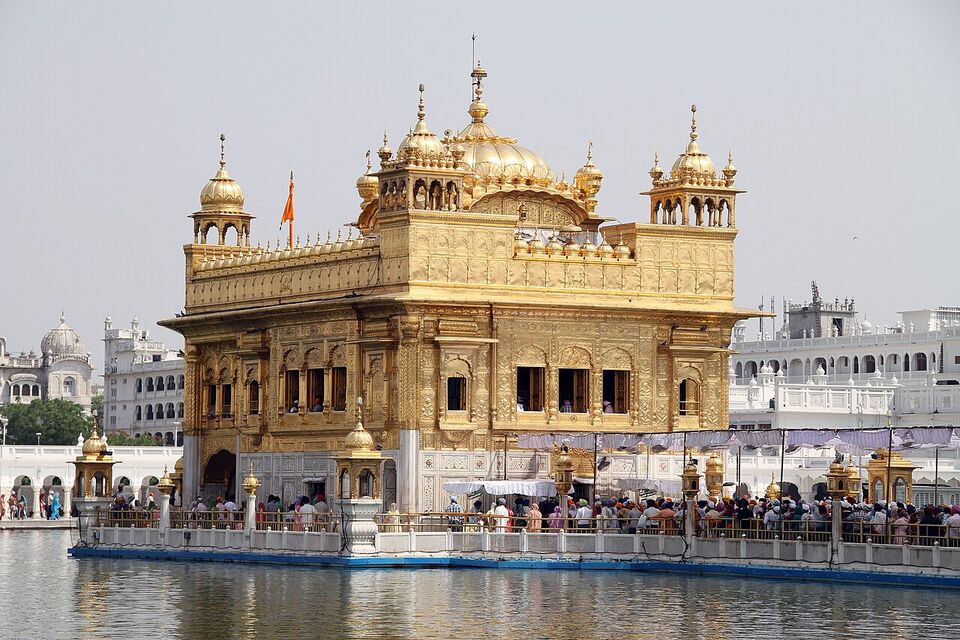
The Harmandir Sahib is the holiest shrine of Sikhism. Guru Ram Das, the fourth Sikh Guru, completed the sacred pool, the Amrit Sarovar, in 1577. Guru Arjan built the temple in the middle of it: work began in December 1581, the building was finished in 1589, and in 1604 he placed the Adi Granth, the Sikh scripture, inside. Maharaja Ranjit Singh rebuilt the shrine in marble and copper in 1809 and covered the sanctum in gold leaf in 1830, which gave the temple its English name.
The complex has four entrances, which Sikh tradition says signal that it is open to people of all backgrounds, and a walkway circles the pool. The gold-covered sanctum stands on a causeway in the middle. Across from it is the Akal Takht, the chief seat of Sikh religious authority. Reference sources estimate that over 150,000 people come each day, so crowds are the norm.
Visitor rules
The basic rules are simple, and they apply to everyone:
- Cover your head. Men and women both wear a scarf or cloth. You can bring your own or buy one cheaply near the entrance; volunteers also hand them out.
- Remove your shoes and socks. Leave them at the shoe-keeping counters near the entrance. You will walk barefoot on marble, and in a shallow water channel you pass through to clean your feet.
- Dress modestly. Cover shoulders and knees. Loose, light clothing works well.
- Bring no alcohol or tobacco. Intoxicants are not allowed in a gurdwara. We have not seen the complex's current list of rules, so check the official site, sgpc.net, for the full wording.
- Be quiet and slow. Walk at the pace of the crowd along the path around the pool, and do not stop in the middle of a walkway.
- Ask before you photograph. Rules on photography differ by area, and the sanctum itself is for prayer. Ask a volunteer, and never photograph people praying without their consent.
Do not touch or enter the pool unless you are shown how, since bathing is part of Sikh devotion with its own customs. If you are not sure what to do, copy what others do, or ask a volunteer. People are used to visitors and are generally glad to help.
When to go
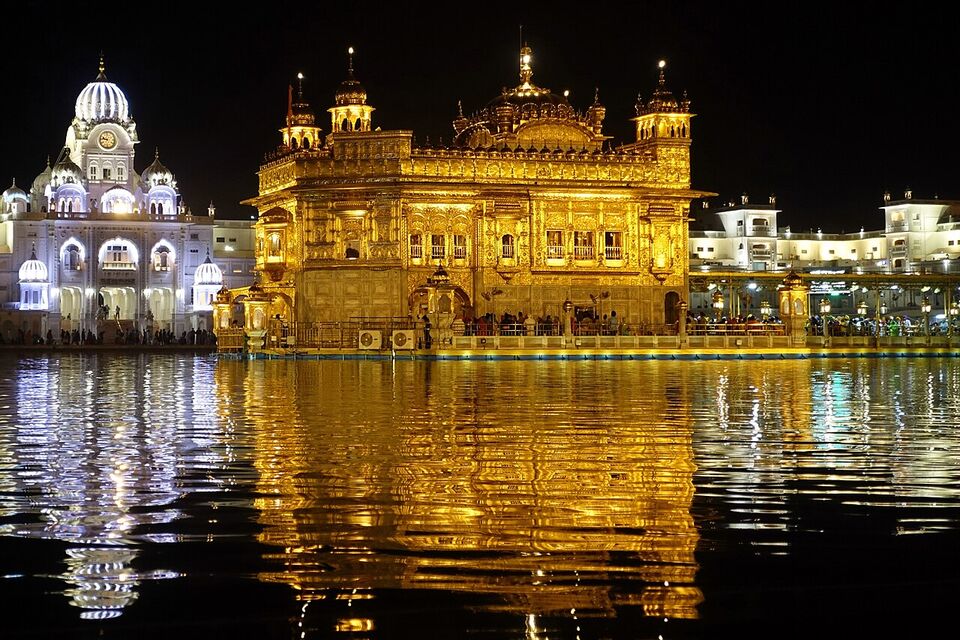
Early morning is the quietest and cool, and the light on the gold is soft. Evening is also a good time, when the temple is lit and its reflection fills the pool. Late morning and weekends are busiest. Expect the biggest crowds on festival days: Guru Nanak Jayanti, the birthday of the first Sikh Guru, falls on about November 24, 2026 (some calendars say November 25), so if you are in Amritsar in late November 2026, plan for very large crowds and check ahead for any changes in access.
In the evening and at night there is a ceremonial closing, in which the scripture is carried in a flower-decorated palanquin to its resting place in the Akal Takht. Reference sources describe it, but we could not confirm the times, so ask a volunteer on the day.
The langar: the free community kitchen
The langar is a free vegetarian kitchen run by volunteers as part of the Sikh principle of seva (selfless service). Everyone eats together, whatever their faith, gender or wealth, and reference sources put the number of meals at over 100,000 each day. It is one of the largest free kitchens in the world.
It is not a restaurant, and it works best if you treat it as an act of community:
- Follow the lines and the volunteers' signals. Visitors sit on the floor in rows, and the food is served by volunteers who walk the rows.
- Keep your head covered in the dining hall, as everywhere in the complex.
- Take what you will eat. You can ask for more, and wasting food is frowned on.
- Eat with your right hand if you can, as is common across India. Use the spoon or fingers as others do.
- Leave when you finish, so the next group can sit, and do as the people around you do with your plate.
- The meal is free, and many visitors make a donation or help with a small task afterward. This is optional; a donation box is a more appropriate way to give than pressing money on a volunteer.
The food is simple (usually lentils, a vegetable dish, bread and a sweet) and clean, since it is cooked in large batches and served fresh. If you are cautious about food, you can also eat a snack beforehand; see the food guide and etiquette for more.
Save money
Entry to the Golden Temple has no charge as far as we know, the langar is free, and you can borrow or buy a head scarf for very little. This is one of the cheapest and most rewarding days in India. If you want to give something back, use the official donation counters or boxes, and avoid anyone who approaches you on the street for money "for the temple."
Jallianwala Bagh
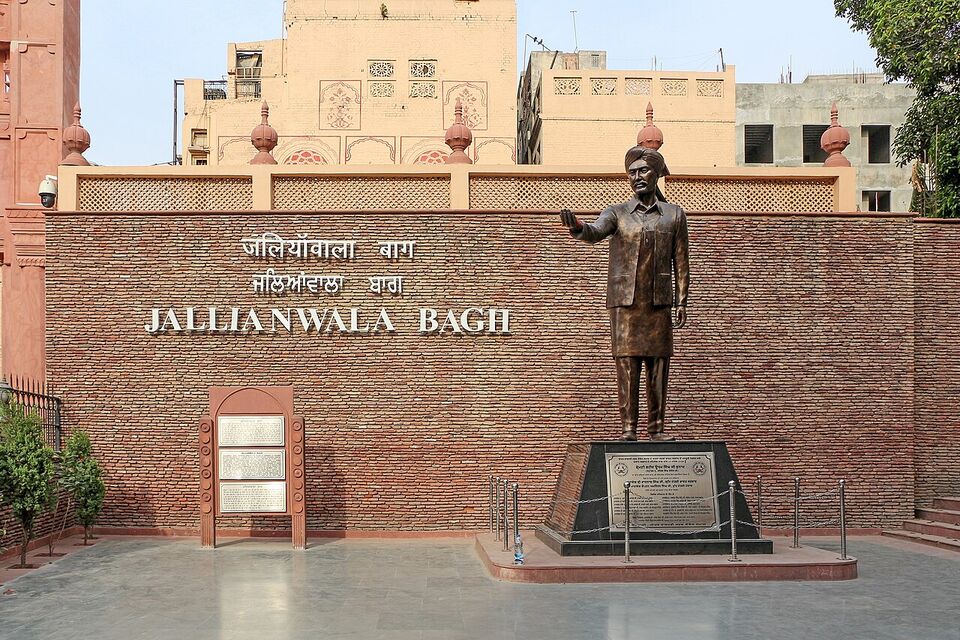
A short walk from the Golden Temple, Jallianwala Bagh is a walled public garden of about 7 acres (2.8 hectares) and a national memorial. On April 13, 1919, the day of the Baisakhi festival, troops under the British Colonel Reginald Dyer fired on a large crowd of unarmed people who had gathered here. Hundreds were killed, and estimates run up to about 1,000. The event is a turning point in the history of the Indian independence movement.
You enter through a narrow passage, the same one the troops used. Inside are a memorial flame, bullet marks that remain on some walls, a well, a martyrs' gallery and a small museum. The visit takes about an hour, and it is a quiet and sobering place. Dress modestly and keep your voice low.
Wikipedia notes the site was renovated in 2019-2021, a project that drew criticism from some historians, and that further work is planned between 2025 and 2027. We could not confirm whether any part is closed now, so check before you go. We also have no confirmed ticket price or opening hours.
The Partition Museum
The Partition Museum covers the division of British India in 1947 into India and Pakistan, one of the largest forced migrations in history. It is built around personal stories, oral histories and objects, and it is a reminder that Amritsar was a major transit point for refugees crossing in both directions. Reference sources say a large share of the city's people are descended from families displaced by the Partition.
Give it at least an hour and a half. We could not confirm the hours, the ticket price or the closing day, so check the museum's own website before going. It is a fitting stop before or after the Wagah-Attari ceremony, which has its own roots in the same history.
The Wagah-Attari border ceremony
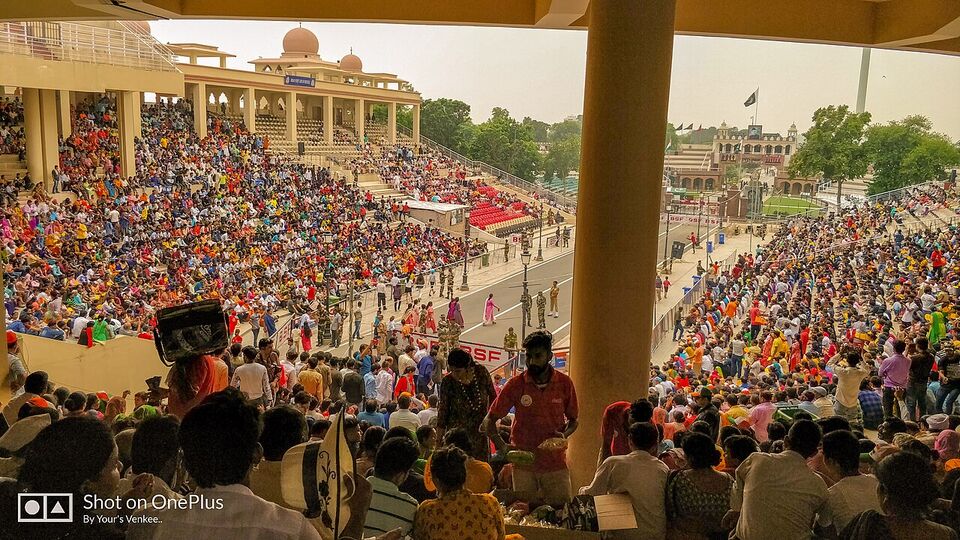
Every evening, soldiers of India's Border Security Force and Pakistan's Rangers lower their national flags at the border crossing on the Grand Trunk Road. The event is a choreographed drill (the "Beating Retreat") with high kicks, stamping, marching and a flag-lowering. It has been held since 1959, and the crowd on the Indian side is loud, patriotic and festive.
What has changed since 2025
After the Pahalgam attack and the India-Pakistan clashes in May 2025, the ceremony was paused indefinitely on May 8, 2025. It resumed in a limited form on May 20, 2025, without the usual handshake between the two sides and without the exchange of sweets. From May 1, 2026, the Tribune reported that the evening ceremony moved to 6:00-6:30 p.m. from 5:30-6:00 p.m., because of summer heat.
The winter start is earlier. The Incredible India page has listed about 4:15 p.m. for winter, but that page is undated, so we cannot confirm it. Check the current time with your hotel, the Punjab tourism office or the Border Security Force before you go, and arrive well ahead; seating fills early.
Watch out
The State Department's India advisory (Level 2, Exercise Increased Caution, as of November 2026) lists the India-Pakistan border area among its Do Not Travel areas. The ceremony site is on that border. Read the exact wording on travel.state.gov, check for any recent incidents or closures, and decide whether to go. Do not plan to cross into Pakistan by land: that crossing can close at short notice.
What foreigners should do
- Carry your passport (not just a copy). We could not confirm the ID rules, but security checks at the site are standard.
- Bring very little. Large bags and some items may not be allowed through security, so leave valuables at your hotel.
- Go with a driver or a tour from Amritsar. The site is about 17 miles (28 km) from the city, and your driver can handle parking and pick-up. Agree the price and the return time first.
- Expect a long wait, strong sun in the afternoon and loud crowds. A hat and water help.
- Follow the guidance of security staff and the Border Security Force. Photography rules may apply.
Getting there and best times
By air. Sri Guru Ram Das Ji International Airport serves Amritsar, with direct flights to Indian and international cities. It is one of the airports on the e-Visa entry list, so Americans on an e-Visa can arrive here directly if they find a connection. Check airline sites, since schedules change. Winter fog disrupts flights across north India on roughly 15 to 20 days a year, so avoid tight connections between December and January.
By train. Amritsar Junction is Punjab's busiest station. The Vande Bharat from New Delhi runs about 5 hours 30 minutes for 447 km (278 miles) according to its published timetable; check the current schedule on the railway site. Book on IRCTC and see the trains guide for booking rules.
By road. Chandigarh is about 135 miles (217 km) away. India drives on the left; for a long drive, hire a car with a driver and avoid night driving.
Seasons
Amritsar is best from October to March, but the winter is colder than many visitors expect. In January the average high is about 64°F (17.7°C) and the average low about 39°F (3.8°C), and the January record low is close to 27°F (-3°C). Fog can be thick in the early morning. In May the average high is about 103°F (39.4°C), and July to September are hot and humid with monsoon rain. See when to go.
What to eat
Punjabi food is rich, filling and widely loved across India. Amritsar's best-known dish is the Amritsari kulcha, a stuffed, tandoor-baked bread served with chickpeas (chole) and a cool yogurt or a tangy chutney. Other staples include dal makhani (slow-cooked black lentils with butter), sarson da saag with makki di roti (mustard greens with cornmeal flatbread; a winter dish), tall glasses of thick lassi and jalebi, a crisp spiral sweet soaked in syrup.
Many eateries near the Golden Temple are vegetarian, and some serve meat and fish. Eat where food is hot, fresh and busy, drink sealed bottled or filtered water, and be careful with ice and raw salads. If you need a break from spicy food, ask for dishes kam mirch (less chili). Punjab is not a dry state, but alcohol is not served in the temple area, and you should not carry it in.
Common mistakes
- Arriving without a head cover. You can buy one nearby, but it adds a queue.
- Visiting at midday or on a festival. Early morning or evening is better.
- Treating the langar as a restaurant. It is an act of service offered to everyone, so there is no menu and no ordering.
- Arriving at the border ceremony late. Seats and standing space fill up, and the winter start is earlier than the summer one.
- Not checking the advisory. The border area is listed at Do Not Travel, so read the text before you go.
- Booking tight flights in winter. Morning fog causes delays.
Women traveling alone will find Amritsar welcoming, and the women travelers guide has practical advice. For other places of worship, see temples and religious sites. For safety, see safety. In an emergency, call 112, and the US Embassy New Delhi can be reached at +91-11-2419-8000.
Add it to a route in the trip builder, or ask us to plan the hotels, trains and guides for you.