Overview
Jaipur is the capital of Rajasthan and the third corner of the Golden Triangle, with Delhi and Agra. Most visitors give it two full days, and that is enough for the big four: Amber (Amer) Fort, the City Palace, the Hawa Mahal and the Jantar Mantar observatory. A third day lets you slow down, shop properly and see the hilltop forts at sunset.
The city was founded on November 18, 1727 by Maharaja Sawai Jai Singh II, who moved his court down from Amber. It was laid out on a grid, which is unusual for an Indian city of that age, and the old walled city was named a UNESCO World Heritage Site in 2019. The "Pink City" name comes from the color of the old town's buildings, which were painted pink in 1876 to welcome the Prince of Wales.
Jaipur works best as a base of two or three nights, either on the way between Agra and Rajasthan's desert cities or as the start of a longer trip through Udaipur, Jodhpur and Jaisalmer. If you are building the full circuit, see the Golden Triangle guide for how the three cities fit together.
Different from home
India drives on the left, and the old city's streets are crowded with cars, auto-rickshaws (tuk-tuks), motorbikes, carts and the occasional camel. Cross where locals cross, wait for a gap and walk steadily. Do not stop mid-street.
A two- or three-day plan
The sights cluster in two groups: the old city (City Palace, Jantar Mantar, Hawa Mahal and the bazaars) and the hills north of town (Amber, Jaigarh and Nahargarh). Do the hills in the morning, when it is cool and the crowds are thinner, and the old city later in the day.
- Day 1
Amber Fort, then the old city
Reach Amber Fort when it opens (check the hours on the Rajasthan tourism site). Spend two hours inside. Return to town for lunch, then walk the Jantar Mantar and the City Palace in the afternoon, when the observatory's shadows are sharp and the palace museum is less crowded. End with tea near the Hawa Mahal as the light turns pink.
- Day 2
Hawa Mahal, bazaars and crafts
See the Hawa Mahal in the morning light, then walk the bazaars around it. Spend the afternoon on a textile or craft visit (see the shopping section) and have dinner at a restaurant serving Rajasthani food. If the City Palace's night visit is open (the Wikipedia listing gives 7 p.m. to 10 p.m.; confirm), it makes a good evening.
- Day 3
Nahargarh, Jaigarh and Jal Mahal
Take a driver up to Nahargarh Fort for views over the city, then continue to Jaigarh, which sits on the ridge above Amber. Stop on the way back at the lakeside promenade for Jal Mahal. Use the afternoon to shop or rest. Three days also leaves slack for a hot afternoon, a late start or a day of heavy traffic.
| Sight | Best time | Time needed | Foreigner ticket (reported) | US$ | Notes |
|---|---|---|---|---|---|
| Amber (Amer) Fort | Opening time | 2 to 3 hours | ₹1,000 | about $11 | About 7 miles (11 km) north of the center; UNESCO site since 2013 |
| City Palace | Mid-afternoon | 2 hours | Separate museum ticket; check | check | Run as a museum; part is still the royal family's home |
| Hawa Mahal | Morning | 45 minutes inside; the facade takes minutes | ₹600 | about $6 | Built in 1799; 953 small windows |
| Jantar Mantar | Late morning or midday | 1 hour | ₹600 | about $6 | 19 astronomical instruments; hire a guide or use the signs |
| Nahargarh and Jaigarh | Late afternoon to sunset | 2 to 3 hours for both | Separate tickets; check | check | Hill forts with city and valley views |
| Jal Mahal | Sunset or evening | 20 to 30 minutes | Viewed from the shore | free as far as we know | A palace in the middle of a lake; check whether visitors can enter |
The ticket prices come from a local news report dated December 29, 2025, which said foreigner fees at Amber, the Hawa Mahal and the Jantar Mantar rose from ₹300 (about $3) at each to the figures above from January 1, 2026. We have not seen the official notice, so treat the figures as approximate and check before you go.
Amber Fort: go early
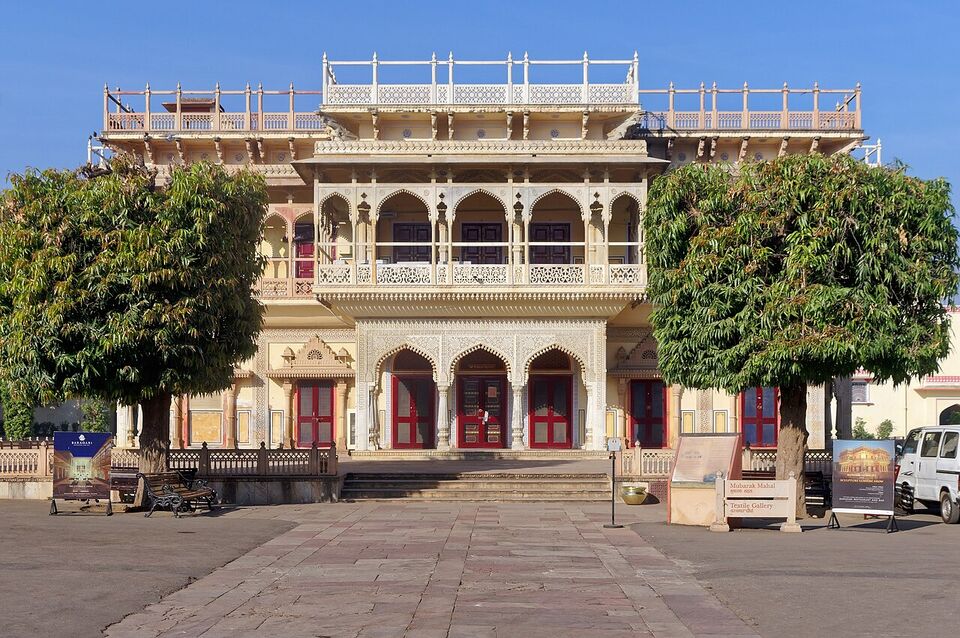
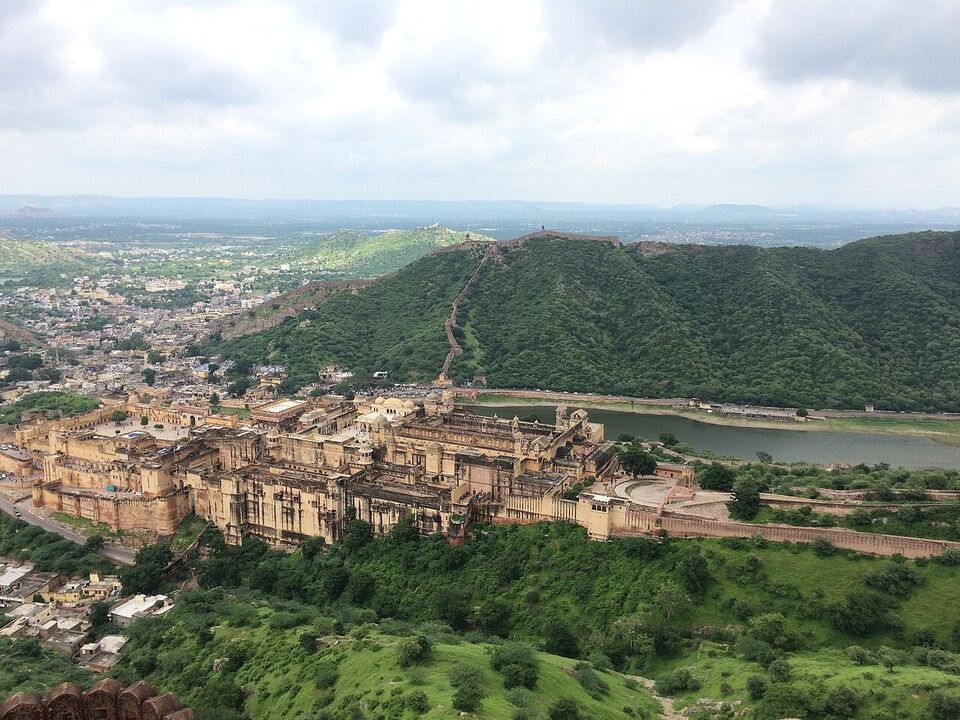
Amber Fort sits on a hill about 7 miles (11 km) from the city center. Maharaja Man Singh I began building it in 1592, in red sandstone and marble, above Maota Lake. It is part of the Hill Forts of Rajasthan, a group of six forts that UNESCO listed in 2013. Inside are four courtyards: a public audience hall with 27 columns, the mirror-lined Sheesh Mahal, a garden laid out on the Mughal pattern, and the private quarters.
Go at opening time. By mid-morning tour buses have arrived, the stone is hot, and the staircases and courtyards fill. In the first hour you can see the Sheesh Mahal's mirrored ceiling without a queue and take photographs with space around you.
How to get up to the gate
You have three choices: a jeep, a walk up the hill, or an elephant. A narrow four-wheel-drive road leads to the Suraj Pol (Sun Gate), and shared or private jeeps use it. Many visitors also walk up the ramp from the lake side; it takes about 15 minutes and is easy in the morning. The jeep is the choice that suits most people, and it costs far less than a guide-led half day. Agree the price before you get in.
The elephant question, plainly
We suggest skipping the elephant ride, for animal-welfare reasons. Animal protection groups, including PETA and India's central zoo authority, have raised concerns about the elephants that carry tourists up the ramp. The reports describe the animals chained, with injuries and health problems, and kept in a camp that critics say breaks rules on captive animals. A New York tour operator announced in 2017 that it would use jeeps instead, saying the mistreatment was too serious to endorse.
Elephants walk the same stone ramp all morning in the heat, usually for several trips a day, and the ride adds nothing to your visit that a jeep does not. We could not confirm how the ride operates in late 2026 or whether limits are in force, so ask your hotel for current information. Even if rides run, you do not have to take one.
Insider tip
Hire a licensed guide at the Amber ticket office for the first hour, then explore on your own. A good guide explains the mirror work and the court layout, but the guide's shop recommendations are where the commission game starts (see the shopping section).
The old city: City Palace, Jantar Mantar and Hawa Mahal
City Palace
Construction began in 1729 and the main complex was finished by 1732, under Jai Singh II. It blends Rajput and Mughal styles, and it now houses the Maharaja Sawai Man Singh II Museum. Part of it is still the home of the Jaipur royal family. Galleries hold textiles, arms and armor, paintings and photographs. Wikipedia lists the museum's day hours as 9:30 a.m. to 5 p.m. and a night visit from 7 p.m. to 10 p.m.; confirm both on the museum's own site, because hours and ticket tiers change.
The palace has its own ticket, separate from the state monuments, so a state composite ticket may not cover it. Check this when you buy.
Jantar Mantar
Jai Singh II built this observatory between 1728 and 1734. It has 19 large stone and metal instruments that measure time, track the sun and map the stars by eye. The monument holds what is described as the world's largest stone sundial, and UNESCO lists it as a World Heritage Site (2010). It is a short visit, but better with a guide or a good audio explanation, because the instruments make little sense without one.
Midday is not a bad time to go. The shadows are short, so the sundials are easy to read, though it is also the hottest part of the day. Bring water and a hat.
Hawa Mahal
The "Palace of Winds" was built in 1799 by Maharaja Sawai Pratap Singh. Its five-floor front is a honeycomb of 953 small latticed windows, built so that the women of the royal household could watch street life and festivals without being seen. The cooling airflow through the lattice gave the building its name.
The famous view is the facade from across the street, and the best light on it is in the morning. The rooms behind are shallow, so the visit inside is short. Many people view it from a rooftop cafe opposite, which is a fair way to see it with a cold drink in hand.
Nahargarh, Jaigarh and Jal Mahal
The Nahargarh hills run along the north of the city. Nahargarh Fort is the usual sunset stop for city views, and Jaigarh Fort sits higher on the ridge above Amber. Both are separate from Amber and have their own ticket and hours, which we could not confirm. Check both at the Rajasthan tourism site or with your driver.
Drive up with a driver rather than walking, since the roads are narrow and the climb is steep. Go in the last two hours before sunset in the cool season. In summer, skip them or go very early.
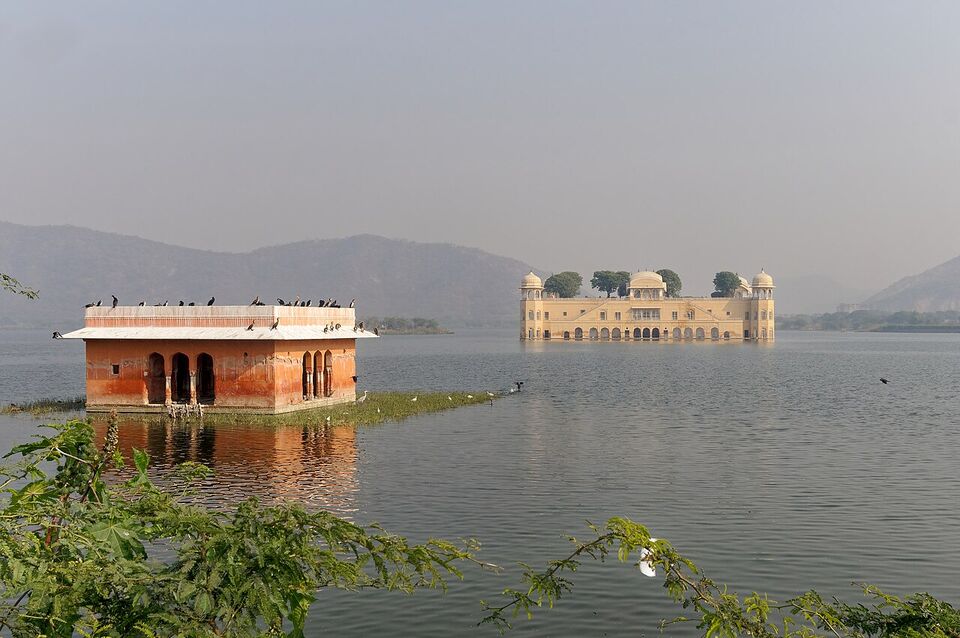
Jal Mahal is a palace set in the middle of Man Sagar Lake. Most visitors stop on the promenade for a photo and a short walk, and that takes 20 or 30 minutes. If you are on the way to or from Amber, it fits on the same road.
Save money
Do the arithmetic before buying a composite ticket. Amber, the Hawa Mahal and the Jantar Mantar at the reported 2026 prices add up to about ₹2,200 (about $23), well below the reported ₹5,500 (about $59) composite. The composite only pays off if you also visit many other state-run museums and sites. For a two- or three-day visit, individual tickets are likely cheaper.
Shopping: textiles, jewelry and the commission problem
Jaipur has been a craft center since its founding, and Wikipedia lists a long run of local trades: block printing, bandhani (tie-dye), stone carving, gems, kundan and meenakari jewelry, blue pottery, miniature painting and leather goods. It is also one of India's largest makers of hand-knotted rugs. You can shop well here, as long as you know how the system works.
Block-print textiles
Hand block printing stamps patterns onto cotton with carved wooden blocks. The villages of Sanganer and Bagru, near the city, are the best-known centers, and several workshops let you watch the process. For a fair price, ask to see the carved wooden blocks and look for small variations in the pattern. Perfectly repeated prints are usually machine- or screen-printed, which is fine, but should cost less.
Good buys include cotton scarves, tablecloths, bedspreads, kurtas (long tunics) and quilts. Washing instructions matter. Many hand-dyed pieces release some color in the first wash, so wash them separately.
Jewelry and gems
Jaipur is known for gemstone cutting and for silver, kundan (set stone) and enameled (meenakari) jewelry. Buy for what you like to wear, not as an investment. Ask for a written receipt that names the stone and the metal, and for a return policy in writing. Treat any pitch that you can resell stones or carpets abroad at a profit as a scam, however friendly the seller.
Commission shops
The most common problem in Jaipur is not theft but steering. Some drivers, guides and hotel contacts are paid a commission by shops for bringing in customers, and that commission is added to your price. A visit can start with a "free" demonstration and end with high-pressure selling.
- Tell your driver at the start of the day that you do not want to stop at shops.
- If you do want to shop, name the market or the shop yourself, and arrange it ahead.
- Compare prices at two or three shops before you buy anything expensive.
- Do not accept a ride, a tea or a gift if you are not ready to listen to a sales pitch.
- Pay by card in shops where you can, and keep the receipt.
For customs rules on bringing items home (including ivory, antiques and spices), read our shopping and bringing things home guide. For common tourist traps, see scams.
Watch out
Antiques and anything made from ivory or other animal products can be illegal to export from India or to import into the United States. CBP says ivory needs a US Fish and Wildlife permit. If a seller says it is fine, ask for the paperwork, and if there is none, walk away.
What to eat
Rajasthani food is mostly vegetarian, hearty and designed for a dry climate. The signature dish is dal baati churma: baked wheat balls (baati) broken open and soaked in ghee, served with spiced lentils (dal) and a sweet crumbled wheat mixture (churma). It is filling, so share a portion at lunch rather than ordering one each.
Other dishes to look for are gatte ki sabzi (gram-flour dumplings in a yogurt curry), ker sangri (a dry desert bean and berry dish), missi roti (a spiced flatbread) and bajre ki roti (millet flatbread). Laal maas is a fiery red-chili mutton curry for meat eaters. Sweets include ghewar (a honeycomb-shaped disc soaked in syrup) and mawa kachori (a sweet stuffed pastry).
A glass of lassi (a thick yogurt drink, sweet or salted) is a good hot-afternoon stop. Choose busy places where the food is cooked in front of you, and drink only sealed bottled or properly filtered water. For general food and water advice, see the food guide and the health guide.
Where to stay: haveli or modern hotel
You will choose between two types of place. A haveli is a restored merchant's or noble's mansion with courtyards, painted walls and a family feel. A modern hotel offers predictable air-conditioning, larger bathrooms, and often a pool. Both are good, and which is better depends on what you want from the stay.
- Havelis and heritage guesthouses are often in or near the old city. They suit travelers who want atmosphere and are fine with narrow lanes, stairs and some street noise. Rooms in smaller ones vary a lot, so check recent photos and ask about air-conditioning and hot water. Most fall in the $ to $$ range.
- Modern hotels in newer districts such as C-Scheme are quieter and easier by car, and good for families and long stays. They fall in the $$ range and up.
- Palace hotels set in former royal residences are the most expensive, usually $$$. They are worth it if the palace is the point of your trip, but you do not need one to enjoy Jaipur.
In January, the Jaipur Literature Festival is reported for January 14-18, 2027 (headline only; check the organizer), and hotels fill early. For a general view of lodging in India, see where to stay.
Getting there and getting around
From Delhi and Agra
Jaipur is about 167 miles (268 km) southwest of New Delhi. By road, each leg of the Golden Triangle is about 4 to 6 hours of driving. Fast trains also connect Delhi and Jaipur (the Ajmer Shatabdi Express is one; fast Vande Bharat services also run on Indian Railways, but check the exact route and timetable). Book on IRCTC well before a busy date. For rules and quotas, see the trains guide.
The Jaipur airport is at Sanganer, about 8 miles (13 km) from the center. It is one of the airports on the e-Visa entry list. Check airline sites for flights, because schedules change.
Around town
Use a ride app for short trips, which gives you a fixed price before you ride, or ask your hotel to book a car. For a day of sightseeing, hire a car with a driver, and agree the price, the hours and the stops in advance (we have no confirmed rates, so ask two or three providers). Auto-rickshaws are cheap for short hops, but agree the fare before you start or insist on the meter.
Jaipur also has a metro; its Pink Line runs from Mansarovar to Badi Chaupar, near the old city. It is useful for the old city, but it does not reach Amber. Confirm the current stations and hours, since the line has been extended in stages. For more on cities' transport, see getting around India.
Heat, seasons and practical tips
Jaipur has a hot semi-arid climate. These are average daily highs and lows (IMD figures):
| Month | High | Low |
|---|---|---|
| November | 85°F (29.6°C) | 58°F (14.4°C) |
| December | 77°F (25.1°C) | 50°F (9.9°C) |
| January | 72°F (22.5°C) | 47°F (8.4°C) |
| May | 106°F (41.1°C) | 81°F (27.1°C) |
The record high is 120°F (49°C), also in May. If you come between April and June, schedule sightseeing for early morning, rest from noon to 4 p.m., and drink sealed bottled water often. The monsoon is mainly July and August, with about 9 or 10 rain days in each month. For more on seasons, see when to go.
Insider tip
Winter mornings and evenings are cool, but strong sun makes midday feel warmer than the numbers suggest. Wear layers you can shed, and carry a light scarf for dusty roads and for visiting temples (see etiquette).
Common mistakes and scams
- Trying to see everything in one day. Amber alone takes a morning. Give the city at least two days.
- Taking the elephant ride. A jeep or a walk gets you to the same gate.
- Buying the composite ticket without doing the sums. It is expensive for a short stay.
- Going where the driver wants to go. Agree the day's route at the start and refuse shop stops.
- Believing that your hotel or a monument is "closed today". A stranger who says so is often steering you to a shop or a different hotel. Confirm with your hotel or the ticket office.
- Paying for photographs. Snake charmers, costumed performers and "guides" at Amber sometimes ask for money after you take a photo. Decide first, or decline politely.
- Summer sightseeing at midday. Heat illness is a real risk from April to June.
If you are traveling alone, the women travelers guide has calm, practical advice on transport and dress. In an emergency, call 112 (India's national emergency number). The US Embassy New Delhi can be reached at +91-11-2419-8000, and the State Department lists India at Level 2, Exercise Increased Caution, as of November 2026; check travel.state.gov for the latest.
Add it to a route in the trip builder, or ask us to plan the hotels, trains and guides for you.