Overview
Rajasthan beyond Jaipur is where the state's landscape changes. Udaipur is a city of lakes and marble palaces in the south, Jodhpur is a walled "blue city" under a huge fort, and Jaisalmer is a golden sandstone fortress at the edge of the Thar Desert. Each takes two or three nights, and the gaps between them are long, so plan the order before you book.
A week is a comfortable minimum for all three, and ten days is better if you include Jaipur at the start. You will spend a lot of time in cars and trains, so build in slack. The most common mistake is trying to cover every city in five or six days, which turns the trip into a series of transfers.
This guide covers the route, how to get between the cities, what each one is known for, the desert camp question, where to stay, what to eat, and the heat and cold. If you are building a longer trip, the Golden Triangle guide shows how Delhi, Agra and Jaipur lead into Rajasthan, and the trip planning guide helps you fit it into your wider route.
Different from home
The e-Visa works only if you enter India through one of its listed airports or seaports. Udaipur and Jodhpur are not on the official list, and Jaisalmer does not appear on it either. Fly into Delhi, Mumbai, Jaipur, Ahmedabad or another listed airport first, then travel on. Read the entry guide for the visa steps, and apply only on the official portal, indianvisaonline.gov.in, not on look-alike agent sites that charge extra.
The three cities at a glance
Udaipur
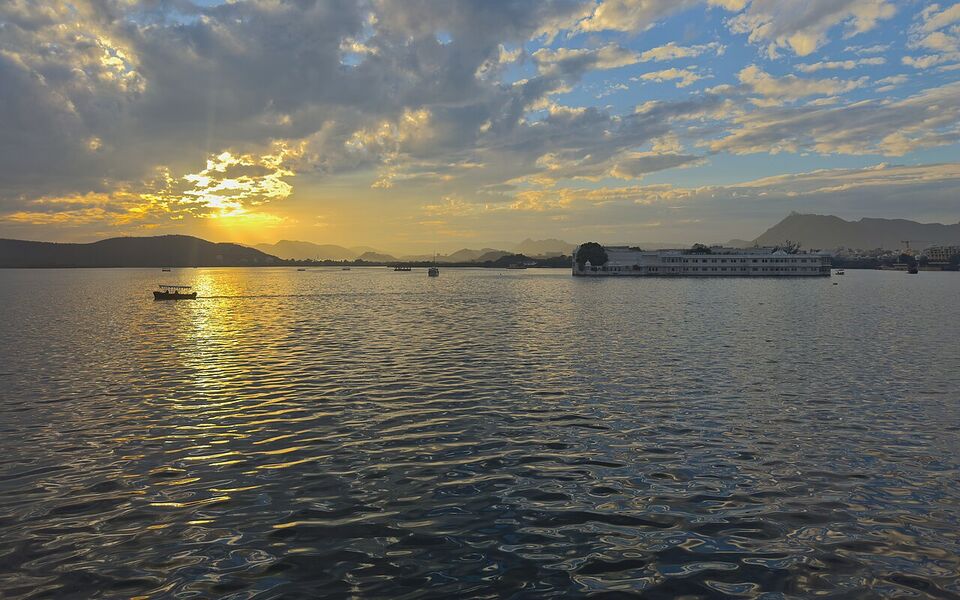
A city of seven lakes, founded in 1559 by Maharana Udai Singh II after Chittorgarh fell under siege. The City Palace rises over Lake Pichola, and the old town's lanes lead down to the water. It is the easiest of the three to relax in.
Jodhpur
Rao Jodha founded Jodhpur in 1459. Mehrangarh Fort stands on a rock about 400 feet (122 m) above the plain, and the old town's cube-shaped houses, many painted blue, spread out below it.
Jaisalmer
Founded in 1156 by Rawal Jaisal, Jaisalmer is a living fort of yellow sandstone, and about a quarter of Jaisalmer's population still lives inside its walls. It is the gateway to the dunes of the Thar Desert.
Udaipur: lakes, palaces and slow evenings
Udaipur's main sight is the City Palace complex, which was built over about 400 years by 22 generations of the Mewar dynasty. It faces Lake Pichola along a facade about 800 feet (244 m) long, and its balconies, courtyards and mirror-work rooms are best seen with a guide or a good audio explanation. Ticket and hour details were not available to us, so check the palace's own website before you go.
The rest of the city is for walking and for water. Lake Pichola, with the island palaces of Jag Mandir and the hotel palace beyond, is best seen from a boat in the late afternoon. The Jagdish Temple sits in the old town, and the Fateh Sagar lake to the north is a quieter evening walk. The hilltop Monsoon Palace (Sajjangarh) gives a wide view at sunset. Udaipur has been recognized under the Ramsar Convention's Wetland City scheme, which says something about how central the lakes are.
Give Udaipur two full days and three nights. It is about 250 miles (403 km) from Jaipur and about 155 miles (250 km) northeast of Ahmedabad. If you are short of time, spend your extra day here, because it is the place on this route that rewards slowing down.
Insider tip
Rooftop restaurants with a lake view are common in the old town, and they are most pleasant just before sunset. Reserve a table a day ahead in December and January, and ask for a window or rail seat when you book.
Jodhpur: the blue city and Mehrangarh
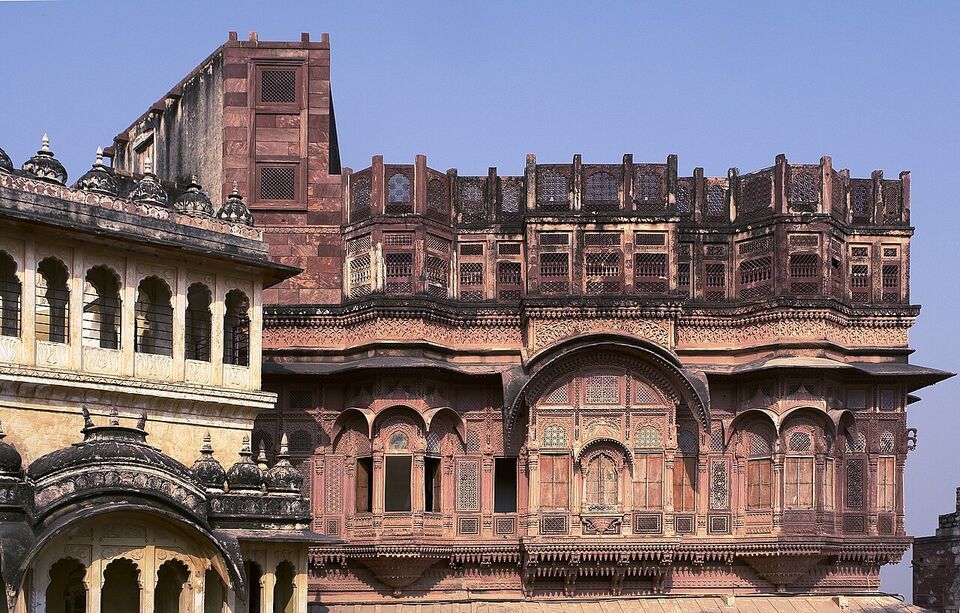
Mehrangarh Fort is the reason to come. It was begun in 1459, though most of what you see dates from the 17th century. The walls are up to 118 feet (36 m) high, seven gates lead in, and the Jai Pol, the "victory gate," was built in 1806. The fort is run by the Mehrangarh Museum Trust, and its galleries hold palanquins, elephant howdahs, arms, paintings and turbans, set in decorated palaces such as the Moti Mahal and the Phool Mahal.
We could not confirm the current ticket price, the audio guide arrangement or the hours. Ask whether an audio guide is offered or included, and check the museum's own site. Plan at least three hours inside. Some visitors add the Rao Jodha Desert Rock Park, which is a restored area of native desert plants next to the fort.
The old city below is the other half of Jodhpur. It is bounded by an old wall with several gates, and many houses are painted in shades of blue; you will see why from the fort's ramparts. Walk down through the lanes in the early morning, then visit the clock tower and the market around it. The white marble Jaswant Thada memorial is a short stop on the way. Two nights is enough.
Jaisalmer: the fort and the desert
Jaisalmer Fort stands on a ridge about 250 feet (76 m) above the town. It was built from 1156, and it is one of the few "living forts" in the world: houses, shops, guesthouses and Jain temples occupy the narrow lanes inside. UNESCO lists it as part of the Hill Forts of Rajasthan (2013). The pale yellow walls turn gold at sunset.
Part of the fort's charm is that people live in it, and part of its problem. Water seepage, poor drainage and heavy use have damaged the foundations over the years, and some of the outer walls have collapsed. If you stay inside the walls, use water sparingly. Many visitors prefer to stay outside and walk in for the day.
Outside the fort, the town has carved sandstone havelis (mansions) such as Nathmal's Haveli and Patwa Haveli, the Gadisar Lake with its steps and shrines, and the Bada Bagh cenotaphs, which are a favorite place to watch the sun set. Kuldhara, an abandoned village a short drive away, can be added to a half-day outing. Fort and haveli ticket systems vary: as we understand it the fort lanes are walkable without a general entry fee, while individual palaces, museums and havelis charge their own. We could not confirm the details, so ask on arrival.
The Jaisalmer Desert Festival is held in February (Wikipedia); confirm dates with Rajasthan tourism, and book early if you plan to attend.
How many days, and in what order
The cities lie on a rough line from northeast to southwest: Jaipur, then Udaipur to the south, then Jodhpur to the northwest, then Jaisalmer deep in the desert, about 357 miles (575 km) west of Jaipur. Here are two ways to do it.
- Route A: 10 days
Jaipur, Udaipur, Jodhpur, Jaisalmer
Start in Jaipur (2 nights), drive or take a train to Udaipur (3 nights), go on to Jodhpur (2 nights), then Jaisalmer (2 nights, one in a desert camp if you want it). Leave from Jaisalmer by flight, or by night train back toward Jodhpur, Jaipur and Delhi. This avoids backtracking, and it puts the most remote city last, when your travel legs are behind you.
- Route B: 6 or 7 days
Jaipur, Jodhpur, Jaisalmer
If you are short of time, skip Udaipur. Go Jaipur, Jodhpur, Jaisalmer, and fly out of Jaisalmer or Jodhpur. This is faster and keeps the forts and the desert, but it drops the lakes.
- Route C: reverse
Fly in at Udaipur, finish at Jaipur
If you are flying in from Delhi or Mumbai, start in Udaipur, go to Jodhpur and Jaisalmer, then return to Jaipur by train or road and finish with Agra and Delhi. This suits travelers who want to end in the Golden Triangle.
Linking the cities
Distances below are rounded. The Jaipur-Udaipur and Jaipur-Jaisalmer distances come from the cities' reference pages; the other two are our own approximations, so check them on a map app. Road times vary a lot with traffic and roadworks.
| Leg | Distance | By car with driver | By train | By air |
|---|---|---|---|---|
| Jaipur to Udaipur | about 250 miles (403 km) | Most of a day; plan for a long drive | Check IRCTC for direct and overnight options | Check airline sites |
| Udaipur to Jodhpur | about 155 miles (250 km), approximate | A long half day | Fewer direct trains; check IRCTC | Check airline sites; a connection may be needed |
| Jodhpur to Jaisalmer | about 175 miles (285 km), approximate | A long half day through desert scrub | Daily trains reach Jaisalmer; check IRCTC for the schedule | Reference pages list flights from Jaisalmer to Jodhpur, Jaipur and Delhi; confirm |
| Jaipur to Jaisalmer | about 357 miles (575 km) | Too long for one day by car | Daily trains link the two; an overnight train saves a hotel night | Check airline sites |
By road
A car with a driver is the usual choice for the Udaipur-Jodhpur-Jaisalmer stretch, because direct trains between some of these cities are less frequent. Agree the full price, the number of days, who pays the driver's meals and lodging, and the stops before you start. We have no confirmed rates, so ask two or three providers. India drives on the left, and long-distance roads include trucks, cattle and stray dogs; avoid driving after dark.
By train
Trains are a good fit for the longer overnight legs. Reserved tickets can generally be booked 60 days ahead, and Tatkal (last-minute) tickets open one day before departure at higher fares. Foreign visitors may be able to book further ahead; check IRCTC and book early on busy routes in December and January. Our trains guide covers classes, booking steps and the foreign tourist quota.
By air
Udaipur has Maharana Pratap Airport, and Jaisalmer's airport is about 11 miles (17 km) southeast of town. Reference pages list flights from Jaisalmer to Delhi, Mumbai, Jaipur and Jodhpur, but schedules change and some routes run seasonally, so check airline sites for your dates. See the flights guide for how domestic flying works.
The desert camp question
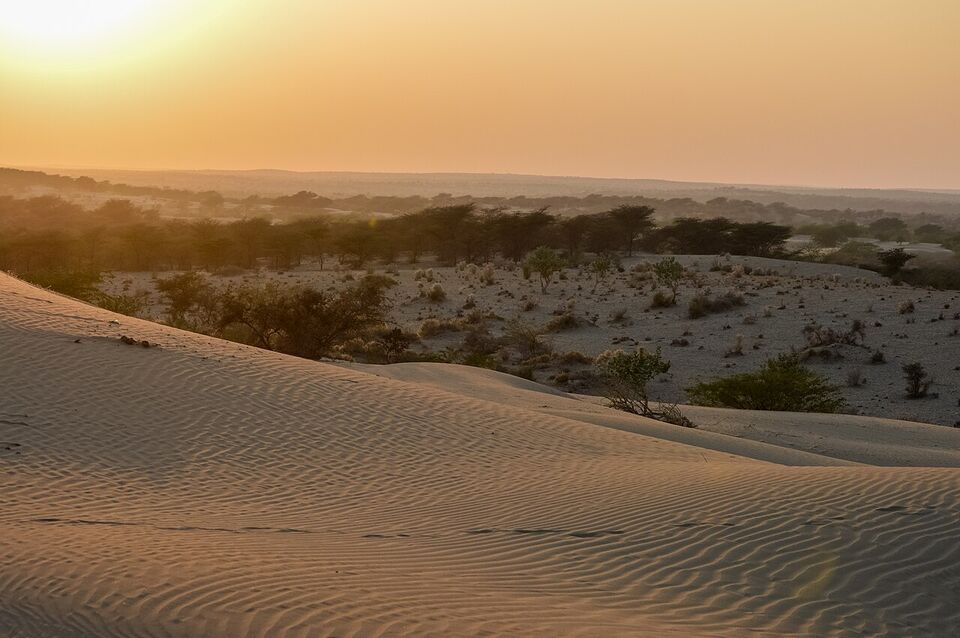
A night in the desert is the most common add-on in Jaisalmer, and the most uneven. Most "camps" are clusters of tents with a dining area and a stage, built within reach of the dunes, and they range from basic to well run. A night can be a good experience, but the most visited dunes can feel crowded at sunset, and some evenings are scripted: a show of folk music and dance, a buffet and an early bedtime.
The best-known dunes are at Sam, roughly an hour's drive from Jaisalmer, and Khuri is a quieter alternative. Both have large clusters of camps. Dune driving by jeep is noisy and can spoil the stillness that people come for.
How to choose
- Ask what is included: transfers, dinner, breakfast, the show and the camel ride.
- Ask about the bathroom. Some tents have attached bathrooms, and others share a block.
- Ask how many tents the camp has and how far it is from the main dune and the road.
- Get the price and inclusions in writing, and book through your hotel or the camp directly, not through a roadside tout.
- In December and January, ask about heating and blankets. Nights can be cold, and tents are not insulated.
A camel ride that is not rushed
A standard camel ride is 30 to 60 minutes around sunset, and it can turn into a rushed circuit with many riders in a line. Ask for a slower ride, or for a smaller group. A longer camel safari, with a night out, is another option and gives you the desert without the tourist crowd, but it is more expensive and less comfortable. Whatever you choose, the camel kneels to let you on and rises back legs first, which tilts you forward, then front legs, which tilts you back. Hold on to the saddle handle and lean back first, then forward.
Check the animals too. They should look fed and rested, the saddle should be padded, and the handler should not be hitting them. If anything looks wrong, choose another operator.
Watch out
The area near the Pakistan border is sensitive. Parts of Rajasthan need a Protected Area Permit for foreigners, and the State Department lists the India-Pakistan border area as Do Not Travel. The dunes at Sam and Khuri and Jaisalmer itself are on the usual tourist circuit. Places closer to the border, such as the Tanot Mata temple near the line, may need special permission or be closed to foreigners. Ask your hotel and a licensed operator, carry your passport everywhere, and check travel.state.gov before you go.
Where to stay: forts, havelis and lakeside
These three cities have the best heritage lodging in India, and the choice is part of the trip. Havelis (restored mansions), small family-run guesthouses and a few fort hotels sit in the old towns, and larger palace hotels sit on the edges. We do not name hotels here because we cannot confirm which are open and on what terms.
- Udaipur: the old town, by the lake, has many small guesthouses and restored havelis in the $ to $$ range. Lake views cost more, and a rooftop restaurant gives you the same view for the price of dinner. Palace hotels on the lake are $$$.
- Jodhpur: choose between the blue-city lanes, with small homestays and haveli hotels in the $ to $$ range, and a modern hotel in the newer city for easier access by car. The lanes are narrow, so check how you will get your bags to the door.
- Jaisalmer: inside the fort, rooms are small, atmospheric and mostly $ to $$. Outside, havelis and larger hotels offer more space and, usually, better water supply. Think about the fort's water problem when you choose.
Book fort and haveli rooms two to three months ahead for December and January, and ask your hotel about heating. Many heritage buildings were built for heat, not cold. For general lodging advice, see where to stay.
Food
Rajasthani food is largely vegetarian and built for a dry climate. In Udaipur and Jodhpur, look for dal baati churma, gatte ki sabzi (gram-flour dumplings in a yogurt gravy) and ker sangri (a dry desert bean and berry dish), plus laal maas, a fiery red-chili mutton dish, for meat eaters. Jodhpur is known for snacks such as mirchi vada (a stuffed, fried green chili) and pyaaz kachori (an onion-filled fried pastry) and for rich, creamy lassi (a yogurt drink).
Many fort and haveli restaurants serve a thali (a platter of small dishes) at set times. Eat where the food is busy and freshly cooked, drink sealed bottled or filtered water, and be careful with ice and raw salads. Our food guide and health guide have more detail. Vegetarian-only and meat-free restaurants are common, and mixed menus may say so at the top.
Heat, cold, sunrise and sunset
Winter in Rajasthan is dry and sunny, but not warm after dark. These are average daily highs and lows from IMD figures:
| City | January high / low | May high | Record high |
|---|---|---|---|
| Udaipur | 76°F (24.5°C) / 46°F (7.6°C) | 104°F (40.2°C) | 115°F (46.4°C) |
| Jodhpur | 76°F (24.5°C) / 49°F (9.6°C) | 106°F (41.2°C) | 120°F (48.8°C) |
| Jaisalmer | 74°F (23.4°C) / 49°F (9.3°C) | 108°F (42.1°C) | 121°F (49.2°C) |
Jaisalmer's record low is 21°F (-5.9°C), in January. Pack layers for evenings, and a warm jacket if you plan to sleep in a desert tent. Between April and June, midday heat is dangerous, so go out early, rest in the afternoon and drink plenty of sealed bottled water. The monsoon is June to September, though the desert gets little rain: Jaisalmer averages about 10 inches (256 mm) a year. See when to go and December in India for more.
Good places for light
- Udaipur: sunset from the lakeside steps or a rooftop, or from the Monsoon Palace hill; morning light on the City Palace facade from across the water.
- Jodhpur: sunrise from the ramparts of Mehrangarh, when the old town below is still in shadow; evening from a rooftop in the blue lanes.
- Jaisalmer: sunset at Bada Bagh or from the fort walls; early morning at Gadisar Lake, before the crowds.
Shopping
Each city has its own crafts. Udaipur is known for miniature paintings and silver; Jodhpur for handicrafts, spices and furniture; Jaisalmer for mirror-work embroidery, patchwork and block-printed cloth. Bandhani, a tie-dye technique, appears throughout the state. Compare prices before buying, set a budget, and avoid shops your driver insists on. For what you can bring home, including limits on ivory and antiques, see shopping and bringing things home.
Common mistakes
- Too many cities in too few days. A seven-day trip works for two or three of these cities, not four.
- Booking a flight into Udaipur or Jodhpur from abroad on an e-Visa. Neither is on the entry list.
- Underestimating the drives. Plan a full day for each long leg.
- Booking a desert camp from a street tout. Arrange it through your hotel or directly and get the details in writing.
- Visiting in summer. April to June is very hot, and the sun reflects off sandstone.
- Not packing for cold nights. December and January evenings and desert tents are chilly.
- Skipping the passport. Carry it, or a copy, when you travel near the border.
For safety and scams, see safety. The US Embassy New Delhi can be reached at +91-11-2419-8000, and 112 is India's emergency number. The State Department lists India at Level 2, Exercise Increased Caution, as of November 2026.
Add it to a route in the trip builder, or ask us to plan the hotels, trains and guides for you.