Overview
India runs on a mix of cash, cards and a phone-payment system that most foreign visitors cannot use. For an American the practical plan is simple: pay with a card that charges no foreign-transaction fee where cards are taken, take rupees from an ATM for everything else, and keep a stack of small notes for autos, tips and street food. The currency is the Indian rupee (₹), and we price everything on this site at US$1 = ₹94, so ₹1,000 is about $11.
The rest of this page covers what an American needs before and during a trip: how Indian prices are written, how to find the day's rate, ATMs, cards, why UPI is mostly closed to you, where to exchange cash, tipping, taxes, the two-tier ticket prices at monuments, and the money mistakes that cost travelers the most. For the visa and entry side of a trip, see e-Visa and entry guide; for a full budget, see budget page.
Different from home
In the US you can pay almost anywhere with a card or a phone tap. In India that is true in hotels, malls, airports and many city restaurants, but not at most rickshaws, tea stalls, small shops, temples or local ticket windows. Carry cash every day, even in big cities.
The rupee and how prices are written
The rupee is divided into 100 paise, but paise are almost never used in daily life. Coins come in small values, and notes are the main money you will handle. The symbol is ₹, and on older signs, menus and bus tickets you may see letters instead of the symbol. They all mean rupees. On this site we always write the amount first in rupees and then the dollar equivalent, as in ₹500 (about $5).
Lakh and crore explained
Indian English counts large numbers in a way Americans have not met. A lakh is 100,000. A crore is 10 million (one hundred lakh). You will see both in newspapers, real estate ads, hotel and car prices, and in news about the economy.
The commas are also placed differently. After the first group of three digits from the right, Indian style groups digits in twos. So "₹1,00,000" is a lakh, which is ₹100,000 (about $1,060), and "₹1,00,00,000" is a crore, which is ₹10,000,000 (about $106,000). If you see a price with commas in odd places, count the digits instead of trusting the commas. Elsewhere on this site we write full numbers with American commas, and we quote the Indian style only when we are repeating a source.
The rate and how to find today's rate
Our site rate is US$1 = ₹94. The Reserve Bank of India (RBI) publishes a daily reference rate on the home page of rbi.org.in. On November 13, 2026 it showed ₹94.1997 per US$1, so our figure is within about 0.2% of the official number. Rates move every day, and the rate you actually get is always a little worse than the reference rate once a bank, an exchange counter or your card network takes a margin.
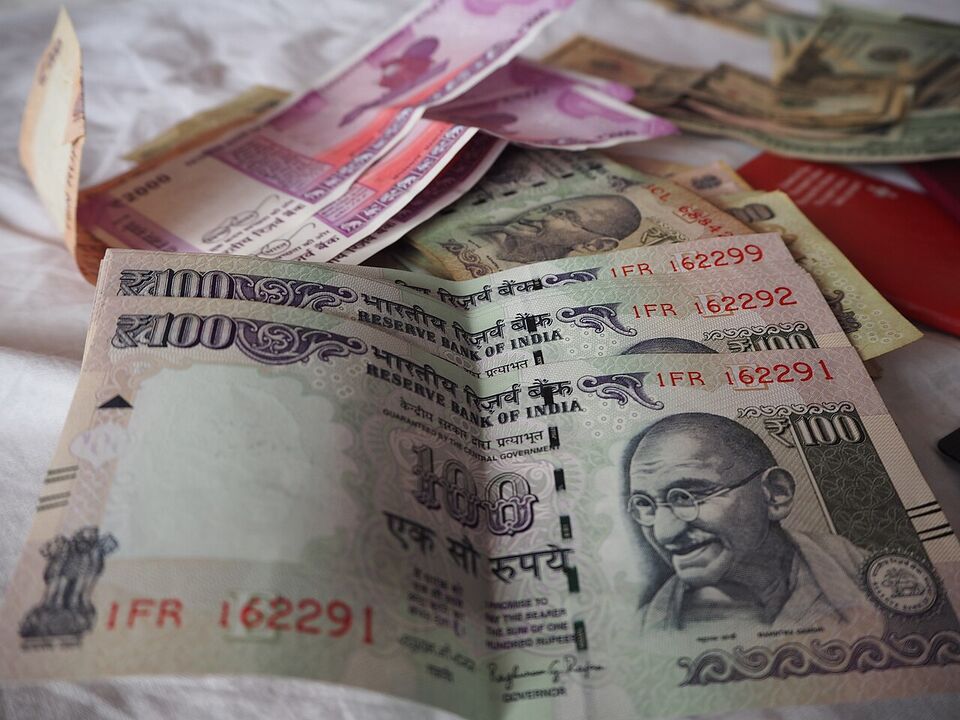
For a quick mental conversion, divide rupees by 94 for dollars, or think of a 100-rupee note as a little over a dollar. A 470-rupee price is about $5. Your phone's currency converter or the converters page page gives the same answer to the cent. For the exact rate charged on a card purchase, check your card app: it shows the posted amount in dollars a day or two later.
Insider tip
Rates change, and we round for readability. Before you convert a big cash amount, look up the day's reference rate on the RBI site or in your bank app and compare it with the rate on the counter board.
ATMs and withdrawal limits
ATMs are the easiest way for most Americans to get rupees. They are common in cities, airports, malls and railway stations, and rarer in small towns, hill villages and national-park areas. Most ATMs take international Visa and Mastercard debit cards that use a four-digit PIN. If your PIN is longer than four digits, ask your bank before you leave.
We could not confirm current per-withdrawal limits or fee amounts for Indian ATMs from an official source, so we give none. Two layers of fees exist: the Indian bank may charge a flat fee for a foreign-card withdrawal, and your own bank may add a foreign-transaction fee and an out-of-network fee. The machine screen usually shows the Indian fee before you confirm. Withdrawal limits vary by machine and by your own card's daily limit, so call your bank before you leave to raise it and to tell it you are traveling.
- Use ATMs inside bank branches, airports and big hotels when you can, and use them in daylight.
- Take out larger amounts less often, if the fee is a flat charge per withdrawal, and split the cash between bags.
- If a machine is out of cash or declines your card, try another one before you assume the card is blocked.
- Ask your bank which Indian ATM networks it reimburses fees for, if any.
Watch out
At some ATMs the screen offers to convert the withdrawal into dollars before it dispenses cash. Decline it and choose to be charged in rupees. The exchange rate on those offers is set by the ATM operator and is almost always worse than your own bank's rate. See the mistakes section below.
Cards versus cash
Credit cards from Visa and Mastercard are widely accepted in mid-range and upscale hotels, airline and rail booking sites, chain stores, malls, and restaurants in big cities. American Express is accepted less widely. Cards often do not work at autos and taxis (unless booked in an app), street stalls, small guesthouses, many temples, local bus and ticket counters, and anywhere the power or the network is unreliable.
A card with no foreign-transaction fee will typically save you about 3% on every purchase compared with an ordinary card, so check the terms before you go. Tell your bank you will be in India, and carry at least two different cards on different networks, in different places, in case one is blocked or lost. Many Indian merchants will ask for a PIN or a one-time passcode sent by text. If the passcode goes to a US phone number that does not work in India, the payment can fail, so check that your bank can reach you abroad or can give you another way to approve payments.
Where cash is needed
- Autos, tuk-tuks and cycle rickshaws, and most street food, tea stalls and small shops.
- Tips for drivers, guides, hotel staff and porters.
- Some temple and local monument ticket windows, and donations.
- Small guesthouses and homestays in smaller towns, which may take cash or bank transfer only.
- Bus tickets and trips in towns where the card machines are slow.
Hotels and large restaurants often accept cards, but a small surcharge can appear. Ask before you pay if the price matters. Indian bills also show taxes as separate lines, which we cover in the taxes section.
UPI and why most foreigners cannot use it
UPI (Unified Payments Interface) is the payment system that runs India's daily life. Almost every shop, tea stall and street vendor shows a printed QR code, and Indians pay by scanning it with a phone app. It is fast, free and trusted. Most UPI apps, however, need an Indian bank account and a phone number tied to it, which foreign visitors do not have. A US debit card cannot simply be added to a standard UPI app.
Special wallet-style apps for foreign visitors have been announced. NPCI, the body that runs UPI, announced a "UPI One World" wallet for international visitors in July 2024; a visitor would verify identity with a passport and a valid visa through an approved issuer at an airport, a hotel or a specified money-exchange site, and any unused balance could be returned to the original payment source. Other apps for tourists, such as Mony, have also been named. We could not confirm from an official source how widely any of them work now, which airports or hotels offer them, or what limits apply, so check the NPCI website (npci.org.in) and your airline or hotel before you count on them.
Our advice is to treat UPI as a bonus and not a plan. You can still benefit indirectly: a friend with a UPI app can pay a shop for you and you can repay them in cash, and many hotels, tour operators and guides will accept a card, a bank transfer or cash instead.
Exchanging cash
You do not need to buy rupees in the US before you go, and the rate at a US airport kiosk is usually poor. For most travelers it is cheapest to arrive with a small amount of rupees or none at all and take cash from an ATM at the airport. If you carry US dollars, exchange them only at banks, airport exchange counters and licensed money changers, and keep the receipt. Never exchange money on the street, from a friendly stranger, or through a tout who approaches you outside a train station.
New, undamaged notes in good condition get a better rate. Count the rupees at the counter before you walk away, ask for an itemized receipt, and compare the board rate with the day's reference rate (see above). Check before you fly how many rupees you may carry in or out; we have seen about ₹25,000 (about $266) given as the cash limit, but we could not confirm it from an official source, so check the current rule with Indian customs or your airline. For large amounts of foreign cash, declare them at customs. See e-Visa and entry guide for the entry basics.
Save money
Skip the first exchange booth you see at the arrivals hall. Withdraw a small amount from an ATM first, pay for the taxi or SIM with it, and compare other rates once you are in the city.
Small notes, change and counterfeits
Having small notes is a daily habit in India. Auto drivers, shopkeepers and tea sellers often say they have no change for your larger notes. Break large notes at hotels, petrol stations and supermarkets, and keep a mix of the lower denominations (the 10-, 20-, 50- and 100-rupee notes) for each day. Keep your small notes in a separate pocket from your large ones so you do not have to show your whole wallet.
Torn, taped or badly worn notes can be refused by shops, even if they are legal tender. Check each note when you receive it, especially at night or from an ATM, and politely return a damaged one for a clean note. Counterfeit notes are rare in the formal economy but do circulate. Notes from ATMs and banks are safe. Be most careful with change handed over in a hurry at night, in crowds or at transport hubs. The RBI publishes guidance on telling genuine notes apart, and a quick look at the watermark and the printed denomination is a good habit.
- Break a large note at the first big shop you use.
- Count change before you leave the counter.
- Refuse notes with tears, large stains or tape and ask for another.
- Keep a few of the smallest notes in a pocket for tips and small purchases.
Tipping norms
Modest tipping is common in India, and an American's habit of tipping is rarely a problem. A reasonable guide is about 10% in a sit-down restaurant when no service charge is already on the bill. A service charge that appears on a restaurant bill is voluntary: you may ask to have it removed if you did not receive service, and you can add a tip in cash instead. Check the bill before you pay.
For others, small amounts are appreciated. Give a driver, a guide, a hotel porter or a housekeeper a tip in rupees that matches the effort and the length of service. We give no fixed figure because it depends on the service and the city; ask your hotel or tour operator what is usual for your route, and make the amount feel fair, not showy. For auto and taxi drivers, rounding up the fare is enough. Tip in cash, in small notes, and hand it to the person directly.
Taxes, fixed prices and bargaining
India has a goods and services tax (GST) that is built into the price of most packaged goods and added as a separate line on many hotel and restaurant bills. The rate depends on the category and has changed in recent years, so we cannot give you a figure here. Read the bill, ask what each tax line is, and check the current rates with the tax authority (cbic.gov.in) if you are comparing hotel quotes. Hotel rates may be quoted with or without tax, so ask which one before you book.
Fixed-price shops, malls, restaurants, pharmacies and chain stores have a printed price (often called the MRP) and bargaining is not expected there. Bargaining is normal at street markets, bazaars, and with rickshaw drivers who do not use a meter. A good method is to know roughly what something should cost, start at about half of the first price in a market (it varies by item), stay friendly, and be willing to walk away. In a ride app the price is shown before the trip, so there is nothing to bargain.
Insider tip
Agree the price for an auto, a tour or a driver before you get in. If a driver says the meter is broken, ask the price first or use a ride app (see phones and apps guide). Avoid anyone who offers a "special" price and then asks for more at the end.
Two-tier prices at monuments
India charges foreign visitors a higher ticket price than residents at most major monuments, and sometimes a different price again for visitors from neighboring countries. The two-tier system is official. A written answer in the Lok Sabha (India's lower house of Parliament) on March 16, 2026 confirmed the practice and said there was no plan to change it, but gave no figures. The foreigner price is often many times the Indian price, and it is the one that applies to you as an American even if you live in India on a long-term visa.
The prices below are the ones we could confirm, mostly from the Taj Mahal's own site. They can change, so check the official page before you go, and note that the page we read carried no date.
| Item | Price in rupees | Notes |
|---|---|---|
| Taj Mahal, foreign visitor | ₹1,100 (about $12) | Includes ASI and ADA fees. Closed Fridays |
| Taj Mahal, main mausoleum (optional) | ₹200 (about $2) | Total with the main ticket: ₹1,300 (about $14) |
| Taj Mahal online discount | ₹50 (about $0.50) off | Per foreign ticket; children under 15 are free |
| Agra Fort | ₹650 (about $7) | ₹600 (about $6) on Friday or after visiting the Taj |
| Fatehpur Sikri | ₹610 (about $6) | ₹600 (about $6) on Friday or after visiting the Taj |
| Sikandra and Itimad-ud-Daulah, each | ₹310 (about $3) | ₹300 (about $3) on Friday or after the Taj |
| Mysore Palace, foreign visitor | ₹1,000 (about $11) | Indians pay ₹120 (about $1); figure as of December 2025 |
For Jaipur, local news reported higher foreigner fees from January 1, 2026 (about ₹1,000 (about $11) for Amber Fort and about ₹600 (about $6) each for Hawa Mahal and Jantar Mantar, with a composite ticket of about ₹5,500 (about $59) valid for 10 days), but we could not confirm these from an official page, so check before you go. We found no confirmed price for the Red Fort, Qutub Minar or Humayun's Tomb, so check the ASI website before you go. See Agra guide and Jaipur guide for the Taj and the Jaipur sights. Tickets for many monuments can be bought online through the ASI ticket page, which for the Taj includes a ₹50 (about $0.50) online discount and can save time at the window.
What things cost
We do not have a confirmed source for everyday prices such as a thali, a bottle of water, an auto ride or a meal, and we do not guess them. Instead, here is what we can confirm, with a pointer to where to check the rest. budget page turns these into a trip total with ranges you can adjust.
| Cost | Amount | Where we got it |
|---|---|---|
| Delhi Metro tourist card, 1 day | ₹200 (about $2) | Includes a refundable ₹50 (about $0.50) deposit |
| Delhi Metro tourist card, 3 days | ₹500 (about $5) | Includes the same refundable deposit |
| Delhi Airport Express fare | Well under ₹100 (about $1) | Check delhimetrorail.com for today's fare |
| Verizon TravelPass abroad | $12 a day | Charged only on days you use it; see phones and apps guide |
| 30-day e-Tourist visa, July to March | US$25 | Plus a card fee of about 3%; check the fee on the official page |
Hotels, trains, guides and drivers change with season and demand, and the festival weeks around Christmas and New Year are the most expensive. Ask for the price in writing before you book, and ask whether tax is included. For hotels we use tiers, not exact rates, on the other pages of this guide.
Money mistakes to avoid
Paying in dollars when asked
Dynamic currency conversion (DCC) is the offer to pay in dollars on a card terminal or ATM instead of rupees. It sounds convenient but it uses a worse exchange rate set by the merchant or the ATM operator, plus a fee. Always choose the local currency, rupees, on the card machine and at the ATM.
Skimmed cards
ATM and card-skimming devices exist anywhere in the world. Use ATMs in bank branches, hotels and malls, wiggle the card slot to check it is not loose, cover the keypad, and check your account for charges every day or two. Do not let a waiter take your card out of sight; ask for the card machine to be brought to the table. If you see an unknown charge, call your bank at once, and use the number on the back of your card from the US.
Torn notes and wrong change
Refuse notes that are torn, taped or soiled, and count your change. Small shops sometimes round up when they have no coins. This is routine, but count it so that you know what you paid.
Counterfeits and street exchange
Never change money with a stranger. If someone offers you a very good rate or a "private" exchange, walk away. Take cash only from ATMs, banks or licensed counters, and look at a note's watermark and security thread when you receive a large one.
Look-alike visa sites
This is a money mistake as much as an entry one. The only official application site for the e-Visa is the Indian government's portal at indianvisaonline.gov.in/evisa, and the government charges no emergency or express fee. Agent sites that look official and charge extra are not authorized. See e-Visa and entry guide and scams guide for more on common scams.
Before you go
- Call your bank and card issuers, tell them you are traveling to India, and raise your daily ATM limit.
- Check that your debit card PIN is four digits and that your cards have no foreign-transaction fee.
- Pack two cards on different networks and keep them in separate places.
- Check the day's rate at rbi.org.in and set your own rule of thumb (divide by 94).
- Check the cash limit rule for carrying rupees and foreign currency with Indian customs before you fly.
- Plan to take some cash from an ATM at the airport or in the first city, and break large notes early.
- Ask your bank how to receive one-time passcodes while you are abroad.
- Check ticket prices for the monuments on your route on the official ASI or monument pages.
For help with your daily plan, the next pages to read are phones and apps guide for phones and apps, flights guide for the trip itself, and getting around guide for rickshaws and drivers.
Add it to a route in the trip builder, or ask us to plan the hotels, trains and guides for you.