Overview
India is a large and varied country, and most American visitors complete a trip without anything worse than an upset stomach and a few sales pitches. It is also a country where the US government asks travelers to take extra care. As of November 2026 the US Embassy's India page shows Level 2: Exercise Increased Caution, "due to crime and terrorism," with the note that some areas carry increased risk. This page explains what that means, where the real risks sit, and what to do about each one.
The calm, factual answer is that three things deserve most of your attention: traffic, health and the handful of regions the advisory tells Americans not to enter. Petty theft, scams and harassment are real, but they are mostly avoidable with habits you already use at home. Violent crime against visitors is not the usual experience, but the advisory warns that it happens, including at tourist sites, and so we say it plainly.
This page is a safety overview. It links to our guides on scams, women travelers, health and getting around, where each topic gets more space.
The State Department advisory, explained
The US State Department rates every country from Level 1 (Exercise Normal Precautions) to Level 4 (Do Not Travel). India is at Level 2, a level shared by many popular destinations. As shown on the US Embassy home page in November 2026, the reasons given are crime and terrorism. We could not read the full advisory text on travel.state.gov from our server, so we cannot tell you its issue date. Check the live page at travel.state.gov before you book and again before you fly, since advisories change.
The advisory text, as we understand it, makes four points that matter for ordinary travelers:
- Terrorists may attack with little or no warning. Possible targets include tourist sites, transport hubs, markets and shopping malls, and government facilities.
- Violent crime, including sexual assault, occurs, and it has occurred at tourist sites.
- The US government's ability to provide emergency help is limited in rural areas, and in areas where Americans are barred from going.
- Some regions are under a Do Not Travel notice, listed below.
A Level 2 rating does not mean "stay away." It means: know the risks, register with the embassy's program, keep your plans flexible and follow local news. Most of the popular routes in our guide, including the Golden Triangle, Kerala, Goa and Varanasi, are outside the Do Not Travel areas.
Areas listed as Do Not Travel
The advisory, as we have it, tells Americans not to travel to the following. We give them without comment on any dispute and in the advisory's own terms. Check travel.state.gov for the exact current wording.
| Area | What the advisory says | What this means for a trip |
|---|---|---|
| Jammu and Kashmir | Do Not Travel, except the eastern Ladakh region and its capital, Leh | Plan Ladakh around Leh and fly in; do not combine it with an overland route through the Kashmir region |
| India-Pakistan border | Do Not Travel to the border area, per the advisory | Day trips to the border ceremony from Amritsar are common; see the border section below |
| Parts of Central and East India | Do Not Travel to areas with Maoist (Naxalite) activity, in eastern Maharashtra, northern Telangana, western West Bengal and parts of Chhattisgarh, Jharkhand and Odisha | Most tourist routes avoid these districts; use a licensed operator if you head into Odisha or Jharkhand interiors |
| Manipur | Do Not Travel because of violence, crime and ethnic civil conflict | Leave Manipur out of any northeast itinerary |
If a trip takes you near any of these areas, read the live advisory first and tell your insurer where you are going. Some insurance policies exclude areas under a Do Not Travel notice.
Crime that affects travelers
Pickpocketing and bag snatching
Crowded places draw pickpockets in India as anywhere: trains and station platforms, Metro carriages at rush hour, markets, festival crowds and the lines for popular monuments. Carry only what you need for the day. Use a zipped cross-body bag worn in front, keep a copy of your passport rather than the original, and put your phone away when walking along a road where scooters pass. Snatching from a moving two-wheeler is a known risk on city roads, so carry your bag on the side away from traffic.
Scams
Scams are the most common trouble visitors meet, and they are usually about money rather than force. Our scams guide covers the taxi, shop, ticket, e-Visa and ATM stories in detail. The most useful single habit is to decide your plan before you step out of the station or airport, and not to change it because a stranger tells you your hotel is closed.
Drink spiking and food
Do not accept food or drink from a stranger you have just met, and keep your glass or bottle in sight. This applies in Goa's bars and in train compartments. Open drinks left unattended are the usual route. If you feel suddenly dizzy or drowsy, tell someone you trust, move to a public place and get medical help. We cover the "drugged food" story in the scams guide.
Assault and harassment
Sexual assault and harassment are risks the advisory names directly, and women travelers receive more unwanted attention than men. The practical advice is on our women travelers page. Men traveling alone should also use the same habits at night: choose well-lit streets, share your plans and use registered transport.
What to carry
- A photocopy or photo of your passport and visa, kept apart from the originals.
- A money belt or a hidden pouch for a card and spare cash.
- A second payment card, stored in a different place from the first.
- A small flashlight or phone light for unlit streets and power cuts.
- A list of emergency numbers on paper, in case your phone is lost.
Traffic and road safety: the biggest everyday risk
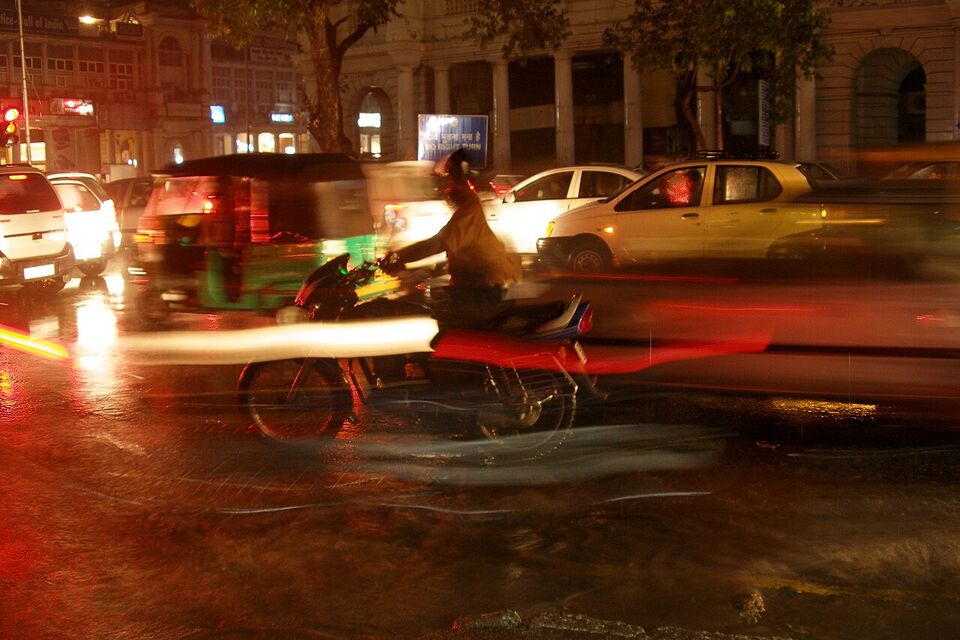
For most visitors, the road is the most likely source of serious harm, and it deserves more attention than crime. India drives on the left, which is the opposite of the US, and roads carry trucks, buses, motorbikes, auto-rickshaws, bicycles, cows and pedestrians in the same space. Lane discipline is looser than Americans expect, horns are used constantly to signal position and overtaking happens on both sides.
On foot
Look right first, then left: with traffic on the left, the nearest lane is the one that comes from your right, the opposite of home. Cross with locals when you can, move at a steady pace rather than darting, and do not assume cars will stop at a crossing. Pavements can be broken or occupied, so walk on the roadside only when you have to. Many accidents involve foreigners looking the wrong way.
In a car
The CDC's advice for India is to hire a licensed driver, avoid driving at night, wear a seatbelt and sit in the back seat. We agree. Driving yourself in India is not recommended for a first trip: if you do drive, the CDC says to carry an International Driving Permit with your US license, and check the rules before you rent. A car with a driver is often the safest and easiest choice, and the fare is often reasonable; agree the price first. Mountain roads, fog and monsoon rains all raise the risk. Do not accept a driver who looks tired, and ask your driver to slow down if you feel unsafe. Most drivers will do so.
On two wheels
Renting a scooter or motorbike is popular in Goa and other beach towns, and it is where many travelers are injured. If you ride, wear a proper helmet that fits, hold a valid license and insurance that covers motorbike use (many travel policies exclude it), and avoid riding at night. Even confident riders at home find Indian traffic hard.
Different from home
Road signs, right of way and lane lines do not work the way they do in the US. A horn in India is usually "I am here," not anger. The biggest adjustment is not the left-hand side but the expectation: be predictable, stay alert and let bigger vehicles go first.
Transport safety
Trains
Trains are the best way to cross the country and a normal way for families to travel. Use air-conditioned classes for long trips, keep your valuables close, lock your bag to the berth with a small cable lock and do not accept food from a stranger. Station platforms and the area outside big stations are where scams and snatching happen, so allow time and go straight to your platform. See our train guide for classes and booking.
Taxis, ride apps and auto-rickshaws
Ride-hailing apps give a record of the trip, a fixed price and a driver's name and plate, which is worth having. For auto-rickshaws and street taxis, agree the fare before you get in or insist on the meter, and use a prepaid counter at airports and large stations. At night, choose an app ride or a hotel-arranged car. Check that the plate on the car matches the app, and share the trip link with someone.
Buses and night travel
Long-distance overnight buses are popular, but road risk is higher at night, and drivers on long routes may be tired. Where there is a good train, take it. If you take a bus, choose a reputable operator that you booked in advance rather than a street offer.
Flights
Domestic flights are the practical choice for long distances. Winter fog in the north can delay flights, and our weather section below says when. Build a day of slack before an international departure.
Air quality
Air quality is a real health issue in the north. Delhi and the plains around it often have Very Poor to Severe air from late October through January, with readings of 300 to 450 or more on bad days. In early November 2026 the national air-quality commission invoked stage-based restrictions (Stage III of its graded response plan) across the National Capital Region, and similar steps are common in this season. The current stage changes, so check before you go.
- Check the live Air Quality Index (AQI) for your city each morning. A reading above 300 is Very Poor, and above 400 is Severe.
- Carry an N95 or equivalent mask and wear it on bad days, especially outdoors and in open cars and rickshaws.
- If you have asthma, heart disease or another lung or heart condition, or you travel with young children or older relatives, talk to your doctor before a winter trip to Delhi or the north. You may choose to visit in another month: see when to go and our November, December and January pages.
- Choose a hotel with air purifiers if the room is for several nights, and keep windows shut on bad days.
Natural hazards and weather
Monsoon floods and landslides
The southwest monsoon normally reaches the southwest coast at the start of June and covers the country by mid-July, then begins to withdraw in early September and normally finishes by the beginning of October. Heavy rain brings flooding in low-lying cities and landslides on hill roads, and it can shut roads, rail lines and airports. The northeast monsoon gives Tamil Nadu most of its rain from around October 20. In the hills, roads and passes can close with little notice. Check the operator's site and the India Meteorological Department (mausam.imd.gov.in) before a trip, and keep a spare day in your plan.
Heat
Pre-monsoon heat in April to June can be severe: in the plains, daily highs of 100°F (38°C) and above are normal, and in low-lying areas temperatures can exceed 122°F (50°C) in May. Plan sightseeing for morning and late afternoon, drink bottled or properly filtered water often, and rest in the middle of the day. Heat illness is a real risk for children and older travelers.
Fog and cold
Winter fog in north India can reduce visibility enough to disrupt air travel on about 15 to 20 days a year, and it can slow roads. Nights on the northern plains are cold: December and January lows in Delhi average about 45 to 47°F (7 to 8°C), with colder nights at times, and unheated budget rooms feel colder than you expect.
Altitude
Leh stands at about 11,562 ft (3,524 m). Altitude sickness is possible if you fly in and go straight to active sightseeing. Rest on the first day and drink water, and ask your doctor about preventive medicine before you go. Descend if symptoms worsen.
Wildlife
Monkeys at temples and monuments steal food and bags, so keep food out of sight and do not feed them. Stray dogs are common, and the CDC notes that rabid dogs are common in India. See the health section below.
Health, vaccines and food
We cover health in its own guide, but the safety points are these. Do not drink tap water: use sealed bottled water or properly filtered water, and be careful with ice and raw salads. The CDC recommends hepatitis A vaccination for unvaccinated travelers, hepatitis B for those under 60, and typhoid vaccination for most travelers. It advises measles (MMR) protection for all travelers. Malaria preventive medicine is recommended for certain areas and the CDC says transmission is reported across the country, including Mumbai and New Delhi, but not above 2,000 m (6,562 ft). Dengue and chikungunya are present, so avoid mosquito bites. Rabies is a risk after any dog or monkey bite: wash the wound with soap and water and seek care at once. The CDC also warns of counterfeit rabies vaccine reported in Delhi, so use a reputable hospital. See a doctor at least a month before you go.
Protests, communal tension and politics
Protests, strikes (called bandh or hartal) and religious or political tension happen in India, and they can close shops, roads and transport, sometimes at short notice. Most are peaceful and local. Keep away from demonstrations and crowds, do not photograph police or security forces, and follow local news and your hotel's advice. Festival days and big religious gatherings bring heavy crowds, and crowd crushes have occurred at large events; give a large gathering a wide berth and know your exit. Our festival guide lists the big dates.
Do not join political rallies or comment on political or religious disputes while you are there. It is better to listen and not to argue.
Borders and sensitive areas
The India-Pakistan border area is under a Do Not Travel notice, and the only official land crossing open to non-citizens is Attari-Wagah, near Amritsar. The daily flag-lowering ceremony there is a popular outing. It was paused on May 8, 2025, and resumed in a limited form on May 20, 2025, without the handshakes or sweets that used to be part of it. A report from May 1, 2026 said the ceremony had moved to about 6:00 to 6:30 p.m. for the summer. We cannot confirm the winter timing or whether any restrictions apply, so check the current time with the Border Security Force or Punjab tourism office, and arrive well ahead. See our Amritsar guide.
For Jammu and Kashmir, follow the advisory (see the table above). The e-Visa is also not valid for protected, restricted or cantonment areas without prior permission, and some areas such as parts of Ladakh, the northeast and the Andaman Islands need a permit for foreigners: see our entry guide, and check before you go.
Watch out
Do not enter a restricted area, photograph military sites or fly a drone near them. Photographing airports, bridges and army posts can bring questions from the police. If a guide offers a shortcut across a border zone, decline.
Emergency numbers and getting help
| Who | Number | Notes |
|---|---|---|
| National emergency number | 112 | Police, fire and ambulance. This is the number printed on official sites such as the Taj Mahal's |
| Women's helpline | 1091 (in many states) | Widely listed; 181 is also listed in some states. Check before you go |
| US Embassy New Delhi | +91-11-2419-8000 | Shantipath, Chanakyapuri; Monday to Friday, 8:30 a.m. to 5 p.m.; closed Saturday and Sunday |
| US Consulate Mumbai | +91-22-26724000 | C-49 G-Block, Bandra Kurla Complex |
| US Consulate Chennai | +91-44-2857-4000 | 220 Anna Salai |
| US Consulate Kolkata | +91-33-6827-2400 | 5/1 Ho Chi Minh Sarani |
| US Consulate Hyderabad | +91-40-6932-8000 | Financial District, Nanakramguda |
| US government, 24/7 | +1-202-501-4444 (from abroad); +1-888-407-4747 (US and Canada) | For Americans who need help abroad |
Save these numbers in your phone and write them on paper. Dial 112 first in a life-threatening emergency. If you are robbed or attacked, go to the nearest police station and ask to file a report. Keep a copy, since your insurer will want it. For a lost passport, contact the embassy or nearest consulate. We cannot confirm how well each city's tourist police work, so do not rely on them as your only plan, but ask your hotel to help you find one.
Travel insurance, evacuation and registering with STEP
Buy travel insurance before you leave. Look for medical cover that includes evacuation to a place with adequate care, since the CDC advises medical evacuation insurance for travelers going to remote places and the advisory warns that US government help is limited outside the big cities. US health plans, including Medicare, rarely cover care in India. Check that the policy covers any adventure activity you plan (trekking, rafting, motorbikes), and that it covers the regions you visit.
Enroll your trip in the State Department's Smart Traveler Enrollment Program (STEP) at step.state.gov, which is free. It lets the embassy contact you in an emergency and sends you alerts. Leave a copy of your itinerary with someone at home, and share your location with a trusted person while you are on the move. Our phones and data guide covers a local SIM or eSIM so you can call and use maps.
Insider tip
Save the address of your hotel in the local script and as a pin on your map. A taxi driver, a rickshaw driver or a police officer can use it when your phone dies, and it is useful when a hotel is difficult to find.
Common mistakes
- Treating Level 2 as either a reason to cancel or a reason to ignore the advisory. Read it and plan around it.
- Underestimating the road: crossing without looking, riding a scooter without a helmet or driving at night.
- Drinking tap water, or ice of unknown source.
- Carrying a passport, all your cards and all your cash in one pocket.
- Accepting a drink or food from a new acquaintance.
- Believing a stranger who says your hotel is closed or the monument is shut.
- Booking the wrong season for the north, then finding the air Very Poor.
- Buying no insurance, or a policy that excludes the activity you plan.
- Planning an overland route through an area on the Do Not Travel list.
- Not registering with STEP or telling anyone the route.
Add it to a route in the trip builder, or ask us to plan the hotels, trains and guides for you.