Overview
India is the home of yoga and Ayurveda, and a large industry has grown around both. For a traveler that means a wide choice: an hour-long drop-in class in a cafe, a week in an ashram or a retreat center, a month-long course at a respected school, or a stay at an Ayurvedic clinic with daily treatments. It also means a wide range of quality, from serious teachers and licensed doctors to places that sell a wellness holiday with little behind it.
This guide explains the three main formats, the places most visitors choose (Rishikesh, Mysuru and Kerala), how to judge a teacher or clinic, what a typical panchakarma program involves, what the Ministry of AYUSH does and does not guarantee, the health cautions that matter, the visa question and the mistakes to avoid. We give no prices, because they vary widely and we could not confirm any: ask each center for a written quote.
Yoga and Ayurveda are practiced as spiritual and health traditions, and we treat them respectfully. We also say plainly where the evidence is limited: our health notes are there so you can enjoy a program and stay safe.
Drop-in class, retreat or long course
| Format | Typical length | Good for | Think about |
|---|---|---|---|
| Drop-in class | One or two hours | Trying a style, fitting yoga into a trip, no commitment | Level and style vary; no screening or follow-up |
| Retreat | A few days to a few weeks | A structured break with meals, lodging, classes and rest | Check what is included, the daily schedule and the refund terms |
| Long course | A month or more | Serious study of a method, or a teacher program | Visa category, commitment, certificate and the teacher's lineage |
| Ayurvedic treatment stay | Several days to a few weeks | A doctor-led program of treatments, diet and rest | Doctor's registration, your own medical conditions and medicines |
If this is your first time, start with drop-in classes in your first days in a town, then decide whether a longer program suits you. Booking a month in advance on the strength of a website can lead to a poor fit, and you usually pay for the best place when you are already there.
Where to go: Rishikesh, Mysuru and Kerala
Rishikesh and Haridwar
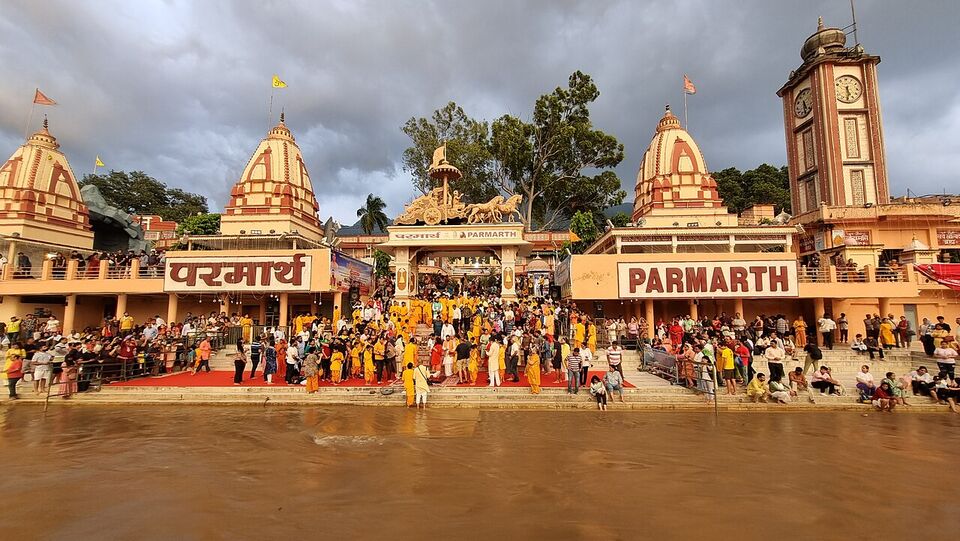
The best-known yoga town for visitors, with many schools, ashrams and drop-in classes along the river. The town has hosted an International Yoga Festival in the first week of March since 1999, according to reference sources: check the current dates. Meat and alcohol are not sold in the town. See our Rishikesh and Haridwar guide. Haridwar is also listed by the Ministry of Tourism as known for Ayurvedic medicine and wellness centers.
Mysuru (Mysore)
Mysuru has a strong link with modern yoga history. Tirumalai Krishnamacharya, known as the "father of modern yoga", taught at the Mysore Palace in the 1920s, and two of his pupils, B. K. S. Iyengar and K. Pattabhi Jois, founded Iyengar and Ashtanga yoga. Serious schools here often expect students to commit for a month or more and to apply in advance: check each school. See our Karnataka guide.
Kerala
Kerala Tourism promotes Ayurvedic treatments, yoga retreats and wellness resorts, and the state's tourism includes Ayurveda as a major draw. Quality ranges from hospital-style clinics to resort spas, so apply the checks below. See our Kerala guide.
The Himalayas and elsewhere
Smaller centers operate in hill towns and in other regions. Roads, weather and seasons affect access, so see our Himalayas guide and check the route before you commit.
You do not need to choose just one. Many travelers take a few days of yoga in Rishikesh and then fly south for a week of Ayurvedic treatment in Kerala, which is the more demanding of the two. Our trips by interest page lists other themed routes.
How to choose a genuine teacher or school
Yoga has no single national license that we could confirm, and a "certified" label from a school is not a government qualification. So the questions that matter are about the person and the program.
- Who teaches? Ask for the teacher's name, training and how long they have taught. A lineage, a known school or a long record is a good sign, and a vague claim of being "world famous" is not.
- What is the daily schedule? A written timetable with classes, meals, rest and free time shows a real program. Be careful with programs that leave out sleep and rest.
- How big are the classes? Large drop-in classes can be fine for practice, but if you are new or have an injury, you need a teacher who can watch you.
- What is the level? Honest schools tell beginners if a class is too advanced.
- What do independent reviews say? Read recent reviews on sites the school does not control, and be wary of pages that only have glowing quotes.
- What is the cancellation and refund policy? Get it in writing, before you pay a deposit.
- Is the teacher training recognized where you want to use it? If you want a teaching credential in the U.S., ask the registry or studio you plan to work with what it accepts. We could not confirm any official Indian recognition scheme for foreign visitors.
Watch out
Be cautious of any program that asks for a large payment to a personal account, promises a cure for a serious illness, pressures you to extend your stay, or discourages you from seeing a doctor. A genuine center answers questions plainly and lets you take your time.
Choosing an Ayurvedic clinic, and what AYUSH means
Ayurveda in India has a formal structure. Public institutions offer a degree, the Bachelor of Ayurvedic Medicine and Surgery (BAMS), and a central council for Indian medicine was set up in 1971 to monitor higher education. In 2014 India formed the Ministry of AYUSH, which takes its name from Ayurveda, Yoga and Naturopathy, Unani, Siddha and Homeopathy. The ministry promotes these systems through research institutes and policy. The legal standing of Ayurvedic practitioners is not equivalent to that of conventional medicine.
What a ministry link does and does not mean
- It can mean that a system, a doctor or an institution sits within a recognized framework, and that you can ask for registration details.
- It does not mean that a particular retreat or resort has been inspected, that its treatments have been proven to work, or that its herbal products are tested. A logo, the word "approved" or a photo with an official is not a guarantee.
We could not confirm from official pages a specific accreditation scheme for visitor-facing Ayurvedic centers, and we could not confirm that any such scheme is mandatory. Check the Ministry's own site, ayush.gov.in, and the relevant state government for any current listing, and treat a claim of accreditation as something you verify, not something you accept.
Questions to ask before you book
- Who is the doctor, what is their qualification (for example, BAMS), and what is their registration number? Ask which council or state body issued it.
- Will I see the doctor at the start, and during the program? Is there a medical consultation before treatment starts?
- What are the herbal medicines and oils, who makes them, and can I see the ingredient list?
- How will you handle my existing conditions and medicines?
- What happens if I feel unwell? Is there a hospital nearby, and who pays for transfer?
- What is included in the price: consultation, treatments, medicines, meals and airport transfer?
Be cautious of "spa" packages that call a massage Ayurveda, of centers with no doctor on site, and of anyone who makes medical claims for a serious disease. Some places are legitimate and some are not, and the labels do not tell you which.
Panchakarma and what to expect
Panchakarma ("five actions") is the best-known Ayurvedic cleansing program. In the tradition, it aims to remove toxins and restore balance through a set sequence of procedures. A treatment stay usually follows this pattern, though each center differs.
- Consultation. A doctor takes your medical history, looks at your pulse and tongue, and sets a plan. This should happen before treatment begins.
- Preparation. Several days of oil massage and steam, with a simple diet, often a rice and lentil dish with ghee.
- The main therapies. These may include shirodhara (warm oil poured on the forehead), full-body oil massage, herbal poultices and, in some programs, therapeutic purging or enemas. Not all programs include the strongest procedures, and you can ask for a gentler version.
- Rest and diet. You are asked to rest, eat the prescribed food and avoid alcohol, caffeine, heavy exercise and sometimes social media or screens.
- Follow-up. A doctor reviews you and gives advice for after the program, which may include herbs and diet changes.
Expect a quiet, structured routine, with treatments in the morning and rest in the afternoon, a vegetarian diet and early nights. Programs usually run several days to a few weeks: ask the center for the length it recommends and for the reason. The oil treatments are messy and the diet is simple, so bring old clothes and low expectations of luxury. Some people feel tired or emotional during the program, and it is not a vacation in the usual sense.
It is important to be honest about the evidence. Ayurveda has been used for centuries, and many people find the massage and the rest relaxing. Scientific reviews cited in reference sources state that there is no evidence it treats or cures cancer, and describe the theory as unproven. Do not use Ayurveda in place of conventional medical care for a serious condition, and tell your own doctor before you go.
Health cautions
- Herbal medicines and drug interactions. Herbs can interact with prescription medicines, including blood thinners, diabetes drugs, blood pressure medicines and antidepressants. Bring a list of what you take, show it to the Ayurvedic doctor and to your own doctor before you leave.
- Heavy metals. Some Ayurvedic preparations, especially those made with metals and minerals in a branch of the tradition called rasashastra, have been found to contain lead, mercury and arsenic. A study cited in reference sources found that about one in five such products sold online in 2005 contained toxic metals, and the CDC linked Ayurvedic drugs to lead poisoning in 2012. Indian authorities have required labels to list metal content, but quality control and testing are described as weak. Avoid metal-based preparations unless your own doctor has agreed, and do not buy large quantities of untested products to take home.
- Medical conditions. If you have heart disease, high blood pressure, diabetes, kidney or liver problems, a bleeding disorder, an eating disorder or a mental health condition, talk to your own doctor before a cleansing program, long fasting or an intensive retreat.
- Pregnancy and breastfeeding. Many herbs and procedures, including purging and some oils and massage techniques, are not suitable. Ask your own doctor and tell the center. Some will not treat pregnant guests.
- Injuries and yoga. Tell the teacher about back, knee, shoulder or neck problems. Do not push into a pose that hurts. Hot or very intense styles can be hard in India's heat.
- Silent and intensive retreats. Long periods of silence or meditation can bring up strong emotions for some people. Ask what support is available, and keep a way to leave.
- Food and water. Use sealed bottled or filtered water. Our health guide has the CDC vaccine advice, including hepatitis A and typhoid, and tips on avoiding traveler's diarrhea, which can be more serious when you are fasting or purging.
- Insurance. Check that your travel health insurance covers you for an Ayurvedic clinic stay and for medical evacuation, and read the exclusions.
Different from home
In the U.S., supplements and herbal products are regulated differently from drugs, and in India a doctor of Ayurveda can prescribe herbal medicines that you would never find in a pharmacy at home. Treat anything you are given as a medicine, ask what is in it and keep a record.
Before you buy Ayurvedic medicines, herbs or supplements to bring home, check the rules at cbp.gov and with the FDA. We could not confirm specific rules for Ayurvedic products. Our safety guide and women travelers guide have more on staying safe, including solo stays.
Ashram rules
If your program is in an ashram, expect a stricter routine than a hotel. Typical rules include vegetarian meals, no alcohol, tobacco or drugs, modest dress with covered shoulders and knees, early wake-up and fixed meal times, quiet hours, a gate closing time and limits on photography and phones in prayer halls. Some ask for a donation instead of a fixed fee, and some separate men and women in classes or rooms. Ask for the rules in writing before you book, and follow them: you are a guest in a religious community. Our Rishikesh and Haridwar guide and our etiquette guide cover this in more detail.
Costs and booking
We give no prices, because they range from very low for a basic drop-in class to high for a resort program, and we could not verify any current figure. Here is how to compare options and avoid surprises.
- Ask for a written quote that lists what is included: lodging, meals, classes, doctor consultation, treatments, medicines, transfers and any taxes.
- Ask whether herbal medicines or products are billed separately, and whether you are expected to buy them.
- Pay a deposit only through a traceable method, and keep the receipt. Be cautious of a request to transfer money to a personal account.
- Get the cancellation and refund policy in writing, and ask what happens if you leave early because of illness.
- Book the first few nights rather than the whole stay when you are unsure, and extend once you know the place.
- Keep a buffer in your trip for a delay, and do not book a flight on the day a program ends.
- Avoid anyone who pressures you to pay quickly or says a price is only valid today.
Book ahead for the main yoga seasons, October to March in Rishikesh, and around festivals. Kerala centers are popular in many seasons, and some promote treatment during the monsoon months: check with the center and see our when to go page for the weather. For a place to stay before or after the program, see where to stay.
The visa question for a long course
Americans need a visa for any stay in India. Most visitors use the e-Visa, which you apply for only on the official government portal, indianvisaonline.gov.in/evisa. Look-alike agent sites charge extra, so do not use them. The fee changes: check the fee on the official page.
The official e-Visa page says the tourist category covers attending a short-term yoga programme and short courses in music, cooking, arts and similar subjects, if they are not a formal or structured course, last no more than 6 months and do not give a qualifying certificate or diploma. That fits most retreats and short courses. It may not fit a formal teacher-training course that issues a certificate. The same page lists medical treatment, including treatment under Indian systems of medicine, as a separate category with its own e-Medical visa. If your stay at an Ayurvedic center is mainly for medical treatment, ask the center which visa it advises, and confirm on the portal or with the Indian embassy.
- Length of stay. The 30-day e-Tourist visa is valid for 30 days from your first arrival. The 1-year and 5-year e-Tourist visas allow a stay of up to 180 days per calendar year. A month-long course plus travel can be tight on a 30-day visa, so check the dates carefully.
- Not extendable. e-Tourist visas cannot be extended or converted into another type.
- Apply early. Apply at least 4 days before you travel, and up to 120 days ahead. Leave much more time in practice.
- Entry airports. You must arrive at one of the listed airports. Dehradun, near Rishikesh, is not on the list, so enter at Delhi or another listed airport first.
- Longer study. For a structured, certificate-based course or a stay of several months, see our guide to long stays and ask the Indian embassy before you pay for a course.
Our entry guide has the full e-Visa rules, including the passport and onward-ticket requirements. We could not verify visa rules specific to a particular school, so ask the school which visa its past students used, and then confirm it with the government.
Common mistakes
- Booking a long retreat or teacher training online without checking the teacher, the program and the refund terms.
- Paying a large deposit to a personal account, or paying the full price in advance.
- Assuming that "AYUSH approved" or a certificate means a center has been inspected.
- Taking Ayurvedic herbs without telling your own doctor, especially if you take prescription drugs or are pregnant.
- Buying metal-based preparations or large amounts of untested products to take home.
- Starting a cleansing program with a medical condition without asking your own doctor.
- Choosing the wrong visa category, or arriving on a 30-day visa for a longer course.
- Expecting resort-style comfort at an ashram, or a quiet retreat at a party hostel.
- Skipping insurance that covers treatment and evacuation.
Add it to a route in the trip builder, or ask us to plan the hotels, trains and guides for you.