
Overview: fly to Incheon, plan for the date line
Almost every flight from the US to South Korea lands at Incheon International Airport (ICN), on an island west of Seoul. A long list of US cities has nonstop service, and most others reach Seoul with one stop, often at a West Coast, Pacific or Asian hub. The trip is long, 13 to 15 hours in the air for a nonstop, and because you cross the date line, you usually land a day later than you left.
This page covers the airports, which US cities have nonstops, flight times, a table of nonstop versus connection trade-offs, the date-line effect, jet lag tips, when to book, open-jaw tickets, domestic flights to Jeju and what the Muan airport closure means. We list no fares, because they change daily. Use the airline sites and Google Flights for prices, and confirm every route on the airline's own schedule. For the whole plan, see the planning page.
Before you book: entry rules for Americans
Americans can visit South Korea visa-free for up to 90 days for tourism. US citizens are exempt from the K-ETA (Korea Electronic Travel Authorization) through December 31, 2026. For travel from January 1, 2027, check k-eta.go.kr before you book. If your trip crosses that date, do not assume the exemption has been extended.
Visitors also complete the online e-Arrival Card before landing, and you should use only the official site, e-arrivalcard.go.kr, because fake look-alike sites exist. We could not confirm the exact rule for US citizens, or any fee, so check the site a week before you fly. Bring a passport valid for your whole stay, and check your airline's rule. The entry page has the details.
Airports: Incheon, Gimpo and the rest
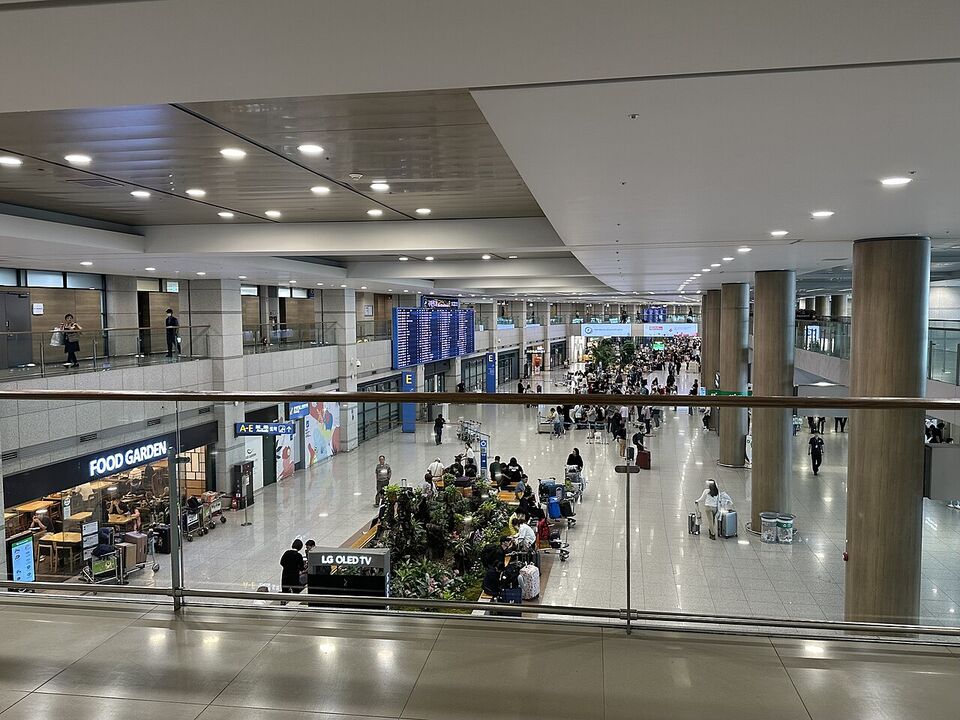
Incheon (ICN): the main gateway
Incheon is Korea's main international airport. It has two terminals: Terminal 1 and Terminal 2. Korean Air, Delta and Air France-KLM use Terminal 2, and Asiana moved there on January 14, 2026. Check your terminal on your ticket and on the airport's site, because it decides where you go for check-in and arrival. The Incheon Airport transfers page explains the trains, buses and taxis into Seoul.
Gimpo (GMP): mostly domestic
Gimpo International Airport is closer to central Seoul and is mostly domestic. It handles the short flights to Jeju and a few international shuttles such as Tokyo-Haneda. The Gimpo-Jeju route is the world's busiest air route by passengers, with more than 13.7 million in 2023. You will not fly to Gimpo from the US, but you may use it if you continue to Jeju.
Busan, Jeju and other airports
Gimhae International Airport serves Busan, and a new airport on Gadeok Island is being built, with no opening date. Jeju International Airport serves Jeju Island. We found no US nonstops to either, so you would connect through Seoul or another hub. A few domestic and regional airports exist beyond these, and the Muan airport is closed (see below).
Nonstop flights from the US
This table shows the US cities with nonstops to Incheon as listed on the airport's reference page in mid-2026, and the airlines named for each. Schedules change by season, and we have not checked the winter 2026-27 timetables, so confirm each route on the airline's site. Not every airline flies every day.
| US city | Airlines listed | Notes |
|---|---|---|
| Atlanta | Delta, Korean Air | Southeast hub |
| Boston | Korean Air | Northeast |
| Chicago (O'Hare) | Korean Air | Midwest hub |
| Dallas/Fort Worth | American, Korean Air | Texas hub |
| Detroit | Delta | Midwest |
| Honolulu | Korean Air, Air Premia | Shortest US flight |
| Las Vegas | Korean Air | Check season |
| Los Angeles | Korean Air, Asiana, Air Premia | Asiana flights become Korean Air from December 17, 2026 |
| Minneapolis/St. Paul | Delta | Upper Midwest |
| New York (JFK) | Korean Air, Asiana | Asiana flights become Korean Air from December 17, 2026 |
| Newark | United, Air Premia | Korean Air Newark service is listed as resuming May 22, 2027 |
| Salt Lake City | Delta | Mountain West |
| San Francisco | United, Korean Air, Asiana, Air Premia | Many options |
| Seattle/Tacoma | Delta, Alaska, Korean Air | Pacific Northwest |
| Washington-Dulles | Korean Air, Air Premia | Air Premia service reported in April 2026 |
Asiana Airlines is merging with Korean Air. Asiana flights become Korean Air flights from December 17, 2026, so tickets bought now for later dates may carry a different airline name. That is normal, but keep your booking reference and check your terminal and baggage rules. Your Asiana Miles or Korean Air SKYPASS account may be affected, so check the airline's notice.
Insider tip
If your home airport is not on the list, price two ways: a one-stop ticket through a hub, and a short domestic hop to a city with a nonstop. Sometimes a separate ticket to a hub costs less, but a single ticket protects you if the first flight is late.
Flight times in general terms
Flight times depend on the route, the winds and the season. In general terms, expect about 13 to 14 hours from the US West Coast and about 14 to 15 hours from the East Coast and Midwest. Seattle and Honolulu are shorter. The flight back to the US is usually shorter than the flight out, because of the jet stream. Check the exact time on your airline's site, and add the time for connections, airport arrival and immigration at the other end.
A rule of thumb for the whole day: allow about 20 hours door to door for a nonstop from a major city, and a full day or more with a connection. For a first trip we suggest leaving your first Korean day light.
Nonstop or connection: the trade-offs
| Factor | Nonstop | One-stop connection |
|---|---|---|
| Total time | Shortest, 13-15 hours in the air | Often 4 to 10 hours longer |
| Price | Often higher, but varies by date | Can be lower, especially off-peak |
| Comfort | One boarding, one set of bags | Two or more flights, more chances for delays |
| Risk of missed connection | None | Higher on separate tickets; a single ticket protects you |
| Departure city | Needs a listed hub | Works from nearly any US airport |
| Jet lag | One long sleep window | A stop can break the trip, or add another night of poor sleep |
| Flexibility | Fewer departures a day | More schedule choices |
| Stopover options | Rare | Possible at hubs in Asia or the Pacific, with a visa-free or transit rule to check |
For a family with young children, we suggest a nonstop if you can find one, because every extra gate adds stress. For a budget trip from a smaller airport, a connection often wins. Always check the connection time: at least two to three hours for an international connection is a cautious rule.
The date line and arriving the next day
Korea is far ahead of the US in time. Korea is on Korea Standard Time (UTC+9) all year, and Korea does not change its clocks. When the US is on standard time, Korea is 14 hours ahead of New York, 15 hours ahead of Chicago and 17 hours ahead of Los Angeles. When the US is on daylight saving time, in summer, the gap shrinks by an hour (13 hours ahead of New York). The gap changes only when the US changes its clocks, next on March 14, 2027.
The result is that a flight east across the Pacific crosses the International Date Line. If you leave Monday afternoon, you will usually land on Tuesday afternoon or evening, Korea time, even though the flight itself is 13 to 15 hours. Hotels count nights by arrival date, so book your hotel from the day you land, not the day you leave. On the way home, you often land the same day you left, even earlier on the clock than you departed.
Different from home
Booking a hotel for the wrong night is the most common date-line mistake. If your flight leaves on June 10 and lands on June 11, your first hotel night is June 11. Check the arrival date on your itinerary, not just the departure date.
Jet lag tips for a big time difference
A 13 to 17 hour difference means your body clock will be close to upside down. Most people need a few days to adjust, and arriving rested helps. These steps are common advice rather than a medical plan, so ask your doctor if you have a health condition.
- Shift your sleep a little in the days before you fly, going to bed an hour or two earlier if you can.
- On the plane, set your watch to Korea time when you board, and sleep when it is night in Korea.
- Drink water, go easy on alcohol, and move around the cabin every few hours.
- When you land, get daylight and stay up until a local bedtime, even if you feel tired.
- Keep the first afternoon light: a walk, a meal and an early night. Save museum days for the next morning.
- If you wake at 3 a.m., use the time for rest, a book or a convenience-store snack, and avoid long naps in the day.
The health page has general travel health advice. Plan the first day around nothing fixed, so a delay or a long immigration line does not ruin a reservation.
When to book, and when fares are lowest or highest
We list no fares, so use the airline sites and Google Flights to compare prices, set price alerts and view calendar and month views. As a general pattern, fares are highest in peak travel times and lowest in the quieter months. We have not confirmed 2026-27 fare patterns, so treat this as guidance.
- Often highest: summer (June to August), the weeks around US holidays in late December, and the fall color season, October and early November. Korean holidays also push demand: Seollal, the Lunar New Year (February 6 to 8, 2027), and Chuseok (September 14 to 16, 2027).
- Often lowest: late January to February (outside Seollal), and parts of March, early December and late spring outside the cherry blossom weeks. Quieter weeks vary.
- Booking window: many travelers start looking three to six months out for peak seasons, and two to four months for quieter ones. Book earlier for holiday periods, and for nonstops from smaller cities.
- Day of week: midweek departures can cost less than Friday and Sunday departures, but check your dates.
Our when to go page and the month pages for November, December and January explain the weather and crowds that drive demand. Use free cancellation or flexible fare rules where you can, because plans can change.
Open-jaw tickets: into Seoul, out of Busan or Jeju
An open-jaw ticket flies you into one city and home from another, for example into Seoul and out of Busan. It saves you from backtracking across the country. A typical trip goes from Seoul through Gyeongju and Busan, then home from Busan, or from Seoul to Jeju and home from Jeju.
There are no US nonstops to Busan or Jeju that we found, so your outbound or return flight would connect through Seoul, Tokyo, or another hub. The simplest way is to book the Seoul gateway as part of the ticket and add a separate domestic flight or a train ride to Busan. Compare the total price, baggage rules and time against a return trip, because the high-speed train between Seoul and Busan takes about 2.5 hours, with fares that vary and should be checked at letskorail.com. See Busan and getting around.
If you use a separate ticket for the final leg home, leave at least three or four hours between flights, and note that you will pick up and recheck your bags. A single international ticket protects you if the first leg is late.
Domestic flights to Jeju
Jeju is about an hour by air from Seoul, and most flights leave from Gimpo, so you need to get from Incheon to Gimpo on arrival. The route is the busiest in the world, so planes and airports are crowded, especially on weekends, holidays and in cherry blossom and fall seasons. Book early, particularly for Friday and Sunday flights, and check baggage allowances on the domestic fare you buy, which can be lower than on your international ticket.
Several Korean airlines fly the route, including Korean Air, Jin Air and Jeju Air. Compare prices on their sites, and check whether your ticket allows changes. Allow time on both ends: arrive at the airport early, and keep your passport handy, because airlines may ask for ID. See Jeju for the island, and Incheon Airport transfers for the Gimpo link.
Watch out
Do not schedule a Jeju flight the same afternoon you land from the US, unless you leave a long buffer. Late arrivals, immigration lines and the transfer to Gimpo can make a tight connection fail.
Muan airport and the southwest
Muan International Airport, in Jeolla province in the southwest, is closed to commercial flights. It closed after an airliner crash there on December 29, 2024. Emergency and training flights resumed in February 2025, but reporting says the runway remains closed until late 2027, so you should not plan to fly into Muan. Check the Korea Airports Corporation and the airline sites for any change.
For the southwest, which includes areas such as Mokpo, Yeosu and Suncheon, plan to arrive by train or bus from Seoul or other cities. Some regional airports may serve the region, but we have not confirmed routes, so check airline sites. The south coast page has more on that region.
What to expect when you land
After a long flight, arrival at Incheon follows a clear order: you walk to immigration, show your passport, have your photo taken and, usually, fingerprints scanned, then collect your bags and pass through customs. Lines are shortest when several flights have not landed at once, and longest in the morning when many long-haul flights arrive together. Complete the online e-Arrival Card before you land, using only the official site, and have your first hotel address ready.
Korea has strict rules on bringing in meat, dairy, fresh fruit, plants and some medicines, so declare food and carry original prescriptions in labeled containers. Check the Korea Customs Service traveler pages before you pack. Then go to the transport: the AREX train, an airport bus, or a taxi. Our Incheon Airport transfers page compares them, including for night and dawn arrivals, and phones, Wi-Fi and apps explains how to get online before you reach the train platform.
Baggage and booking details to check
- Check the checked-bag allowance on your fare, since it varies by airline and by fare class, and by the domestic leg if you add Jeju.
- Buy one ticket, not two, if you can, so the airline rebooks you if the first flight runs late.
- Add your Korean hotel's address and phone number to the booking, and keep a copy offline.
- Look at the seat map for the long flight: an aisle near a restroom suits restless sleepers, while a window helps you lean and rest.
- Consider travel insurance that covers delays and medical care abroad, and keep the policy number in your phone.
Mistakes to avoid
- Booking the hotel for the wrong night. You land the day after you leave.
- Going to the wrong terminal. Check Terminal 1 or 2 before you leave for the airport.
- Booking a trip that lands on or after January 1, 2027 without checking K-ETA. The exemption runs through December 31, 2026.
- A tight connection on separate tickets. If the first flight is late, the second may not wait.
- Flying to Jeju on arrival day. Leave time, and book a day later if you can.
- Waiting too long during holidays. Seollal and Chuseok fill flights and trains.
- Trusting an old blog's route list. Routes change by season. Check the airline.
- Ignoring the airline merger. Asiana becomes Korean Air on December 17, 2026, so check names, terminals and baggage rules.
Add it to a route in the trip builder, or ask us to plan the hotels, trains and guides for you.