Overview
Gyeongju (the spelling you will see on signs and KTX tickets; old guidebooks may print a different romanization) was the capital of the Silla kingdom, which ruled much of the Korean Peninsula from 57 BC to 935 AD. It is often called a museum without walls, and that description holds up: grassy royal burial mounds sit in the middle of town, an ancient stone observatory stands in a field, and a restored palace pond is lit up each night. Two parts of the city are on the UNESCO World Heritage list: the Gyeongju Historic Areas (inscribed 2000) and the Bulguksa temple and Seokguram grotto (inscribed 1995).
Gyeongju is not a big city. It has about 245,000 residents spread over a large area of 511 square miles (1,324 square km), and it is about 230 miles (370 km) southeast of Seoul. The center is flat and easy to walk or bike, but the best-known temple and grotto are in the mountains to the east, and the high-speed rail station is some distance west of town. That layout is behind most visitor mistakes, which is why this page spends time on how to get around.
Gyeongju is a common stop between Seoul and Busan, and a natural pair with the temples in temples and temple stays. This guide covers the tombs, Bulguksa and Seokguram, the night sights, cafes, getting around, one-day and two-day plans and the mistakes to avoid.
Getting to Gyeongju from Seoul and Busan
The KTX Gyeongbu line stops at the high-speed station in Geoncheon-eup, which is west of the city center. KORAIL timetables and the station sign list it as Singyeongju (New Gyeongju), and some maps just call it Gyeongju Station. Gyeongju also has a regional station nearer the center, so check which one your ticket names. The trip from Seoul takes about two hours on the fast KTX services, and we could not confirm current timetables or fares, so check letskorail.com or the KORAIL app before you book. Foreign visitors can use a Korail Pass on many KORAIL trains, but compare it with single tickets for your plan.
From the high-speed station, a local bus or a taxi runs into the old town. Allow roughly 20 to 30 minutes (check on your map app), and ask your hotel which bus stops nearest to it. Express and intercity buses from Seoul, Busan and Daegu also reach Gyeongju's bus terminal in the town center, which saves the transfer; check the express bus operators for current times. From Busan, Gyeongju is a short trip by train or bus (check times), which makes it an easy day trip from there (see Busan). Daegu is about 34 miles (55 km) to the west.
If you plan to rent a car, Gyeongju is simple to reach by expressway, and parking is available at the main sites, but traffic is heavy in blossom and fall season. For rules, tolls and what an American needs, see driving in South Korea.
Watch out
The KTX station is not in the old town. Arriving late, with a full schedule and no plan for the bus or taxi, is the most common way to lose an afternoon. Look up the last train home before you start, and leave a buffer.
Bulguksa: the temple on Mount Toham
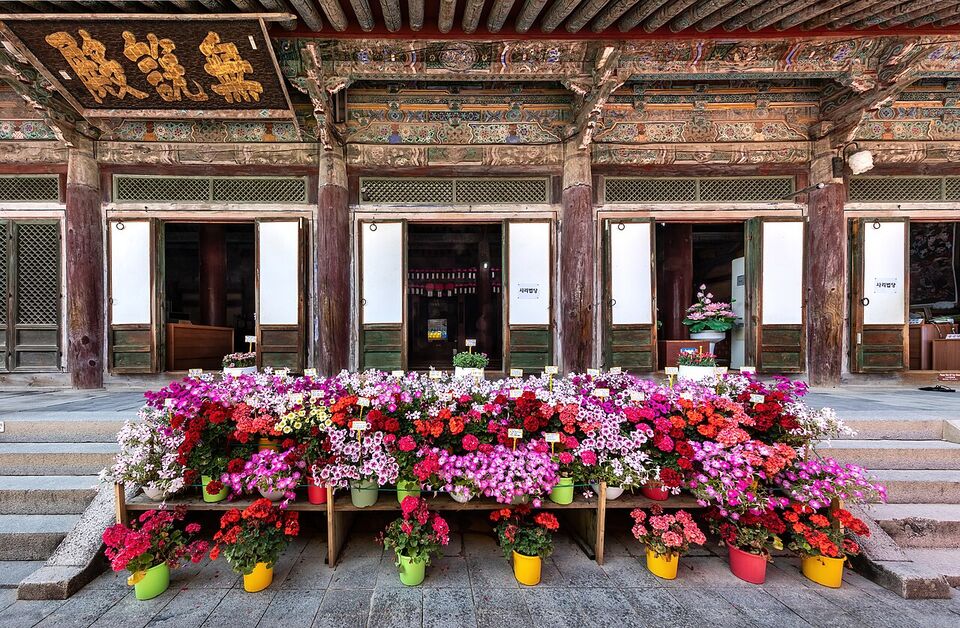
Bulguksa (the name means "Temple of the Buddha Land") is a head temple of the Jogye Order, the largest sect of Korean Buddhism, and one of the country's most-visited heritage sites. The current temple was built from 751 and finished in 774 under the Silla court. Wooden buildings burned in the Imjin wars of the 1590s, were rebuilt after 1604 and restored in the 1960s and 1970s. The stone structures are original Silla work, and six National Treasures are here.
The most famous features are in the main courtyard. Two stone pagodas stand in front of the main hall: the plain Seokgatap, about 27 feet (8.2 m) tall, and the ornate Dabotap, about 34 feet (10.4 m), which is pictured on the 10-won coin. At the entrance, a double stone stairway and bridge, Cheongungyo (Blue Cloud Bridge) and Baegungyo (White Cloud Bridge), has 34 steps, said to stand for the steps to enlightenment. Take your time in the compound; the hillside setting and the layered halls are what make it feel different from the temples you may have seen in Seoul.
The temple is a working place of worship as well as a tourist site. Take off your shoes where signs ask, keep your voice down and follow the photography rules posted at the halls. The temples and temple stays page covers etiquette in detail.
Tickets, hours and rules at Bulguksa
Entry fees and opening hours for Bulguksa and Seokguram are set by the temple and the Korea Heritage Service, and they may differ between the two sites. We could not confirm the 2026 fees, the closing times or any restrictions, so check the temple's official site (bulguksa.or.kr) and the Korea Heritage Service (khs.go.kr) before you go. Hours often change by season, with earlier closings in winter. Some stone bridges are closed to walking for protection, which you will see marked.
Seokguram Grotto
Seokguram is a stone grotto shrine on Mount Toham, about 1.9 miles (3 km) from Bulguksa and about 2,460 feet (750 m) above sea level, facing the East Sea. It was begun in 751 and completed in 774, in the same period as Bulguksa. The grotto is an artificial chamber made of hundreds of granite slabs, with an entrance corridor and a round main room holding a seated Buddha about 11.5 feet (3.5 m) tall, surrounded by carved guardians and bodhisattvas. It is a National Treasure and part of the same UNESCO listing as Bulguksa.
The interior is now seen through a glass wall, installed to protect the grotto from the many visitors and changes in temperature, so you stand outside the chamber and look in. That is a limit visitors sometimes do not expect. Photography inside is usually restricted; follow the signs. Sunrise over the sea is a famous sight from near the grotto, but be careful: opening times and any early-morning access rules vary, and the mountain road and car park can close in bad weather.
How to reach Seokguram, and whether you need a reservation
There are three common ways to reach Seokguram from Bulguksa: a shuttle or local bus that runs up the mountain road, a taxi, or a hiking trail between the two sites. Which bus or shuttle runs, how often and how much it costs changes by season, so check the Gyeongju city tourism page (gyeongju.go.kr) or ask the information desk at Bulguksa when you arrive. A taxi from the Bulguksa area is simple if you can share the cost. We could not confirm whether Seokguram needs a reservation or timed entry in 2026, and no source we had says it does. Verify this on the official Bulguksa or Korea Heritage Service pages, especially for sunrise visits or weekends. If you plan to hike, check trail conditions, and allow time and daylight for the walk back.
The royal tomb park and Cheomseongdae
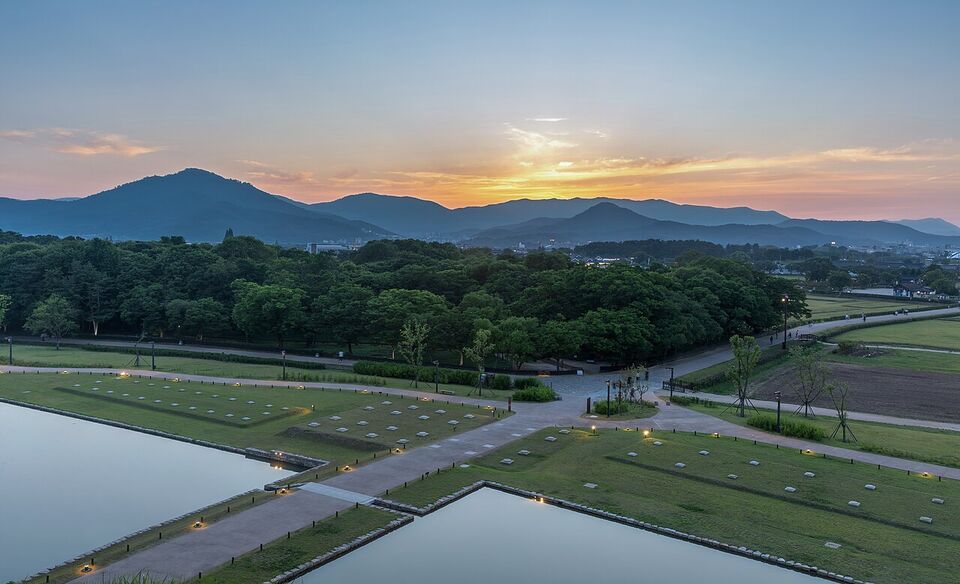
In the middle of town, Daereungwon (the Tumuli Park) is a grassy park of Silla royal burial mounds. It holds 23 tombs of kings, queens and nobles, and about one million people visit in a typical year. Most of the mounds look like green hills. One of them, Cheonmachong (the Heavenly Horse Tomb), was excavated by archaeologists; it held a painted winged horse on a birch-bark saddle flap and many gold objects. A 2023 report said admission would become free from May 2023, so check the current rule on arrival.
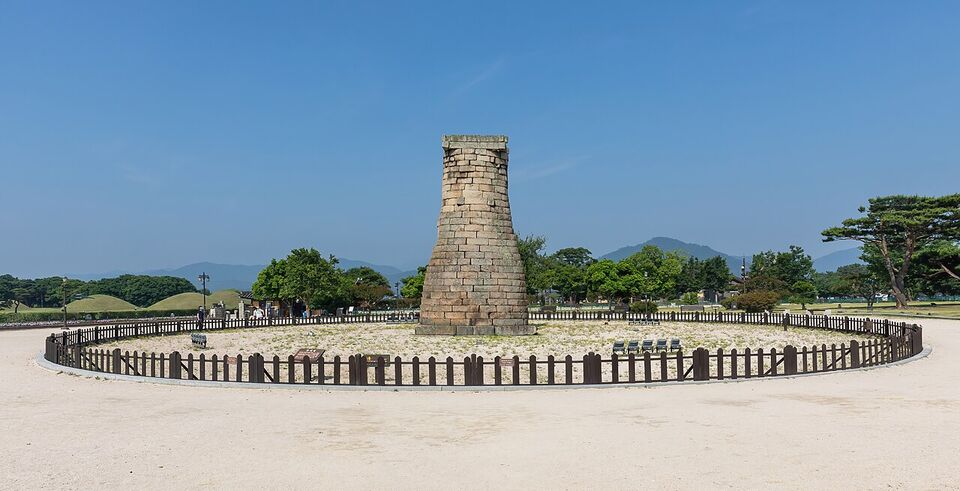
A short walk away, Cheomseongdae is a small bottle-shaped stone tower from the Silla period. It is considered the oldest surviving observatory of its kind in East Asia. It sits on flat ground near Gyerim woodland and the former Wolseong palace site. It is small and is usually a 20- to 30-minute stop, but it is one of the best places to take photos at sunset, when the tower and the tombs are in good light and the crowds thin.
Gyeongju National Museum is nearby and holds many of the artifacts excavated in the region, including gold crowns and the relics from the Anapji pond. If you like museums, it is a good rainy-day stop, but check its hours and closed days on the museum's site.
Donggung Palace and Wolji Pond at night
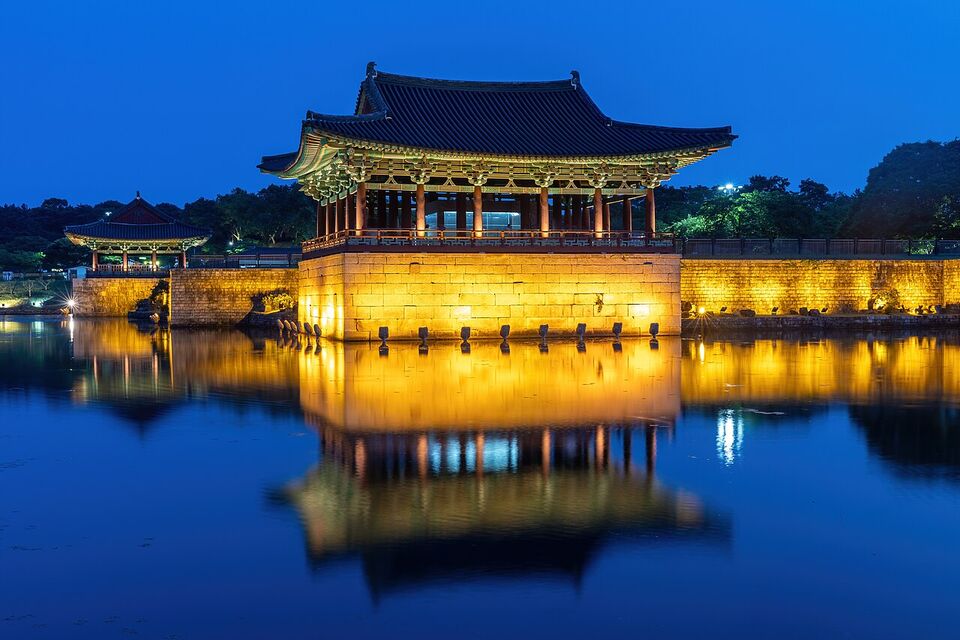
Donggung Palace and Wolji Pond are a Silla-era palace garden, built by King Munmu in 674. The oval pond (about 650 feet by 590 feet, or 200 m by 180 m) has three small islands and, in the older sources, goes by the name Anapji. It was dredged and rebuilt in the 1970s, and an excavation between 1975 and 1986 turned up almost 33,000 pieces, many of which are held in museum collections. A few reconstructed pavilions stand beside the pond.
The site is best known for its night view: after dark the reconstructed pavilions are lit up and reflected on the water, which is why many visitors come in the evening. We could not confirm the current evening opening hours and last entry time, so check the Gyeongju city tourism page (gyeongju.go.kr) for the current schedule and any seasonal closures. Evening visits are the reason a one-night stay is worth it. Pair Wolji Pond with a walk through the tomb park or a dinner on Hwangnidan-gil.
Insider tip
Visit Wolji Pond around dusk and stay for the lighting rather than arriving late at night. In fall and winter it gets dark early, so a late-afternoon arrival still lets you see the sunset and the lights in one visit.
Hwangnidan-gil and the cafe area
Hwangnidan-gil is a district of low-rise buildings and old houses that were turned into cafes, restaurants, bookshops and gift stores. It has about 400 shops and grew popular through social media. It sits beside the tomb park, so it fits easily between Daereungwon and an evening at Wolji Pond. Streets here are narrow and busy on weekends, and some restaurants have waits at dinner time.
Near the tomb park, a cluster of restaurants serves ssambap (a spread of leaf wraps with rice and side dishes), which is a common Gyeongju meal. Another local specialty is haejangguk, a hangover soup, and a street near the national museum has many restaurants that serve a local style. Sweet red-bean pastries are a popular local snack. Cards are widely accepted, but keep a little cash for small stalls. For general ordering help see Korean food.
Yangdong village and other options
Yangdong Folk Village is a clan village of tile-roofed and thatched houses from the Joseon period, in the hills northeast of the city. It is UNESCO-listed together with Hahoe Village in Andong (the two form the "Historic Villages of Korea" site, inscribed in 2010). It is quieter than the city sights and gives a rural contrast, but it is a drive of roughly 30 to 45 minutes from the center and not on the main bus routes, so plan a taxi or a rental car. For a second village of the same listing, see Andong and Hahoe.
Other options: Namsan, a mountain south of the center with Buddhist carvings and temple ruins, is a hiking area for those with a full day; Bunhwangsa has a stone pagoda that is a National Treasure; and the Bomun Lake area on the east side has a resort district and cherry trees in spring. Hotels and traditional hanok guesthouses are in the old town; the hanok rooms have heated floors and are popular, so book early in blossom and fall season. See where to stay for room types.
Bicycles, taxis and local buses
The central sights (tomb park, Cheomseongdae, Wolji Pond and Hwangnidan-gil) are within about a mile of each other and can be walked in a day. Bicycle rental shops near the town center and the tomb park rent standard and electric bikes by the hour; prices change, so ask before you take one. Cycling is a pleasant option on the flat paths, but not for Bulguksa or Seokguram, which are in the hills.
For the eastern sights, a taxi is the simplest, and many drivers offer a fixed fare or a half-day price to take you to Bulguksa, Seokguram and back; agree the price and the route before you get in. Taxis are metered in the city, and you can order them with the Kakao T app if you have a Korean phone number set up; otherwise ask your hotel. Local buses reach Bulguksa from the old town and the bus terminal; check the number and last return time. A T-money card works on buses; see getting around South Korea.
One day or two? Plans for Gyeongju
| Time | One-day plan (from Seoul or Busan) | Two-day plan |
|---|---|---|
| Morning | Arrive on an early KTX. Go straight to Bulguksa by taxi or bus. | Day 1: Arrive by late morning, drop bags, walk the tomb park, Cheomseongdae and Hwangnidan-gil for lunch. |
| Midday | Seokguram if the transport is easy, then lunch in town. | Day 1: National museum or a bicycle loop; rest. |
| Afternoon | Tomb park and Cheomseongdae. | Day 1: Wolji Pond at dusk, then dinner. |
| Evening | Wolji Pond for the lights, then the last KTX back. | Day 2: Bulguksa early, Seokguram by shuttle or taxi, and Yangdong or Namsan if you want more. |
| Best for | People short on time who accept a long day. | Most visitors; avoids rushing and keeps you off the road at night. |
If you only have a day, order the visit by distance and daylight: start with the eastern sights while it is cool and the roads are quiet, and keep the tombs and Wolji Pond for the evening. If you have two days, put the night views on the first evening and Bulguksa on the second morning.
When to go and mistakes to avoid
Spring and fall are the best seasons, and also the busiest. Cherry blossoms in Gyeongju usually peak in the first half of April, around the same time as the Jinhae festival further south (the national forecast is from the KMA and the Korea Tourism Organization), and the fall color around Bulguksa and the tomb park typically comes between late October and mid-November. Dates move from year to year, so check the forecast. Summer is hot, humid and rainy; winter is cold but clear, with fewer visitors and early closings.
Gyeongju gets crowded during school trips in spring and on holiday weekends, especially Chuseok and Seollal, when many restaurants close for a few days. See when to go and festivals and holidays for the calendar.
- Arriving too late. If you reach the city after 2 p.m., you will have to choose between Bulguksa and the night sights. Take an early train.
- Underestimating the distances. The tomb park and Wolji Pond are close together, but Bulguksa is several miles east and Seokguram higher still. Do not plan to walk it.
- Going to the wrong station. Know which station your KTX arrives at and how you will get into town before you leave.
- Not checking Seokguram. Confirm the access rules, hours and weather on the official page the day before.
- Booking only hotels, not trains. Weekend and blossom-season KTX seats sell out first.
- Taking a bike to the temple. Cycling is fine in the flat city but a poor choice for the mountain road.
Save money
If two or three people travel together, a half-day taxi to Bulguksa and Seokguram can cost about the same as separate bus rides and saves time. Agree the price in advance, and check the bus option on the city tourism page first.
Add it to a route in the trip builder, or ask us to plan the hotels, trains and guides for you.