Overview
South Korea is one of the easiest countries for a shopping trip. Skincare and cosmetics are the headline, but the best buys also include stationery, tea, hanji (Korean mulberry paper) goods, small ceramics, snacks and a long list of local fashion brands. Prices are not always cheaper than at home, so the real value is in finding products that are new to you, hard to find in the US or sold in smaller sizes and gift sets.
This page covers what is worth buying, where to shop, how tourist tax refunds work, what US Customs allows you to bring back and how to avoid fakes and overspending. For other practical planning, see Money in South Korea and South Korea Packing List. Shopping is also a good rainy-day plan for Seoul or Busan.
We have not confirmed a number of shop hours and tax-refund figures for November 2026, so wherever the rules matter, we tell you where to check.
What is worth buying
K-beauty and skincare
Serums, essences, sunscreens, cleansers and cushion compacts are the best known. Brands sell in drugstore chains, department stores and flagship shops. Sample sets and travel sizes are good for trying a few products.
Sheet masks
Boxes of sheet masks are easy to pack, easy to give as gifts and sold everywhere from convenience stores to specialist shops. Buy a few brands and compare.
Stationery and design shops
Notebooks, pens, stickers and planners are affordable and well designed. Large stationery stores often have a big range of pens and paper in one place.
Ginseng and teas
Red ginseng products, citron tea (yuja-cha), barley tea and herbal blends are popular gifts. Check labels and your customs rules before you pack ginseng roots or anything containing animal products.
Ceramics and hanji
Celadon and buncheong ceramics, and hanji paper lamps, cards and boxes, are traditional crafts. Pack ceramics carefully, and see the note on tableware below.
Snacks
Seaweed snacks, honey butter chips, instant noodles and candy are cheap and light. Seaweed (gim) is a common gift. Packaged and sealed items are the easiest to carry home.
Fashion
Local brands and street fashion are the draw. Check sizes, because Korean sizing often runs smaller than US sizes, and try on if you can.
Where to shop
Myeongdong
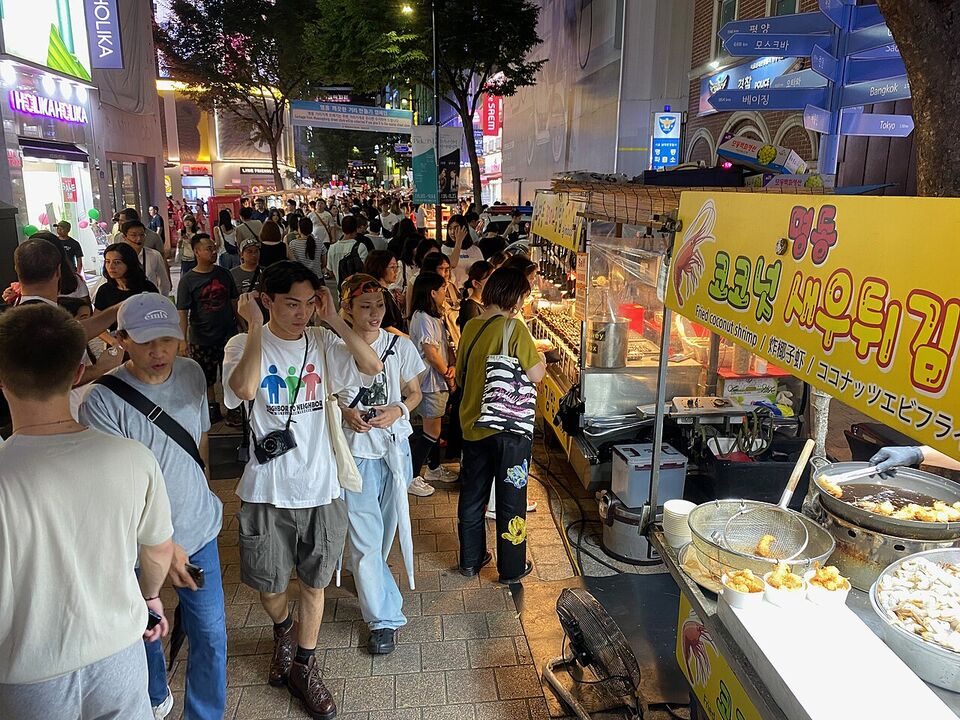
Myeongdong is the most visitor-oriented shopping area in Seoul. It is packed with skincare and cosmetics shops, many with English- and Chinese-speaking staff, along with street food stalls in the evening. Shops often hand out free samples, and some give a small gift with a purchase. It is busy, so go earlier in the day if you want to browse in peace. Shop hours vary, but many stay open into the evening; check each store before you plan around a late visit.
Hongdae
Hongdae (short for Hongik University) is a better area for young fashion, stationery, accessories and small designer shops. The area is lively in the evening, with street performers and cafes.
Dongdaemun and Namdaemun
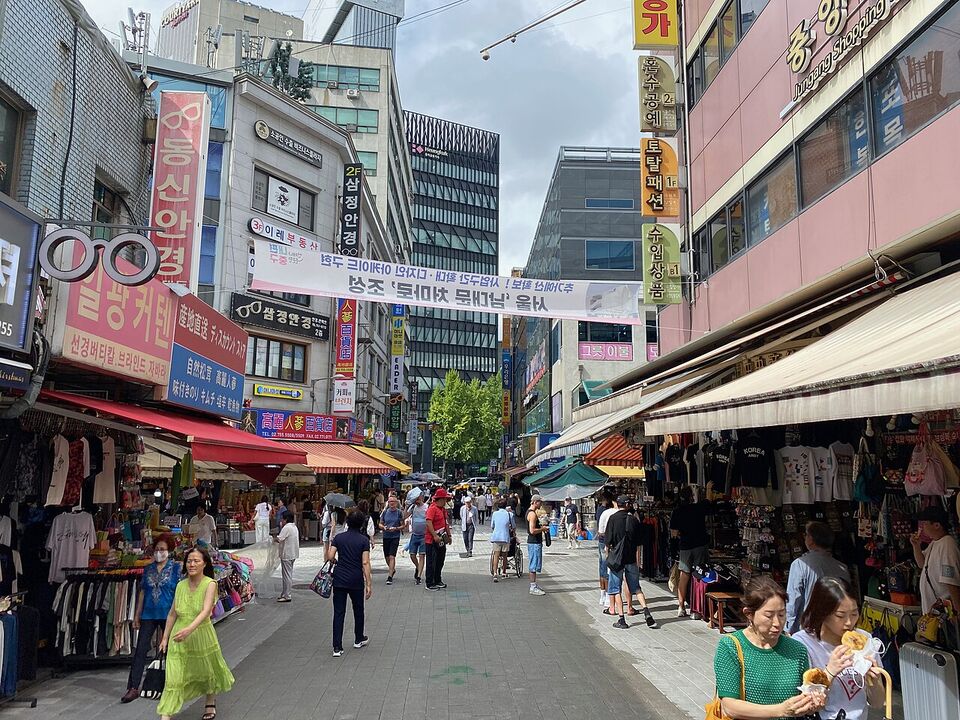
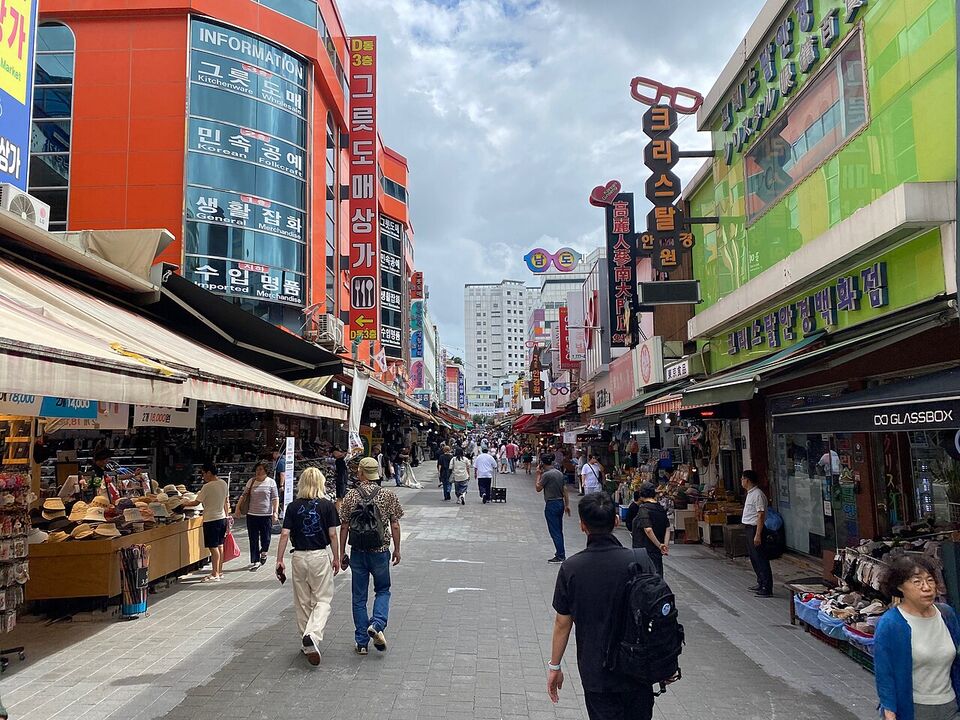
Dongdaemun is Seoul's wholesale and fashion district, with large malls and markets that serve both retailers and shoppers. It is known for night shopping, though hours differ by building and many wholesalers do not sell single items on a retail basis, so ask before you buy. Namdaemun Market, near Seoul Station, is one of the city's oldest traditional markets, with food, kitchenware, souvenirs and clothing. Bargaining is possible in traditional markets, but keep it friendly and do not push hard.
Olive Young and drugstore chains
Olive Young is a Korean health and beauty chain with many branches across the country. You can browse a wide range of brands in one place, compare prices and read English labels at stores in tourist districts. Staff may offer tourist discounts at some branches, so ask and show your passport. Other drugstore and beauty chains sell similar goods.
Department stores and duty-free
Large department stores in Seoul, such as those run by Lotte, Shinsegae and Hyundai, have beauty floors, fashion and food halls. Many have tourist desks that help with tax-free paperwork. Duty-free stores in downtown Seoul and at Incheon Airport sell cosmetics, fragrances, alcohol, tobacco and fashion, usually for departing international passengers. You normally need your passport and your flight details. Purchases from duty-free stores still count toward your US customs exemption when you come home: see below. For airport details see Incheon Airport Transfers.
Other places
Insadong is the place for crafts, tea, hanji and traditional gifts: see Seoul Neighborhoods. Seongsu mixes design stores, pop-ups and cafes. In Busan, department stores and the Jagalchi area give a different range of local goods; see Busan. If you want a day among markets and shops outside the capital, Jeonju and Gyeongju have craft shops and local food products.
Paying and shop hours
Cards are widely accepted, including contactless and phone payment, and transit cards cover subways, buses and many convenience stores. Cash is still handy at traditional markets, street food stalls and small shops in less-visited areas. Foreign cards generally work at shops, but a few smaller places may not accept them, and ATMs may take some foreign cards but not others, so try more than one machine and see Money in South Korea.
The rate we use on this site is US$1 = ₩1,330. It moves daily, so a purchase of ₩66,500 is about $50 at the guide rate, but may be a bit more or less on the day. Your card may add a foreign transaction fee, so check with your bank. If a terminal offers to charge you in dollars rather than won, choose won: this "dynamic currency conversion" usually has a worse rate.
Shop hours differ by area and type. Large stores and tourist-area shops usually open late morning and stay open into the evening, while some neighborhood shops close earlier. Public holidays such as Seollal (Lunar New Year) and Chuseok (the harvest holiday) can close many small shops and restaurants for a few days: Seollal 2027 is on Sunday, February 7, with the holiday running February 6 to 8, and Chuseok 2027 is on Wednesday, September 15, with the holiday September 14 to 16. We list more dates on Festivals and Holidays.
Tourist tax refunds
Many shops in Korea offer tax-free shopping for tourists, which means you can recover the value-added tax included in the price on eligible goods. There are two ways to get it back, and both need your passport. The rules, such as the minimum purchase per receipt and the maximum refund, are set by the government and have changed in recent years. We could not confirm the current numbers from an official page, so we give no amounts here. Check the Korea Customs Service (customs.go.kr, Travelers and Tax Refund) and the refund operators' pages before you shop.
| Method | How it works | What to remember |
|---|---|---|
| Instant refund at the store | At a participating shop, the tax is deducted at the till after you show your passport | Ask whether the shop offers it, ask what limits apply and keep your receipt. Goods generally need to leave Korea within a time limit, so do not use or open them if told not to. |
| Airport or post-departure refund | You pay full price, receive a refund slip, and claim the refund at a kiosk or counter on departure | Bring your passport, receipts and refund slips. Allow extra time in the airport. A customs officer may need to see the goods before you check your bag. |
Keep receipts together in an envelope, keep sealed purchases in your carry-on bag if customs may want to see them and ask the shop before you pack. If you plan to check a bag, find out in advance whether unopened goods must be shown to a customs officer before check-in. Allow plenty of time at the airport for the process, and see Incheon Airport Transfers for terminal and timing advice.
If you buy items that you will use in Korea, such as skincare opened at the hotel, you may not be eligible for a refund on those. Ask staff about exceptions. Refunds can be paid in cash, to a card or in other ways depending on the operator, so confirm how you will receive yours.
Insider tip
Do your tax-free shopping in as few stores as you can, and ask at the first shop how its refund works. A little time at the till can save a long wait at the airport.
Korea Grand Sale and seasonal deals
The Korea Grand Sale is a nationwide shopping promotion aimed at visitors, with discounts and events from shops, malls and brands. We cannot confirm the 2026-27 dates, and organizers announce them through the Korea Tourism Organization, so check Visit Korea before you book flights around it. Department stores and beauty chains also hold seasonal sales around holidays such as Chuseok and in winter, but the timing changes. Treat any discount you see as a pointer to compare prices, and make sure a deal is not on goods that are nearly expired.
What US Customs allows home
US Customs and Border Protection (CBP) lets a returning US resident bring home up to $800 in goods duty-free once every 31 days, if you have been abroad for at least 48 hours. That covers personal and gift items you carry, including purchases from duty-free shops. If you go over the limit, you pay duty on the excess, and you declare everything on your customs form. For alcohol and tobacco, there are extra rules inside the exemption: the CBP example allows 1 liter of liquor within the exemption, with more being dutiable and taxed, and tobacco is limited to 200 cigarettes and 100 cigars. State laws can also limit alcohol. See cbp.gov for the current rules.
Food
CBP says many prepared foods are admissible, but almost anything containing meat products is not, including bouillon and soup mixes, and some fruits and vegetables are restricted. We do not have a CBP page that lists kimchi, so do not assume. Packaged foods are often fine, but anything with meat, and fresh fruit or vegetables, can be refused. Instant noodles with meat-based seasoning packets are a common example to check. Declare all food on your customs form. An honest declaration may lead to an inspection but the food can usually be assessed, while a false one risks a fine.
Plants, seeds and ginseng
Plants, seeds, soil and many fresh plant products are restricted to protect US agriculture. Skip live plants, seeds and fresh roots. Processed ginseng products in sealed packaging are generally easier than fresh roots, but check cbp.gov and the USDA plant inspection pages for the current rule, and declare them.
Medicines and cosmetics
Over-the-counter and prescription medicines are covered by US Food and Drug Administration rules, and CBP warns that some unapproved drugs can be refused or seized. Carry medicine in its original labeled packaging, bring only a personal supply and keep prescriptions with you. Cosmetics are generally fine for personal use, but items sold as medical products, strong ingredients or health remedies may be questioned. If in doubt, check the FDA and CBP pages first.
Ceramics, antiques and other items
CBP and the FDA warn that foreign ceramic tableware may contain lead in the glaze. If you plan to eat from ceramics you buy abroad, ask about food safety or use them for decoration. Counterfeit goods, such as fake designer bags or copies of branded products, can be seized, and the importer can face fines. Protected wildlife products and some antiques also need special permits. When you buy a traditional or antique object, ask the seller about export paperwork.
Different from home
In the US, the sticker price excludes sales tax, which is added at the till. In Korea, the listed price generally already includes the tax, so the number you see is the number you pay, except where a tax-free refund applies to your purchase.
Shipping and packing
Pack skincare and liquids with a plan. In carry-on bags, liquids must follow TSA's size rules (check tsa.gov), so large bottles of toner or serum belong in checked luggage, wrapped in plastic bags in case they leak. Sheet masks and small sealed items are flat and easy. Wrap ceramics in clothing and place them in the middle of your suitcase. Leave room in your bag, or bring a spare foldable bag, and check your airline's baggage limits before you leave.
If you buy too much, shops and post offices can send parcels home, and some stores ship tax-free purchases. Shipping adds cost, parcels can face customs duty and delay, and some items such as food or liquids may be refused by carriers. Ask about the price and the delivery time before you pay. Keep a copy of the invoice and a record of what is inside. For a small shipment, carrying items yourself is usually simpler.
When you arrive in Korea, the country has its own customs rules, including limits on meat, dairy, fruit and plants, and a declaration rule for large amounts of cash. Check customs.go.kr (Travelers) for those. For help planning your luggage, see South Korea Packing List.
Shopping by category
| Category | Where to look | Notes for the trip home |
|---|---|---|
| Skincare and cosmetics | Myeongdong, Olive Young, department stores, duty-free | Check carry-on liquid limits; keep receipts for tax refunds |
| Sheet masks | Convenience stores, drugstores, specialist shops | Flat and light; sealed packs travel well |
| Stationery and paper goods | Hongdae, Insadong, large bookstores | Low risk; fits in a carry-on |
| Ginseng and tea | Department stores, Insadong, supermarkets | Choose sealed, processed products; declare all food |
| Snacks and seaweed | Supermarkets, convenience stores, airport shops | Packaged is easier; meat flavors and seasoning packets can be a problem |
| Ceramics | Insadong, craft shops, Icheon area | Pack well; use for decoration if you are unsure of glaze safety |
| Hanji paper goods | Insadong, museum shops, Jeonju | Flat and light; keep dry |
| Fashion | Dongdaemun, Hongdae, Seongsu, malls | Check sizing; count toward your $800 exemption |
| Alcohol (soju, makgeolli) | Duty-free, supermarkets | 1 liter inside the exemption; state laws apply; makgeolli can ferment and leak |
| Medicines and supplements | Pharmacies, drugstores | Original packaging; follow FDA and CBP rules |
Mistakes to avoid
- Buying cosmetics from an unlicensed seller, a market stall with no brand shop, or a social media seller, where fakes and old stock turn up. Buy at brand shops, large chains and department stores, and check the seal and the expiry date.
- Going over your duty-free allowance and leaving something off the customs form. Add up your purchases, keep receipts and declare everything.
- Packing meat-based snacks, fresh fruit or plant products in your bag.
- Opening or using goods that need to be shown for a tax refund, or losing the refund slips.
- Skipping the tax refund process because it seems complicated, or arriving at the airport with no time to complete it.
- Paying in dollars when a terminal gives you the choice. Choose won.
- Counting on a sale or holiday opening without checking: Seollal and Chuseok can close shops.
- Buying large glass bottles or ceramics without a plan to protect them.
Watch out
If a price on a luxury product is far below the shop next door, or the seller is not a known brand store, treat it as a possible fake. Counterfeit goods may be seized at US customs, and counterfeit cosmetics can harm skin.
Save money
Compare the same product at an Olive Young branch, a brand flagship and a duty-free store before you buy. Look for sets and sample gifts, and compare after tax-free pricing. Do not buy more than you will use just because a bundle is cheap.
Where to go next
Pair shopping with neighborhoods in Seoul Neighborhoods and street food in Where to Eat in Seoul. For K-pop and drama stores, see K-pop and K-drama. Before you fly home, check Incheon Airport Transfers for the airport process, and if you are still choosing your dates, see When to Go to South Korea.
Add it to a route in the trip builder, or ask us to plan the hotels, trains and guides for you.