
The short answer
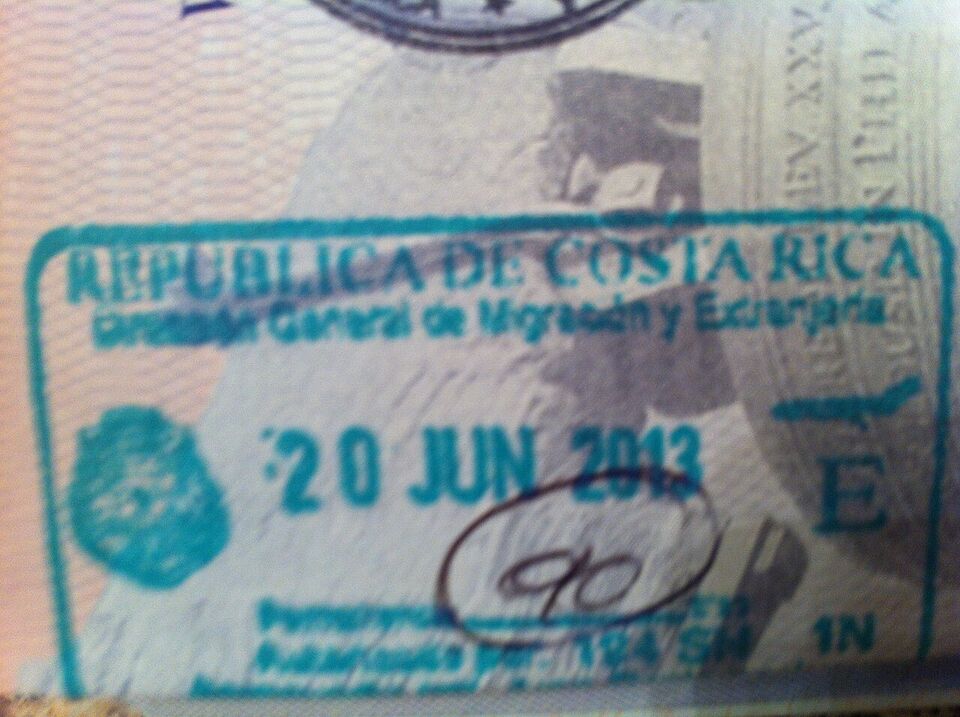
Americans do not need a visa to visit Costa Rica. You arrive with a US passport, show that you plan to leave, answer a few questions, and the immigration officer stamps your passport with the number of days you may stay. The ceiling for US citizens is 180 days, but the officer sets the actual number at the desk, so look at the stamp before you walk away.
Everything on this page was checked in November 2026 against the Costa Rica Tourism Board (ICT) entry page, the 2025 immigration directive as reported in the press, the CDC and US Customs and Border Protection. Rules in this area change with a published directive, not with much warning. Before you fly, read the State Department's Costa Rica country page and Costa Rica's immigration service, Migración. Both sites blocked our automated checks in November, so we relied on the tourism board's page and press coverage of the official directive for the details below.
Watch out
Lookalike sites sell "Costa Rica entry permits", "e-visas" and "arrival forms" to US citizens. We found no such paid document for American tourists. The official sites are migracion.go.cr for immigration, visitcostarica.com for the tourism board and travel.state.gov for the US government. Do not pay a third party for something that is supposed to be free.
Your passport
Costa Rica sorts visitors into four groups by nationality. The United States is named in Group 1, the most relaxed group, in a directive Migración published on November 17, 2025 (Alcance 148 to La Gaceta 216). For Group 1 the rule is short: your passport must be valid for at least one day when you arrive, and the stay the officer grants cannot go past the passport's expiry date.
That second half matters more than the first. If your passport expires in 40 days, the most you can be granted is 40 days, even if you only planned a week. We suggest a passport that is valid for the whole trip with comfortable room to spare. Other countries on your itinerary, and some airlines, apply their own validity rules, and you do not want to find out at a check-in desk.
- A regular US passport book. The ICT page says the passport must be machine-readable, which every current US passport book is.
- A passport in good condition. We found no official wording about damaged passports, but a travel-cost report that quotes the State Department says immigration may refuse one. Water damage, a detached cover or a cut page is a reason to renew before you go.
- Two or more blank pages are a sensible habit, since the officer stamps your entry.
A US passport card is not a good idea for this trip, because it works only at US land and sea border crossings with Canada, Mexico and the Caribbean. For flying to Costa Rica you need the book.

How long you can stay
The tourism board lists Group 1 as "up to 180 calendar days, non-extendable". The officer decides the actual number when you enter. Most visitors on a one- or two-week trip never think about it, but read the stamp anyway: the days written there, not the 180 you read online, are the legal limit for your visit.
Extensions are limited. La Nación reported in January 2026 that if the officer first grants fewer than 90 days, one extension of up to 90 more days is possible, and the same article says the 180-day stay itself is not extendable. The tourism board only says "non-extendable". If you want to stay longer than the days you were given, ask Migración in person or through its website before the stamp runs out. We do not recommend planning a trip around leaving and re-entering to reset the clock. The 2025 rules make that less certain than blog posts from earlier years suggest, and we found no official source that endorses it. Our long stays guide covers remote work, residency and the realities of staying months rather than weeks.
Overstaying has consequences. Reports based on the State Department's page mention fines, deportation and a possible future entry ban. If you are unsure of the date, count from the day on your stamp and leave early rather than late.
Different from home
US entry rules for foreign visitors are mostly decided before you board, with a visa or ESTA. Costa Rica works the opposite way for Americans: there is no pre-approval, and the officer at the airport decides your length of stay on the spot. That is why the stamp matters, and why a printed itinerary and an onward ticket in your bag are worth having.
Proof of onward travel and funds
This is the rule travelers most often get wrong. The ICT entry page says every visitor needs proof of return or onward travel, and that the immigration officer "will ask to see" it on arrival. It stresses three situations where you must have it ready:
- You are arriving on a one-way ticket.
- Your return flight is more than 90 days after your arrival date.
- You are flying in and flying out of a different country (for example arriving in San José and leaving from Panama City).
By law the proof can be a pre-purchased flight out of the country, a pre-purchased bus ticket out of the country or proof of passage on a cruise ship. A hotel booking, a rental car reservation or a plan to "figure it out later" does not count. If you are combining Costa Rica with Panama or Nicaragua overland, buy the bus ticket out, or an onward flight, before you land. Our guide to Panama and Nicaragua explains the border crossings.
Airlines see this requirement too. A US carrier that is worried about flying you to a country that might turn you away can ask for your return at check-in. Keep the e-ticket on your phone and a paper copy in your bag, in case the signal at the immigration hall is poor.
Proof of funds
The same page says an officer may ask you to show economic means of at least US$100 for each month or partial month of your stay. On a two-week trip that is a single US$100. In practice this means a credit card, a bank app or some cash. We know of no fixed form to fill in, and most travelers are never asked. Still, answer plainly and show the card or the app if you are.
Forms, health rules and vaccines
As of mid-November 2026, we found no required arrival form, health pass or online registration for US visitors on the tourism board's entry page, and none on the State Department's country page. Earlier pandemic-era requirements are gone. We cannot read Migración's own site, so the safe wording is this: check migracion.go.cr in the week before your flight, and treat any paid "pre-registration" as a red flag.
Yellow fever
The CDC does not recommend the yellow fever vaccine for visitors to Costa Rica. The country requires proof of vaccination only from travelers aged nine months and older who arrive from countries with yellow fever risk. The CDC's list includes several African countries and, in the Americas, Bolivia, Brazil, Colombia, Ecuador, Guyana, French Guiana, Paraguay, Peru, Suriname, Trinidad and Tobago and Venezuela. If you fly from Miami, Atlanta, Houston, Dallas or Newark, this does not apply to you. It could matter if your itinerary includes a long stay in one of those countries just before Costa Rica, or if you connect through a South American hub, so check with the airline.
The tourism board's entry page also mentions a rule that began on August 31, 2026 for yellow fever vaccination. It applies to Costa Rican citizens and residents leaving for at-risk destinations, not to visitors arriving, so ignore it on this trip.
Health notices
The CDC lists a chikungunya outbreak notice for northwest Costa Rica (updated July 30, 2026) and a hepatitis A outbreak notice, with most cases in San José province (September 18, 2026). They are not entry requirements, but they are a reason to read our health and medical care guide before you pack.
Arriving at San José (SJO) and Liberia (LIR)
Whichever airport you use, the sequence is the same. Our flights guide explains how to choose between them.
- Walk to immigration. Follow the "Migración" or "Immigration" signs from the gate. Have your passport out, and your onward ticket and hotel address ready on your phone. Lines are the main variable. They can be long at peak times, and at San José the terminal is under construction: work on the departures level, mostly security and immigration areas, began in July 2026 and is due to finish in the second half of 2027. Allow extra time for anything you have booked within a couple of hours of landing.
- Speak to the officer. You will usually be asked how long you are staying, where you are staying and whether you have a ticket out. Answer briefly and truthfully. Say "tourism" if asked about the purpose of your visit. The officer stamps the passport and writes the permitted days.
- Collect your bags. Screens show the belt for your flight. Carts are available in the baggage area.
- Customs. Bags are x-rayed or checked at the exit. If you carry cash of about US$10,000 or more, or goods you must declare, use the declaration channel (see the next section).
- Exit to the arrivals hall. San José's official site lists a currency exchange house, free Wi-Fi throughout the terminal and duty-free shops. For taxis, SIM cards and shuttles, see our guides to money and phones and data.
Liberia works the same way on a much smaller scale. The airport (Daniel Oduber Quirós International Airport, sometimes branded "Guanacaste Airport") is about 7 miles (11 km) west-southwest of Liberia city and operates only from 6 a.m. to 9 p.m. Because it is small, a pile of flights landing together can still make the immigration hall busy. A late flight that would land after 9 p.m. is not an option there, regardless of what a search engine shows.
Insider tip
Take a photo of the stamp page on your phone as soon as you are through immigration, and tuck a paper copy of your passport photo page and stamp into your daypack. The ICT recommends carrying a photocopy of your passport with the entry stamp at all times, which lets you leave the original in the hotel safe on days when you are not driving or changing money.
What immigration may ask for
Most arrivals take under a minute at the desk. These are the items officers are allowed to ask about, so have them in one place:
- Your passport with space for the stamp.
- Proof of return or onward travel (flight, bus or cruise ticket).
- Your first night's address, and a hotel confirmation if you booked ahead. The tourism board's list does not name it, but it is a common question.
- Proof of funds, at least US$100 for each month of your stay, if the officer asks.
- Your return flight details and a rough itinerary, in case of questions.
If the officer grants you fewer days than you need, politely say how long you plan to stay and show your ticket. The decision stays with the officer, but a clear answer and a ticket that matches your plan make it easy to grant what you asked for.
Customs: what you can bring into Costa Rica
Costa Rican customs (the Aduana) has its own limits on goods and cash. We could not confirm the allowance figures on an official page, so we give only the points we could trace to government-linked sources:
- Cash. Declare cash or monetary instruments of about US$10,000 or more when you arrive or leave. Both a State Department-based report and a customs guide give that figure.
- Personal items and gifts. Clothes, a camera, a laptop and a phone for your own use are normal. If you are carrying a lot of new electronics or gifts, ask Aduana about the current duty-free allowance before you go; we have not confirmed it.
- Food, plants and animal products. SENASA, the agriculture health service, controls these. Do not bring fresh fruit, meat, seeds or plants. Pets have their own paperwork: see traveling to Costa Rica with a pet.
- Medicines. Bring them in original labeled containers, in your carry-on, in the quantity you need for the trip. Add a doctor's letter for controlled medicines.
- Drones. The rules are strict, and the only source we found was a third-party guide. It says recreational drones need no registration but must stay in daylight and line of sight, 30 meters (about 100 ft) from buildings and 8 km (5 miles) from airports. It also lists Arenal Volcano among the no-fly zones. We do not recommend flying one in any park. Check before you fly.
Pets are not allowed inside Costa Rica's protected wilderness areas, which includes national parks, a point worth knowing if you travel with a dog.
What to carry with you
You do not need to carry your passport everywhere, but the ICT does recommend that you keep a photocopy of the passport with the entry stamp on you, and some situations call for the original: changing money at a bank or an exchange house (they ask for the original passport, not a copy), buying national park tickets (the booking uses your passport number) and picking up a rental car. For more on rental paperwork, see our car rental guide.
- Passport (original in the hotel safe or a hidden pouch, copy with the stamp in your daypack).
- Your US driver's license, if you will rent a car. No International Driving Permit is required, and the license is valid for as long as your entry stamp allows, according to most sources (some say 90 days). Carry your passport with the entry stamp, and confirm with your rental company.
- Proof of onward travel on your phone and on paper.
- Travel insurance details, including a medical evacuation policy number. The CDC says trauma care is uncommon outside urban areas.
- The embassy number: U.S. Embassy San José, +506 2519-2000, in the Pavas district. From outside Costa Rica, the State Department's 24-hour line is +1-202-501-4444.
- A card that works abroad, and a little cash in small bills. See money in Costa Rica.
Leaving Costa Rica: the departure tax
Everyone flying out of San José or Liberia pays a departure tax. The tourism board's FAQ puts it at US$29 per person, payable in US dollars, colones or by credit card, and most airlines now fold it into the ticket price. Older sources quote US$27 or US$31, so you may see different numbers on blogs; US$29 is the figure on the official site.
How to check it: look at the fare breakdown on your e-ticket for a line labeled "CR" or "departure tax" or ask the airline. If it is not included, pay at the departure-tax counter in the terminal before you check in with the airline. A private travel company says that paying by card carries an extra US$10 fee because it is processed as a cash advance, so bring cash for it if you can. We could not confirm the fee on an official page.
We found no source for the tax on cruise passengers or for land crossings, so ask your cruise line (our cruise guide covers the ports) and assume that it applies to air departures only. Arrive earlier than you would at a US airport of the same size, particularly at San José while the terminal work continues.
Children, families and minors
We found no Costa Rican rule that requires a US child traveling with one parent to carry a permit. The immigration exit permit (permiso de salida) that you may read about applies to minors who are Costa Rican nationals, including dual citizens, and to legal residents. One news report adds that a child born in Costa Rica to American parents is a Costa Rican national and would need it. If your child was born in the US, the exit-permit rule does not apply to you.
Airlines are another matter. Many ask for a notarized letter of consent when a child travels with one parent or with someone who is not a parent. That is general advice, not a Costa Rican law, so carry the letter, a copy of the birth certificate and the other parent's contact details. Our family travel guide has more on traveling with kids.
Coming home to the US
US citizens re-enter with a passport book or card at the airport. CBP sets the rules for what you can bring back. We could not confirm the duty-free allowance on CBP's pages in November 2026, so we give no figure. Check the allowance for your trip on CBP's Know Before You Go page before you shop, and declare everything you bought.
- Coffee and chocolate. CBP says condiments, vinegars, oils, packaged spices, honey, coffee and tea are generally admissible.
- Fruit and vegetables. These are restricted depending on the type and where they come from. Declare any you carry or leave them behind.
- Meat. Fresh, dried and canned meat products are not admissible, and neither are soup mixes that contain meat. CBP also suggests avoiding rice.
- Wildlife products. Feathers, bones, skins, eggs, shells and anything made from endangered species are restricted or banned. Skip carved turtle shell, coral and bird feathers, however convincing the vendor is.
- Alcohol. The laws of the state where you first arrive in the US govern how much you can bring, so check yours.
- Plants and seeds. Rules apply, and you will need to declare them.
Our shopping and taking things home guide lists what is worth buying and how to pack it. Answer the declaration honestly: a declared item that turns out to be prohibited is usually confiscated, while an undeclared one can bring a fine.
A checklist for the week before you fly
- Check your passport's expiry date and condition.
- Confirm your return or onward ticket and keep it on your phone and on paper.
- Read the State Department's country page and, if you want to be sure, Migración's site. See our safety guide for the advisory in plain language (as of mid-November 2026 it is Level 2, "exercise increased caution", mostly because of crime).
- Look at your airline's baggage and document rules.
- Download maps and keep a screenshot of your hotel address.
- Pack a printed copy of your insurance card and the embassy number.
- Check the departure tax on your ticket.
The Costa Rica FAQ answers more of the common questions, and the trip planning guide turns the rules above into a schedule.
Add it to a route in the trip builder, or ask us to plan the hotels, transfers and guides for you.