The short answer
Costa Rica has two international airports that matter to visitors: Juan Santamaría International Airport (SJO) at Alajuela, near San José, and Daniel Oduber Quirós International Airport (LIR) near Liberia in Guanacaste. Pick the one nearest your first base. Landing at the wrong one can add four or five hours of driving to your first day. San José is the right choice for Arenal, Monteverde, Manuel Antonio, the south Pacific, the Osa and the Caribbean. Liberia is the right choice for Guanacaste's beaches and Rincón de la Vieja.
Nonstop flights reach both airports from many US cities. This page lists who flies where as of mid-November 2026, what is new this winter, how to choose, what to expect when you land, and how to move on from each airport. Some routes are seasonal and schedules change, so check your airline's page for your dates before you buy. The airport operators publish arrivals and departures at sjoairport.com for San José and on the Liberia airport's own site, and the Costa Rica Tourism Board's visitcostarica.com keeps an airline list.
San José or Liberia: how to choose
The question is not which airport is nicer. It is where you will sleep your first night and how much of the country you want to see. The table below shows average drive times from the Costa Rica Tourism Board's travel guide, plus one source for Nosara. They are averages without stops, so add time for rain, roadworks, slow trucks and the habit of mountain roads to take longer than the map suggests.
| Destination | From San José (SJO) | From Liberia (LIR) |
|---|---|---|
| Arenal and La Fortuna | about 2.5 hours | about 3.25 hours |
| Monteverde | about 3.5 hours | about 2.5 hours |
| Manuel Antonio and Quepos | about 3 hours | about 5 hours |
| Jacó | about 2 hours | about 3 hours |
| Dominical / Uvita | about 4 / 5 hours | about 7 hours to Dominical |
| Tamarindo | about 4.5 hours | about 1 hour |
| Flamingo and Papagayo area | about 4.5 hours (Flamingo); about 4 hours (Papagayo) | about 1 hour (Flamingo) |
| Nosara | about 5 hours | about 2.5 hours in good conditions; the last stretch is unpaved |
| Sámara | about 4 hours | about 2.75 hours |
| Puerto Viejo de Talamanca and Cahuita (Caribbean) | about 4.5 hours / about 4 hours | not practical |
| Poás and Irazú volcanoes | about 1 hour | not practical |
| Tortuguero (boat access) | about 2.5 to 3 hours to the boat dock, then 1 to 1.5 hours by boat | not practical |
The Osa Peninsula and Corcovado are a long day from either airport. Manuel Antonio to Puerto Jiménez is about 5.5 hours by the same source, and many visitors fly by small plane instead (see the domestic flights section below). The two airports are about 3 hours apart by road. Our Osa Peninsula guide and destinations overview show where each place sits.
A simple way to decide
- One beach base in Guanacaste (Tamarindo, Papagayo, Flamingo, Nosara, Playas del Coco): fly into Liberia. You save about three hours each way compared with San José.
- Volcano and rainforest trip (Arenal, Monteverde, Manuel Antonio): fly into San José. Monteverde is closer to Liberia on paper, but the extra flight choice and the road to Manuel Antonio favor San José.
- Caribbean or the south (Tortuguero, Puerto Viejo, Uvita, Osa): San José.
- Two regions, one in each direction: consider flying into one airport and out of the other. See the tip below.
- Staying in San José itself or near it, or arriving after 9 p.m.: San José.
Insider tip
An "open-jaw" ticket, flying into Liberia and out of San José (or the reverse), can save a day of backtracking on a trip that crosses the country, for example beaches first, then the volcano, then the capital. Search "multi-city" on your airline's site and compare it with the round-trip fare. Ask your rental company about one-way drop-off fees before you commit. See our trip planning guide for routes that work.

Nonstops to San José (SJO)
San José is the busier airport and the one with more airlines. The list below is compiled from airport route listings in November 2026. Entries marked seasonal do not fly all year, and listings can be out of date, so confirm on your airline's site.
| Airline | US cities (nonstop to SJO) |
|---|---|
| American | Charlotte, Dallas/Fort Worth, Miami; Chicago O'Hare (seasonal) |
| Delta | Atlanta; Los Angeles (seasonal) |
| United | Houston, Newark, San Francisco; Chicago, Denver and Los Angeles (seasonal) |
| Southwest | Houston Hobby, Orlando; Baltimore and Denver (seasonal); Austin from March 13, 2027 (Saturdays) |
| JetBlue | Fort Lauderdale, New York JFK |
| Alaska | Los Angeles |
| Frontier | Atlanta and Orlando (seasonal) |
| Breeze | Tampa (Wednesdays and Saturdays, new from October 3, 2026) |
| Avianca Costa Rica (based at SJO) | Miami, New York JFK, Washington Dulles; Chicago O'Hare (seasonal) |
Beyond the US, Mexican, Central and South American, Canadian and European airlines also fly to San José. As of the 2026-27 winter, British Airways flies from London Heathrow five days a week (Tuesday, Wednesday, Friday, Saturday and Sunday) and Lufthansa from Frankfurt five days a week through March 27. Canada has new routes too: Porter from Toronto (four a week, December 2 to April 30) and Air Transat from Quebec City (weekly from December 15).
Nonstops to Liberia (LIR)
Liberia is smaller but growing fast. The airport had its busiest quarter on record in early 2026, and the Costa Rica Tourism Board reported US arrivals to Liberia up 8 percent in the first quarter of 2026. Many airlines fly only in the dry season. The list below is compiled from airport route listings in November 2026.
| Airline | US cities (nonstop to LIR) |
|---|---|
| American | Charlotte, Dallas/Fort Worth, Miami; Chicago O'Hare and Philadelphia (seasonal) |
| Delta | Atlanta, Los Angeles; Boston, Detroit and Minneapolis/St. Paul (seasonal); New York JFK on Saturdays, December 19, 2026 to April 10, 2027 |
| United | Houston; Chicago, Denver, Los Angeles, Newark and San Francisco (seasonal); Washington Dulles daily, December 17, 2026 to January 4, 2027 |
| Southwest | Houston Hobby; Baltimore and Denver (seasonal); Nashville on Saturdays, February 13 to March 6, 2027 |
| JetBlue | Fort Lauderdale, New York JFK; Boston (seasonal) |
| Alaska | Los Angeles; San Francisco and Seattle (seasonal) |
| Sun Country | Dallas/Fort Worth and Minneapolis/St. Paul (seasonal) |
Canadian routes to Liberia are plentiful. Air Canada's Vancouver service runs Mondays and Thursdays from December 13 to April 12, and WestJet's Ottawa flight runs Sundays from December 20 to April 4.
Watch out
Liberia's airport operates only between 6 a.m. and 9 p.m. A flight that would arrive later is not available, whatever a search shows. The tourism chief said in June 2026 that he supports keeping the airport open 24 hours, but nothing has been approved. Also read the end dates on seasonal routes: several winter flights run for weeks, not months, and a return flight that does not exist yet is a common way to get stuck paying for a change.
What is new this high season
The Tico Times counted fourteen new or expanded nonstop services between October 2026 and March 2027. The ones that matter to Americans:
Breeze: Tampa to San José
Breeze's first service to Costa Rica, on an Airbus A220. Tampa had no direct link to San José for more than 25 years.
Southwest: Austin to San José
The only nonstop between Central Texas and San José. It leaves Austin at 10:25 a.m. and lands at 2:05 p.m.; the return leaves at 3:05 p.m.
Southwest: Nashville to Liberia
A four-week window, the shortest on the list, on a Boeing 737 MAX 8. Book early if you want it, and have a plan B.
United: Washington Dulles to Liberia
A holiday-season route on a Boeing 737 MAX 9. It makes United a presence at Liberia from all of its US hubs.
Delta: New York JFK to Liberia
Delta returns to this route on an Airbus A321neo after years without it, in addition to its flights from Atlanta, Boston, Detroit and Minneapolis/St. Paul.
One heavily promoted route did not happen: Southwest cancelled its planned Las Vegas to San José service in July 2026 before any flight operated. That leaves the western US where it was. From Nevada, Arizona and most of California you still connect, except for the Los Angeles and San Francisco nonstops above.
Flight times and time zones
As a rough guide, nonstop flights take about 2.5 to 3.5 hours from Florida and Texas, about 5 hours from the New York area and about 5.5 to 6 hours from California; exact times vary by airline and season. One confirmed example: Southwest's Austin flight leaves at 10:25 a.m. and lands at 2:05 p.m. local time. Because Austin and Costa Rica are on the same clock on March 13 (Texas is still on Central Standard Time that day and Costa Rica is on UTC-6), that is a block time of about 3 hours 40 minutes. Look at the departure and arrival times on your own itinerary, and remember that the time zones differ.
Costa Rica is on UTC-6 all year with no daylight saving time. It is one hour behind New York from early November to mid-March and two hours behind for the rest of the year. Chicago is the same time as Costa Rica in winter, and Los Angeles is two hours behind Costa Rica in winter. Short time differences mean little jet lag, a real advantage over Europe or Asia. Our phones and power guide has a full time zone table.
When to book and what drives the price
We have no fare data to quote, and fares move daily, so we describe only how demand works. Costa Rica's high season runs from December to April, the Pacific dry season. Demand peaks from mid-December to early January, around Easter week (Holy Thursday and Good Friday fall on March 25 and 26 in 2027) and in the weeks of school breaks. The green season, roughly May to November, is typically cheaper for flights and hotels. One travel-cost source says lodging can drop 20 to 40 percent in the green season.
- Book holiday flights early. If you want to be in Costa Rica from mid-December to early January, or over Easter week, book as soon as your dates are firm. Routes with short windows, such as United's Dulles flights, can sell out or be pulled if they do not sell.
- Use a fare calendar. Check a week either side of your dates. A Tuesday or Wednesday departure is often cheaper than a weekend one, though not always.
- Compare both airports. A fare to Liberia can be higher or lower than one to San José, and the cost of the drive matters too.
- Watch seasonal routes. If a specific nonstop matters to you, buy it early. Travel insurance that covers trip interruption protects you if an airline drops the flight after you have booked hotels and tours.
- Know your holidays. December 1, 2026 (Tuesday) and December 25, 2026 (Friday) are public holidays, and Costa Ricans travel in numbers around them. See our December guide and when to go guide.
Save money
If your dates are flexible, consider the first weeks of December before the Christmas rush or the weeks after New Year. They are still dry season, but they tend to be in less demand than the peak holiday week. Compare the cost of a rental car, a shuttle and a domestic flight before deciding on a routing: the cheapest airfare is not always the cheapest trip.
Arriving and departing: tips for each airport
Arriving
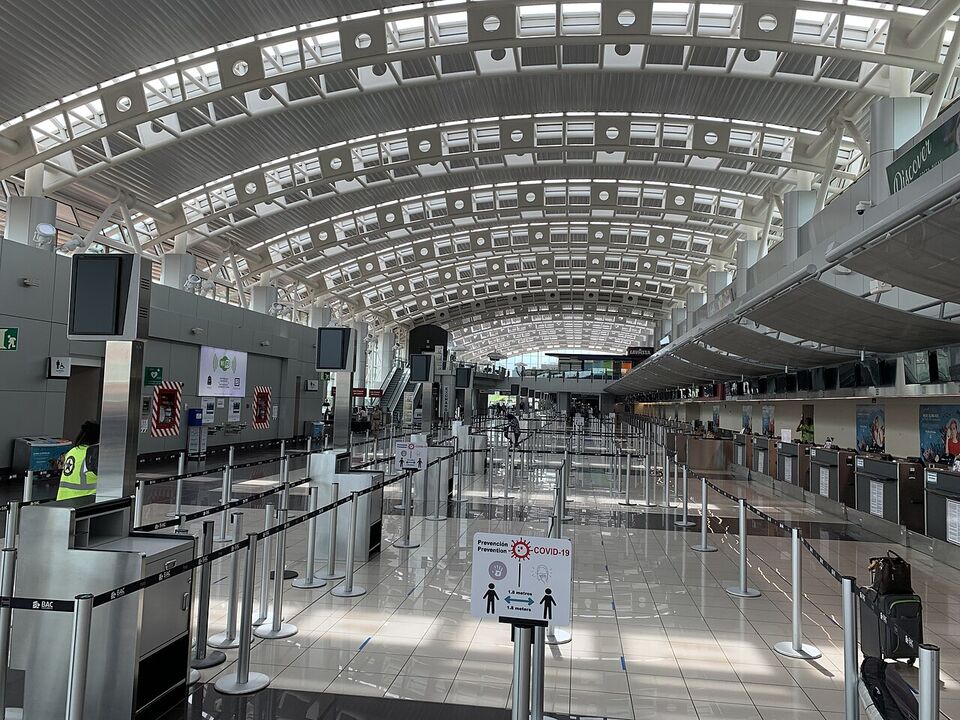
- Allow time at immigration. Lines can be long at peak hours. At San José the terminal is being expanded: work on the departures level, mainly security and immigration areas, began in July 2026 and should finish in the second half of 2027. Some parking areas are closed. Our entry requirements guide walks through the arrival steps and the documents to carry.
- Plan the first night. If you land late and face a long drive on mountain roads, sleep near the airport and go in daylight. Costa Rican road guides advise driving in daylight, and darkness falls around 5:30 to 6 p.m. most of the year.
- Money and phones. San José's airport has an exchange house and free Wi-Fi throughout. Do not count on buying a SIM card at either airport. See money and phones and data.
- Rental cars. A pickup at the airport usually adds a surcharge of about 12 to 13 percent on top of the 13 percent tax, according to one expat guide. Ask whether the price you were quoted includes it. Our car rental guide explains insurance.
Departing
- The departure tax is US$29 per person, and most airlines include it in the ticket. If not, pay at the departure-tax counter before airline check-in. A private source says paying by card adds a US$10 fee, so carry cash.
- Allow extra time at San José while the terminal work continues. Heavy return traffic on Sunday evenings can add about an hour to the drive back to the airport, according to a rental company.
- Driving back from the Pacific coast. One rental company's guide reportedly warns of petty theft at the stop by the Tárcoles river bridge, so do not leave valuables visible in the car.
- Last day. Spend any leftover colones and check that your onward flight to the US allows enough time for US customs. Our entry guide covers what you can bring home.
Getting from the airport
From San José (SJO)
The airport is in Alajuela, about 12 miles (20 km) northwest of downtown San José, with an exit from Route 1 near the exit for Alajuela. There is no rail service to the terminal: the commuter train between San José and Alajuela passes close but does not serve it.
- Official taxis: licensed taxis are red with yellow triangles on the doors, and a special airport service uses orange taxis. Taxis take colones and US dollars. Expect about US$25 to US$35 to central San José, and agree the fare or use the official taxi desk before you go.
- Uber: widely used, but in a legal gray area; there is no platform law as of mid-November 2026. A pilot lets about 100 airport taxis be booked in the Uber app. If you use a ride-hailing app, drivers may ask you to meet away from the arrivals exit.
- Public bus: a bus stop near the terminal has frequent service to downtown San José for a few dollars. Check the fare at the stop.
- Shuttles: shared shuttles on popular routes run roughly US$40 to US$70 per person, and private transfers roughly US$200 to US$400 per vehicle, depending on the route. Companies include Interbus, which says it has more than 180 routes and offers discounts for booking two to three months ahead. Caribe Shuttle runs shared shuttles and says it is not taking private transfer requests at this time.
From Liberia (LIR)
The airport is about 7 miles (11 km) west-southwest of Liberia city. We found no published taxi fares for it, so agree the price before you get in. Most visitors rent a car at the airport or book a shuttle or private transfer to their beach base. Distances are in the table above. For a rental, see getting around Costa Rica and our Guanacaste guide.
Domestic flights and small airstrips
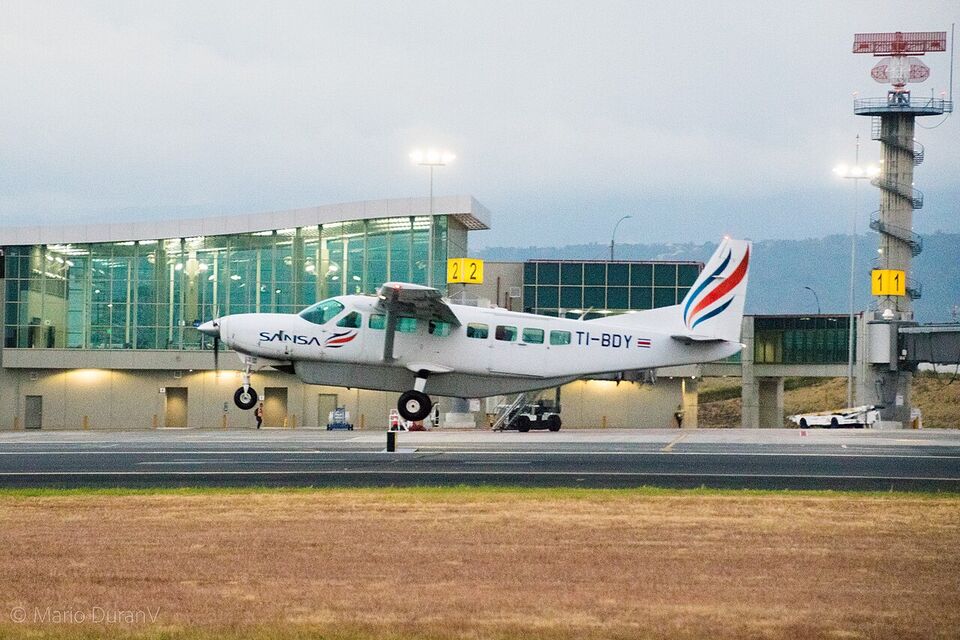
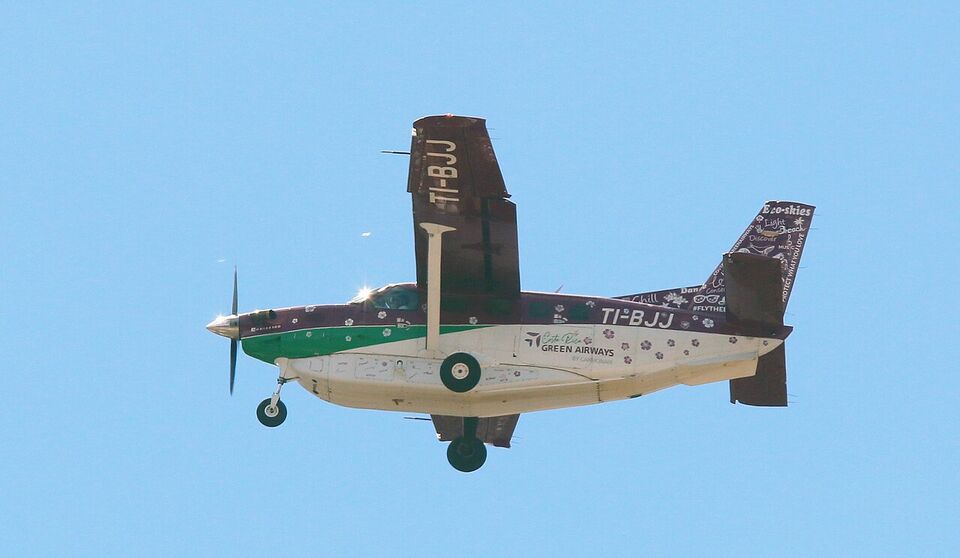
Small planes link places that take half a day by road. Sansa Airlines, the main domestic carrier, lists flights to Drake Bay, Golfito, La Fortuna, Liberia, Nosara, Puerto Jiménez, Limón, Quepos (for Manuel Antonio), San José, Santa Teresa, Tamarindo and Tortuguero, plus Bocas del Toro in Panama and Managua. Costa Rica Green Airways flies a smaller network that includes Quepos and Tambor. Reservations for Sansa are on its website or at +506 2290-4100.
Fares are not published on the pages we could read. Blogs put a Sansa flight from San José to Tamarindo at about US$90 to US$155 in high season, Tortuguero at about US$100 to US$120 or more one way and Nosara at US$100 to US$200. Treat those as ballpark figures. Domestic flights leave from San José's domestic terminal (separate from the international one), so ask your airline which terminal you need.
Different from home
Domestic flights use small propeller planes. Baggage allowances are small (one blog says 30 pounds, but that is unverified, so check with the airline), and weight limits can be strict. Pack in a soft duffel bag and leave bulky luggage at your hotel in San José.
Flights are worth the cost to Tortuguero, the Osa and Nosara if time is short, and can be the only sensible way to reach some lodges. For most other trips, a shuttle, bus or rental car is cheaper. Our Tortuguero guide covers the boat and flight options.
Connecting through US hubs
If there is no nonstop from your home airport, connect through one of the hubs that fly to Costa Rica: Atlanta, Charlotte, Dallas/Fort Worth, Houston, Miami, Newark, Chicago, Fort Lauderdale or New York JFK, among others, depending on the airline. A few practical points:
- Stay on one ticket. If your first flight is late and the connection is on a separate ticket, you are on your own. A single itinerary protects you.
- Allow a realistic layover, and more in winter, when delays and storms are common at Northeast and Midwest hubs.
- Connecting through Latin America (Bogotá, Panama City, Lima, Mexico City) is possible but can raise a health-rule question: Costa Rica asks for a yellow fever certificate from travelers arriving from certain countries, including Colombia, Brazil and Peru. Check with your airline and see our entry guide.
- The return trip: you clear US immigration and customs at your first US airport. Allow time for that if you connect onward.
Once you know your airport and dates, the next steps are the trip planner and the FAQ.
Add it to a route in the trip builder, or ask us to plan the hotels, transfers and guides for you.