The short answer
The best time to visit Costa Rica depends on where you are going. For the Pacific side (Guanacaste, Manuel Antonio, Uvita, the Osa Peninsula) and the Central Valley, the dry season from December to April is the popular choice: sunny mornings, dependable beach days and the highest prices. For the Caribbean side, the pattern is different, and February-March and September-October tend to be the more settled spells.
The green (rainy) season is not a bad time to visit. It runs roughly May to November, brings lush scenery, fewer visitors and lower lodging rates, and most rain falls in short bursts. If you can only pick one thing to avoid, avoid the peak of the green season on the Pacific side (September and October) if you want beach days, and avoid Christmas-New Year and Holy Week if you hate crowds and high prices.
This page covers the whole year. For single-month detail, see Costa Rica in November, Costa Rica in December, Costa Rica in January, Costa Rica in February and Costa Rica in March. For choosing regions and routes, use the trip-planning page.
Dry season and green season: what each feels like
Costa Rica sits close to the equator, so temperatures change little through the year. What changes is rain, wind and crowds. The Costa Rica Tourism Board (ICT) describes the Pacific side as having a well-defined dry season from December to March, with April a transition month and March the driest and hottest. The rainy season runs from May to October, and November is a transition month.
The dry season (December to April)
Expect sun, blue skies and little rain on the Pacific side. Guanacaste can be very hot, and ICT calls March the hottest month. Roads and trails are firm, boat trips run on schedule, and the beaches are at their best. It is also when hotels, lodges and rental cars are most expensive and most likely to sell out, and when popular parks have the longest lines.
Even in the dry season, the highlands are not dry in the way a beach is. Monteverde and the volcano areas keep their clouds, mist and wind, so pack a light rain jacket for them in any month.
The green season (May to November)
ICT says rain on the Pacific side mainly falls in the afternoon and early evening. In practice, that means planning outdoor activities for the morning and leaving afternoons flexible. Hikers get lush forest and full waterfalls, rivers run higher for rafting, and prices drop. The tradeoffs are muddy trails, occasional road trouble, and a few weeks, mainly September and October, when rain can be steady for days.
There is also a short break in the rain, called the veranillo ("little summer"), in July and August on the Pacific side. It is a dip, not a dry spell, and it does not apply to the Caribbean.
Insider tip
In the green season, book morning tours and park visits first. ICT also recommends visiting Guanacaste's national parks in the morning at this time of year. Keep afternoons for a spa, a long lunch or a drive.
Month by month
The table summarizes the pattern. Rain and price patterns follow the ICT weather page and general price patterns from travel-cost sources, and "peak" or "shoulder" labels are our simplification: each lodge sets its own dates. Always check your own lodge's rate calendar.
| Month | Pacific side and Central Valley | Caribbean side | Crowds and prices |
|---|---|---|---|
| January | Dry season, sunny and breezy | Still wet; the strongest rainy period ends | High season |
| February | Dry and sunny | Relatively drier | High season |
| March | Driest and hottest month | Relatively drier | High season; Holy Week falls March 21-28, 2027 |
| April | Transition: first showers, still hot | Rain increases | High season early, easing later |
| May | Green season begins, afternoon showers | Wet period starts | Low to shoulder |
| June | Green, frequent afternoon rain | Wet | Low |
| July | Short dip in rain (veranillo) | Peak rain | Low to shoulder |
| August | Veranillo continues | Wet | Low to shoulder |
| September | Among the rainiest months | Relatively drier | Lowest prices |
| October | Among the rainiest months | Relatively drier | Lowest prices |
| November | Transition; rain eases late in the month | Wet period begins | Shoulder; prices rise toward December |
| December | Dry season starts | Wettest month | Peak from mid-month |
The next table shows average monthly rain, rounded, from published climate records for San José and the Caribbean lowlands, with a words-only pattern for Guanacaste, where we found no published figures to rely on. A millimeter is about 1/25 of an inch, so 250 mm is about 10 inches. These are averages: individual years vary a lot, and 2026-27 is expected to be unusual (see the El Niño note below).
| Month | San José and Central Valley | Liberia and Guanacaste (pattern only) | Caribbean lowlands (Limón area) |
|---|---|---|---|
| January | 6 | almost none | 320 |
| February | 10 | almost none | 200 |
| March | 14 | almost none | 195 |
| April | 80 | light | 285 |
| May | 270 | heavy | 280 |
| June | 280 | heavy | 275 |
| July | 180 | lighter (veranillo) | 410 |
| August | 275 | heavy | 290 |
| September | 355 | heaviest | 165 |
| October | 330 | heaviest | 200 |
| November | 135 | moderate, easing | 365 |
| December | 35 | very little | 400 |
Notice the two shapes. The Pacific-side columns are close to zero from January to March and spike from May to October. The Caribbean column never falls near zero, and its lowest month (September, about 165 mm) is still wetter than a dry month on the Pacific side. These figures come from published climate tables (Wikipedia pages for San José airport and Limón airport), not from our own measurement, so use them to compare regions, not to predict a day. For current forecasts, check the Instituto Meteorológico Nacional at imn.ac.cr.
The Pacific versus the Caribbean side
The mountains that run down the middle of the country split the weather. The Pacific side has a dry and a rainy season. The Caribbean side, according to ICT, has no well-defined dry season: rain stays between 100 and 200 mm even in the driest months. It has two relatively dry periods, February-March and September-October. The first lines up with the Pacific dry season, and the second lands in the Pacific's rainiest months.
Between those drier periods are two wet periods. The first, from November to January, is the strongest, and December is the wettest month because of cold fronts from the Northern Hemisphere (most active from November to March). The second runs from May to August and peaks in July. Rain on the Caribbean side falls mostly at night and in the morning, unlike the Pacific's afternoon showers.
That means a Christmas trip to the Caribbean coast is a bet on wet weather, even though the Pacific is sunny. It also means that September and October, a poor time for the Pacific beaches, are a good time for the Caribbean. Read more on the Caribbean coast and Tortuguero.
Watch out
Do not pair a Caribbean beach stay with a December-to-January trip on the assumption that "dry season" applies to the whole country. It does not. If your dates are fixed in those months, plan indoor and tour options and consider a Pacific beach base instead.
Highlands versus lowlands
Elevation changes temperature more than the calendar does. San José sits at about 3,000 feet (920 m) at the airport, with typical highs around 81-86°F (27-30°C) and lows around 65-67°F (18-19°C), a bit cooler in downtown. Monteverde, at about 4,600 feet (1,400 m), averages around 64°F (18°C) with high humidity and persistent cloud. The Caribbean lowlands average highs near 82°F (28°C), and Guanacaste afternoons are the hottest in the country in the dry season. Mountain summits are cold at night.
Practically, this means you want layers in the highlands (a fleece for Monteverde and the volcano parks) and light, quick-drying clothes on the coast. The highlands get fog and wind even in the dry season, so rain gear matters year-round. Our packing checklist covers the details.
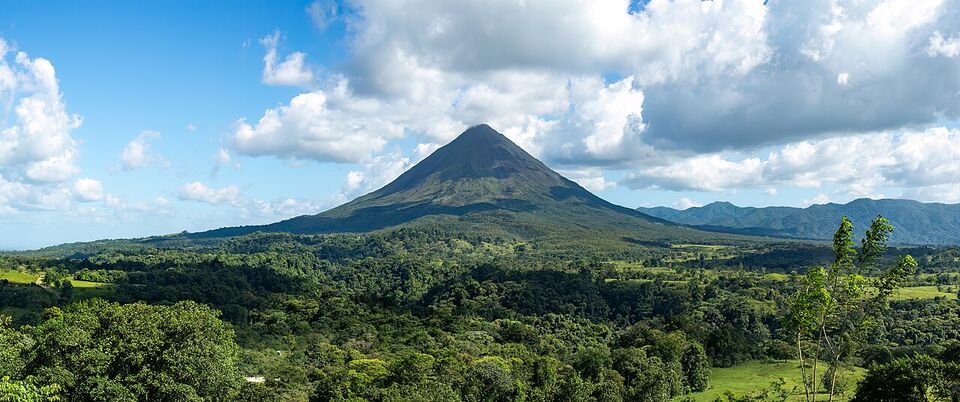
Volcano views are best in the morning. Cloud cover builds as the day goes on, particularly at Arenal, where the summit is often hidden. Do not plan a whole trip around a clear view.
Region by region in one line each
If you already know where you are going, this is the quick version. It combines the ICT regional notes with the climate tables above, so treat it as a guide to the pattern, not a forecast.
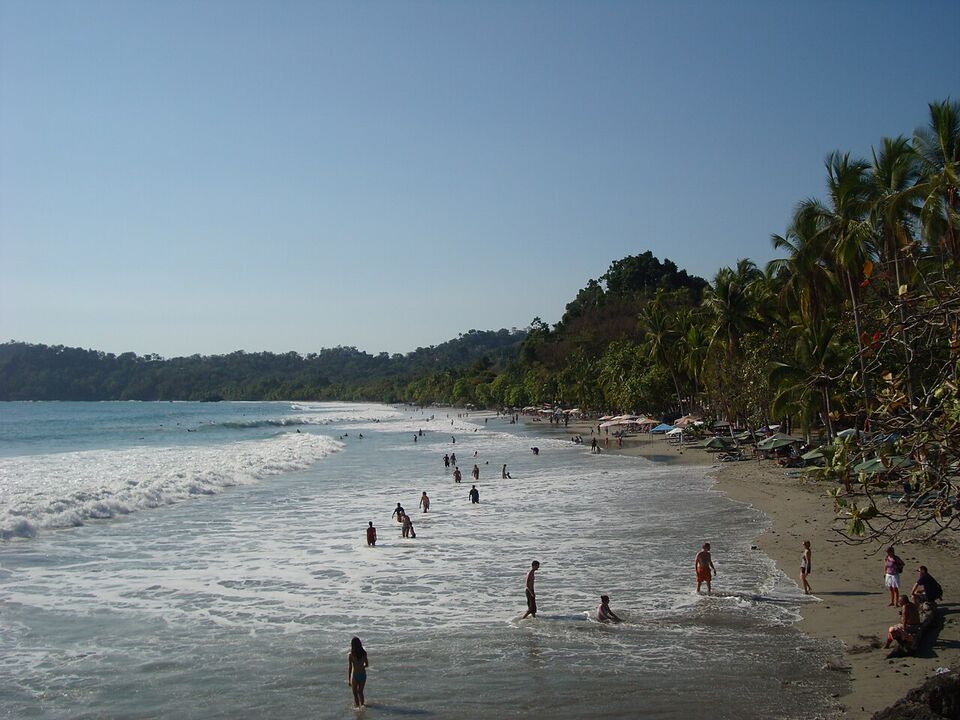
- Guanacaste: the hottest and driest corner of the Pacific side, with beach weather from December to March and real rain from May to October.
- Manuel Antonio and the Central Pacific: a dry season from December to April and some of the heaviest rain in September and October.
- Osa Peninsula: wet for much of the year. December to March is the easiest window for boats, trails and remote roads, and ICT lists Corcovado hiking under the green season.
- Arenal and La Fortuna: showers can come in any month, and clear volcano views are a bonus, not a promise. The hot springs work in any weather.
- Monteverde: misty and breezy from December to April, wetter from May to November. The cloud forest is worth a visit in either season.
- Central Valley: mild all year, with a dry season from December to April and afternoon rain in the green season. Volcano visits are best early.
- Caribbean coast: no dry season, with the best odds in February-March and September-October.
If your trip crosses regions, set the date by the region where weather matters most. A beach week with a two-night cloud forest stop should follow the beach calendar, because mist is part of the cloud forest in every season.
Peak, shoulder and low prices
Lodging prices follow demand. A common pattern, supported by travel-cost blogs and resort guides rather than any official source, is this:
- Peak: mid-December through April. Resort sites describe dry-season rooms as 30 to 40 percent above green-season rates. Tabacón, a hot springs resort in Arenal, treats December 18 to January 8 and Easter week as its special booking windows, which gives a good sense of when demand peaks.
- Shoulder: late November and early December, and May-June, when rain is still light and prices have not yet climbed or have started to fall.
- Low: the wettest months, September and October, with the lowest prices and the fewest visitors.
Operators set their own seasons. A mountain lodge and a beach resort may switch rates on different dates, and some raise prices in mid-December. Ask for the rate calendar before you choose dates. Our budget calculator and where-to-stay guide help you compare.
Save money
If you want the dry-season weather without the highest prices, aim for late January to early March, outside holiday weeks, or the first half of December. Compare shoulder rates against the extra rain risk before deciding. Flights also vary, so price your airfare with and without the holidays.
Holiday weeks to book early
Two periods stand out because both visitors and Costa Ricans travel at the same time.
Christmas and New Year
The days from Christmas to New Year are the tightest of the year. December 25, 2026 is a Friday and January 1, 2027 is a Friday, so many people will take a long stretch. Lodges, rental cars, shuttles and popular tours fill early. Tabacón charges your card 45 days before arrival for stays that fall between December 18 and January 8 (15 days for other dates). Start by locking in lodging and a rental car, then reserve parks. See Costa Rica in December and the festivals page.
Holy Week (Semana Santa)
Holy Week is the other peak. In 2027, Easter Sunday is March 28, and Holy Thursday (March 25) and Good Friday (March 26) are public holidays. Many Costa Ricans also travel that week, so Pacific towns and highways can be crowded, and prices rise. For 2026, the holidays fell on April 2-3. Holidays in Costa Rica keep their fixed dates and do not move to Mondays.
Other public holidays include December 1 (Abolition of the Army), April 11 (Juan Santamaría Day), July 25 (Guanacaste Day), August 15 (Mother's Day) and September 15 (Independence Day). National parks stay open on public holidays unless closed for safety, but tickets and shuttles can be tighter. Manuel Antonio is closed on Tuesdays even when a holiday falls on one, which affects December 1, 2026.
Different from home
Do not expect holidays to shift to a Monday for a long weekend. In Costa Rica a holiday stays on its date, so a Tuesday or Thursday holiday does not always create a four-day weekend. Check the calendar and your lodge's minimum-stay rules for those dates.
Wildlife and surf timing in brief
Wildlife is a year-round attraction, but a few seasonal facts help. ICT lists whale and dolphin watching at Marino Ballena National Park and turtle watching at Tortuguero under the green season. Humpback whales are generally watched from July to October on the southern Pacific, and some sightings are reported between December and April, but we could not confirm a second season, so ask a local operator. Turtle nesting runs for months and varies by species and beach, so ask your lodge for current dates. See the wildlife page for more.
Surf conditions depend on the coast, the beach and the swell, and local surf schools are the best source for what is running during your dates. Our surfing page covers beginner and experienced breaks. In general, Pacific surf towns draw the most visitors in the dry season, and rougher roads and heavier rain in the green season can make access harder at beaches such as Nosara.
For birdwatching and hiking, the dry season gives firmer trails, while the green season gives greener forest and fewer people. Neither is wrong.
Best month for each kind of trip
| If you want | Aim for | Why |
|---|---|---|
| Guaranteed sunny beach days (Pacific) | January to March | Driest period, with the most dependable weather |
| Fewer crowds and lower prices, with decent weather | Late November or May-June | Rain is lighter than in September and October and prices are lower than in peak |
| Lowest prices, rain tolerance required | September and October | Wettest on the Pacific, but the Caribbean is relatively drier |
| The Caribbean coast | February-March or September-October | The two relatively dry spells |
| Whale watching (southern Pacific) | July to October | The season operators describe most often |
| Rafting and lush rainforest | May to November | ICT lists rafting on the Pacuare, Savegre and other rivers in the green season |
| Cloud forest and volcano hikes | December to April mornings | Firmer trails, though mist is common in any month |
| Christmas traditions and festivals | December | Festival de la Luz is on December 12, 2026 |
| Families wanting predictable weather | January to March | Pacific resorts are at their driest, but book early |
The 2026-27 El Niño and what it changes
The national weather institute (IMN) calls the 2026-27 El Niño the most intense since 1888, and the national emergency commission raised the national alert to red on October 22, 2026. Forecasts issued in June said the North Pacific could get up to 50 percent less rain than normal and run 1-2°C warmer, while the Caribbean and the north could be wetter than usual. As of mid-November 2026, the dry season is starting in Guanacaste and the Central Valley, and the water utility (AyA) has asked people to save water and says more than 306,000 people could have trouble getting drinking water, about 48 percent of them in Guanacaste.
For a visitor, that could mean a hotter, drier Pacific dry season, higher wildfire risk, hotels asking you to conserve water, and possible rationing in Guanacaste and the Central Pacific. It could also mean extra rain on the Caribbean side. Forecasts can change, so recheck before you book and again before you travel. The Guanacaste page has more on that region.
Whatever month you choose, keep a plan B for weather, buy flexible bookings where you can, and read our planning guide for how to build one. For border-crossing trips and flights, see flights and airports.
Add it to a route in the trip builder, or ask us to plan the hotels, transfers and guides for you.