Overview
Manuel Antonio is the place where the jungle runs down to the sea, and the reason is a small national park just south of the town of Quepos. It is one of the easiest places in Costa Rica to see wild animals without a long hike: sloths, three kinds of monkey, iguanas and coatis live a short walk from the beach. It is also the most visited national park in the country, so the practical details (tickets, the closed day, what time to arrive) matter more here than almost anywhere else.
The area is really three things. Quepos is the working town with the supermarkets, banks, buses and fishing boats. The hillside road (Route 618) climbs and winds for several miles between Quepos and the park, lined with hotels, restaurants and viewpoints. The park and its beaches sit at the end of that road. Most visitors spend two to three nights, which is enough for one park morning, one beach day and one boat or river trip.
This page covers how to get there from the San José airport (SJO), how to buy park tickets, the rules, wildlife and how to watch it responsibly, where to stay, what to expect from crowds, and the small risks (parking, theft, rip currents) that are easy to avoid when you know about them. For the wider region, see our guides to the Uvita and Dominical coast to the south and to Costa Rica's national parks in general.
Quepos and Manuel Antonio: how the area is laid out
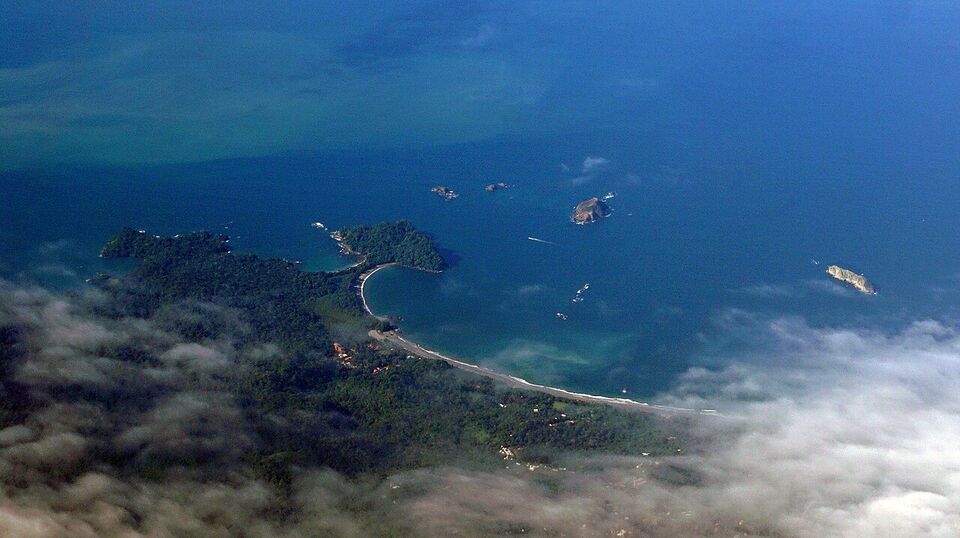
The park is about 98 miles (157 km) from San José and sits just south of Quepos, in Puntarenas province. The only road in is Route 618 from Quepos. Along that road the buildings thin out and the hills get steep. Hotels sit on the slopes above the water, many with a view of the ocean and the offshore islets. The road ends at the park entrance and the public beach area beside it.
Three practical points follow from that layout:
- Where you sleep decides your day. The closer you are to the park end, the shorter your walk to the gate and the beach. The Quepos end is cheaper and has more shops and local restaurants but is a few miles from the sand.
- It is hilly. Some hillside hotels have long, steep driveways and stairs between rooms and the pool. Ask about this if anyone in your group has trouble with stairs.
- Traffic bunches up. The single road backs up in the morning when everyone heads for the park, and in the afternoon when they leave. Leave early or walk.
Quepos itself is a town of working docks, small supermarkets, pharmacies, ATMs and local restaurants. It is where most residents shop and where buses arrive. Visitors who want local prices (a plate of rice, beans and chicken at a soda, a small family-run restaurant) will find them here rather than on the hill. Many hotels on the hillside offer a shuttle into town, or you can take a local bus or taxi along the same road; ask your hotel for the fare and the last return time before you go out for dinner.
Getting there from San José
Quepos is about 3 hours from San José by car, according to common drive-time tables, and about 5 hours from Liberia (LIR). Rain, roadworks and slow trucks can add an hour. The usual route leaves San José on Route 27, the toll highway toward the Pacific, and then turns south on the coastal highway. Route 27 has four toll booths (Escazú, San Rafael, Atenas and Pozón) that together cost roughly ₡1,700 to ₡2,100 (about US$4 to US$5) for a car, and the booths accept a card tap. The smaller tolls on other roads are cash only, in colones.
Different from home
On weekend afternoons, Route 27 uses reversible lanes to push extra capacity toward San José. If you are driving back to the airport on a Sunday afternoon, expect heavy traffic and leave extra time. Fuel stations are full service: an attendant fills the tank, and a small tip for a windshield wash is customary but not required. See our driving guide for the rules.
Your options
| Option | Cost | Notes |
|---|---|---|
| Rental car | From roughly US$60 a day with insurance in high season | Mandatory third-party insurance is usually missing from online quotes; airport pickups add a surcharge. See the car rental guide. |
| Shared shuttle | Roughly US$40 to US$70 per person | Air-conditioned vans, fixed departure times; book early in high season |
| Private transfer | Roughly US$200 to US$400 per vehicle for long routes | Quotes usually exclude 13% tax; prices tend to rise in December |
| Public bus | Most intercity rides cost under US$10 | Tracopa and other companies run San José to Quepos and Manuel Antonio; confirm the San José terminal with the company, because several terminals changed in 2025 |
| Domestic flight | Check Sansa for fares | Sansa lists Quepos (code XQP) among its airports; reservations +506 2290-4100 |
These price ranges are estimates from shuttle and rental sites and from travel blogs, not fixed fares. Treat them as a way to compare options, and get a written quote before you pay. A taxi from SJO to central San José runs about US$25 to US$35, but a taxi all the way to Manuel Antonio is a long and expensive ride; use a shuttle or arrange a private transfer instead.
If you land late, do not drive the coast road in the dark on your first night. Sleep near the airport or in the Central Valley and start fresh. The tropics have no long twilight: the sun sets around 5:30 to 6 p.m. all year, and Costa Rica is on UTC-6 all year with no daylight saving time, so it is one hour behind New York from early November to mid-March and two hours behind the rest of the year.
The national park: tickets, hours and the closed day
Manuel Antonio National Park is small (about 1,983 hectares, or 4,900 acres, of land), but it is one of the most popular in the country. Tickets are controlled for that reason. As of mid-November 2026, this is how it works:
- Tickets are sold online only, through SINAC (the national parks service) at serviciosenlinea.sinac.go.cr. There is no ticket window at the entrance, and visitors without a booking are turned away.
- Price: US$18 for a foreign adult (age 13 and over, tax included), US$5 for children 2 to 12, and free under 2. The US$16 you may see on older tables is the price before 13% sales tax.
- Hours: open Wednesday to Monday, 7 a.m. to 4 p.m. Closed on Tuesdays, and that includes holidays that land on a Tuesday, such as December 1, 2026. Older sources that say the park closes on Mondays from July to November are out of date.
- Time slots. Tickets are for an entry time. One news site reports entry windows every 15 minutes until 3 p.m.; check the booking page for the exact slots. Arrive during your slot.
- Passport number is required for each visitor, and the ticket is tied to it. Bring the passport to the gate along with the QR code from your confirmation email (a screenshot works, because there is little phone signal at the entrance).
- Payment is by card. Costa Rica's parks no longer take cash at the entrance.
- Limits per purchase: one purchase per account per day, and up to six tickets in it, according to a Costa Rica travel site. If you are a group of eight, split the booking across accounts and check that the slots match.
- No refunds for bad weather or no-shows. If the park closes for an emergency, email reservaciones.sinac@sinac.go.cr to move your date.
The park also sets a daily visitor limit. We could not confirm the current figure, so check SINAC when you book: if your date shows no slots, it is full. In the high season (December to April, plus Christmas week and Easter week) dates sell out, so book as soon as you know your itinerary, and book the earliest slot you can.
Watch out
Look-alike ticket sites exist, and SINAC warned of a fake site in March 2026. Type the SINAC address yourself, and be wary of any site that adds service fees or asks for your passport number somewhere other than the official booking system. If you book a guided tour, ask whether the entrance ticket is included; operators often buy it for you.
What is open inside the park
The park has a network of trails with rest areas and lookouts, and Wikipedia says some trails are adapted for wheelchairs (ask the park before you count on it). As of November 12, 2026, news reports said the Punta Catedral trail was temporarily closed with no reopening date, one of several parks with closed trails this high season. Check SINAC and ask your guide before you plan a loop around the point.
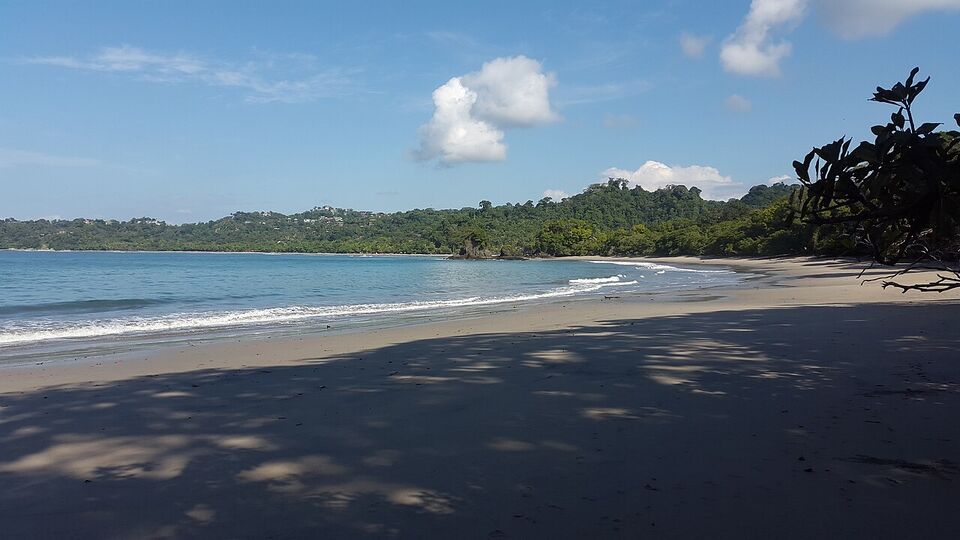
Four beaches lie inside the park limits: Manuel Antonio, Espadilla Sur, Tesoro and Playita. Manuel Antonio and Espadilla Sur are linked by a natural sandbar (a tombolo) and both have tidal pools where people snorkel. A lifeguard program exists, but rip currents do occur, so read the flags and ask the staff where it is safe to swim that day.
Rules: food, drones and animals
The park rules are short, and they matter because the animals are used to people and fines for breaking them have been tightened.
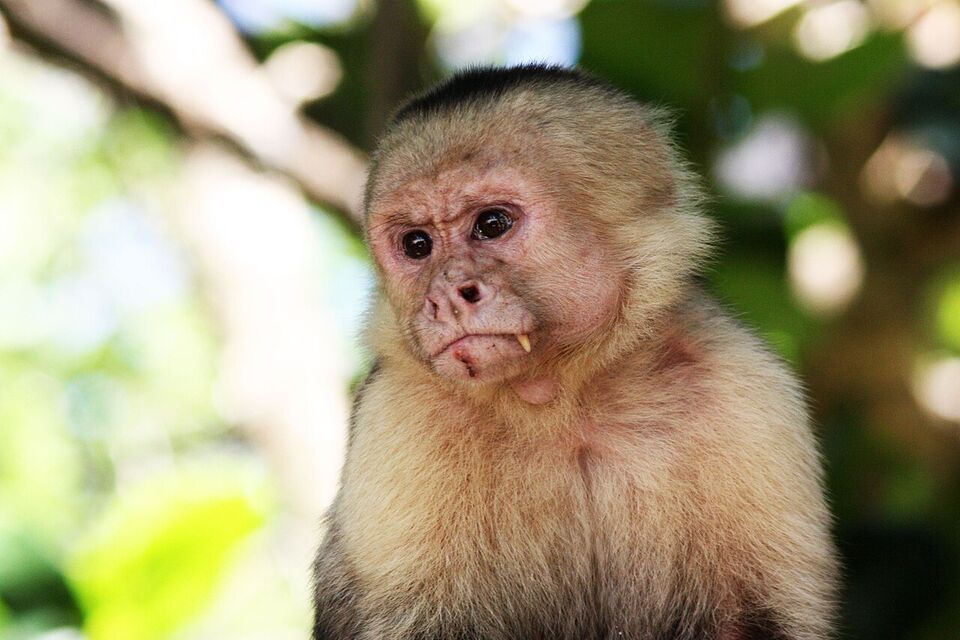
- No food inside. A ban on bringing food into the park has been in force since 2021. Water is fine. Keep bags closed: capuchin monkeys have learned that backpacks and purses contain snacks.
- No feeding wildlife. Feeding wild animals is illegal under Costa Rica's wildlife law (Law 7317). Enforcement has been weak, and fines are usually small, but feeding changes the animals' behavior and makes the monkeys aggressive. It is the reason some visitors get bitten or scratched.
- Stay on the trails. A national law that took effect April 30, 2026 sets fines for entering restricted areas of ₡1,386,600 (about US$3,100), and bigger penalties for operators and guides who take people into high-risk zones. Tour sellers who offer entry to closed areas are breaking it.
- Drones. Rules for recreational drones are strict and we could not confirm the official text. Do not fly a drone in the park or over wildlife. Check with the aviation authority before you bring one to Costa Rica at all.
- Pets are not allowed inside national parks.
The park may also close sectors for safety or maintenance. Check SINAC the week you go, and again the day before.
Do you need a guide?
No. A guide is optional at Manuel Antonio, unlike Corcovado, where one is required (see our Osa Peninsula and Corcovado guide). The trails are well marked and short enough to walk alone.
The case for a guide is the animals. Sloths sleep high in a tree and look like a clump of leaves. A guide has a spotting scope on a tripod, knows where the animals were this morning, and can show you a tiny frog or a well-hidden bird. Guides usually book a private or small-group tour for a set time (a park FAQ listed 7:30 a.m. and 12:30 p.m. starts), and tours run about two hours. Check whether the guide's price includes your park ticket.
Ask for a certified guide and look for a credential. Guides who loiter near the entrance and offer a "cheap tour" can be genuine, but you have little way to tell. Booking ahead through your hotel or a licensed operator is the safer route. If you go without a guide, walk slowly, stop whenever you see other people looking up, and stay alert for movement in the trees at the edge of the trail.
Insider tip
Book the earliest time slot. Animals are more active in the cool early hours, the trails are quieter, and you can finish the walk and be on a beach before midday heat and the biggest crowds. The sun is strong, so bring a hat, sunscreen and plenty of water, since there is little place to refill.
Wildlife and how to watch it responsibly
Despite its small size, the park has about 109 mammal species and 184 bird species. What most people see:
Sloths
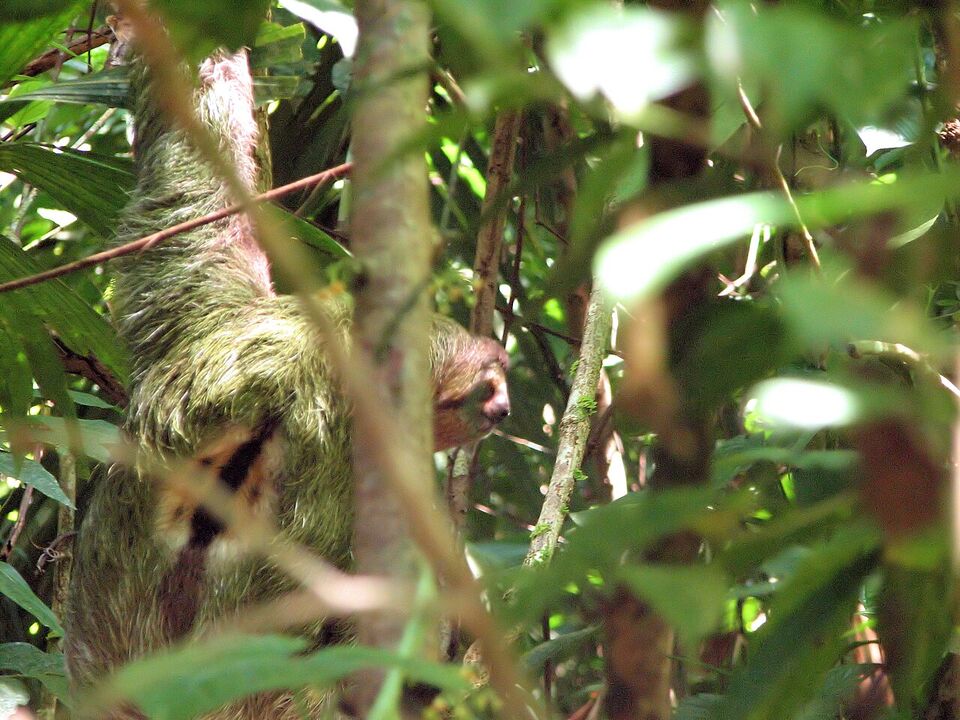
Slow and well hidden. Look for a round, brownish clump in the fork of a tree. They are easiest to find with a guide's scope. Never touch or shake a branch.
Monkeys
Howlers make a loud roar at dawn. White-faced capuchins are the bold ones that steal food. The Central American squirrel monkey is listed as endangered, which is one more reason to keep your distance.
Iguanas and lizards
Black spiny-tailed and green iguanas, and basilisks (the "Jesus Christ lizard" that runs across water), are common around the beaches.
Coatis and raccoons
White-nosed coatis forage in groups. Raccoons raid bags and picnic spots. They look friendly, but they can bite.
Birds
Toucans, motmots, tanagers, parakeets and hawks, plus pelicans and other seabirds on the coast.
Dolphins and whales
Dolphins are often seen from tour boats, and whales occasionally pass through. See the section on day trips.
Wildlife ethics are simple. Do not feed, touch, call or chase animals, and do not hold a branch to bring a sloth closer. Keep at least a few yards away, never use a flash, and avoid selfies that need you to reach toward the animal. Be careful with boat or mangrove tours that advertise feeding monkeys from your hand; the Tico Times has reported that such tours near Quepos take clients to feed capuchins, and the practice teaches wild animals to rely on people. Choose operators that tell you not to feed.
For more on responsible viewing and what you can see elsewhere, see our wildlife guide.
The beaches
There are two kinds: those inside the park, and the public beach that runs along the outside of the entrance.
- Inside the park: Manuel Antonio, Espadilla Sur, Tesoro and Playita. Shaded by forest, with rest areas and tide pools, and there is a lifeguard program. Tickets are required.
- Outside the park: the long public beach beside the entrance, with vendors, loungers and restaurants. Free to enter, and crowded on weekends and holidays. Because it is not in the park, you do not need a park ticket, and the park's food ban does not apply there.
Rip currents occur on this coast, and drownings happen on beaches without lifeguards. Swim near a lifeguard, stay shallow if the surf is up, and if a current pulls you out, do not fight it: swim sideways, parallel to the shore, then back in. Children should be within arm's reach in the water. Our beaches guide has more on flags, rip currents and which beaches suit families.
Watch out
Leave nothing visible in a parked car, and do not leave a bag on the sand while you swim. Petty theft from rental cars and unattended beach belongings is the most common crime reported on Costa Rica's beaches. The US State Department's advisory for Costa Rica is Level 2 ("exercise increased caution due to crime"). See Is Costa Rica safe? for how to read it.
Where to stay
We do not name hotels here, because prices, ownership and quality change quickly and we can only recommend what we have confirmed. Choose by location and type instead.
| Where | Good for | Trade-offs | Typical tier |
|---|---|---|---|
| Hillside near the park | Views, short trip to the gate and beach, wildlife in the grounds | Steep driveways; restaurants mostly by taxi or short walk; rooms can be loud at dawn | $$ to $$$ |
| Mid-road hillside | Balance of price and view; pools; shuttle services | You rely on a shuttle, taxi or car for the beach | $ to $$$ |
| Quepos town | Budget, local food, buses, supermarkets, early boat tours | Not near the beach; fewer views | $ to $$ |
| Vacation rentals | Families and groups who want a kitchen | Check locks and security; the State Department notes robberies at short-term rentals | Varies |
The tiers follow our rule: $ is under US$120 a night for a double, $$ is US$120 to US$300, and $$$ is over US$300. Prices swing with the season, so check the final total, including taxes and any service charge. Restaurants usually add 13% tax and a 10% service charge to the bill; ask whether your hotel quote does the same. For general advice, see our where to stay guide.
Ask three questions before you book. Is there air conditioning (humid nights can be hot in March and April)? How steep is the walk from the car park to the room? How far is it to the beach and to a restaurant at night? Hillside hotels often have monkeys and sloths on the grounds, and some will warn you to keep balcony doors closed so that raccoons and monkeys do not come in.
Crowds, weather and when to go
This is Costa Rica's busiest park. The park's Wikipedia entry counts about 4.39 million visits from 2012 to 2022. The weekend crowd is heavier than the weekday one, and the weeks around Christmas, New Year and Easter are the busiest of all. Because the park is closed on Tuesdays, Monday and Wednesday can be busier than you expect.
The Pacific coast has a dry season from December to March, with April a transition month, and a rainy season from May to October, with November another transition month. Older weather-station averages (1984-2003) for the Quepos area show roughly 25 to 45 millimeters of rain in February and January against more than 500 millimeters a month in September and October, with daytime highs of about 86°F to 90°F (30°C to 32°C) all year. Rain usually comes in the afternoon, so mornings are often clear even in the wet months.
Save money
Go in the green season (May to November, but avoid September and October if you dislike heavy rain). Hotels cut their rates, tours have space, and tickets are easy to get. The trade-off is afternoon downpours, so plan the park and the beach for the morning and keep the afternoon for a pool or a restaurant.
One item for dry-season trips in 2027: forecasters expect a strong El Niño this season, with water shortages likely, mostly in Guanacaste but possibly along the Central Pacific. Ask your hotel about water supply and rationing before you book, and bring a reusable bottle. See our when to go guide for the full picture.
Eating, parking and getting around
Quepos has sodas with a plate of the day (a casado: rice, beans, a protein and salad), fish restaurants and supermarkets. On the hill the restaurants are aimed at visitors and cost more. A tourist dinner usually runs about US$20 to US$50 per person, and a meal at a soda about US$5 to US$10, according to travel-cost blogs; treat those as ranges, not quotes. Tap water is generally drinkable in the country.
Parking near the park
Expect to pay for parking near the park entrance. Informal attendants may wave you into a spot along the road and ask for a fee, and some visitors have paid more than they expected or found nothing guaranteed in return. We could not confirm a rate for official car parks, so ask the price before you park, use a lot with a posted price near the gate, and pay when you leave, not before. Never leave anything visible in the car, and do not trust anyone who offers to watch your bag. Better still: take a taxi, hotel shuttle or the local bus from your hotel, and walk the last stretch. You also avoid the traffic.
Cars and the road
Do not drive through rivers. Doing so voids all rental insurance, including the mandatory cover. Seat belts are required, and children under 12 and shorter than 4 feet 9 inches (1.45 m) need a booster or child seat. Fines are issued as a written ticket and are not paid on the spot. See our driving guide.
Day trips and things to do nearby
- Mangrove or river boat tour near Quepos. Birds, crocodiles and monkeys from a quiet boat. Skip any tour that feeds animals.
- Whale and dolphin watching. Boats leave from Quepos in the whale season; see our Uvita and Dominical guide for the whale windows, which are the same species. Ask the operator how recent their sightings are, as the season is not guaranteed.
- Sport fishing. Quepos is known for sailfish, marlin and roosterfish.
- White-water rafting on the Savegre and Naranjo rivers is listed as a green season activity by the national tourism board.
- Carara National Park to the north. Tickets are sold online through SINAC, and a base fee of about US$10 plus tax applies. Quieter than Manuel Antonio, and a good place for macaws and other birds.
- Dominical and Uvita to the south: about an hour to Dominical by road, with the whale tail beyond it.
- Zip lines, canopy walks and horseback rides are sold by many operators. We did not confirm prices, so check each operator's own website and book with one that has clear safety information.
Sample plans
- Day 1
Arrive and settle in
Reach Quepos by mid-afternoon. Check in, walk to a nearby beach and eat dinner close to the hotel. Book the park and a guide for the next morning if you have not already.
- Day 2
Park morning, beach afternoon
Take the earliest time slot, with a guide if you want to see animals. Be out by late morning, swim on the beach next to the park, and spend the afternoon at a pool. Park hours end at 4 p.m.
- Day 3
Boat or river day
A morning mangrove tour, dolphin trip or fishing charter. Keep the afternoon free for the Tuesday trap: the park is closed, so do something else that day.
- Departure
Head south or north
Continue south to Dominical and Uvita, or north to the airport. Leave early on Sunday to avoid the afternoon Route 27 queue.
Before you go
- Book park tickets on SINAC for a day other than Tuesday, and save the QR code offline.
- Carry your passport to the gate. The ticket is tied to its number.
- Pack water, sunscreen, a hat, bug spray and a light rain jacket, but no food for the park.
- Check the status of trails and sectors on SINAC a day or two before.
- Bring reef-safe sun protection and shoes for wet trails.
- Buy travel insurance with medical evacuation cover; trauma care is thin outside the cities.
- Confirm hotel taxes, service charges and parking before you arrive.
Add it to a route in the trip builder, or ask us to plan the hotels, transfers and guides for you.