Overview: what you can realistically see
Costa Rica packs a great deal of wildlife into a small country, but animals are not in a zoo, and the best sightings come from a combination of place, timing and a sharp-eyed guide. On a typical two-week trip most visitors see monkeys and many birds, a sloth or two, frogs on a night walk, iguanas on many beaches, and at least one animal they would never have spotted without help. Big cats and tapirs are real, but they are rare, and anyone promising them is overselling.
This guide covers what is reasonable to expect, where to look, when to go, whether to hire a guide and how to watch without causing harm. It draws on SINAC rules, park information and reputable news coverage, and we point out where sources disagree. For the parks themselves, see our national parks guide.
Where to see what: a quick table
| Animal | Good places | Best times | Notes |
|---|---|---|---|
| Sloths | Manuel Antonio, Cahuita, Tortuguero canals, cloud-forest edges | Daylight; early morning with a scope | Hard to spot alone; they hang still in trees |
| Monkeys | Manuel Antonio, Corcovado, Cahuita, Tortuguero, many hotel grounds | Early morning and late afternoon | Howlers are heard before they are seen |
| Toucans | Caribbean slope, Arenal area, Osa, many lodge gardens | Early morning | Fruiting trees attract them |
| Macaws | Carara, the Osa Peninsula, Corcovado area | Morning and late afternoon flights | Large, loud and easy to hear before you see them |
| Quetzals | Monteverde, Santa Elena, high-altitude forests | Early morning | Not guaranteed anywhere |
| Frogs | Night walks in Monteverde, Tortuguero, wet lowland forest | After dark, wet months best | Do not touch |
| Caimans and crocodiles | Tárcoles River, Tortuguero canals, Corcovado rivers, wetland boat trips | Daytime sunning on banks | Keep well back from the water's edge |
| Sea turtles | Tortuguero, Ostional, the Osa and other beaches with turtle programs | Nesting runs for months; ask your lodge | Only with licensed guides at night |
| Whales and dolphins | Marino Ballena (Uvita), Dominical, Quepos, Golfito | Whales July-October; ask about other months | Boat tours of 3-4 hours |
The table is a starting point, not a promise. A cloud-forest morning and a lowland river trip will feel like two different countries, which is why most good itineraries include both a mountain and a coast stop. Our regions guide shows how those pieces fit together.
Sloths
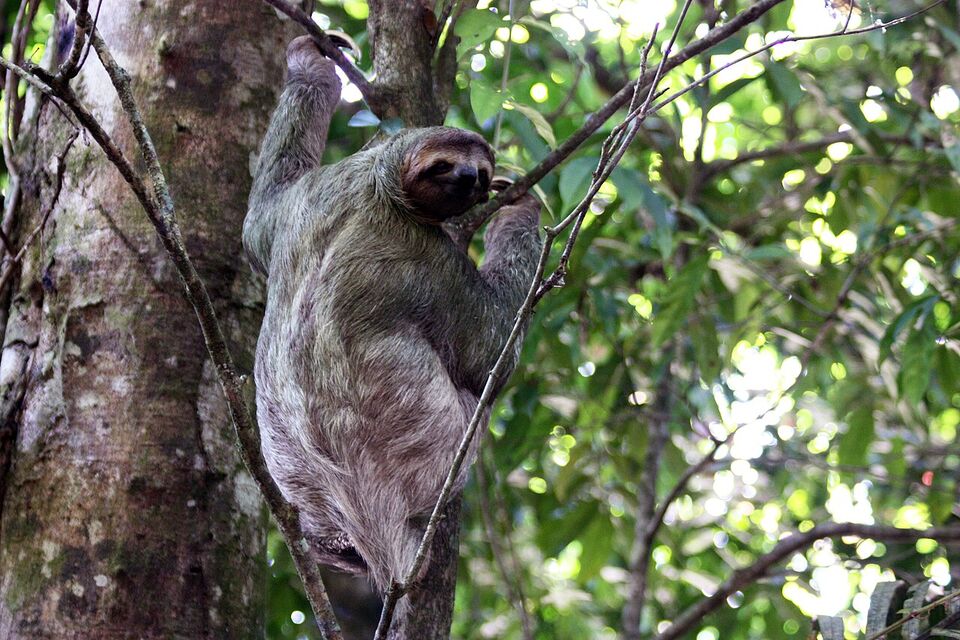
Sloths are the animal most visitors want and the one most often missed. They are slow, camouflaged and often asleep in a tangle of leaves. Two kinds live in Costa Rica, and both the brown-throated three-toed sloth and Hoffmann's two-toed sloth are a major feature at Manuel Antonio National Park, which also has records of 109 mammal species and 184 bird species in a small area. Cahuita and the Tortuguero canals are also good places.
The practical answer is a guide with a spotting scope. Guides know which trees sloths sleep in and check them daily, and they let you look without disturbing the animal. If you go without one, scan the crowns of trees with binoculars, and look for a round, brownish lump among the leaves. Sanctuaries and rescue centers can offer a closer look, but see the section below on how to judge them.
At Manuel Antonio, book your park ticket early (the park is closed on Tuesdays and sells tickets only online, per our Manuel Antonio guide).
Monkeys
Costa Rica has four monkey species, and all four live in Corcovado National Park: the mantled howler, the white-faced capuchin, Geoffroy's spider monkey and the Central American squirrel monkey. Three of the four live at Manuel Antonio (the spider monkey is the exception). The squirrel monkey is listed as endangered by the IUCN, with a decreasing population.
- Howler monkeys are the loudest. Their roar carries for a long way at dawn, and they are the most commonly heard species at hotels with forest.
- White-faced capuchins are the bold ones. At Manuel Antonio they have a reputation for stealing food from visitors, which is why food is banned inside the park.
- Spider monkeys are tall, long-limbed and more shy. Corcovado is a good place for them.
- Squirrel monkeys move in noisy groups and are small and quick. Manuel Antonio and the Osa are the places to look.
Watch out
Never feed monkeys, even to get a photo. It teaches them to approach people, which leads to bites and stolen bags. Keep your food zipped away, hold on to your bag and give them room. If a monkey grabs something, do not chase it.
Toucans and macaws
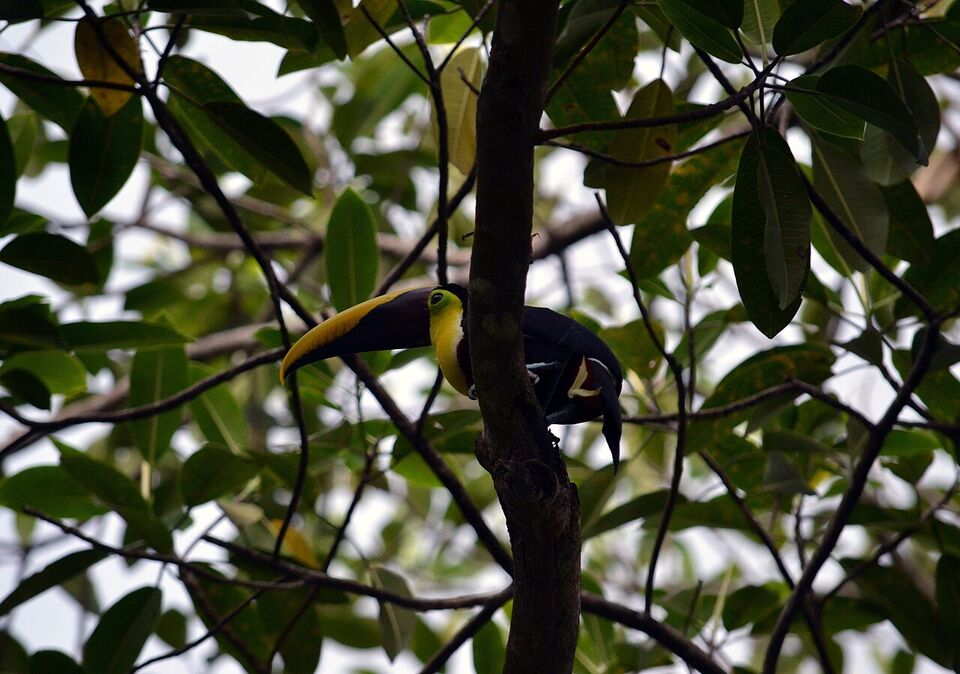
Toucans are common in the Caribbean lowlands, the Arenal area and the Osa, and they often show up in the fruit trees at lodge gardens. Early morning is best. A guide will find them quickly because the bird's call is distinctive; a good scope gives you a view of the bill that photos rarely match.
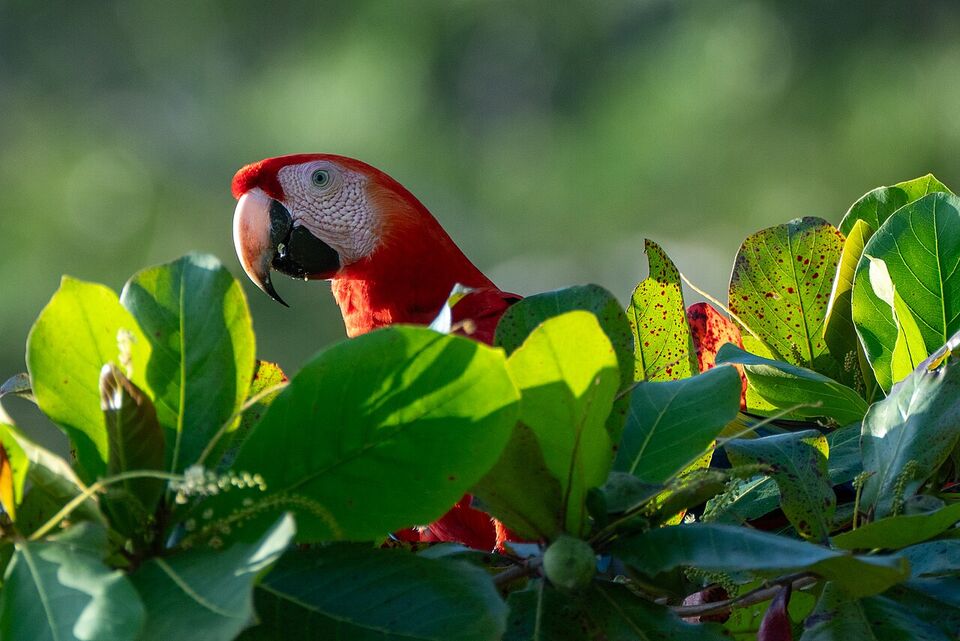
Macaws are the other big draw. Scarlet macaws live on the Central and South Pacific, including near Carara National Park and on the Osa Peninsula. Sunrise and late afternoon are good times to watch them fly in pairs. Carara is also a major birdwatching park; the Costa Rica Tourism Board lists birdwatching at Carara in the dry months (December to April). The park sells tickets online through SINAC, which our national parks guide explains. The Osa Peninsula guide covers the macaw country farther south.
Quetzals
The resplendent quetzal is the bird many Americans put on their Costa Rica list. Monteverde protects one of its remaining strongholds, according to the Monteverde Cloud Forest Preserve, and the birds feed on wild avocados. Guides check fruiting trees and listen for calls. One commercial source also lists Cerro Chirripó as a place for them, and sightings are never guaranteed anywhere.
One commercial source calls March a peak month, but we could not confirm a quetzal season from an official source, so treat any "best month" claim as approximate. A guide, an early start and a second morning are your best odds. Read the quetzal section of our Monteverde guide for reserve details.
Frogs
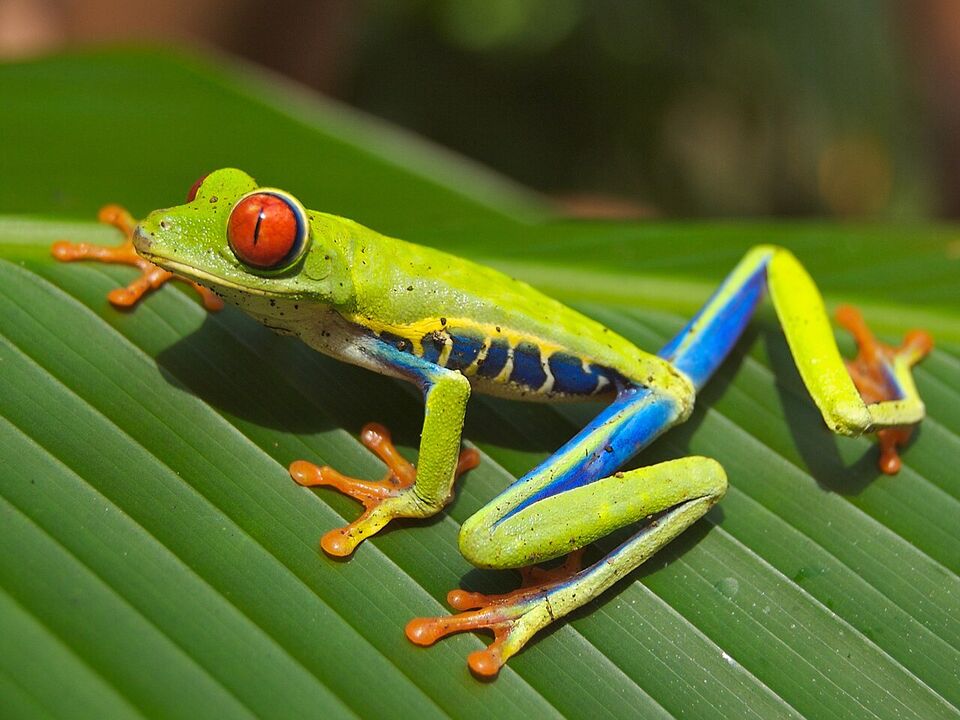
Frogs are mostly nocturnal, small and well camouflaged, so you see them on a night walk, not on a daytime hike. Wetter months and humid forests are best. At Monteverde, the Preserve's night walk lists tree frogs and salamanders among what visitors may see. The golden toad of Monteverde disappeared in the late 1980s, and it is a reminder that amphibians are sensitive to change.
Do not touch frogs. Their skin is delicate and can absorb oils and sunscreen from your hands, and some frogs secrete toxins. Use a red-light or low-power flashlight if your guide does, and keep camera flash off unless the guide says otherwise.
Caimans and crocodiles
Spectacled caimans and American crocodiles live in rivers, lagoons and estuaries. Corcovado's rivers hold both, and the Tortuguero canals are a good place for caimans from a boat. The most famous croc stop is the road bridge over the Tárcoles River on the Pacific highway, where visitors often stop to look down at large crocodiles on the banks.
The Tárcoles bridge
The bridge is a short stop, not a destination, and it is the one place on this page where we suggest you stay on the bridge. Watch the crocodiles from above and do not leave valuables visible in a parked car: a rental company that has covered the route warns about petty theft at the bridge stop.
River boat tours and feeding
Some boat operators on the Tárcoles River feed crocodiles to create dramatic photos. A 2024 Tico Times report says many operators have fed the crocodiles for years (citing a former employee), that feeding is illegal and that it teaches the animals to associate people with food. We cannot say which operators do or do not, so ask before you book: "Do you feed the crocodiles?" If the answer is yes or evasive, choose another operator.
Watch out
Treat every river, estuary and mangrove channel as crocodile habitat. Do not swim, wade, wash dishes or stand on the bank to take photos. Stay in the boat or on the bridge, and do not let children play near the water's edge. If an animal moves toward you, back away quickly.
Sea turtles
Sea turtles nest on Costa Rican beaches on both coasts, and nesting runs for months. Sources disagree about exact windows. Wikipedia says all species nest at Tortuguero from February to July, while other guides list green turtles from July to October and leatherbacks earlier in the year. The Costa Rica Tourism Board lists turtle watching at Tortuguero and at Ostional in the green season, and at Ostional in the dry season too. The safe advice: ask your lodge for current nesting dates before you book.
Nesting-beach rules matter. Go only with licensed guides, stay behind the guide, keep lights and flash off, and never touch a turtle or her eggs. See our Tortuguero guide for how a visit works, and the Caribbean coast guide for the rest of that coast.
Whales and dolphins
The South Pacific coast is the place for whale and dolphin boat tours. The Costa Rica Tourism Board lists whale and dolphin watching at Marino Ballena National Park in the green season (May to November). Humpbacks are best known from July to October, and some operators advertise other months, so ask. A September 2024 news report put the season in September and October at Quepos, Dominical, Uvita and Golfito, and listed tours of 3 to 4 hours. Prices from that report are outdated, so check with operators.
A responsible operator keeps a respectful distance, limits time near animals and does not chase them. If the boat crowds a whale or follows it, say so and consider another operator. Marino Ballena's Piñuela sector closed on November 9, 2026 for about six months, though the Uvita, Colonia and Ballena sectors stay open. See our Uvita and Dominical guide.
Best seasons and times of day
Animals are active year-round, but the day matters more than the month. Plan your wildlife hours for the first two hours after sunrise and the last hour of daylight, when birds feed, monkeys move and the heat is lower. Midday is the quiet period, a good time for a swim or a long lunch.
- Dry season (December to April): more reliable weather and trails, easier travel and busier parks. Birdwatching at Carara and sea-level beach days are at their best.
- Green season (May to November): fewer visitors, lush forest, more frogs, and whales and turtles in season. Expect afternoon showers; start early. ICT recommends mornings for parks in this season.
- Caribbean side: there is no true dry season, so wildlife trips rely on early starts and rain gear.
See when to go for the seasons by coast. The 2026-27 dry season is also shaped by a strong El Niño, which may mean a drier North Pacific and a wetter Caribbean than usual.
Guides versus going alone
You can see wildlife without a guide, and in places like hotel gardens and wide beach trails you will. But a guide changes what you see. A trained guide recognizes bird calls, checks known sloth trees, uses a scope so you do not have to get close and explains behavior. In parks with lots of animals, such as Manuel Antonio, a guide with a scope finds more than a group can alone. In parks with few animals, you may save the money.
- Required: Corcovado and Turrialba Volcano. A guide at Corcovado can cost about US$80-120 a day, according to a Rio Times report; many visitors buy a package that includes boat and park ticket.
- Worth it: night walks, birding, Manuel Antonio, and anywhere you want to find one particular species.
- Optional: big, open trails and hotel gardens.
Save money
Share a guide. Small-group tours cost less per person than private ones, and a private guide for a family or a few friends can be split. Also ask whether the tour includes the park ticket; guides who buy the ticket for you may price it in, and paying twice is a common mistake.
Hire licensed operators only. Costa Rica's 2026 law fines unauthorized tours and guides who take visitors into high-risk areas, and a licensed guide knows what is allowed. Ask how many people are in the group, how long the walk is and whether the guide carries a scope.
Ethical rules: feeding, selfies and sanctuaries
Do not feed wild animals
Feeding wildlife is illegal under Law 7317, Article 116. Enforcement is weak, but the harm is real: animals lose foraging skills, become dependent and can become aggressive. If a tour operator offers to feed animals for your photos, decline.
No selfies, no touching
Costa Rica has run a "stop animal selfies" campaign asking travelers not to touch, grab or hold wild animals, and to keep a safe distance. It is a campaign, not a specific cited law, but the principle is clear. Do not pick up sloths, hold snakes or pose with any animal. Ask for photos taken at a distance, with the animal in its habitat.
Different from home
In the US, a state park sign may say "Do not feed the animals" and few people check. In Costa Rica the same sign is backed by a law, and the animals at popular stops, such as capuchins at Manuel Antonio, have learned to grab bags and food. Seal snacks, hold straps and treat every animal as wild.
Sanctuary, rescue center or zoo?
A good rescue center cares for injured or orphaned animals and releases them when it can. A bad one keeps animals for photos. We have no way to rate individual centers, so use these questions: Does the center let you hold or touch animals? Does it explain where each animal came from and whether it can be released? Are animals kept mainly so visitors can take photos? If the answers point to holding and photos, skip it. A Tico Times writer put it well: watching a wild animal behave naturally in its habitat is an experience that no zoo or sanctuary can replicate.
Souvenirs
Skip anything made from wildlife: feathers, bone, shells, skins and eggs are restricted or banned for import into the US by CBP, and they are a bad idea for the animals too. See our shopping guide for what is safe to bring home.
Snakes, insects and health around wildlife
Snakes are present, and almost all would rather avoid you. Stay on trails, watch where you put your hands and feet, wear closed shoes and long pants in forest, and use a flashlight at night. Never touch a snake, even a dead one. If someone is bitten, call 911 and go to the nearest clinic; note the time and keep the person calm and still. CDC warns that trauma care is limited outside urban areas, which is another reason to buy medical evacuation insurance.
CDC also notes that rabies is present in bats, not common in dogs, so do not handle bats and seek care for any bat contact. Leptospirosis can follow contact with floodwater or muddy water after heavy rain. CDC's malaria advice names Alajuela and Limón provinces, which include the Arenal and Caribbean lowland areas where many wildlife tours run, and its notice for a chikungunya outbreak in the northwest of the country was updated on July 30, 2026. Use repellent, especially at dusk, and read our health guide before you go.
What a night walk is
A night walk is a guided walk in the forest after dark, with flashlights. The guide looks for animals that are asleep or just waking: tree frogs, large insects, spiders, sleeping birds, small mammals and glowing fungi. At the Monteverde Preserve it starts around 6 to 6:30 p.m. and is guided by a naturalist; private gardens in Monteverde and La Fortuna run others.
What to bring: a light jacket (Monteverde is cool), closed shoes, insect repellent and a headlamp if the operator allows it. Walk single file, keep your voice low and let the guide choose where to shine the light. Do not expect big mammals, and do not pressure the guide to move branches or handle animals. Our Monteverde guide and Arenal guide cover where to find them, and the families guide explains which tours suit children.
Gear and photography
Binoculars matter more than a camera. A small pair (8x or 10x) turns a brown lump into a sloth, and a guide's scope will help you take photos with a phone held to the eyepiece. Bring a zoom lens if you have one, a rain cover and spare batteries, since humidity drains them. Leave the drone at home; the rules are strict and national parks are no place for one.
For a complete list, see our packing guide, and for a route that links wildlife stops, start with the national parks guide.
Add it to a route in the trip builder, or ask us to plan the hotels, transfers and guides for you.