How eating in Japan works
Eating in Japan is easier than it looks, and it is cheaper than most Americans expect. A filling bowl of noodles or a rice set meal costs about ¥1,000-1,500 (about $6-10) in nearly every city, there is no tipping, and tap water is free and safe at every table. The hard part is not the food. It is knowing how restaurants are organized, because many work differently from a sit-down place at home.
Most Japanese restaurants do one thing and do it well: a ramen shop makes ramen, a tempura counter fries tempura, a tonkatsu (breaded pork cutlet) place serves cutlets. Menus are short, and the staff may not speak much English. That is normal, and the tools in this guide (picture menus, plastic models, ticket machines) exist precisely so you can order without it.
Two habits will help you right away. First, say irasshaimase back with a nod if staff greet you, and itadakimasu (a thanks-for-the-meal phrase) before you eat. Second, carry cash. Credit cards are accepted in hotels, chains and department stores, but small restaurants, ramen counters and market stalls are often cash-only. Our money guide covers ATMs and cards, and our Japanese phrases page has the words you need for ordering.
Prices in this guide use US$1 = ¥157. Restaurant prices rose through 2025 and 2026, so treat every figure as a typical range and check the menu or the shop's own page before a special meal.
Regional dishes: what to eat where
Japan is a small country with big regional differences. A rule that works well: eat the local specialty in each place rather than chasing the same dish everywhere. The table below lists the best-known regional foods and the cities where they are strongest. Prices are typical for 2026 and can be higher in tourist areas.
| Region | Dish | What it is | Typical price |
|---|---|---|---|
| Hokkaido (Sapporo) | Miso ramen, soup curry, seafood bowls | Rich miso broth with corn and butter; spiced curry soup; fresh crab, sea urchin and salmon roe on rice | ¥1,200-1,600 (about $8-10) ramen; seafood bowls ¥2,500+ (about $16+) |
| Tohoku (Sendai) | Beef tongue (gyutan), hiyamugi | Thick-cut grilled tongue set with barley rice, soup and pickles | ¥2,000-3,500 (about $13-22) |
| Tokyo | Edomae sushi, tempura, monjayaki | Traditional Tokyo-style nigiri, fried seafood and vegetables, a runny griddle batter eaten from the grill | ¥1,500-3,000 (about $10-19) lunch; counters much higher |
| Kanazawa | Sea bream, shrimp and crab sushi | Sea-side sushi using fish from the Sea of Japan; crab season runs roughly November to March | ¥2,000-4,000 (about $13-25) |
| Nagoya | Hitsumabushi, miso katsu, chicken wings (tebasaki) | Grilled eel over rice served three ways; pork cutlet with dark red miso sauce | ¥1,800-4,500 (about $11-29) |
| Kyoto | Kaiseki, tofu dishes, obanzai | Multi-course seasonal dining, simmered tofu, home-style small plates | ¥1,500-3,000 (about $10-19) lunch sets; kaiseki ¥10,000+ (about $64+) |
| Osaka | Takoyaki, okonomiyaki, kushikatsu | Octopus balls, savory cabbage pancake, deep-fried skewers | ¥600-1,200 (about $4-8) |
| Hiroshima | Layered okonomiyaki, oysters | Pancake built in layers with noodles, plus grilled or fried oysters in winter | ¥1,000-1,600 (about $6-10) |
| Kobe and Hyogo | Kobe beef | Marbled beef from Tajima cattle; steak and teppanyaki | ¥8,000+ (about $51+) for a proper steak dinner |
| Shikoku (Kagawa) | Sanuki udon, bonito tataki (Kochi) | Chewy udon eaten at self-service shops; seared bonito with garlic | Udon ¥400-900 (about $3-6) |
| Fukuoka and Kyushu | Hakata tonkotsu ramen, mentaiko, motsunabe | Milky pork-bone ramen with thin noodles; spicy cod roe; offal hot pot; open-air yatai food stalls | ¥900-1,400 (about $6-9) ramen |
| Okinawa | Goya champuru, Okinawa soba, taco rice | Bitter melon stir-fry, pork noodle soup with wheat noodles, an island-style spiced beef rice dish | ¥800-1,500 (about $5-10) |
For deeper local guides see Tokyo food, Osaka, Kyoto, Hokkaido, Kyushu and Okinawa.
How to order
Ticket machines (shokkenki)
Many ramen, gyudon and udon shops make you pay first at a vending machine near the door. You press a button for the dish, insert cash (some newer machines take cards and IC cards), take the printed tickets and hand them to the staff after you sit down. Older machines have only Japanese buttons, but the top-left or top-center buttons are usually the house specialty, and photos are almost always printed on or next to the buttons.
If you are unsure, press the first big photo button, then add a side such as rice or an egg if you want it. Extra toppings (tokumori for a bigger portion, kae-dama for a noodle refill) are separate buttons. Take your change and the small coins that drop out.
Picture menus and plastic food models
The plastic food models in restaurant windows, called sampuru, are made to help you choose. Point at the dish through the window or bring the staff outside. Most chain restaurants and many tourist-area places also have picture menus or tablet ordering with an English button.
Sit-down restaurants
You will usually get a hot or cold towel (oshibori) and a glass of water or tea. Call the server with a raised hand and a polite sumimasen (excuse me); at many places, a call button sits on the table, and staff will not come back until you press it. This is not rude service: they are giving you space. Pay at the register on your way out. The bill is usually on a slip you carry to the counter, not brought to the table.
Different from home
There is no tip, no splitting the check at the table, and no one asking how everything is. Many places seat you at a shared counter. If a restaurant has a line outside, join it and wait; staff will usually ask how many people before you reach the door.
Sushi: types and how to eat it
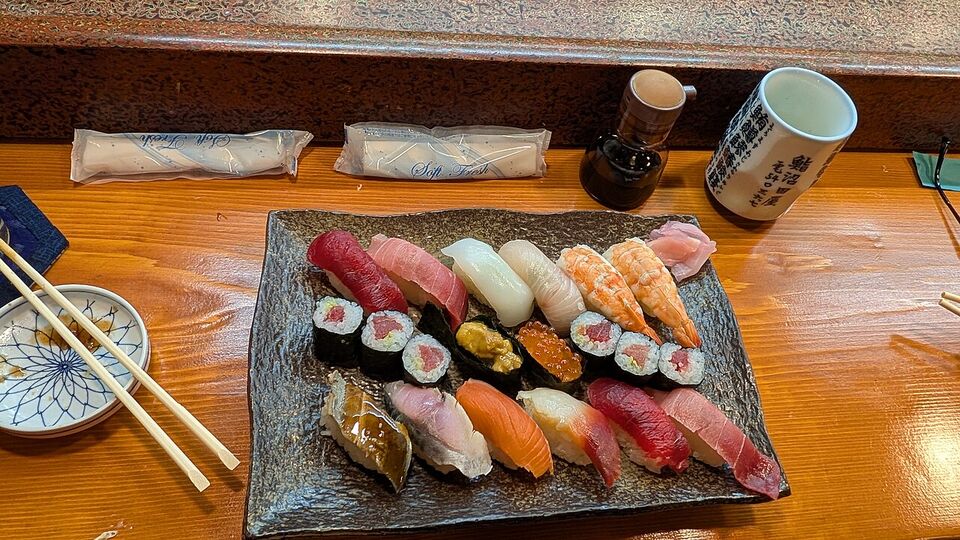
Sushi in Japan covers a lot more than raw fish on rice. The main types you will see:
- Nigiri: a hand-pressed oval of rice with a slice of fish on top. This is what most visitors think of as sushi.
- Maki: rolls wrapped in seaweed. Thin rolls (hosomaki) usually hold one filling, such as tuna or cucumber.
- Gunkan: "battleship" rolls with a strip of seaweed around rice, filled with sea urchin, salmon roe or other soft toppings.
- Temaki: a hand roll, a cone of seaweed filled to order.
- Chirashi: a bowl of rice topped with slices of raw fish, often the best-value way to try several kinds.
- Inari: rice stuffed into a sweet fried tofu pouch. It is vegetarian in many cases, though the rice may be seasoned with fish-based ingredients.
- Oshizushi: pressed sushi in a box, the style of Osaka.
Conveyor-belt sushi
Kaitenzushi restaurants send plates around on a belt, or take orders from a touchscreen and deliver by a fast-moving lane. Plates are priced by color or pattern, and the budget chains charge roughly ¥130-400 (about $1-3) a plate, with prices creeping up. You pay by counting your plates at the end, or the table computer totals them. This is a good first sushi meal because there is no pressure, English screens are common, and you can see the food before you take it.
Counter sushi
A traditional counter, with a chef making each piece in front of you, is a different experience. Dinner omakase (the chef chooses) typically starts at about ¥10,000-15,000 (about $64-96) and rises sharply from there. Lunch sets at the same shops are often much cheaper. Many top counters take bookings by phone, through the hotel concierge, or through reservation sites, and some ask for a deposit or cancellation fee. Tell them about allergies when you book.
To eat nigiri, you can use chopsticks or your fingers. Dip the fish side, not the rice, lightly in soy sauce. Do not rub wasabi into the soy sauce dish. If the chef has already brushed on sauce, eat the piece as is. Eat each piece in one or two bites, soon after it is set down.
Ramen styles
Ramen is not one dish but a family of them. The main styles, defined by broth and seasoning:
- Shoyu (soy sauce): clear brown broth, the classic style of Tokyo.
- Shio (salt): lighter and clearer, popular in Hakodate and other port towns.
- Miso: thick, savory and often topped with corn and butter; associated with Sapporo.
- Tonkotsu (pork bone): cloudy, creamy, long-simmered broth; Hakata ramen in Fukuoka and Kurume are the best-known examples.
- Tsukemen: thick noodles served cold or warm beside a concentrated dipping broth. Ask for soup-wari at the end and the staff will thin the leftover dip with hot broth so you can drink it.
At most shops, you can specify noodle firmness (katame firm, futsu regular, yawarakame soft) and the richness of the broth. Slurping is normal and even encouraged. Eat quickly: noodles go soft. In busy shops you may be expected to finish and leave within about 15-20 minutes. Vegetarian and vegan ramen shops exist in Tokyo, Kyoto and Osaka, and are covered below.
Kaiseki, izakaya and other sit-down meals
Kaiseki
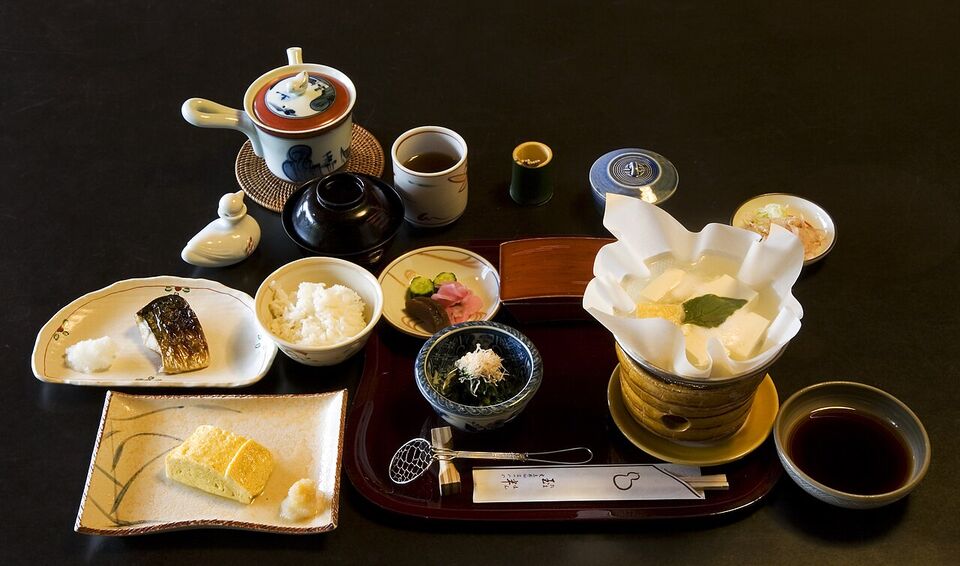
Kaiseki is Japan's multi-course traditional meal, built around the season, with small dishes served in a set order. Expect about eight to twelve courses, often served in a private room at a ryokan or a restaurant in Kyoto or Kanazawa. Dinner commonly costs ¥10,000-30,000 (about $64-191) a person, and the best houses cost more. Lunch versions can start at ¥5,000-8,000 (about $32-51). You eat what is served; dietary requests need to be made well in advance, ideally when you book.
If you are staying at a ryokan with dinner included, you are eating a kaiseki-style meal. Our where to stay page explains how ryokan meal plans work.
Izakaya and the table charge
An izakaya is a casual pub where you order many small dishes to share, along with drinks. It is the most relaxed way to eat dinner in Japan. Most start with a drink order, then you add dishes as you go. Menus often have photos, and staff are used to groups.
Almost every izakaya adds a table charge called otoshi (or tsukidashi), usually ¥300-500 (about $2-3) per person. In return you get a small appetizer you did not order. Some places add a seating fee instead. It is legal, standard, and not a scam, but it surprises first-time visitors. Look for "no otoshi" if you do not want it, though in practice most places include it. For drinks and all-you-can-drink plans, see our drinks guide.
Watch out
In entertainment districts such as Kabukicho in Tokyo or Dotonbori in Osaka, street touts who invite you into a bar or "snack" can hand you a very large bill. Choose places where you can see the menu with prices posted, and avoid anywhere that will not show you the cover charge. Our safety guide explains common problems.
Specialty restaurants
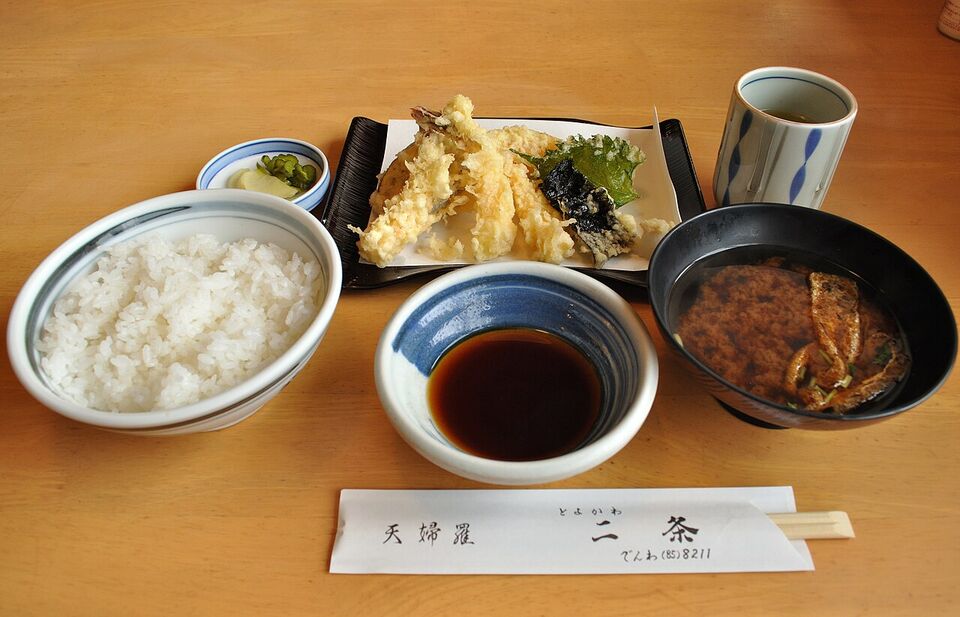
Many restaurants specialize in a single food. Tonkatsu shops serve breaded pork cutlets with shredded cabbage, rice and miso soup, often with free refills of rice and cabbage. Yakitori places grill chicken skewers over charcoal, and tempura counters fry each piece to order. Yakiniku is grill-it-yourself beef, and shabu-shabu and sukiyaki are hot-pot meals cooked at the table. These specialty shops are usually good options for a first dinner because the menu is simple and prices are on the board.
Convenience stores, supermarkets and food halls
Konbini
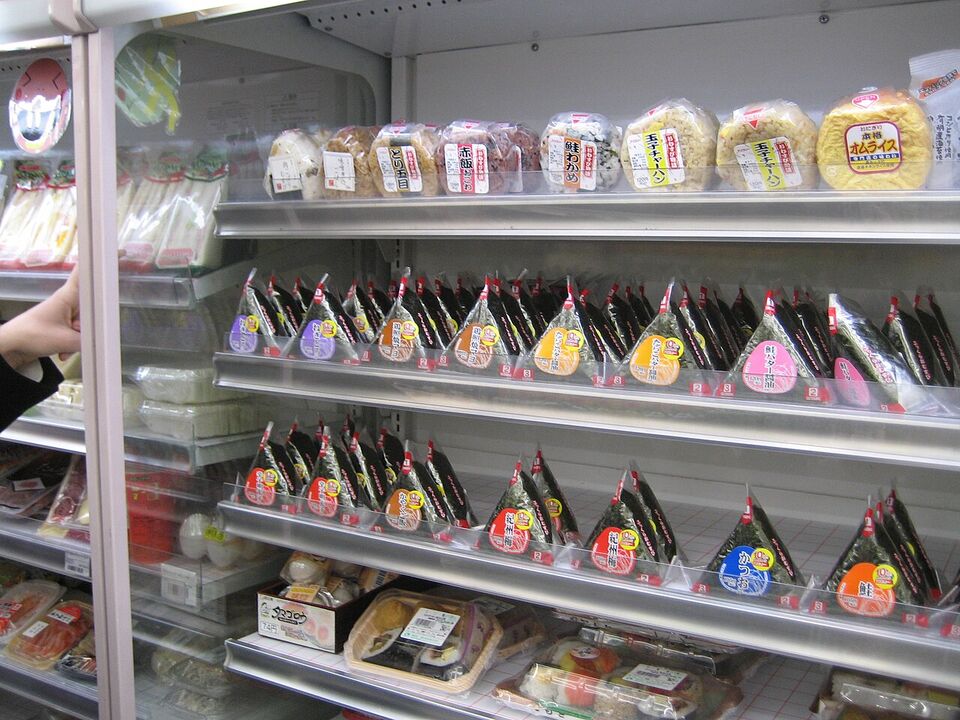
Japan's convenience stores (konbini), mainly 7-Eleven, Lawson and FamilyMart, sell real meals at low prices. Typical finds: onigiri rice balls (about ¥150-250, or about $1-2), sandwiches with soft white bread, boiled eggs, salads, hot fried chicken, noodle bowls, and desserts. Staff will heat up a bento or noodle dish on request: say "atatamete kudasai." Many stores have an eat-in space and a free toilet, and 7-Eleven and Japan Post ATMs take foreign cards.
Look for the English-style ingredient labels printed on the back of packages, which list the main allergens. Convenience stores are also the most reliable place to find vegetarian-friendly snacks such as plain onigiri with ume (pickled plum) or kombu (kelp), though the rice may be wrapped with seasonings that contain fish.
Department store food halls
The basement floors of department stores (depachika) are huge food halls with counters for sweets, bento, sushi, pickles, tea and gift boxes. They are one of the best places to try many Japanese foods at once and a good source of souvenirs. Prices are higher than a konbini but the quality is high, and the best time to shop is late afternoon, when many bento and prepared foods are discounted, usually starting around 7 p.m. Tax-free rules for food have changed; see our shopping guide for how the refund works.
Supermarkets
Supermarkets are cheaper than convenience stores, and they also have prepared foods and sushi packs. Stores like these are the best way to eat on a tight budget, and they mark down prepared items in the evening.
Standing restaurants, markets and street food
Tachigui (standing) restaurants serve fast, cheap food, often soba or udon noodles, at counters with no seats. A bowl of soba can be about ¥400-700 (about $3-4). Standing sushi bars and standing bars (tachinomi) offer the same quick, low-cost eating for a drink and a few snacks.
Markets such as Nishiki in Kyoto or Tsukiji Outer Market in Tokyo have grilled seafood, skewers and sweets. At some, eating while walking is discouraged; the vendor will point you to a spot beside the stall where you can finish before moving on. See our etiquette guide for the unwritten rules.
Save money
Lunch is the bargain. The same restaurant that charges ¥4,000 (about $25) for dinner often has a teishoku or ranchi setto (lunch set with rice, soup and pickles) for ¥1,000-1,800 (about $6-11) between roughly 11 a.m. and 2 p.m. Gyudon chains, udon shops and ticket-machine ramen stay cheap all day.
Table manners
You do not need to memorize a rulebook. These are the points that matter most; our etiquette page has the full list.
- Do not stick chopsticks upright in rice, which resembles a funeral offering, and do not pass food from chopstick to chopstick.
- Rest chopsticks on the rest (hashioki) or across the bowl, not on the table.
- Lift small bowls of rice and soup to your mouth. Drink miso soup straight from the bowl.
- Do not pour soy sauce over plain rice.
- Say itadakimasu before eating and gochisosama deshita afterward.
- Do not blow your nose at the table; step away. Sniffling is acceptable.
- Do not eat and walk in most places. Finish at the stall or in a park.
Most restaurants in tourist areas expect foreigners to make mistakes and will not mind.
Allergies and special diets
Food allergies
Japan requires labeling of a short list of major allergens on packaged foods. The mandatory list covers eggs, milk, wheat, shrimp, crab, buckwheat (soba), peanuts and, more recently, walnuts, with a longer list of recommended labels. The list has been expanding, so check the Consumer Affairs Agency page for the current requirements. Labeling at restaurants is not required in the same way, and cross-contact is common because kitchens are small and shared fryers are normal. Soba in particular is often made in the same place as wheat noodles, and buckwheat allergies are taken seriously.
The best protection is a printed allergy card in Japanese that lists your allergens and says you need to avoid even trace amounts. Print one before you travel, show it when you sit down, and ask the staff to confirm. Be cautious at buffets, markets and street stalls, where there is no one to ask. Serious allergies deserve extra caution, because many small restaurants cannot guarantee safety. Pack your own epinephrine and a doctor's letter, and read our health guide for medical help and insurance.
Vegetarian and vegan
Japanese cooking is built on dashi, a stock made from dried bonito (fish) and kelp, and it shows up in miso soup, noodle broths, simmered vegetables, sauces and even some tofu dishes. A dish with no visible meat may still contain fish stock, pork lard or bonito flakes. Vegetarian travelers who want to be strict should ask directly and expect to be turned down in some places.
What works well:
- Shojin ryori: Buddhist temple cuisine, fully plant-based and available at temples in Kyoto and at Koyasan, usually by reservation and from about ¥3,000-6,000 (about $19-38) for a lunch set.
- Vegan ramen and gyoza shops in Tokyo, Kyoto and Osaka. Check the shop's current page first, because small places close or change.
- Soba, udon and tempura: ask for vegetable-only dishes and a broth without bonito. Plain cold soba (zaru soba) often has a dipping sauce made with fish stock.
- Self-catering: supermarkets and konbini sell salads, edamame, fruit and rice balls with plum or seaweed.
Useful phrases for vegetarian and vegan requests are on our phrases page. Apps and websites that list vegan restaurants help in big cities, but check the date on any listing.
Halal
Halal food is easier to find than it used to be, particularly in Tokyo, Osaka, Kyoto, Kobe and near major airports and stations, where many halal restaurants and Muslim-friendly prayer rooms now exist. Outside big cities, options are thin. Japanese cooking uses mirin (sweet rice wine), sake, pork lard and dashi, so a menu without pork is not necessarily halal. Look for restaurants that state halal certification, and seafood or vegetarian-only restaurants if you are unsure. Many Muslim visitors bring snacks for rural stretches.
Gluten-free
Gluten-free eating is hard in Japan. Soy sauce contains wheat and is in nearly everything, including sauces, broths, marinades and many "plain" dishes. Ramen, udon, tempura, gyoza and okonomiyaki are wheat-based. Rice, sashimi, plain grilled fish, yakitori with salt (shio) instead of sauce (tare) and rice-flour sweets are safer. Soba is traditionally buckwheat but many restaurants add wheat flour. Ask about gluten-free "tamari" soy sauce only at places that clearly understand. Carry an allergy card and expect to cook for yourself some of the time.
What things cost
These are typical prices in major cities in 2026. Smaller towns are cheaper; resort areas and airports cost more. Expect prices to shift, since food costs have risen in Japan over the past two years.
| Meal | Typical price | US$ (about) |
|---|---|---|
| Konbini onigiri or sandwich | ¥150-400 | $1-3 |
| Gyudon, udon or soba (chain or standing) | ¥400-900 | $3-6 |
| Ramen | ¥1,000-1,600 | $6-10 |
| Weekday lunch set (teishoku) | ¥900-1,800 | $6-11 |
| Conveyor sushi meal | ¥1,500-3,000 | $10-19 |
| Izakaya dinner with drinks | ¥3,500-6,000 | $22-38 |
| Mid-range sushi or tempura dinner | ¥6,000-15,000 | $38-96 |
| Kaiseki dinner | ¥10,000-30,000+ | $64-191+ |
| Coffee at a cafe | ¥450-700 | $3-4 |
A traveler eating mostly cheap meals can spend about ¥3,000-4,000 (about $19-25) a day on food. Add a nice dinner every couple of days and plan on ¥5,000-8,000 (about $32-51). Our budget page puts food in the context of a whole trip.
Bringing food home to the US
This is where visitors get caught. The US Department of Agriculture and Customs and Border Protection (CBP) regulate food that enters the country, and the rules are strict for meat, fresh produce, plants and some dairy.
- Meat products: US rules on meat depend on the animal-disease status of the country of origin and on the type of product, and most meat and poultry products are restricted or prohibited. That includes beef jerky, sausages, meat-flavored snacks, and instant noodles or ramen kits with meat or pork in the package. Assume that anything meat-based should stay in Japan, unless the label and the USDA rules say otherwise. Wagyu or Kobe beef cannot simply go in your suitcase.
- Fresh fruit and vegetables: usually restricted. Japanese fruit gift boxes are a common problem.
- Safe items: commercially packaged, shelf-stable sweets, tea, seasoning, sauces, dried seaweed, miso paste and sealed snacks are usually fine. Keep them in original packaging with labels.
- Alcohol: separate allowances apply; see our drinks guide.
Declare all food on your CBP declaration. If you declare an item that is not allowed, it is usually just taken; if you hide it, you can face fines and other penalties. Rules change, so check the current USDA APHIS and CBP guidance before you pack. Our shopping and bringing things home page covers duty and tax-free shopping.
Insider tip
For gifts, buy sealed tea, sweets and regional snacks from department-store food halls and airport shops. They are made for travelers, packed to travel, and rarely a problem at US customs.
Add it to a route in the trip builder, or ask us to plan the hotels, trains and guides for you.