The short version
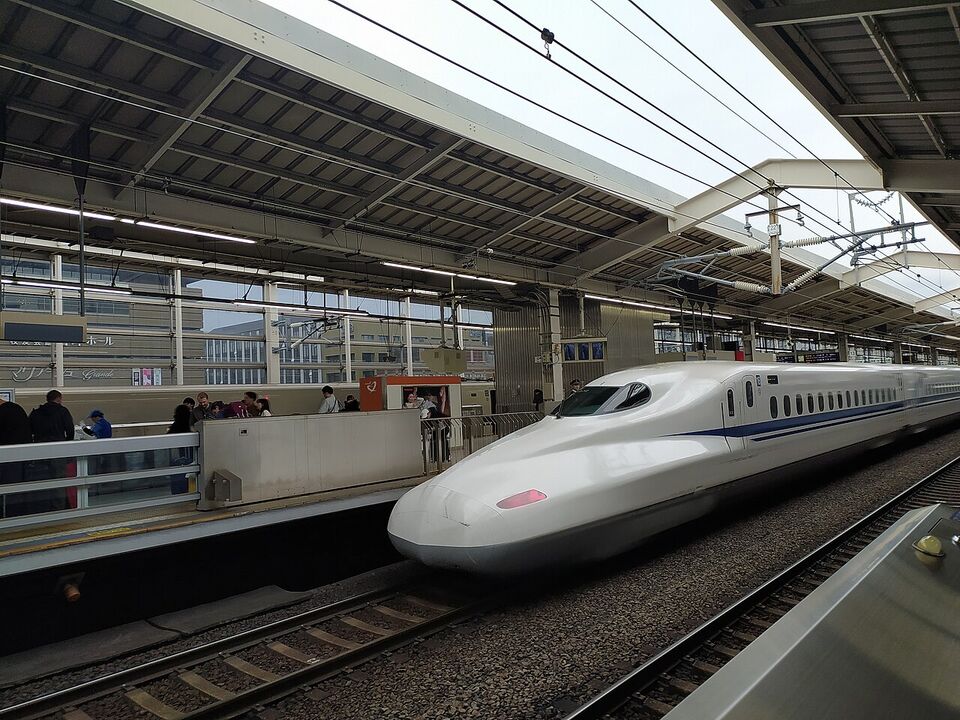
Japan's trains are the best way to cover most of the country, and for a first trip you can do almost everything with three things: a Shinkansen (bullet train) ticket for each long hop, one IC card for everything local, and a plan for your suitcases. You rarely need a car, and you almost never need to buy more than one rail pass. This page explains each piece in order, with 2026 prices.
Two decisions come first. One is whether a nationwide pass is worth buying, which we cover on its own page: Is the JR Pass Worth It? The other is how you will carry your bags between hotels, because that choice shapes everything else (see the luggage section below).
For most itineraries that use Tokyo, Kyoto and Osaka, we suggest single Shinkansen tickets plus an IC card. Add a regional pass if you are leaving that corridor, or a short domestic flight if you are going to Hokkaido, Kyushu or Okinawa. For the full picture of how to plan a route, see Plan Your Trip to Japan.
The Shinkansen lines in words
The Shinkansen is a set of separate high-speed lines, each named for the region it serves. They all radiate from Tokyo except the western ones, which continue from Osaka. Train names (Nozomi, Hikari, Kodama and so on) are the "speeds" on each line: the fastest stop least often.
- Tokaido Shinkansen: Tokyo to Nagoya, Kyoto and Shin-Osaka, about 320 miles (515 km). Trains are Nozomi (fastest), Hikari and Kodama (stops at every station). Tokyo to Shin-Osaka takes about 2 h 22 min on the fastest Nozomi, and Tokyo to Kyoto about 2 h 15 min. Nozomi runs every few minutes at peak times.
- Sanyo Shinkansen: Shin-Osaka to Okayama, Himeji, Hiroshima and Hakata (Fukuoka). Tokyo to Hiroshima takes about 3 h 45 min to 4 h on the fastest trains, and Shin-Osaka to Hiroshima about 1 h 30 min. Many Tokaido trains continue onto this line.
- Kyushu Shinkansen: Hakata to Kumamoto and Kagoshima-Chuo, with the Nishi-Kyushu Shinkansen (Kamome) running a short link to Nagasaki. Sakura and Mizuho trains run through from Osaka.
- Tohoku and Hokkaido Shinkansen: Tokyo to Sendai, Morioka and Shin-Aomori, and on to Shin-Hakodate-Hokuto. The fastest trains are named Hayabusa. The extension to Sapporo has been delayed until at least the end of fiscal year 2038 (March 2039), so Sapporo is reached by air or a transfer to a regular train.
- Joetsu, Hokuriku and the "mini" lines: Tokyo to Niigata (Joetsu), and Tokyo to Nagano, Toyama, Kanazawa and Tsuruga (Hokuriku, with Kagayaki and Hakutaka trains). Tokyo to Kanazawa takes about 2 h 30 min on the Kagayaki. The Yamagata and Akita lines are shorter "mini-shinkansen" branches on slower track.
If you are planning the classic loop, the Tokyo to Kyoto leg is covered in Kyoto and the Osaka and Hiroshima legs in Osaka and Hiroshima and Miyajima.
Reserved, non-reserved and Green Car
Most Shinkansen have three kinds of seats. In an ordinary reserved car, you pick a specific seat and a specific train. In a non-reserved car, you board and sit anywhere that is empty. In a Green Car (business class), the seats are wider, laid out two by two, and always reserved.
Reserved ordinary seats cost a small surcharge on top of the base fare: the seat fee runs from about ¥330 to ¥930 (about $2-6) depending on the travel date, so check the JR calendar for your day. The Green Car supplement is much larger and distance-based; between Tokyo and Kyoto it typically adds several thousand yen. Nozomi trains also carry a higher fee than Hikari. Prices change, so use the booking app to see the exact amount for your date.
When to reserve
We suggest reserving for any of these: weekends, Friday evenings, Golden Week (April 29-May 5 in 2027), Obon (about August 13-16) and New Year travel (about December 28 to January 4). Nozomi trains on the Tokaido line are fully reserved on holiday peaks. You also need a reservation if you are traveling with a suitcase of 161 cm or more (see below) or if you must sit with your family.
The Hayabusa, Komachi and Tsubasa on the northern lines and the Kagayaki on the Hokuriku line are all-reserved services. Reservations open one month before the ride, at 10 a.m. Japan time for most JR East trains.
Different from home
Ordinary Shinkansen seats have more legroom than a typical US domestic coach seat, and your ticket prints a car and seat number. Trains leave on the minute and are rarely more than a minute late, so be on the platform early, and note where on the platform your car number stops (it is painted on the floor).
How to buy Shinkansen tickets
You have four options. All are valid for any traveler; the right one depends on how much you like to plan.
- Ticket machines and counters at the station. Machines have an English menu and take Visa and Mastercard. Counters (midori no madoguchi) are easier for complicated trips and for oversized-luggage seats. Write down your stations, date and train time to show the clerk.
- The smartEX app or website (JR Central and JR West), for the Tokaido, Sanyo and Kyushu lines. You register a credit card, reserve from one month ahead, and ride with a QR ticket or a linked IC card. Fares are charged to the card, not drawn from your IC balance.
- Eki-net (JR East), for Tohoku, Hokkaido, Joetsu and Hokuriku trains. It covers journeys with no transfer and does not sell Tokaido Shinkansen seats. Pickup of paper tickets must be done in eastern Japan, and bookings open at 10 a.m. Japan time one month ahead.
- The pass-holder reservation service, if you bought a Japan Rail Pass (see the JR Pass guide).
Do US cards work online? Often, but not always. Both systems run a 3-D Secure check, and a card can fail if the issuer cannot complete authentication. If a card is declined, try another card, check that your issuer allows a transaction in yen, and keep the station machine as your fallback. We cannot confirm success rates for particular banks. Register and test the app before you leave home, not on the platform.
Insider tip
Each major station also has a Shinkansen ticket machine in English. If an app fails, you can usually buy a same-day seat in minutes. The exception is a holiday peak, when popular trains sell out; in those weeks, book as soon as the one-month window opens.
Big suitcases and luggage forwarding
This is the rule that surprises Americans most. On the Tokaido, Sanyo, Kyushu and Nishi-Kyushu Shinkansen, a bag whose three dimensions (length + width + height) add up to 161-250 cm (64-98 in) is "oversized" and needs a seat reservation with an oversized baggage area. The seat costs the same as a regular reserved seat. Without the reservation, there is a ¥1,000 charge (about $6) and you may be asked to take a later train. Bags over 250 cm (98 in) are not allowed.
Bags of 160 cm (63 in) or less need no reservation and fit on the overhead rack or in the space at the end of the car. Many big checked suitcases from a US airline sit right at the line, since US airlines allow up to 62 linear inches (157 cm) for free, so measure yours. You can reserve the oversized seats on smartEX, JR West's site, at the ticket office, or at a reserved-seat machine; reservations open one month ahead.
Takkyubin: luggage forwarding
Takkyubin (delivery services such as Yamato's Kuroneko and Sagawa) will send a suitcase to your next hotel or to the airport for a flat fee. Reported prices run from about ¥1,500 to ¥3,500 (about $10-22) per bag, depending on size and distance, with oversized bags costing more. Check the amount at the counter, because we could only confirm an approximate range for 2026 from secondary sources.
How it works: ask your hotel front desk or visit a convenience store counter and fill out a slip with the next hotel's name, address and phone number, and your check-in date. Hand over the bag by about noon, and it generally arrives the next day. For a flight home, send it two days ahead, not the same morning, unless the counter confirms same-day airport delivery. Pack a small bag with one night's essentials, and keep the tracking number.
Save money
Forwarding your main suitcase between cities and traveling with a small bag is usually cheaper than a taxi for each transfer, and much easier on crowded trains and station stairs. It also avoids the oversized-seat issue entirely. Keep passports, medicines and electronics with you.
IC cards and tapping a credit card
An IC card is a rechargeable prepaid card you tap at ticket gates, vending machines, buses, many convenience stores and some coin lockers. Suica (JR East), PASMO (Tokyo-area private lines), ICOCA (JR West) and several others all work interchangeably across the main cities, so one card is enough. Add cash at any ticket machine.
- Suica and PASMO in Apple Wallet. An iPhone can hold a Suica or PASMO card, loaded with a US credit card, with no plastic needed. Android support for foreign users is not confirmed.
- Welcome Suica. A visitor card with no deposit and no refund, valid 28 days counting the purchase day as day one, topped up with cash only (yen), sold at JR East Travel Service Centers and the Narita and Haneda airport machines. A mobile version for iPhone is reported to be valid for 180 days.
- Regular Suica, PASMO, ICOCA. Plain cards returned to sale in March 2025. A ¥500 (about $3) deposit is refundable, though machine stock can vary. ICOCA costs ¥2,000 (about $13), which includes the deposit.
Since March 25, 2026, you can also tap a Visa, Mastercard, JCB, American Express, Diners, Discover or UnionPay card, or a phone with Apple Pay or Google Pay, at the gates of 11 Tokyo-area operators including Tokyo Metro, Toei and the Tokyu, Keio, Odakyu and Tobu lines. Osaka Metro, Hankyu, Hanshin, Nankai and Kintetsu accept taps too. JR East and JR West, the Keisei Skyliner, Kyoto's subway and buses, and Hiroshima's JR and streetcars do not. Tap in and out with the same card, and no child fares apply.
Our advice: for a trip that includes JR lines, still carry an IC card. The tap-to-pay system is a good backup, and a good way to avoid buying a card for a short stay in Tokyo only. For ticket prices in the capital, see Tokyo and for money basics, see Money in Japan.
The Tokyo Subway Ticket (Tokyo Metro and Toei lines) is ¥1,000 (about $6) for 24 hours, ¥1,500 (about $10) for 48 hours and ¥2,000 (about $13) for 72 hours, and it is worth it only if you ride the subway five or six times a day.
Regional passes in a nutshell
Regional JR passes are cheaper than the national pass and often better for focused trips. Prices below are the adult, ordinary-car amounts we found for 2026 (the Kansai-Hiroshima figure is from a JR West page last dated 2024) and may change, so confirm them on the operator's site. The JR Pass page has the full table with rules.
| Pass | Area | Days | Price |
|---|---|---|---|
| JR EAST PASS | Tokyo north to Aomori, plus Nagano, Niigata and Nikko | 5 or 10 | ¥35,000 or ¥50,000 (about $223 or $318) |
| Hokuriku Arch Pass | Kansai to Kanazawa and Tokyo (Hokuriku Shinkansen) | 7 | ¥35,000 (about $223) |
| Kansai-Hiroshima Area Pass | Kansai, Okayama and Hiroshima | 5 | ¥17,000 (about $108) |
| Takayama-Hokuriku Area Tourist Pass | Nagoya, Takayama, Kanazawa, Kyoto | 5 | ¥19,800 (about $126) |
| JR Kyushu Rail Pass | All Kyushu | 3, 5 or 7 | ¥22,000-¥26,000 (about $140-166) |
Pair these with a regional guide when you plan: the Japanese Alps, Kanazawa, Tohoku and Kyushu each show the best way in.
Domestic flights
For long distances, flying is often faster and sometimes cheaper. Tokyo to Sapporo is about 1 h 40 min in the air, against a day of trains; Tokyo to Okinawa is about 3 hours. Haneda and Itami (Osaka) are the most convenient airports for city travel.
- Low-cost carriers. Peach and Jetstar Japan fly between Narita, Kansai, Nagoya and many regional airports. Fares can be very low, but luggage, seat choice and meals cost extra, and Narita is far from central Tokyo. Check each carrier's site for current routes and bag fees.
- JAL Japan Explorer Pass. This is a foreign-visitor fare on JAL and its partners, for people with an international ticket to and from Japan (it need not be on JAL). Examples shown on JAL's site in November 2026 (one way, and they change): Tokyo (Haneda) to Sapporo from US$93, Haneda to Osaka (Itami) from US$76, Haneda to Okinawa from US$97. Two 23-kg checked bags are included, tickets are non-refundable and cannot be changed, and availability is limited. Some regional carriers, including Jetstar Japan, are excluded.
- ANA. ANA offers similar visitor fares (its "Experience JAPAN Fare"). We could not confirm the current prices, so check ana.co.jp when you book your international flight.
Visitor fares sell out on busy dates, so buy early. Check the details on the pages covering flights from the US, Hokkaido and Okinawa, which are the routes where flying makes the most sense.
Highway buses
Intercity buses are the cheap option, and they also reach places the train does not. Tokyo to Osaka takes 8 to 9 hours, with rest stops every two to three hours. Willer Express, one of the largest operators, offers an English website; fares from Tokyo to Osaka vary widely by date and seat type: ¥6,000 (about $38) is a reasonable planning figure for a weekday night, promotional fares can be lower, a booking fee may apply, and prices rise on weekends and holidays. Check the Willer site for the actual fare. Premium three-row night buses cost more and recline further.
Willer also sells a Japan Bus Pass for travelers (3-day, 5-day and 7-day versions, with a weekday-only discount), usable on selected buses within a two-month window. Prices and rules change, so check the Willer site before buying; a pass only pays off if you take several long rides.
A night bus saves a hotel night but not much comfort. Most people sleep poorly on one, and we suggest it only if you are on a tight budget or the route has no good train.
Overnight trains and ferries
Japan has just one regularly scheduled sleeper train, the Sunrise Izumo and Sunrise Seto, which leave Tokyo at about 9:50 p.m. as one train. They separate at Okayama: the Izumo continues to Izumoshi (arriving about 9 a.m.), and the Seto goes to Takamatsu on Shikoku. Reported fares for Tokyo to Izumoshi (regular season, from a July 2026 timetable article) are about ¥16,150 (about $103) for a "Nobinobi" carpeted seat and about ¥23,320 (about $149) for a Single sleeper compartment.
Sleeper tickets go on sale one month ahead and the private rooms sell out fast. You need a physical ticket and cannot board with an IC card alone. The Japan Rail Pass may cover the Nobinobi seat, but compartments need extra fees. Treat the timetable and fares as approximate and check them with JR East or JR West.
Ferries
Ferries matter in a few places: the short hop to Miyajima from Hiroshima, between Honshu and Shikoku islands, and long-distance overnight ferries to Hokkaido and Kyushu. Short routes cost a few hundred yen. Overnight ferries are inexpensive compared with flights, but they are slow and schedules change with weather. Typhoons from August through October can cancel sailings and Shinkansen runs, so leave a buffer day before an international flight.
Watch out
Do not buy a Shinkansen ticket for the last train of the day, or tight same-day connections, if you have an international flight out. If a typhoon or earthquake stops the line, staff can rebook you but the next train may be hours away. Leave the night before for a morning flight if you can.
City transit and what comes next
Each major city has subways, JR loops and buses that use IC cards. Tokyo is rail-based, Kyoto relies on buses (a flat fare of ¥230, about $1.50, in the central zone, though a higher fare for non-residents is planned for as early as 2027), and Osaka has a good subway. Taxis are metered and clean, but cost more than American ones, and tipping is not expected.
Once you know your route, book the longest legs first and the lodging next: see Where to Stay in Japan. If you want to explore the countryside by car, read Driving in Japan first. And for cost planning, Budget shows how transport fits into a daily total.
Add it to a route in the trip builder, or ask us to plan the hotels, trains and guides for you.