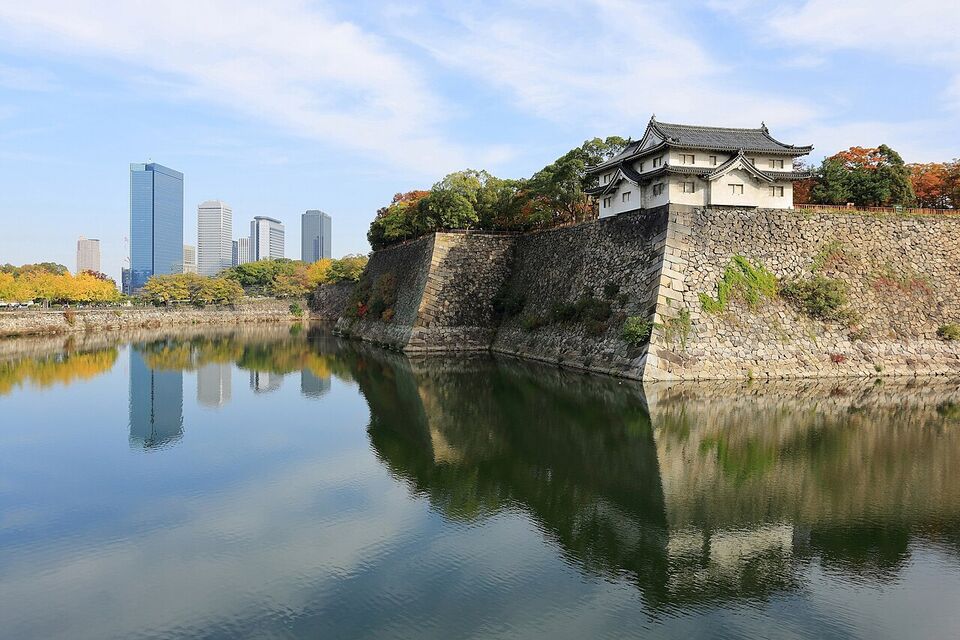
Overview: why Osaka
Osaka is the right city if you want to eat well, stay up late and spend less on a room than you would in Kyoto. It is Japan's third-largest city, about 15 minutes from Kyoto by Shinkansen, and it has more hotel beds at lower prices than its neighbor. Most visitors treat it as two things at once: a city worth two or three days on its own, and a convenient base for Kyoto, Nara, Himeji and Kobe.
The city's reputation is built on food. Kuidaore, roughly "eat until you drop," is the local motto, and the main dishes are cheap and informal: takoyaki (octopus balls), okonomiyaki (savory pancake) and kushikatsu (deep-fried skewers). The people are known across Japan for being louder and more direct than in Tokyo, and many visitors find that a relief.
Two things have changed recently. Expo 2025 on the island of Yumeshima ended on October 13, 2025, and the city is now in the long process of deciding what comes next. And the price of everything that tourists do has gone up: Osaka Castle doubled its admission in 2025 and Universal Studios Japan now uses date-based pricing. This page gives current figures and says where they can move.
Where to base yourself
Osaka has two centers, and the choice shapes the trip. Kita ("north") means the Umeda area around Osaka and Umeda stations, with department stores, office towers and the best train links to Kyoto and Kobe. Minami ("south") means Namba and Dotonbori, with the food streets, the nightlife and the direct airport train from Kansai.
Namba and Dotonbori
The best choice for a first visit built around food and nightlife. It is loud and crowded after dark, so ask for a room away from the main street. The Nankai line from the airport ends here, and Kintetsu trains to Nara leave from nearby Osaka-Namba station.
Umeda and Shin-Osaka
Best if you will make several day trips by rail. Umeda has JR, Hankyu and Hanshin lines and Shin-Osaka has the Shinkansen. It is less atmospheric at night, but it is quiet, orderly and well connected.
Shinsekai and Tennoji
Older, cheaper and a little rougher around the edges. Tennoji is a big hub with the Haruka airport train and a loop line connection. Good for budget travelers who do not mind an earlier night.
Osaka Castle and Honmachi
Mostly office buildings and business hotels, with the castle park on your doorstep for a morning walk. Fewer restaurants at the door, but the subway reaches Namba and Umeda in minutes.
Bay area near USJ
Makes sense only if USJ is the center of the trip. You can walk to the park gate and skip a morning commute, but the area is quiet at night and far from the food streets.
For a hotel budget, expect business hotels in the $ and $$ range in most neighborhoods. See our where to stay in Japan guide for how Japanese business hotels, capsules and ryokan differ, and book early for cherry blossom season, Golden Week and the autumn leaf weeks.
Different from home
Japanese hotel rooms are small, and a "double" can mean two people squeezed beside a bed. Check the room size in square meters (a standard double is often 15 to 20 square meters, about 160 to 215 square feet) and whether the bed is a double or two narrow ones.
Getting in and around
From Kansai Airport
Kansai International Airport (KIX) is on an island in Osaka Bay, about 30 miles (50 km) from the city. Two private Nankai trains go to Namba: the Rapi:t limited express (about 38 minutes, ¥1,670 or about $11, reserved seats) and the Airport Express (about 43 minutes, ¥970 or about $6, no reservation, IC cards accepted). Both are good; the cheaper train is fine unless you have big bags and want a guaranteed seat.
JR West's Haruka limited express runs to Tennoji, Shin-Osaka and Kyoto. It takes about 80 minutes to Kyoto at ¥3,390 (about $22) for a standard seat. Overseas visitors can buy discounted one-way Haruka tickets (¥2,700 (about $17) to Kyoto and ¥1,900 (about $12) to Osaka and Shin-Osaka, per JR West after its November 2026 price change) if purchased outside Japan with a foreign passport, and the Haruka is covered by the JR Pass. Check the current price before you buy on the JR West site. For airline routes to Osaka, see our flights to Japan page.
From Tokyo and Kyoto
The Tokaido Shinkansen reaches Shin-Osaka in about 2 hours 22 minutes from Tokyo on the fastest Nozomi, for about ¥14,500 (about $92). Kyoto to Shin-Osaka is about 15 minutes by Shinkansen or about 30 minutes by JR rapid train, which is cheaper and does not need a reservation. Details of the passes that cover these trains are in our JR Pass guide.
Inside the city
The Osaka Metro is the backbone: the red Midosuji Line links Shin-Osaka, Umeda, Namba and Tennoji in one line. You can now tap a contactless Visa, Mastercard, JCB, American Express or Diners card or a phone wallet at Osaka Metro gates, with fares capped for the day, and the same works on Hankyu, Hanshin, Nankai and Kintetsu. It does not work on JR West. A rechargeable IC card (ICOCA, Suica) still works on everything and is the easiest option. More on cards is in getting around Japan.
The Osaka Amazing Pass is a sightseeing pass that bundles transit within the city with admission to around 40 attractions. The official site lists the 1-day pass at ¥3,500 (about $22) and the 2-day pass at ¥5,000 (about $32), valid through March 2027. It pays off only if you visit several included sights in a day, so add up your own list first. The pass is not valid for the Haruka or the Shinkansen.
Dotonbori, Namba and the food streets
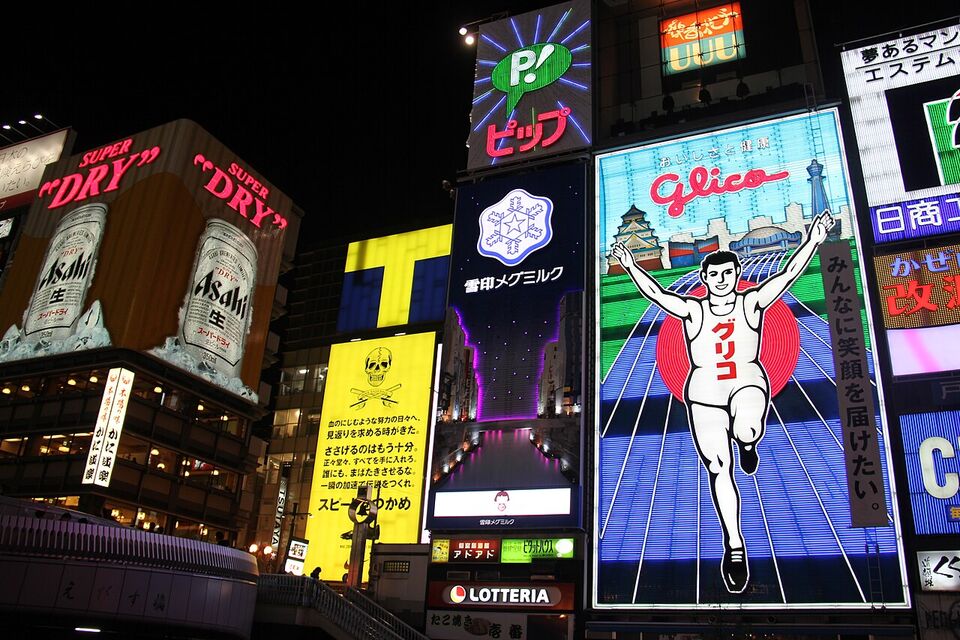
Dotonbori is the canal-side street that appears on every postcard: neon, the Glico running man, the giant mechanical crab and rows of food stalls. It is at its best after dark, when the signs are lit and the canal reflects them. It is also at its most crowded, so walk it once in the evening and eat somewhere a block or two away.
A few streets matter more than the main strip. Hozenji Yokocho is a narrow stone lane with lanterns and small bars, and it is quieter than Dotonbori. Sennichimae and the Kuromon Ichiba market are close by. Ura-Namba, the back-alley district east of Namba station, has dense clusters of izakaya (Japanese pubs) where locals go.
What to eat
- Takoyaki: batter balls with octopus, cooked in a rounded iron mold, usually 6 to 8 pieces for about ¥600 to ¥900 (about $4 to $6). Let them cool, because the center stays very hot.
- Okonomiyaki: a cabbage pancake cooked on a griddle at your table at many shops, with sauce, mayo and bonito flakes. Expect about ¥1,000 to ¥1,800 (about $6 to $11). Hiroshima's version is different: see Hiroshima and Miyajima.
- Kushikatsu: skewers dipped in a shared sauce bath. The rule is simple: never double-dip. Use the cabbage on the table to scoop more sauce onto your skewer.
- Negiyaki, udon and kitsune udon: lighter local dishes. Osaka udon broth is milder and more dashi-forward than Tokyo's.
For other regional dishes and how ordering works, see our Japanese food guide.
Insider tip
Many of the best-known Dotonbori takoyaki stands have queues of 20 minutes or more at dinner. A shop one block off the main strip often makes the same dish with a shorter line, and you will see the locals eating there.
Kuromon Market and Shinsekai
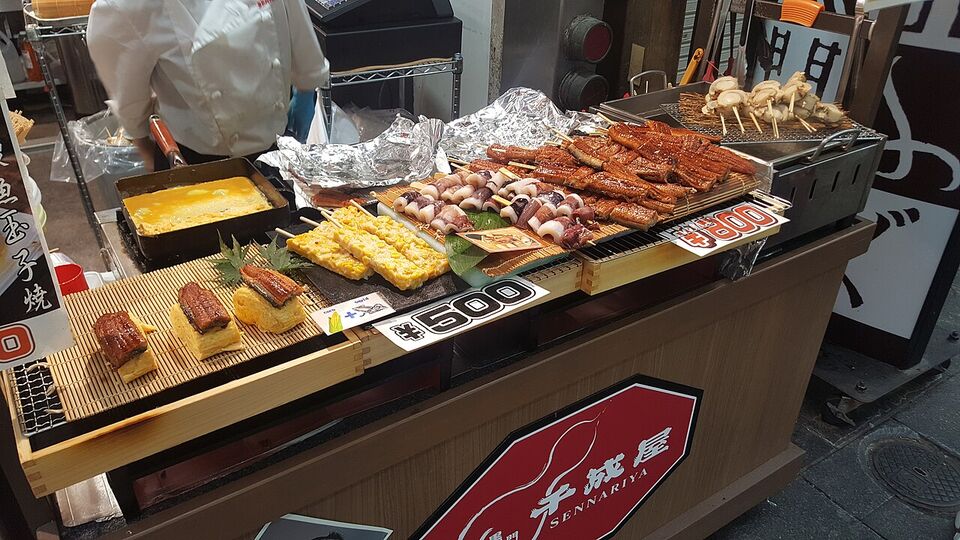
Kuromon Ichiba is a covered market street about a third of a mile (roughly 580 m) long, with around 150 shops. It started as a place for chefs and home cooks to buy fish and produce, and many stalls now cater to visitors with grilled scallops, uni, wagyu skewers and fruit. Prices are higher than at a supermarket, and some stalls have raised them noticeably. Look at the price before you order, and eat what you buy at the stall instead of while walking, which many stalls ask you not to do.
The market is best before noon. Many shops close by 5 p.m., and a number shut one or two days a week, so do not plan your dinner there. It is next to Nipponbashi station, about a 10-minute walk from Dotonbori.
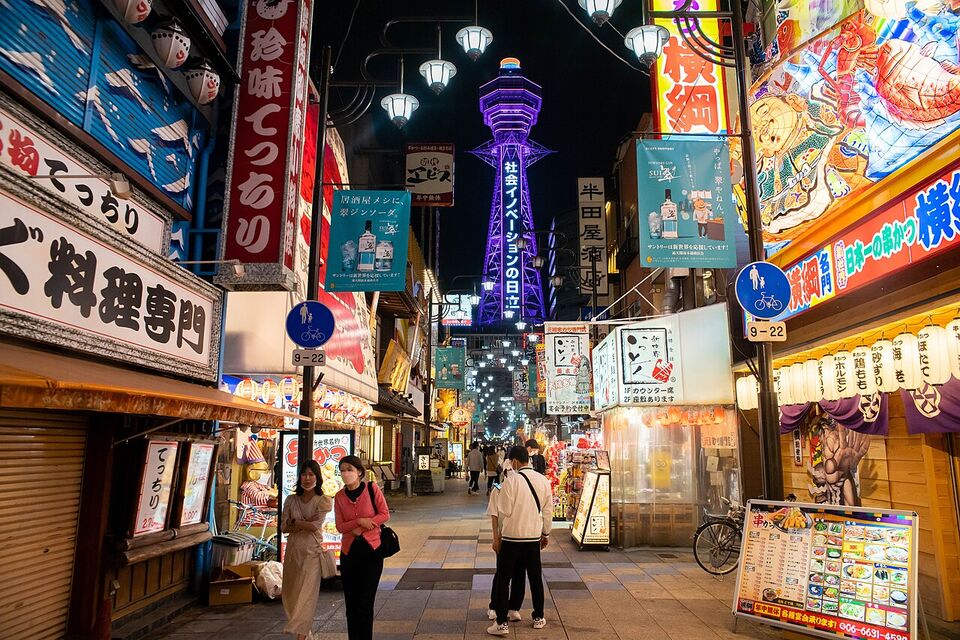
Shinsekai ("new world") is a retro district built in 1912 around Tsutenkaku Tower, an old observation tower that is a local landmark. It is known for kushikatsu restaurants, cheap bars and arcades, and the area is livelier than it is polished. It is safe for visitors during the day and evening, but some side streets in the Airin-Nishinari area to the south are rougher, so stay near the main streets.
Osaka Castle
Osaka Castle was built in 1583 by Toyotomi Hideyoshi, the warlord who unified Japan, and the present main keep is a 1931 concrete reconstruction with an elevator and a museum inside. It is not an original castle, unlike Himeji's, but the stone walls and moats are some of the largest in Japan, and the park around it is free and worth a walk.
Admission to the main keep is ¥1,200 (about $8) for adults, ¥600 (about $4) for university and high-school students (with ID) and free for junior-high students and younger. That price doubled from ¥600 in April 2025 and includes the new Toyotomi Stone Wall Museum, which shows an excavated section of wall from Hideyoshi's original castle. The keep is open 9 a.m. to 6 p.m. (last entry 30 minutes earlier) and closes December 28 to January 1; confirm hours before you go. Lines for same-day tickets can be long, and the castle's official site sells advance web tickets.
If you only have a short time, the best views of the castle are from the outer moat and the Nishinomaru Garden, which charges a small separate fee. The park is a popular cherry blossom spot in late March and early April. For the better-preserved original, see Himeji Castle on our Himeji and Kobe page.
Umeda, Kaiyukan and the bay
Umeda Sky Building
The twin towers of the Umeda Sky Building are linked at the top by a circular open-air observatory called the Kuchu Teien (Floating Garden). Adult admission is ¥2,000 (about $13), ages 4 to 12 are ¥500 (about $3), and it is open from 9:30 a.m. to 10:30 p.m. (last entry at 10 p.m.). The Osaka Amazing Pass gives free entry before 3 p.m. The observatory is breezy even in spring, so bring a layer for the evening. Go near sunset and stay for the lights.
Osaka Aquarium Kaiyukan
Kaiyukan is one of Japan's large aquariums, built around a central tank with a whale shark, set in a ring of exhibits that follow the Pacific Rim. It is a good rainy-day choice, especially with children. Hours are usually about 10 a.m. to 8 p.m., though they vary by date. Adult tickets have been listed at around ¥2,700 (about $17) in recent years, but the price and the entry slots now vary by day, so buy a timed web ticket in advance and check the aquarium's official calendar for the current price.
It is in the Tempozan harbor area, a short walk from Osakako station on the Chuo Line. Kaiyukan and Universal Studios Japan are on opposite sides of the bay and are not a natural combination: do one on each day.
Universal Studios Japan
Universal Studios Japan (USJ) is the main reason many families come to Osaka, and it is the one outing here that needs real planning. The park is in Universal City, about 15 minutes from Osaka station on the JR Yumesaki Line (change at Nishikujo). It is a full-day trip. Opening hours change by date, so check usj.co.jp before you buy.
Tickets and pricing
USJ uses dynamic pricing: the one-day Studio Pass costs more on weekends and school holidays and less on quiet weekdays. Prices reportedly start at ¥8,400 (about $54) for the lowest-priced dates from September 1, 2026 and rise on busier dates; recent third-party guides put typical adult one-day prices somewhere around ¥9,000 to ¥12,000 (about $57 to $76), with children aged 4 to 11 well below that. We could not confirm a single current price list, so use those numbers only as a rough guide and look up your date on the official site or an authorized reseller. A ticket is tied to a date and its pricing tier, so you cannot swap to a more expensive day without paying the difference.
Express Pass
The Express Pass is a separate paid add-on that lets you skip the standby line at selected rides and shows. It comes in several bundles, with prices that rise with the number of rides and with the date, and the cheaper bundles cost a few thousand yen while the premium ones can cost more than the admission itself. You still need a Studio Pass. Express Passes sell out on busy days, so buy ahead.
Super Nintendo World
Super Nintendo World (Mario Kart: Koopa's Challenge, Yoshi's Adventure and the Donkey Kong Country area) has a limit on how many people can enter at once. On crowded days you need a timed-entry ticket, which in 2026 is issued through the official USJ app after you enter the park, or an Express Pass or package that includes guaranteed area entry. The rules change, so check the app and the official site on the day. Get the app before you arrive and register your ticket in it.
Save money
Visit on a weekday outside school holidays, and buy a ticket for a lower-priced date. Most of the extra cost in a USJ day comes from dynamic pricing and the Express Pass, not from the food or transit, so these are the two places to save.
Watch out
USJ tickets, Express Passes and timed-entry rules are sold by many resellers. Only buy from the official site or a well-known reseller, and confirm that your ticket is for the right date and that Super Nintendo World entry is included if you need it. Names on tickets must match the entry rules.
After Expo 2025 and the casino
Expo 2025 ran from April 13 to October 13, 2025 on Yumeshima, an artificial island on the western side of Osaka Bay, and drew more than 25 million ticketed visitors. The site is not open to the public now. Pavilions were demolished after the close, and the grounds are due back to the city by about February 2028. Planners intend to keep about 200 meters (650 feet) of the Grand Ring, the huge wooden circular roof, as the centerpiece of a public park, with the roof level expected to open to visitors around the start of 2030.
The same island is where Japan's first casino resort, an integrated resort (IR) developed with MGM, is being built. Construction began in April 2025 and the opening is targeted for around autumn 2030. Nothing there is open to visitors, and any other plans for the site, such as an arena or racing circuit, are still proposals. Do not plan around any of it.
What changed for visitors already is mostly the metro: a Yumeshima extension of the Chuo Line opened for the Expo and now serves the island. Check the Osaka Metro site for service details before you plan a trip there.
Day trips: why stay in Osaka for Kyoto and Nara
Osaka works as a base because of price, choice and transit. Hotel rooms are usually cheaper than in Kyoto, especially in busy seasons, and Kyoto's hotel tax rose sharply in March 2026 (as much as ¥10,000, about $64, per person per night at the top end), while Osaka's tax is much lower. You also have more late-night food. The cost is the commute and the loss of an early start or an evening in Kyoto.
- Kyoto: about 30 minutes from Osaka station on the JR Special Rapid, or about 15 minutes from Shin-Osaka on the Shinkansen. Hankyu trains from Umeda reach Kawaramachi in about 45 minutes. See Kyoto and Kyoto sights.
- Nara: about 40 minutes on the Kintetsu Nara Line from Osaka-Namba, or about 50 minutes on the JR Yamatoji Rapid. See Nara.
- Himeji and Kobe: Kobe is about 30 minutes from Osaka by JR or Hankyu, and Himeji is about an hour on JR's Special Rapid. See Himeji and Kobe.
- Hiroshima: about an hour and a half on the Shinkansen from Shin-Osaka. See Hiroshima and Miyajima.
Insider tip
The last trains from Kyoto to Osaka leave around midnight, but check the timetable for the line you plan to use. Plan to leave Kyoto's evening events early enough to catch it, and keep taxi money in reserve.
The Osaka hotel tax
Osaka Prefecture charges an accommodation tax per person per night, calculated from the room rate per person. Since September 1, 2025, the rates are:
| Room rate (per person, per night) | Tax | About |
|---|---|---|
| Under ¥5,000 | None | Free |
| ¥5,000 to ¥14,999 | ¥200 | about $1.30 |
| ¥15,000 to ¥19,999 | ¥400 | about $2.50 |
| ¥20,000 and above | ¥500 | about $3.20 |
Hotels usually collect it at check-in or check-out or include it on the bill. Compare that with Kyoto's top rate of ¥10,000 (about $64) per night from March 2026. Rates and brackets can change, so confirm with your hotel when you book. For the other cities' taxes, see money in Japan.
A realistic plan
- Day 1
Castle, Namba and Dotonbori
Walk the Osaka Castle grounds and see the keep in the morning (buy a web ticket). Lunch at an okonomiyaki shop, then take the Midosuji Line to Namba. Walk Hozenji Yokocho in the afternoon and eat around Dotonbori after dark.
- Day 2
Kuromon, Shinsekai and Umeda
Be at Kuromon Market by 9 a.m., then move on to Shinsekai for a kushikatsu lunch. In the late afternoon go to the Umeda Sky Building for sunset.
- Day 3
USJ or Kaiyukan
Spend the day at Universal Studios Japan with timed entry and a plan for Super Nintendo World, or choose the aquarium and the harbor for a lighter day.
- Next days
Day trips
Use Osaka as the base for Nara, Kyoto, Himeji or Hiroshima, leaving after the morning commute rush.
Safety and practical notes
Osaka is safe by international standards, and the usual advice applies: watch for pickpockets in crowded areas, keep valuables out of back pockets, and be careful on crowded Dotonbori bridge at night. Bicycles are everywhere, and since April 2026 Japan fines cyclists on the spot for offences such as phone use. Smoking on the street is banned in many central areas, so look for designated smoking spots.
Plan for the heat: summer in Osaka is hot and humid, with highs around 90°F (32°C) or above in July and August. See when to go to Japan for the seasons. The US Consulate General Osaka-Kobe can be reached at 81-6-6315-5900.
Add it to a route in the trip builder, or ask us to plan the hotels, trains and guides for you.