Overview
Berlin's food scene is built from the city's migrants, its working-class snack stands and, more recently, its young creative crowd. That makes it unlike the sausage-and-schnitzel image of Germany that many Americans carry. The best-known foods are cheap and eaten standing up: currywurst and the doner kebab. Behind them sit Turkish bakeries and grills, Vietnamese kitchens, Middle Eastern cafes, craft-coffee shops and a large vegetarian scene.
The prices below are typical ranges that we could not check restaurant by restaurant; menus change, and Berlin prices have risen. Where we give a figure, treat it as a guide and look at the menu board. For the national picture of German dishes and dining customs, see German Food, and for beer and wine see Beer and Wine in Germany. For the sights between meals, see Berlin Sights and the Berlin guide.
Currywurst
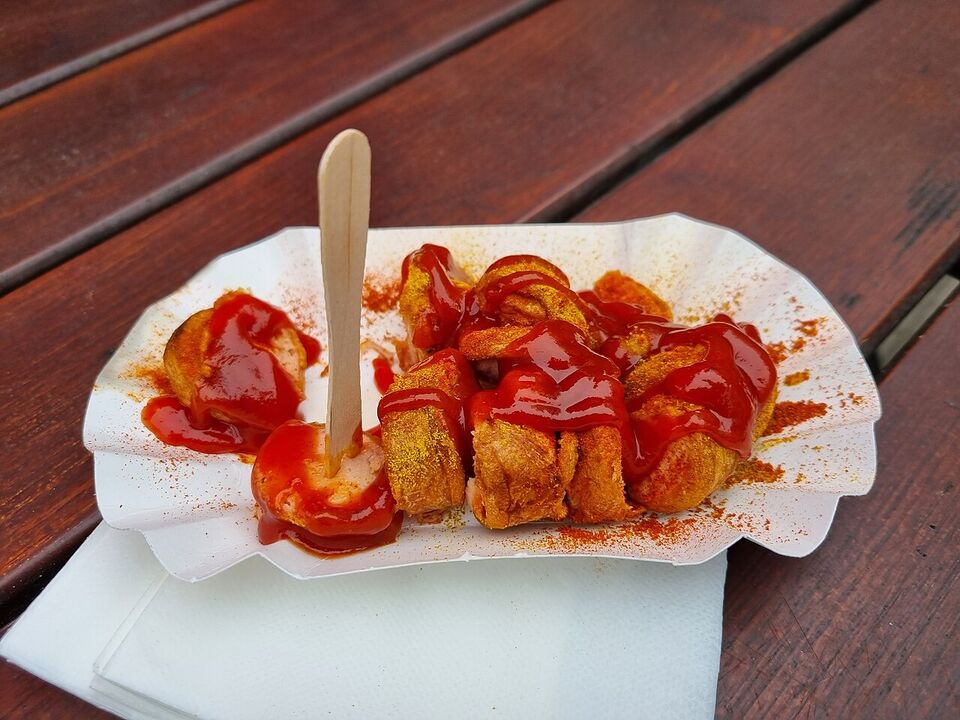
Currywurst is a pork sausage, usually sliced, covered with a warm tomato-based sauce and dusted with curry powder, and served with fries or a bread roll (Brötchen). The story most often told is that it was invented in Berlin in 1949, and the city treats it as a local symbol. It is a snack, not a meal to linger over, and you eat it standing at a stand (Imbiss) with a small wooden fork.
Look for a stand where the sausage is made to order, and choose between mit Darm (with casing) and ohne Darm (skinless), a choice Berliners argue about. You can also ask for scharf (spicy). Expect to pay about €4 to €7 (about $4.50 to $8) for a portion, more at tourist hot spots near the Brandenburg Gate and Checkpoint Charlie. We would skip the stands directly beside the major sights and walk a few blocks.
Doner kebab
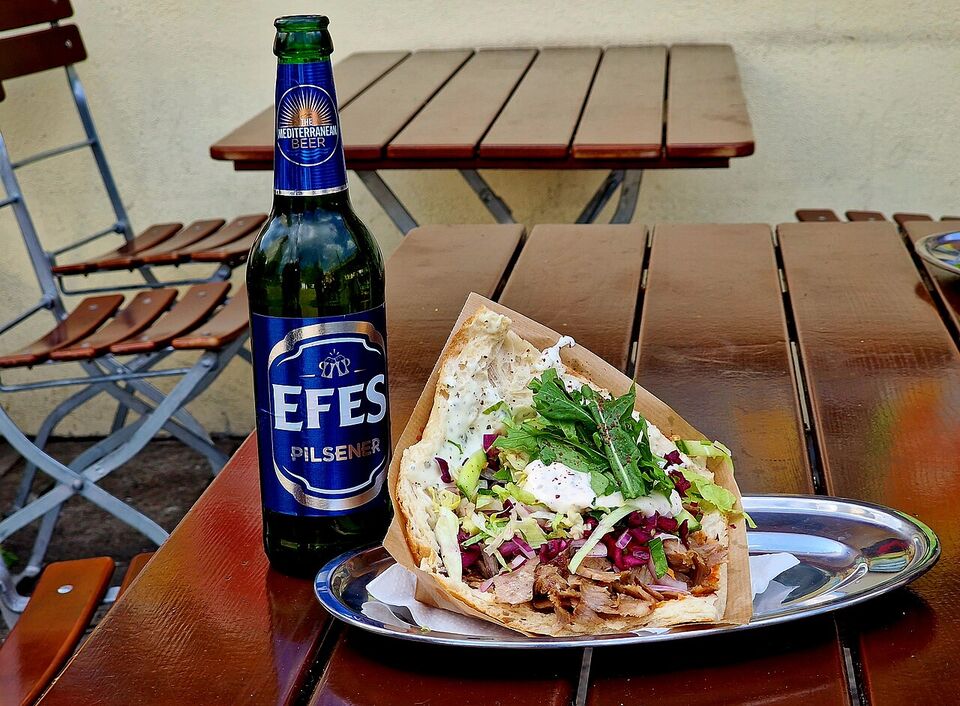
The doner, meat shaved from a vertical spit and packed into flatbread with salad and sauces, is also tied to Berlin through its Turkish community. The version most Berliners know is a thick sandwich in a pocket of bread, often with chicken or veal, plus lettuce, tomato, red cabbage, onion and yogurt-garlic and chili sauces. You will be asked "mit allem?" (with everything?) and "scharf?" at the counter.
In central Berlin, a sandwich typically costs about €7 to €9 (about $8 to $10), and prices run slightly lower in outer neighborhoods; we could not verify a current citywide average. You can also order a Dürüm (wrapped in thin flatbread) or a plate (Teller). Vegetarian options, often with grilled vegetables or halloumi, are common. Open until late, doner shops are the standard answer to an 11 p.m. dinner or a post-bar snack.
Different from home
A doner is not "street meat" by German standards; it is a normal, regulated fast-food lunch, and many Berliners eat one weekly. Choose a place with a busy spit and fresh salad, as you would for any fast food at home.
Turkish and Vietnamese food
Berlin has one of the largest Turkish communities outside Turkey, and it shows in the bakeries (Bäckerei) with flatbread and börek, the grill restaurants and the Turkish grocery stores, especially in Kreuzberg and Neukölln. A weekly Turkish market takes place along the Maybachufer canal in Neukölln, typically on Tuesdays and Fridays, with produce, cheese, olives and ready-to-eat snacks; confirm the days and hours before going. Breakfast at a Turkish cafe (Türkisches Frühstück), with cheese, olives, eggs, bread and tea for sharing, is an easy way to eat well for around €10 to €20 (about $11 to $22) per person.
Vietnamese food came to Berlin with workers and refugees from both former Germanys, and it is now one of the city's staple cuisines, from small pho and bun shops to modern restaurants. Neighborhoods such as Mitte, Prenzlauer Berg and Lichtenberg all have good options. A pho or noodle bowl commonly costs about €10 to €15 (about $11 to $17). Lichtenberg is also home to a large Vietnamese wholesale and retail market, the Dong Xuan Center, which is mainly a trade site but has food stalls; check opening times before you go.
Many other kitchens are worth looking for: Lebanese and Syrian falafel and shawarma, Israeli-style hummus, Georgian khachapuri, Korean and Japanese ramen, and Italian pizza. A walk through Neukölln or Kreuzberg shows how many.
Markthalle Neun and street food days
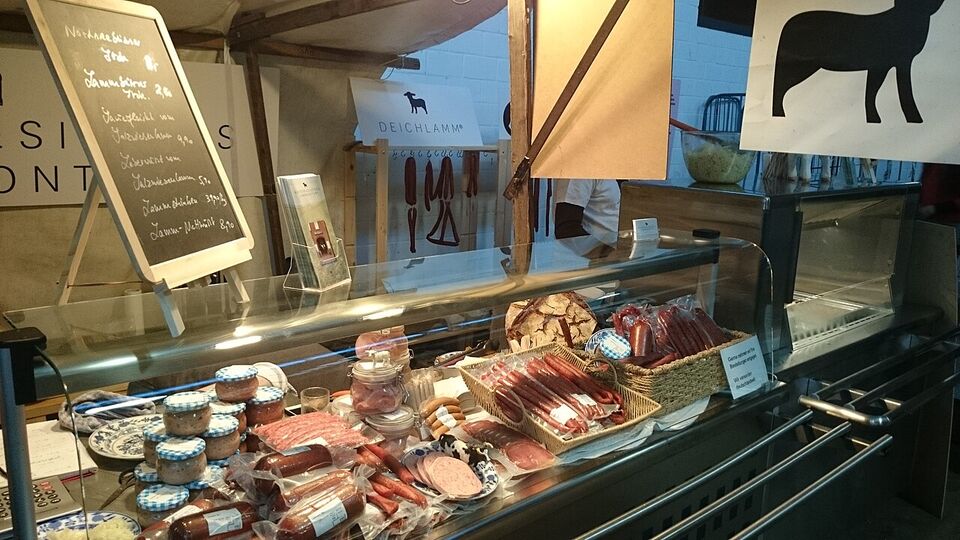
Markthalle Neun is a restored 19th-century market hall in Kreuzberg (Eisenbahnstrasse 42/43, near U1 Görlitzer Bahnhof). The hall is open Monday to Saturday, with the main hall doors open Monday to Wednesday from 8 a.m. to 8 p.m., Thursday from 8 a.m. to 10 p.m. and Friday and Saturday from 8 a.m. to 8 p.m. Butchers, bakers and cafes inside open early. Its markets (the Small Market from Monday to Thursday, 12 to 6 p.m.; the Big Market on Friday from 12 to 6 p.m. and Saturday from 10 a.m. to 6 p.m.) offer produce and prepared food.
The best-known event is Street Food Thursday, when stalls from many countries set up inside the hall, in the evening. The hall's own page shows special editions (a Taiwan special runs 5 to 10 p.m. on a listed Thursday), so check the calendar at markthalleneun.de for the date you want. Eating here costs more than at a doner stand, with dishes typically around €8 to €15 (about $9 to $17), but it is the easiest place to taste many things at once. Come hungry, and arrive before 7 p.m. to avoid a crush. Bring some cash even if many stalls take cards.
Insider tip
Go for a late lunch on a Saturday, when the Big Market is on and the hall is open from morning, or on a Thursday evening for the street food. Special-edition Thursdays, like national food nights, usually draw bigger crowds.
Sunday brunch
Brunch is a Berlin habit, and on Sundays, when shops are closed, it is the big social meal. Cafes in Prenzlauer Berg, Kreuzberg, Neukölln and Friedrichshain serve long brunch menus, often until 3 or 4 p.m., with eggs, bread, cheese, cured meats, pastries and fruit. Some offer a fixed-price buffet; plan for roughly €15 to €30 (about $17 to $34) per person with a drink, though we could not confirm typical citywide prices.
Reserve for weekend brunch, especially for a group, or arrive before 10 a.m. to avoid a wait. The Berlin habit of taking your time is real: do not expect the bill to arrive until you ask for it. Say "Zahlen, bitte" (the check, please) when you are ready. Because shops are shut, a brunch spot also solves the problem of "where do I eat on Sunday" and ties in neatly with a stroll or a flea market.
Kaffee und Kuchen
Kaffee und Kuchen (coffee and cake) is a mid-afternoon ritual, usually around 3 or 4 p.m., and Berlin cafes take it seriously. A slice of cake (Kuchen or Torte), such as cheesecake (Käsekuchen), plum cake in season or poppy-seed cake, costs roughly €4 to €7 (about $4.50 to $8) with coffee around €3 to €4.50 (about $3.40 to $5). Berlin also has a strong specialty-coffee scene, with flat whites and filter coffee in many cafes.
The local pastry is the Berliner, a jelly-filled doughnut, which is called a Pfannkuchen in Berlin (and a Berliner in much of the rest of Germany). A New Year's Eve tradition is a Pfannkuchen with a surprise mustard filling. Bakeries are open early, often from 6 a.m., and some open on Sunday mornings under special rules, so check the sign before you trek. In cold months, hot chocolate and Glühwein from the Christmas stalls (see Christmas Markets in Germany) fill the same role.
Späti culture
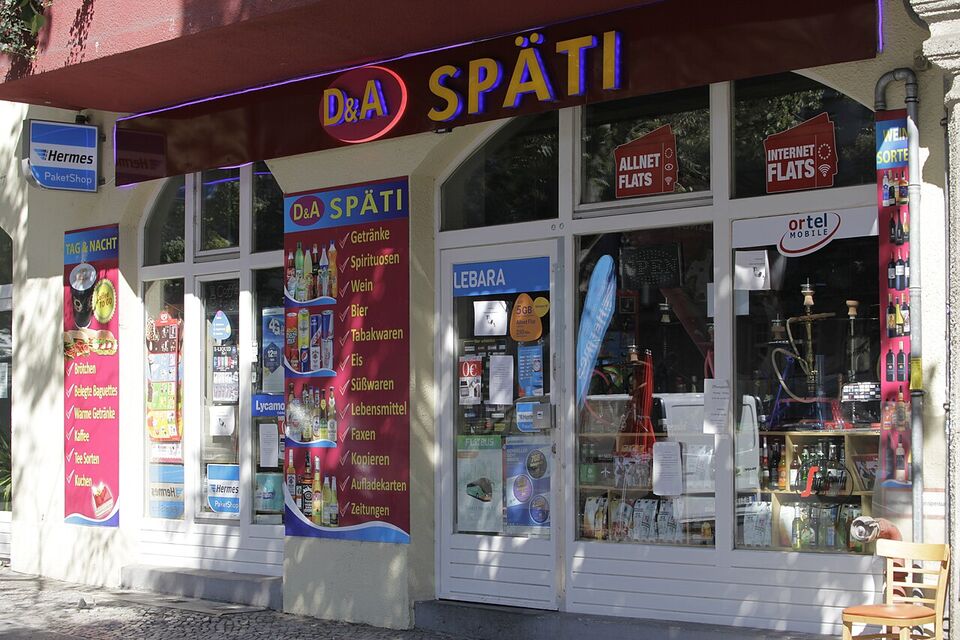
A Späti (short for Spätkauf, a late shop) is a corner shop that stays open late and sells drinks, snacks, cigarettes, basic groceries and often cold beer. It is a Berlin institution and the answer to Sunday closing, since many open when supermarkets do not, although their legal status on Sundays is a gray area. People buy a bottle of beer there and drink it on a bench, in a park or on the canal bank, which is common in Berlin parks and along the canals, though local rules apply in some places, so follow posted signs and take your litter.
Prices are higher than at a supermarket. Beer typically costs around €1.50 to €3 (about $1.70 to $3.40) a bottle plus deposit. Many Spätis are cash-only or have a card minimum, so bring coins. The bottle deposit (Pfand) is €0.08 for many beer bottles and €0.25 for single-use cans and plastic bottles; return them to a supermarket machine or leave them next to a public bin, where collectors will take them. See Money in Germany for details.
Beer and Berliner Weisse
Berlin is not Munich: the city's beer scene is more about bottles on the street and craft bars than big beer halls. The classic local style is Berliner Weisse, a low-alcohol, sour wheat beer. It is usually served in a wide bowl-like glass with a shot (mit Schuss) of raspberry syrup (red, rot) or woodruff syrup (green, grün) to soften the sourness. It tastes more like a tart soda than most beers, and it is usually a summer drink. Many bars offer it, and some craft breweries make modern sour versions.
Pilsner is the everyday draft beer, and Berlin has a growing craft brewing scene, as well as large lager brands sold in bottles at Spätis. A half-liter in a bar typically costs about €4 to €6 (about $4.50 to $6.70). A typical bar in Berlin is more relaxed than a Bavarian beer hall: there is no stein tradition, you pay as you go in many places, and music runs late. For beer styles and etiquette across Germany, see Beer and Wine in Germany. The drinking age for beer and wine is 16, with 18 for spirits.
Prices, cash, reservations and tipping
These are our typical ranges for 2026, not official prices. Berlin has become more expensive, especially in Mitte and tourist areas, and the same dish can differ by 30% from one neighborhood to another.
| Item | Typical price | Notes |
|---|---|---|
| Currywurst with fries | €4-7 (about $4.50-8) | Higher near major sights |
| Doner sandwich | €7-9 (about $8-10) | Often less outside the center |
| Pho or noodle bowl | €10-15 (about $11-17) | Casual Vietnamese restaurants |
| Brunch with a drink | €15-30 (about $17-34) | Reserve on weekends |
| Cake slice and coffee | €7-11 (about $8-12) | Cafe prices vary |
| Half-liter of beer in a bar | €4-6 (about $4.50-6.70) | Cheaper at a Späti |
| Dinner with a drink | €25-45 (about $28-50) | Per person, mid-range |
Cash and cards
No law requires a business to accept a card today. The finance ministry presented plans in September 2026 for a requirement to offer at least one digital payment option from 2027, but it is not law yet. In practice, most Berlin restaurants take cards, but many small stands, bakeries, Spätis and markets accept cash only or set a minimum. The German debit card (Girocard) is common, and a foreign Visa or Mastercard debit card may be refused at some terminals, so ask before you order and keep cash as a backup.
Reservations and service
Book a table for Friday and Saturday dinners at popular places, and for any group. Many restaurants hold tables for only 15 minutes. Service is slower than in the US: the server will not hurry you, and the bill arrives when you ask for it. Tell the server whether you pay together or separately (Zusammen oder getrennt?) when you ask for the bill. Tap water is not served automatically. You can ask for Leitungswasser (tap water), but some restaurants decline or charge for it, so expect to order a bottle of still (still) or sparkling (mit Kohlensäure) water. See German Etiquette.
Tipping
Tipping is smaller than in the US. A 2026 survey reported that just over half of Germans tip 5 to 10% in restaurants, and about 35% of Berliners tip 10% or more. The usual method is to round up or tell the server the total you want to pay as you hand over cash or before the card is run ("Machen Sie 20", make it 20; "Stimmt so", keep the change). Do not leave coins on the table after you leave.
Where to eat by neighborhood
You do not need a restaurant list to eat well in Berlin; choose the neighborhood that fits the meal. We do not name individual restaurants here because menus and ownership change quickly, but these are the areas to look in.
- Kreuzberg: Turkish bakeries and grills, Markthalle Neun, Middle Eastern cafes and the Maybachufer market area on the Neukölln side. Best for a casual, varied day of eating.
- Neukölln: inexpensive international food, Arab bakeries, bars along the canal and Weserstrasse. Late, loud and relaxed.
- Prenzlauer Berg: brunch, cake and cafes with high chairs, plus quiet restaurants for families. Prices are a little higher than in Kreuzberg.
- Mitte and Hackescher Markt: a mix of tourist restaurants and good Vietnamese and modern German places. Read the menu for prices; the busiest streets are the most expensive.
- Charlottenburg: traditional restaurants, wine bars and older German cafes. A good choice if you want white tablecloths and Kaffee und Kuchen.
- Friedrichshain: student-priced food, vegan cafes and late-night snacks near the clubs.
As a rule, a place with a menu in six languages and photos of every dish is aimed at tourists, and the better value is often a street or two away. If a dish name is unclear, ask what is typical; staff in Berlin usually speak English.
Vegetarian and vegan Berlin
Berlin is among the easiest cities in Europe for vegetarians and vegans. Most menus mark vegetarian and vegan dishes (vegetarisch, vegan), and there are vegan doner and currywurst stands, plant-based bakeries, vegan ice cream and entire vegan restaurants. Turkish, Vietnamese, Lebanese and Indian kitchens all offer many meat-free dishes, and falafel is a cheap standby.
A few cautions. A dish called "vegetarisch" may use animal rennet or lard, and in traditional German places soups can be made with meat stock, so ask. A "Salatteller" may come with ham or egg unless you request otherwise. If you have an allergy, say it in German or show a card: "Ich bin allergisch gegen..." (I am allergic to...). Our German phrases page has other useful lines for ordering.
Save money
Lunch is the cheapest way to eat well. Many restaurants offer a lunch special (Mittagstisch) on weekdays at a lower price than dinner, and bakery or Turkish cafe breakfasts are inexpensive. Supermarket bakery counters and deli counters are a good option on weekdays, but remember that supermarkets close on Sundays.
Add it to a route in the trip builder, or ask us to plan the hotels, trains and guides for you.