Overview
The Romantic Road (Romantische Straße) is a themed route of about 286 miles (460 km) that links 29 towns from Würzburg in the north to Füssen in the south, through the Tauber valley, the Franconian hills and the Alpine foothills. It was marketed as a tourist route in 1950 and follows ordinary country roads, not a single highway. The towns are medieval walled centers, baroque palaces and pilgrimage churches rather than a single sight.
Three practical points shape any plan. First, the route is a collection of stops, so choose a handful rather than trying to see all 29. Second, day-trip buses crowd the best-known towns, especially Rothenburg, from mid-morning to mid-afternoon, so an overnight stay changes the experience. Third, a car makes the smaller towns easy, but trains do well for the main ones, so you do not need to rent. We explain both options below, and the getting around guide covers the national system.
This page works through the main towns from north to south, then covers the route by car and by public transport, the Romantic Road Coach, where to sleep and when to go. If you plan to continue to the castle at the end, our Neuschwanstein guide covers tickets and timing.
The towns, north to south
Würzburg
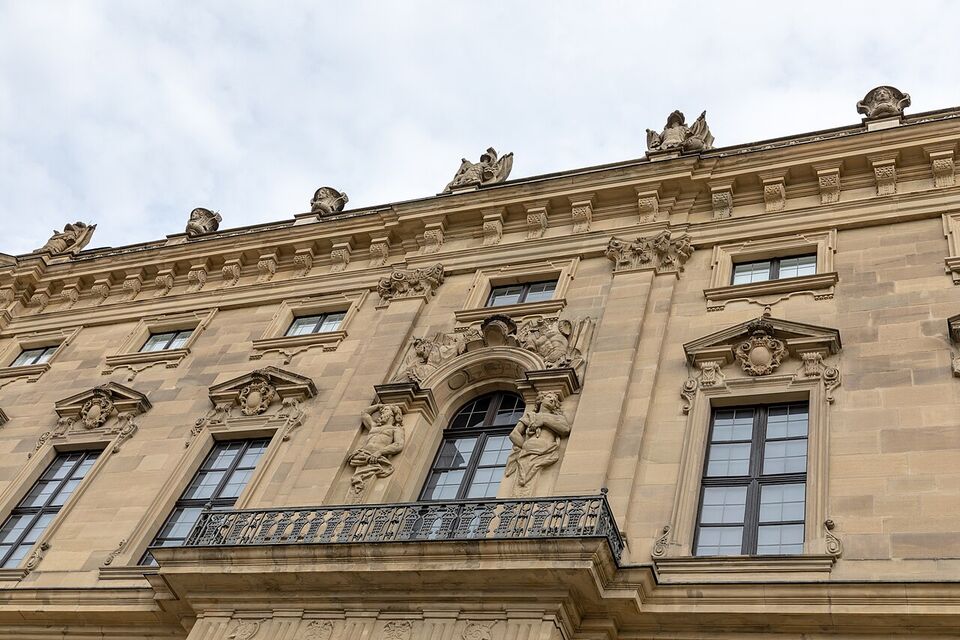
A wine city on the Main river, known for the Residence, a baroque palace with a famous ceiling fresco above the main staircase by Giovanni Battista Tiepolo. The Residence, its garden and the square became a UNESCO World Heritage site in 1981. Franconian wine is sold in the squat flask called a Bocksbeutel.
Rothenburg ob der Tauber
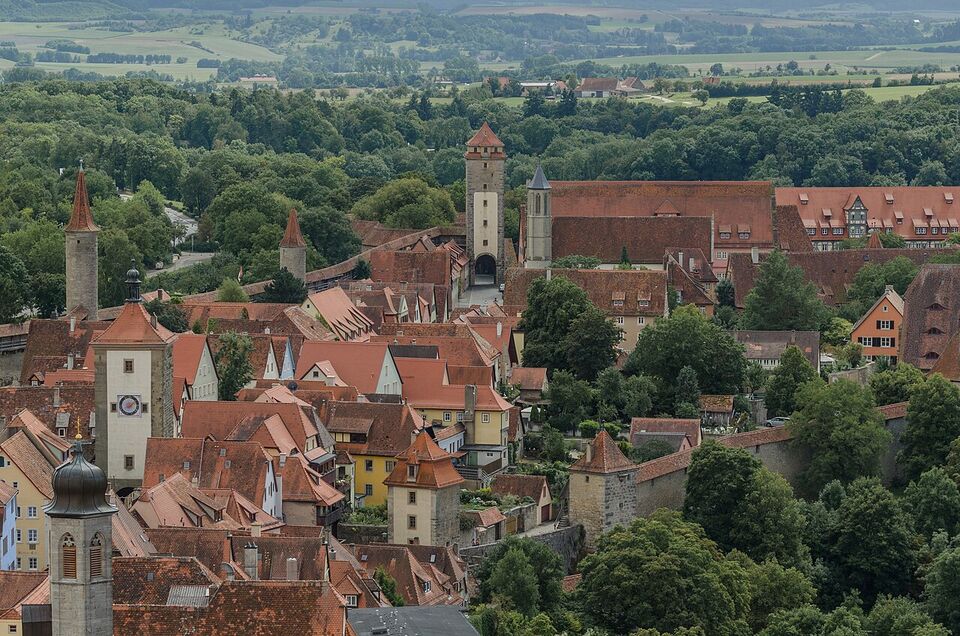
An intact walled town above the Tauber valley, with half-timbered houses and a walkable town wall. The Plönlein, a picture-postcard fork in the lane with a tall narrow house between two towers, is the most photographed corner. It is crowded in the middle of the day and calm in the evening.
Dinkelsbühl
A smaller, less crowded cousin of Rothenburg, with gabled houses around a church and a ring of walls and towers you can walk around. Its Kinderzeche, a children's festival with historical costumes, takes place in July.
Nördlingen
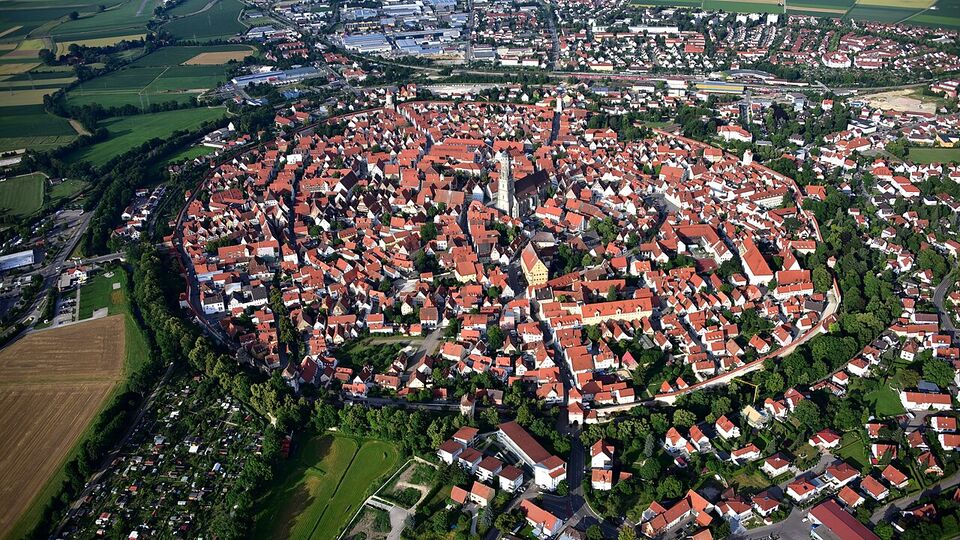
The town sits inside the Ries, a roughly circular basin about 15 miles (24 km) wide, formed when a meteorite hit about 14.5 million years ago. The round town wall is walkable, and you can climb the church tower, called the "Daniel," for a view over the crater floor.
Harburg
A large, well-preserved medieval castle above a small town with a river bridge. The castle runs a seasonal schedule and is normally closed in winter, so check dates before a late-year visit.
Augsburg
One of Germany's oldest cities, founded by the Romans in 15 BC. The Fuggerei, built in 1521, is the oldest social housing complex still in use. Augsburg is also the best train stop on the route, between Munich and Nuremberg.
Landsberg am Lech
A pretty old town on the Lech river with a market square, a town gate (the Bayertor) and a small weir in the center. It makes a good lunch stop between Augsburg and the Alps.
Wieskirche
A pilgrimage church built in the 1740s and 1750s in fields near Steingaden, with a bright interior of stucco and ceiling paintings. Worth the detour even if you are not usually a church visitor.
Füssen
An old town at the foot of the Alps, close to the Lech and to King Ludwig's castles. The High Castle (Hohes Schloss) and monastery tower the center, and the town is the usual base for Neuschwanstein.
Würzburg
Most visitors reach the Romantic Road through Würzburg, which is about 1 hour 10 minutes from Frankfurt by fast train. The Residence is the main sight: a palace begun in 1720 for the prince-bishops and furnished over the following decades, with a vast staircase, the Tiepolo ceiling and a mirror room. Admission to the Residence is €10 (about $11) for adults, €9 (about $10) reduced, and free for visitors under 18, per the 2026 price list of the Bavarian Palace Administration. The fortress above the river (Festung Marienberg) is a separate visit; check its site for tour prices.
Watch out
The Residence lists cleaning and maintenance work in November 2026 that limits access to some rooms: the north wing on November 4-6, the White Hall on November 9-11, and the south wing with the Mirror Cabinet on November 25-27. An alternative tour route is offered, but if the Mirror Cabinet or the White Hall is the reason for your visit, avoid those dates. Check the Residence's site for hours, which change between summer and winter.
Beyond the palace, walk across the Old Main Bridge, lined with statues, and try a glass of Franken wine in a wine bar by the river. The city is also a good place for a first night, since trains from Frankfurt and Nuremberg run often.
Rothenburg ob der Tauber
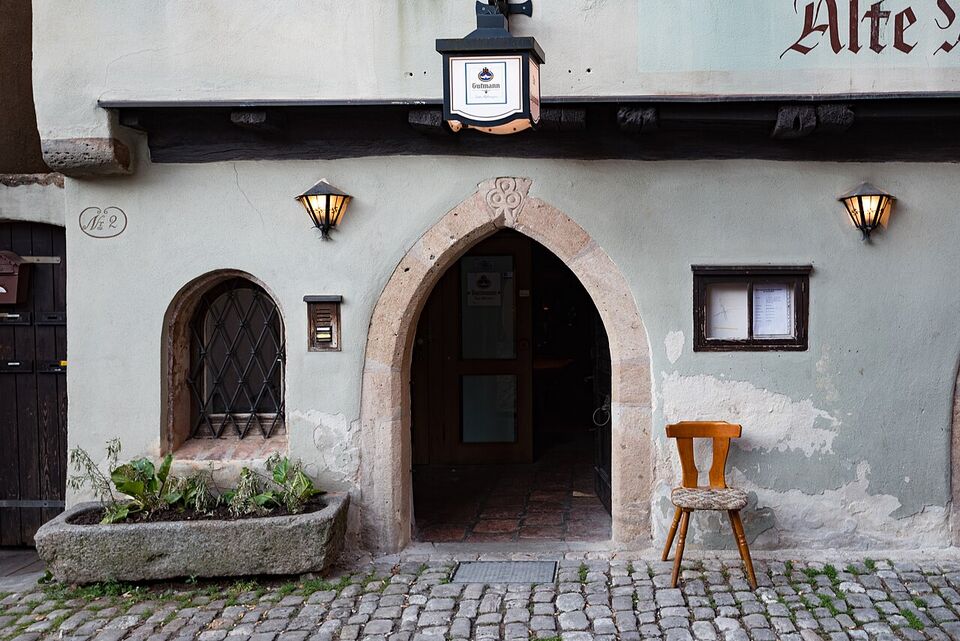
Rothenburg is the reason most people take the route. It has a compact, walled center that avoided heavy rebuilding, and its lanes lead to the Market Square (Marktplatz), the town hall tower and St. James's Church (St. Jakob), which holds a carved altarpiece by Tilman Riemenschneider. Allow a full day, or better, an afternoon plus a night.
What to do
- Walk the town wall. A covered walkway on the wall circles most of the old town and is free to walk. You can do a loop in about an hour, with views over the rooftops.
- Plönlein. Go early in the morning or at dusk to photograph it without crowds.
- Night watchman tour. A costumed guide leads an evening walk through the lanes, in English on set evenings. We have seen a report that the long-time guide's final rounds are on November 14, 2026, but we could not confirm it with the tourist office. Schedules and prices vary by season, so ask Rothenburg Tourism (Marktplatz 2, phone +49 9861 404-800) or check the tour site.
- Christmas Museum. The German Christmas Museum (Deutsches Weihnachtsmuseum) sits above a huge year-round Christmas shop. The museum has an admission fee; check the current price on its site.
- Medieval Crime Museum. A museum of the history of law and punishment, open daily, with hours that change by season. Adult tickets have recently cost about €10.50 (about $12), but we could not confirm the 2026 price, so check the museum's site.
Try a Schneeball ("snowball"), a ball of crisp pastry strands dusted with sugar or dipped in chocolate, a local specialty. Our German food guide covers other regional dishes.
The Christmas market here, the Reiterlesmarkt, runs November 20 to December 23, 2026 (Sunday to Thursday 11 a.m.-7 p.m., Friday and Saturday 11 a.m.-8 p.m., per a secondary listing; hours on Totensonntag, November 22, are unclear). For other markets, see the Christmas markets guide.
Insider tip
Day-trip coaches arrive from about 10 a.m. and leave by about 4 p.m. If you spend the night inside the walls, you get the town almost to yourself before 9:30 a.m. and after 5 p.m. Book a room within the walls early in the Christmas market season.
Dinkelsbühl, Nördlingen and Harburg
South of Rothenburg, three smaller stops fit into a day by car. They are close together: Dinkelsbühl to Nördlingen is about 25 miles (40 km), and Nördlingen to Harburg about 11 miles (18 km).
Dinkelsbühl is a good overnight alternative if Rothenburg is full. Walk the ring of walls, look inside the large St. George's Minster and have a coffee on the market square. Nördlingen is more than a medieval town. The stone in its buildings, including the church, was formed by the meteorite impact that made the Ries, which gives it a geological story. Climb the Daniel tower for the best view of the round layout, and walk the full circle of the wall. A crater museum in town explains the impact. Harburg is a short stop to photograph the castle from the river bridge, and to visit the castle in season (it normally closes for winter, so check its dates).
Augsburg, Landsberg and the Alps
Augsburg
Augsburg is a big city (about 300,000 people) with a Roman past, a Renaissance town hall and a cathedral. The main reason to stop is the Fuggerei, a walled mini-town of small yellow houses built in 1521 by the banker Jakob Fugger for needy Catholic citizens. About 150 people still live there, and the annual rent is a token €0.88. Visitors pay €8 (about $9) for adults, €4 (about $4) for children 8 to 17, and €18 (about $20) for a family; the price includes a museum, a World War II bunker and a display apartment. The Fuggerei is open 9 a.m. to 6 p.m. from October to March and 9 a.m. to 8 p.m. from April to September, and closed on Christmas Eve. Be quiet and respectful, since residents are mostly seniors. Augsburg also holds a city-only public holiday, the Peace Festival, on August 8.
Landsberg am Lech and the Wieskirche
Landsberg is a pleasant lunch stop, with a market square and a gate tower. Further south, the Wieskirche (Pilgrimage Church of Wies) is open for visits every day. Hours change with the season and are shorter in winter (we could not confirm the current times), so check the church's site before you go. Entry is generally free, with donations welcome. Visits are not possible during services. Public transport is limited; most visitors come by car, and a regional bus from Füssen serves the church on a reduced schedule, so check the timetable.
Füssen and Neuschwanstein
Füssen is the southern end of the road. It has a pedestrian old town, the High Castle and the Lech river with a small waterfall just upstream. Neuschwanstein is in Schwangau, about 3 miles (5 km) away. Tickets are timed guided tours only: the adult price is €21 (about $24) plus a €2.50 (about $3) service fee when booking online. The Ticket Center in Hohenschwangau sells same-day tickets only, from 8 a.m. to 3:30 p.m. since October 16, 2026, and these often sell out by late morning. See the Neuschwanstein guide for the full plan, and the castles guide for other royal palaces. For the mountains nearby, see the Bavarian Alps.
By car: how many days
Driving the full length takes about 6 hours without stops, but the point is to stop. A realistic plan is:
- Day 1
Würzburg to Rothenburg
See the Residence in the morning, then drive south for about 1 hour to Rothenburg. Arrive mid-afternoon, walk the wall, then stay the night.
- Day 2
Rothenburg, Dinkelsbühl and Nördlingen
Walk the town before 10 a.m., then drive to Dinkelsbühl (about 40 minutes) and on to Nördlingen. Stay in either town.
- Day 3
Harburg and Augsburg
Stop at Harburg, then spend the afternoon in Augsburg, including the Fuggerei.
- Day 4
Landsberg, Wieskirche and Füssen
Short stops at Landsberg and the Wieskirche, then Füssen for the night.
- Day 5
Neuschwanstein
Reserve a morning tour, then continue to Munich or the Alps.
With only 3 days, skip Harburg and Landsberg and combine days 3 and 4. The route is signposted with brown signs showing the Romantic Road logo, but you will still want a navigation app, because the signed route wanders through villages. Rental cars are best picked up at Frankfurt, Munich or Nuremberg airports. Our driving guide explains rental rules, fuel and winter tires. In the old towns, park outside the walls: Rothenburg and Dinkelsbühl both have signed car parks at the edge of the center.
By train and bus
You can see the main stops without a car if you accept a few changes. Trains serve Würzburg, Augsburg and Füssen well. Rothenburg is a branch-line stop reached by changing at Steinach (a short shuttle on a regional line), and the trip from Würzburg takes about an hour in total. Dinkelsbühl and Nördlingen have limited connections, though Nördlingen has trains to Augsburg and Donauwörth. Check the exact connections on bahn.de before you go.
- Würzburg: about 1 hour 10 minutes from Frankfurt, and about 1 hour from Nuremberg on a fast train.
- Rothenburg: via Steinach from Würzburg or Nuremberg, plus a short ride on the Steinach shuttle.
- Augsburg: on the main Munich-Nuremberg line; about 30 to 45 minutes from Munich.
- Füssen: about 2 hours from Munich on a regional train, usually direct or with a change at Buchloe.
With the Deutschlandticket (€63, about $71, a month in 2026, rising to €66.80, about $75, on January 1, 2027), regional trains are covered, which makes a train-based Romantic Road cheap. Long-distance trains need a separate ticket. The train tickets guide explains how to pick between the options.
Different from home
Rail strikes are unlikely this winter, as of early November 2026: the train drivers' union GDL signed a contract in February 2026 with a peace obligation until the end of March 2028. Local transit strikes are a separate matter and were not announced at the time of writing. Still, German trains run late: in 2026 only about 55 to 60 percent of Deutsche Bahn long-distance trains arrived on time (less than 6 minutes late counts as on time). Leave 30 to 40 minutes between connections on a tight day.
The Romantic Road Coach
The Romantic Road Coach is a tourist bus on the route. According to the operator's site, it runs from May to September, so it does not run in winter, and the dates for the 2027 season had not been published at the time of writing. If you want to use it, check the booking page on romanticroadcoach.com in early 2027. The site lists day trips from Frankfurt and from Würzburg to Rothenburg (departure and return times are on the booking page), and a Christmas day trip on December 8, 2026. The schedules may differ in the new season. Fares were not shown on the pages we could read.
The tradeoff is clear. A day trip gives you only a few hours in Rothenburg, which is short, and puts you in the town with every other coach. Taking the train and staying overnight costs less and gives more time. For other ideas, see the day trips guide.
Where to sleep
Hotels in the walled towns book out for the Christmas market, summer weekends and festival dates, so reserve ahead. Choose by what you want to see:
- Rothenburg: best for atmosphere. Rooms inside the walls cost more ($$ for most, $$$ for the best-known inns), and simple guesthouses outside the walls may be $ to $$.
- Dinkelsbühl and Nördlingen: quieter and slightly cheaper, $ to $$.
- Würzburg and Augsburg: city hotels near the station, $$, with better rail connections.
- Füssen: the usual base for Neuschwanstein, $$, and busy in summer.
Our where to stay guide covers how to choose between hotel types, and the when to go guide compares seasons.
Best seasons
- April to June: green fields, flowers and long days. Busy around holidays like Ascension and Whitsun.
- July and August: warm, with the biggest crowds and the highest prices. Dinkelsbühl's Kinderzeche is in July.
- September and October: often clear and calmer, with wine harvest in the Würzburg area.
- Late November and December: Christmas markets in Rothenburg, Würzburg, Augsburg and Füssen. Daylight is short (the sun sets about 4 p.m. in late December), and the Coach does not run.
- January to March: the quietest time, cold and often gray, with some sights on reduced hours.
Add it to a route in the trip builder, or ask us to plan the hotels, trains and guides for you.